A sample text widget
Etiam pulvinar consectetur dolor sed malesuada. Ut convallis
euismod dolor nec pretium. Nunc ut tristique massa.
Nam sodales mi vitae dolor ullamcorper et vulputate enim accumsan.
Morbi orci magna, tincidunt vitae molestie nec, molestie at mi. Nulla nulla lorem,
suscipit in posuere in, interdum non magna.
|
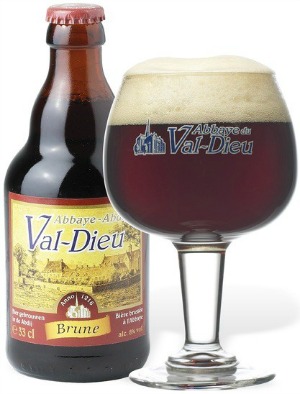 Val Dieu Brune ABV: 6.5%
Origin: Aubel, Liège, Wallonia
Website: valdieu.com
First published: 6 November 2000
Another review from the archive written for the pioneering Oxford Bottled Beer Database (OBBD). I’ve left it uncorrected — so please read it in that historical spirit. This beer is still available, though has had its ABV hiked to 8% since this was written.
One of the unusual micro-brewed specialities at 2000’s Catford Beer Festival, this beer comes from a small scale secular operation in a former monastic brewery at Aubel. It’s a very inviting strong bottle-conditioned abbey brown, with malty aromas, a chocolatey fruit palate with some phenolic complexity, and a brown sugar sweetness balanced by warming alcohol and restrained hops. The lengthy finish is also predominantly sweetish. It’s well made and distinctive, if not particularly distinguished and probably a bit oversweet for some tastes, but at this strength you’re hardly likely to guzzle it in quantity.
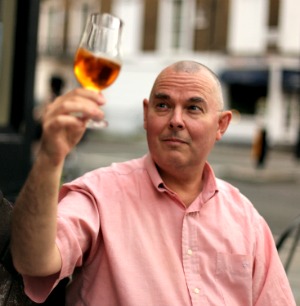 Des de Moor, London, May 2015. Pic: Luke Doyle. I’m a beer writer, tour guide, walk leader, tutored tasting host and Accredited Beer Sommelier based in London.
My latest book is Cask: The real story of Britain’s unique beer culture, published in August 2023. Cask beer is a unique format of fresh, live draught beer that, at its best, delivers a taste experience unmatchable in any other way. My pioneering book, aimed at the discriminating drinker, explains what makes it special, and explores its past, present and future.
I’ve published three editions of London’s Best Beer, Pubs and Bars, the award-winning definitive guide to drinking beer in London. “Probably the best book about beer in London” — Londonist. For more see the London page.
Why not join me on one of my regular brewery heritage walks or tutored tastings. Or I can provide an informal private London heitage pub walk and tasting for your group, or a tasting for your event, alongside various other beer-related services. For more see the Beer Tours page.
I’m a contributor to numerous other books, magazines and websites, including providing the UK listings for The Pocket Beer Book and editing the 2020 edition of Beer in the Netherlands.
Elsewhere on the site are numerous blog posts and beer reviews, many of them archiving material that’s already appeared elsewhere but with some exclusive pieces. Scroll down to see the latest posts, or try these:
I also blog about walking at London underfoot: London’s walking trails under the microscope.
 Whim Ales, Derbyshire ABV: 5%
Origin: Hartington, Derbyshire, England
Website: www.whimales.co.uk
Date: 6 November 2000
Another review from the archive written for the pioneering Oxford Bottled Beer Database (OBBD). I’ve left it uncorrected — so please read it in that historical spirit. Whim is still very much in business, though now just producing beer in cask and polypin. This particular beer appears to have been retired.
“The last word in fine dark ales”, claims the label, not entirely convincingly. It’s a brewery-conditioned beer, quite lively, deep amber with ruby hints and with a small but extremely long-lasting fine-grained head. The aroma is initially very hoppy but with some citric and dark fruit overtones too.
The flavour is full and quite complex, notably sweetly malty but well offset by a firm hop character that begins bitter-cherryish and develops into grapefruit in the back of the mouth for a moderately long finish. While not a spectacular pint, the beer is certainly unusual in being rather difficult to place: with its dark colour and very malty palate it has a certain Scottish character, perhaps as a tribute to the nationality of its namesake, tempting classification as an 80/-, except that its full hop character places it firmly south of the border.
And indeed the brewery is located in Buxton, Derbyshire, though the same company now owns Broughton/Greenmantle in the Scottish lowlands so perhaps the influence has percolated south. Such a classification problem seems appropriate in a beer named after a lexicographer.
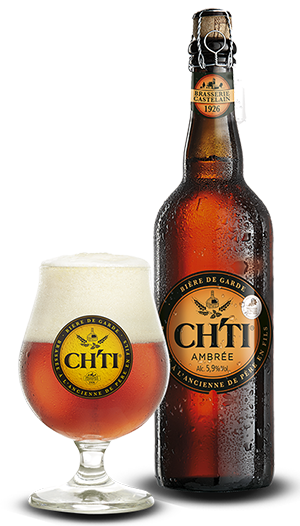 Castelain Ch’ti Ambrée ABV: 5.9%
Origin: Bénifontaine, Pas-de-Calais, Hauts-de-France
Website: brasseriecastelain.com
Date: 6 November 2000
Another review from the archive written for the pioneering Oxford Bottled Beer Database (OBBD). I’ve left it uncorrected — so please read it in that historical spirit. Oh for those halcyon days when Safeway UK (since taken over by Morrisons) offered an interesting range of imported beers thanks to the late Glenn Payne. The Ch’ti range is still around, though the brune has been withdrawn, and there’s now a triple and a Christmas beer.
A fairly new line from this well-known Bière de Garde producer: the Ch’ti range, which also includes a Blonde and a Brune, is made with bottom-fermenting yeasts and pasteurised but otherwise brewed along traditional lines, emphasised by the corked Champagne bottle-style presentation.
There’s some debate about the origin of the brand name: some sources, including the label, say it’s slang for a Northerner but I’ve also heard it’s a local dialect pronunciation of c’est toi – ‘it’s you’ in the sense of ‘it suits you’. The brewery is in a former mining area but I notice the portrait of a miner that used to adorn the labels has been removed, at least for the British market, perhaps to avoid any unwelcome proletarian associations.
The beer is rubyish in colour – a very dark amber – and has a smooth but short-lived head. The aroma starts deliciously yeasty but then develops fruity and distinctly sherryish notes. The palate is very malty and has, again, a distinctly sherryish character with a slight hint of wood. It also has a certain syrupy, brown sugar texture, rapidly lifted by very dry, smooth and slightly ashy hops with a mere hint of coffee grounds in a good, long, tangy finish. Somewhere in there is also a hint of marmite.
For a bottom-fermented beer it is notably complex and is very drinkable (especially at a gravity that’s comparatively low in this part of the world) while preserving, in its hop character, something of the northern austerity that is characteristic of the style. A good buy from your local Safeway.
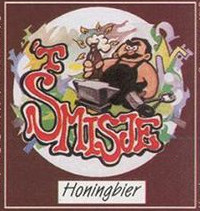 De Regenboog ‘t Smisje Honingbier ABV: 6%
Origin: Assebroek (Brugge), West-Vlaanderen, Flanders
Website: www.smisje.belgianbeerboard.com
Date: 23 October 2000
Another review from the archive written for the pioneering Oxford Bottled Beer Database (OBBD). I’ve left it uncorrected — so please read it in that historical spirit.
De Regenboog (The Rainbow) was originally a printing business founded by homebrewer and beekeeper Johan Brandt. He began brewing commercially on a part-time basis in 1997 using the brand ‘t Smisje (the neighbouring house had once been a smith’s shop). In response to tightening hygiene regulations, brewing ceased at the original site in a suburb of Brugge in 2008, restarting in new premises at Mater near Oudenaarde under the name Smisje. Despite the beekeeping background, the honey beer is no longer brewed — a shakeout of brands in 2010 saw the brewery concentrating on a much smaller number of beers.
This honey beer from ‘The Rainbow’, a very small micro near Brugge, was one of the specialities on offer at 2000’s Great British Beer Festival: the suitably artisanal trademark means ‘the little smith’ and the honey is apparently collected from the brewery’s own bees.
The beer is well-made but nothing outstanding. It’s a cloudy amber colour, overcarbonated at first, and slightly estery with a honey and toffee fudge nose. After scenting the honey, the dry and attenuated taste comes as surprise: there’s also toffeeish malt and orangey-plum fruit and where the honey really makes its mark is in the subtley silky texture, at least once the CO2 has settled down a bit.
The finish brings citric hops, malt and more gentle honey. Perhaps, in trying to avoid the risk of making a honey beer that’s too sweet and cloying, the brewers have erred slightly too far on the side of caution.
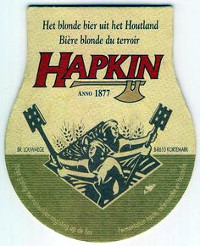 Louweage Hapkin ABV: 8.5%
Origin: Kortemark, West-Vlaanderen, Flanders
Date: 23 October 2000
Another review from the archive written for the pioneering Oxford Bottled Beer Database (OBBD). I’ve left it uncorrected — so please read it in that historical spirit.
The Louwaege brewery, founded in 1877, closed in 2002 when the founding family sold it to Alken-Maes; it has since been demolished and the site redeveloped as housing. Hapkin, from the nickname of an early 12th century Count of Flanders, Boudewijn VII, is the only brand to have survived, now brewed at Alken. Since 2008 it’s been part of the Heineken portfolio.
The ‘houtland’ or land of wood is a geographical region in the northeast of the province of West-Vlaanderen, so named for its extensive woodlands.
‘The blond beer from the land of wood’, announces the label of this bottle-conditioned Belgian strong blond ale, loosely in the Duvel style. It’s a much more straightforward proposition, however, than Moortgat’s finest, opting for a honeyed character rather than the dry, aromatic complexities of Duvel.
It has a thick, foaming long-lasting head, a delicate aroma of inviting Saaz hops and some estery nail-varnish hints, and a full, very honeyed, malt taste offset by a firm hop finish with grapefruit and a trace of lime. As strong and straightforward as you might expect from a place that prides itself on its wood.
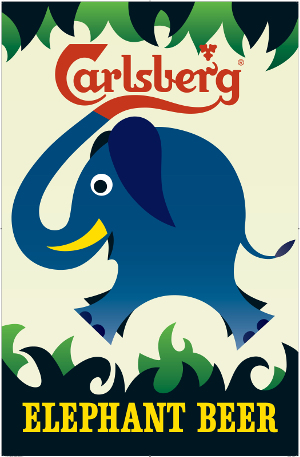 Carlsberg Elephant Beer: vintage poster ABV: 7.2%
Origin: København, Hovedstaden, Denmark
Website: www.carlsberggroup.com
Date: 23 October 2000
Another review from the archive written for the pioneering Oxford Bottled Beer Database (OBBD). I’ve left it uncorrected — so please read it in that historical spirit. Elephant Beer is still brewed, as it has been since 1959, though I haven’t seen it in the UK for years. I suspect the “rotting meat” I smelt was Dimethyl Sulphide (DMS).
Elephant beer is a strong, Bock-type lager named after the beasts depicted on the imposing columns of the Danish giant’s historic Copenhagen brewery. I’m not entirely convinced, however, that this example, purchased at Safeway supermarket in the UK, actually left through those gates, since although it claims to be imported, it also carries the legend ‘brewed and bottled *for* the Carlsberg breweries’.
It has a very intense, sharply herbal hop aroma with a very slightly unpleasant enzymic “rotting meat” note and a distinct whiff of alcohol. The head is only temporary, the colour mid-golden, and it has a full and slightly fruity taste with estery nail-varnish notes and considerable bitterness, almost like a bitter liqueur. The pronounced carbonation gives a creamy texture, and the beer dries rapidly, staying very dry to the mouth-filling herbal hop finish.
An intense beer where sweetness is well-counterbalanced by hoppy dryness but there are some unpleasant, artificial notes in there too, and at this strength it could do with a bit more character.
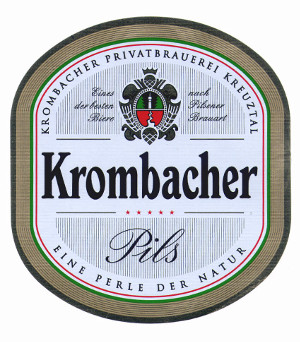 Krombacher Pils ABV: 4.8%
Origin: Kreutzal, Nordrhein-Westfalen, Germany
Website: www.krombacher.de
Date: 23 October 2000
Another review from the archive written for the pioneering Oxford Bottled Beer Database (OBBD). I’ve left it uncorrected — so please read it in that historical spirit. Perhaps I underestimated the fame of Krombacher, now one of Germany’s biggest independents, with roots going back to 1618 and brewing pilsner since 1890. I’d certainly be more merciful to this beer today.
From a specialist Pilsener brewery in the Rhineland, this claims to be a “pearl of nature” and it certainly tastes clean, but also rather boring. It has a very good firm head, a smooth malty aroma with a hint of slightly sweet hops (Saaz?), and a clean malt taste with an almost immediate hit of hops, mellowing out with a hint of melony fruit and then drying again in the finish to a firm back-of-the-mouth grapefruity bitterness with a touch of crisp malt.
The logic of supermarket stocking policies is puzzling — it’s a fair enough beer, but neither remarkably good nor famous, so out of all the Rhenish lagers they might have stocked, why have Safeways picked this one?
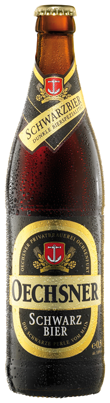 Oechsner Schwarzbier ABV: 5%
Origin: Ochsenfurt, Franken (Bayern), Germany
Website: www.oechsner.de
Date: 9 October 2000
Another review from the archive written for the pioneering Oxford Bottled Beer Database (OBBD). I’ve left it uncorrected — so please read it in that historical spirit. I resisted the temptation to correct the bit where I show my ignorance of the long history of brewing black beers in Franconia. This is probably the first time I used the breakfast cereal Shreddies as a taste comparison.
Johann Georg Oechsner began brewing in 1798 at a brewpub in Frickenhausen called Zum Bären (‘the Bear’), with a history dating back to the 16th century. Over the next two centuries the family added several other pubs in the area and in 1902 opened a production brewery in Ochsenfurt. It’s still in business today, now in the seventh generation of family ownership, and still brewing this beer.
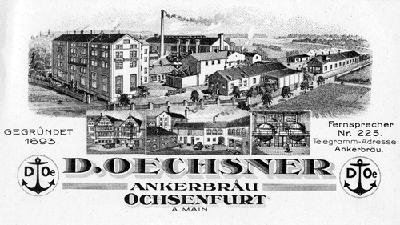 Brauerei Oechsner, Ochsenfurt, in the early 20th century. Artworks were protected in its cellars during World War II. Black beers of this kind are normally considered a speciality of Thuringia (Köstritzer is the classic), but this example, picked up in the Pitfield Beer Shop, London, is from Ochsenfurt in Franconia: whether it’s a long-established speciality there or the result of the current spirit of innovation and experiment among German brewers, I’m not sure.
It’s certainly a very enjoyable half-litre. The beer is almost jet black, with a good foamy head. The aroma is smooth, sweetish and very malty: it reminded me of the breakfast cereal Shreddies. Somewhere in there, there are also sweaty and flowery hints. The palate is biscuity-sweet and malty, with a good creamy texture lifted by a hint of sourness and a fruity currant-like flavour. The beer moves towards a nicely drying, grapefruity finish with a malty, curranty tang.
I’ve had some German dark beers that treat you to the same kind of inviting, fruity-malty flavours then lay it on too thick with the hops: I’m glad to say this isn’t one of them, and the balance is just right.
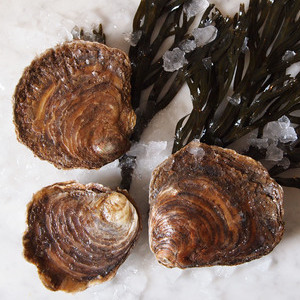 Whitstable oysters. ABV: 4.5% / 8.5%
Origin: Newham, Kent, England / Bergen op Zoom, Noord-Brabant, Netherlands
Website: www.scheldebrouwerij.com / http://whitstablebrewery.co.uk
Date: 9 October 2000
Two more reviews from the archive written for the pioneering Oxford Bottled Beer Database (OBBD). This was my first attempt at a comparative tasting, but to fit the OBBD format it was originally written up as two separate, linked entries. I’ve made some minor edits to the text so it reads as a single piece, but otherwise left it uncorrected, so please read it in that historical spirit.
Swale Brewery had a rather unsettled history. It was founded in Milton Regis in 1995 by homebrewer John Davidson, with the assistance of microbrewing pioneer Rob Jones of Pitfield’s and Dark Star fame. It expanded in 1997 to Sittingbourne, moved again in 2000 to Newham when it was briefly known as the Tun, Vine and Press. In 2001 it moved again to a farm at Grafty Green near Maidstone.
Production of Oyster Stout led to a relationship with the Whitstable Oyster Fishery, who bought out the business when it was on the point of closure in 2003 and renamed it the Whitstable Brewery even though it was now some distance from Whitstable. In this guise it’s become one of the most successful and consistent of Kent micros, with excellent branding and presentation. Oyster Stout is still very much a part of the range, though with some tweaks to the recipe.
As recounted in the preamble to my review of Lamme Goedzak, Scheldebrouwerij has also undergone some changes since 2000, moving from the Netherlands to Belgium. Oesterstout remains a popular fixture in the range, though the brewery no longer claims to filter it through oyster shells.
Though some of the more imaginative breweries have experimented with using oysters themselves in the brewing of stout, most oyster stouts are so called in deference to the time-honoured affinity between the shellfish, which are notoriously difficult to match with wines, and dry stouts of the Irish-style roasted barley variety, Guinness being the classic pairing.
In recent years Marstons of Burton have done well with their take on the style, but it’d take a brave bivalve to find its way that far up the Trent. Swale, the Kentish micro best known for Indian Summer Ale, are more appropriately located in Sittingbourne: it’s just down the Thames estuary from Whitstable, famed these past centuries for oyster beds which are now sadly largely farmed out.
Not so far east from here, across the channel, is another estuary, that of the Scheldt, whose banks seem to provide most of the Low Countries’ mussel supply. Oysters are found here too, and on the north bank at ‘s-Gravenpolder in Zeeland, another micro, the Scheldebrouwerij, also offers an appropriate stout. They don’t bung the flesh in the mash here either, but they do filter the beer through the shells. I thought the two, both bottle-conditioned, would make an interesting comparison, even without the benefit of oysters.
Swale’s offering, the weaker of the two, was tasted first. This is an excellent dark beer, subtle and rich but not over-thick or heavy in the slightest. It pours beautifully dark and oily with a cappuccino head, giving up a crisp aroma with a clear, slightly burnt roastiness and bitter chocolate, but also the scent of rust and an appropriately salty tang. The texture is light, with a marked spritziness without being over-gassy, lacking the smooth creaminess sought after by its Irish cousins.
The palate is full of tasty chocolatey malt, with a slight milkiness and a range of other subtle hints, including tar and, far back, some tangy, plummy fruit. Hops develops in a good drying finish, and in the aftertaste that slightly meaty saltiness noted in the aroma returns, alternating with firm but not overstated hops.
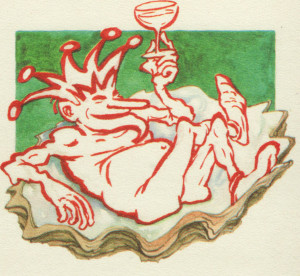 Scheldebrouwerij Oesterstout. The Schelde example, which is filtered through oyster shells, was brewed at the behest of the Bierkoning beer shop in Amsterdam. It was one of the rarities on sale at the Great British Beer Festival 2000. With a very Dutch flourish, the bottle replaces the olde worlde image of basket-laden oyster fisherman on Swale’s label with a cheerfully grinning naked Neptune indulging in a glass of ale.
It’s a much stronger beer too — nearly twice the strength (though considering some varieties of Guinness reach 8%, not uncharacteristically strong for the style) — and though it doesn’t look quite as oily on the pour, appears just as beautifully black in the glass, with a creamier and everlasting but similarly coloured cappuccino head. The aroma is very different and much more assertive: intensely malty and sweet, a smell familiar to anyone who grew up in a brewing town.
There’s roastiness there (the recipe includes 900EBC roasted malt as well as caramalt and Munich malt) but little trace of bitter coffee or chocolate. The condition is livelier but given a certain smoothness through the creamy head, and the palate is predominantly malty, with some rich chocolate (Dutch?) and burnt fruit, with a definite Trappist-style sugariness that I’ve noted in other beers from this brewery. This latter characteristic is soon balanced by rapidly developing hop bitterness, slightly more intense and tangy than in the Kentish offering.
The hops linger long in the finish, becoming slightly earthy with very dry plain chocolate hints, and there’s a sweet fruitiness with a splash of alcohol that is almost liqueur-like. Overall, an interesting take on the style, with that sweetness marking it out from its British counterparts. However, it lacks the meaty saltiness that gives the Swale entrant its extra interest, and enables the latter to stand up well against even such a big, strong brew at this one.
|
|
