A sample text widget
Etiam pulvinar consectetur dolor sed malesuada. Ut convallis
euismod dolor nec pretium. Nunc ut tristique massa.
Nam sodales mi vitae dolor ullamcorper et vulputate enim accumsan.
Morbi orci magna, tincidunt vitae molestie nec, molestie at mi. Nulla nulla lorem,
suscipit in posuere in, interdum non magna.
|
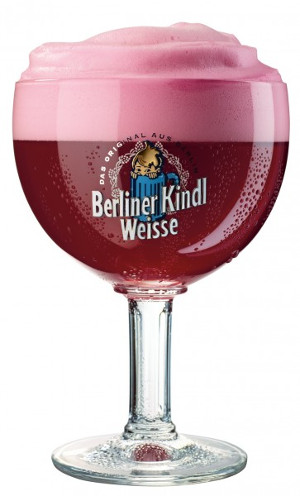 Berliner Kindl Weissbier mit Schuss Himbeere ABV: 2.5%
Origin: Berlin, Germany
Website: www.berliner-kindl.de
Date: 2 October 2000
Another review from the archive written for the pioneering Oxford Bottled Beer Database (OBBD). I’ve left it uncorrected — so please read it in that historical spirit. For an update on the fate of the brewery since this was published, see the Waldmeister review mentioned below. Of course the reason aspartame is used rather then real sugar is because using the latter would risk an unwanted further fermentation in this unfiltered beer.
This is a ready-mixed combination of the sour low-gravity Berlin style of wheat beer with its traditional additive, a flavoured syrup. It’s a companion product to the bright green Waldmeister variety reviewed elsewhere on the database with considerable background detail, and many of the same remarks apply, though in this case the flavouring is raspberry – also a popular addition to beers from other parts of the world, and with good reason.
The perfumed dryness of the fruit is a very good match for the characteristics of beer in general, and proves a particularly welcome combination with the sour, thin base beer found here. This version exhibits the same curious barley-sugar aroma noted in the Waldmeister, but it’s less cloyingly sweet than its green cousin and the distinctive sourness comes through much more clearly as a result; the raspberry flavour is aromatic and subtle and overall the product (which according to the Reinheitsgebot cannot actually be labelled a beer) is much less soft-drink like.
Interestingly, the ‘syrup’ used in both this and the Waldmeister turns out to be sweetened with aspartame rather than real sugar: I don’t know if this is for economic reasons or to make the beer more attractive to kilojoule-counters. I’m so used to the stuff in soft drinks that I didn’t bat an eyelid at its presence here, but purists and those prone to health-scare panics might object.
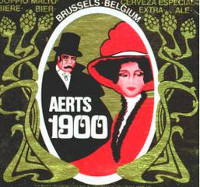 Palm Aerts 1900 ABV: 7.5%
Origin: Steenhuffel (Londerzeel), Vlaams-Brabant, Flanders
Website: http://palm.be
Date: 25 September 2000
Another review from the archive written for the pioneering Oxford Bottled Beer Database (OBBD). I’ve left it uncorrected — so please read it in that historical spirit. Palm is still very much around as one of Belgium’s national brewers, but, despite effusive praise from Michael Jackson among others, Aerts 1900 was discontinued soon after this review was written. One of the retired brands I’d most like to see revived.
The Palm brewery in Steenhuffel is an important independent known for the depiction of a local Brabant horse on its logo and the production of Palm Spéciale, a best selling Belgian pale ale in the hoppy malty style that is the closest traditional beer to English bitter. The Spéciale, to me, isn’t a patch on its closest rival De Koninck, but this sister beer at a premium gravity is something else — I remember loving the first bottle I tried in Belgium and I eagerly snapped it up when I spotted some on the shelf at Bottles in east London. I wasn’t disappointed.
Aerts (pronounced Arts) is a defunct brewery taken over by Palm, and the ‘1900’ refers to the year: as confirmed by the label’s art nouveau pastiche, the beer is intended to evoke the sort of thing the cosmopolitan sophisticates of the last fin de siècle might have enjoyed.
Indeed this triple-fermented (bottle-conditioned) beer oozes class. Poured clear, as advised on the label, it comes out deep chestnut in colour with a very restrained aroma of fine hops. The soft head soon shrinks but the lace lingers to the last.
The taste is full of sweetish fruit-cakey malt with lots of inviting fruit flavours, including figs and a slight grapiness, balanced by sharp citrus and rich hops. The bitterness that develops is very firm but by no means overstated and balanced just right: it stays with you through a long finish that reprises some of the grapiness of the palate. As you drink you can just catch the whiff of alcohol, but the beer isn’t in the slightest heavy and cloying: if it doesn’t leave you gasping for more it’s because the experience is so satisfying.
It’s also a beer which should prove appealing to British ale drinkers: if you appreciate a strong pale ale, you’ll be on familiar territory here. A minor classic of the Belgian scene, well-worth seeking out – thankfully they do still make ’em like that these days!
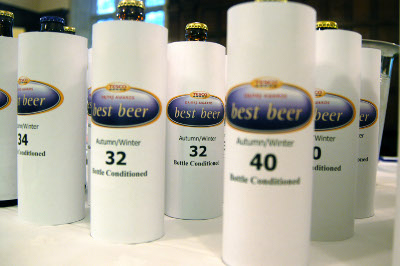 Waiting for judgement day: bottles at the Tesco Drinks Awards. Here’s a look back to the beer judging at the Tesco Drinks Awards in 2006, as published in the November 2006 issue of BEER. It was my second proper feature commission, and my first time as a beer judge. I’m eternally grateful to the awards organiser Richard Morrice for getting me started on what’s become a regular activity for me, not only in the UK but abroad.
As mentioned in the article, I was teamed up with Pete Brown, the first time we’d met and the first time he’d been asked to judge beer too. Today I would probably advise against putting two inexperienced judges together but we coped. Like many new judges we were over-conscientious in spending too much time on each beer, and ended up alone at our table long after everyone else had gone to lunch.
There have been many changes in the decade since, and I’ve noted a few of them in square brackets in the text. Most significantly, the competition itself is no more — I believed it survived only another year after this piece. I find it perplexing that the major supermarket chains seemed more excited about speciality beer 10 years ago when far fewer people were buying it than they are today when it’s an established growth market.
Pete meanwhile followed up the success of Man Walks Into a Pub with several other books to become the closest thing in beer writing to a crossover artiste. I’ve since requoted Richard’s comment on the generosity of the industry many times, and it remains essentially true.
 Tesco Drinks Awards. It’s 10 o’clock on a rainy Friday morning in the City of London and I’m among a gathering of brewers, beer writers, cider wonks and sundry industry figures facing the daunting prospect of tasting 205 beers and ciders before lunchtime. The occasion is the preliminary judging of the 2007 Tesco Drinks Awards, and all the beers are new to the UK bottled market, which means many British ones are new recipes.
I’m assigned to tackle 22 autumn and winter beers from small brewers, with three bottles of each entrant lined up anonymously, numbered like prizes at a WI tombola stall. I’m joined by Pete Brown, cheerful author of Man Walks into a Pub, though we’re asked to score individually rather than confer, giving marks for appearance, aroma, palate, aftertaste and overall appeal.
Pete and I are both newbies at this and, several litres of mineral water and a packet of water biscuits later, we’re the last table to finish. Pete is a fan of hoppy pale beers while I tend towards the dark side, but I’m reassured to see our judgements broadly align. Nearly all our beers have reached a good basic standard, but only a few really stand out.
Based on our scores, between five and eight beers in each category go forward to a 15-strong final panel a fortnight later. The winners earn an engraved tankard – and more importantly an 18-week guaranteed listing at Britain’s biggest supermarket chain, with the assistance of Tesco marketing experts to help name the beer and design the packaging.
This year the tankards went to Loddon and Hook Norton for spring/summer beers; Williams Brothers and Hall & Woodhouse/Badger for autumn/winter beers; Coopers of Adelaide, Australia in the import category with their vintage ale; Coors for innovation with a new method of making low alcohol lager; and a cider from Whin Hill.
Now in its 11th year, the contest, the only one regularly supported by a major retailer, can boast the widest consumer recognition other than CAMRA’s Champion Beer of Britain. “About this time of year, stores start asking us when the new winners are coming in,” says Tesco beer wines and spirits director Dan Jago, “because their customers have been asking them.”
In fact, CAMRA provided the original inspiration when, back in 1996, Tesco asked independent marketing consultant Richard Morrice, formerly of Courage, to think of a good way to raise awareness of its speciality ale list, back then one of the most interesting on the UK high street.
Inspired by the CBoB model, Richard worked with CAMRA and the British Guild of Beer Writers to devise what was then called the Tesco Beer Challenge. The first contest in 1997 attracted over 100 entries, from which ScotCo’s McEwan’s No 1 Champion Ale emerged victorious [the brand is now owned by Heineken].
The next year there were both spring and autumn winners, and in 1999 awards for both small (under 10,000 barrels/16,700hl per year) and large brewers. An import category debuted in 2005, followed by innovation and cider this year, spurring a rebrand to “Drinks Awards” to reflect the enhanced scope. The concept has even crossed the supermarket aisles, with a Cheese Challenge launched in 2003.
While Tesco’s everyday beer list is not quite the standout it once was, the grocery giant remains committed to the Awards. It’s a way of raising authority and credibility for what bottled ale buyer Ian Targett calls a “hero area”, appealing to the more sophisticated consumer who also spends on other high-end items.
Everyone agrees that the Awards have spurred innovation in the industry: Dan Jago, who spends a good deal of time at much bigger and better established international wine contests, tells me he rarely encounters so much enthusiasm among wine makers for new ideas as British brewers now display.
For the brewers, the Awards can provide a step change in access to market. Four-time winner Hall & Woodhouse, a sizeable regional once best known for rather staid cask ale, has become a major supplier of exotic bottled specialities since elderflower-flavoured Badger Golden Champion scooped top honours in 1998. Four Badger beers are now among the top 10 best selling ales at Tesco.
“The Beer Challenge was massively important to us”, says Badger marketing manager Rick Payne. “It took us from 2 per cent to 10 per cent of the bottled ale market. We’ve targeted a different kind of consumer, more willing to experiment with unusual flavours, but the product development benefits our on-trade too.”
Success is not always guaranteed, however. Scottish micro Harviestoun, now owned by Caledonian [now once again independent, while Caledonian is part of Heinkenen], has since dropped two of its three previous winners and the third is no longer sold in Tesco. “But it was still well worth doing,” says the brewery’s Ryan Main. “It prompted us to innovate, and it broke us into the bottled beer sector, where we’ve had most success with other brands like Schiehallion and Bitter and Twisted.”
2001 winner Wickwar’s Mr Perrett’s Traditional Stout didn’t even complete its original listing period. “I don’t think we worked together well enough on the marketing,” says brewery founder Ray Penny, “and the beer didn’t get the in-store promotion it needed.”
“Tesco could do more to guide customers to winning beers,” Ray continues, “but I think they’re nervous of robbing Peter to pay Paul. Having said that, we’ve all learnt from the experience, and we’re doing well with another brand in Tesco, Cotswold Way. I’d certainly consider it worthwhile to enter again when the opportunity arises.”
Real Ale in a Bottle accounts for under a third of previous winners. Both brewers and retailers agree that consumer education is still needed here – and the consistency of quality to nurture consumer confidence. “We eliminated six bottled conditioned beers from this year’s competition simply because they were off,” says Ian Targett. “But if we get these issues sorted out I think RAIB could be a sleeping giant. The CAMRA badge scheme is a great help here and I’m proud we’re showing it on one of the 2006 winners, Young’s Ruby Star” {Young’s is no longer brewing].
Richard Morrice agrees that getting the marketing right for winning beers is the key to capitalising on success. But in the meantime there’s the winning itself to enjoy. “I know it’s an obvious thing to say, but the thing I still like best is when the winners are announced to a wave of genuinely warm applause,” he says. “It’s a very generous industry.”
 ABV: 4.4% ABV: 4.4%
Origin: Ickburgh, Norfolk, England
Website: http://icenibrewery.co.uk
Date: 25 September 2000
Another review from the archive written for the pioneering Oxford Bottled Beer Database (OBBD). I’ve left it uncorrected — so please read it in that historical spirit. The beer is still in Iceni founder Brendan Moore’s range today.
The intriguing label designs from this Norfolk-based micro resemble the open pages of a book, explaining the mainly Celtic connections of their product names. Here we see the eponymous Deirdre, “the fairest and most beautiful of all the daughters of Ulster [who] will bring sorrow and pain to all the heroes of Ulster”, cradling one man while another lies pinioned by a spear, while people apparently armed with umbrellas and riot shields look on.
Quite how this relates to the beer is not clear: it’s not at all like a contemporary Irish-style ale, though perhaps, as the authors of CAMRA’s Good Bottled Beer Guide speculate, the inclusion of roasted barley in the grist is in tribute to Hibernian brewing practices.
Poured clear, the pale copper beer is lively and forms a rich, thick, well-sustained head, giving off aromas of elusive herby hops, barley sugar-sweet malt, wood and a hint of roastiness. The beer is very well-textured, with a complex taste and a refreshingly light touch reminiscent of altbier: there’s biscuity malt with a definite tang of oaky vanilla, and an upfront hop attack that develops scented orange and lime hints.
The hops remain on the finish with a rounded bitterness, along with tangy malt and sweetish fruit flavours. I doubt that this delightful beer could bring sorrow and pain to anyone — unless, of course, consumed to excess, which, given its moreish drinkability, is an understandable danger.
 Coopers Original Pale Ale ABV: 4.5%
Origin: Regency Park, City of Port Adelaide Enfield, South Australia
Website: http://coopers.com.au
Date: 18 September 2000
Another review from the archive written for the pioneering Oxford Bottled Beer Database (OBBD). I’ve left it uncorrected — so please read it in that historical spirit. A beer from a classic historic brewery which is thankfully still around 16 years on. Unlike the Pitfield Beer Shop, where I bought my review bottle.
Coopers of Adelaide were the last bastion of craft brewing in Australia for many years, doggedly sticking with their range of idiosyncratic bottle-conditioned ales while the rest of this vast country succumbed to corporate lager. Like a number of other world-class speciality breweries, they have a very distinctive house character that includes some characteristics which, on their own, might be seen as unpleasant and undesirable but, when properly balanced, add immensely to the interest and enjoyment of the product.
The beers have an extremely lively bottle fermentation which gives them an assertive carbonation but, underneath this, they are actually quite thin textured, and they have a salty, brackish quality, like the whiff of an estuary wall at low tide — a quality also apparent at Adnams in Southwold and among certain single malt whiskies.
In the brewery’s flagship Sparkling Ale and well-loved Stout, these qualities co-exist with other strong, rich flavours, but in the present lesser-known and more delicately flavoured product, picked up at the Pitfield Beer Shop, they are much more prominent.
Poured clear, the pale ale is actually an extremely pale yellow colour; swirled round the bottle and poured with the plentiful sediment, as is traditional, it takes on a more peachy hue. It has a marvellously thick, rocky and long-lasting head and an intriguingly strong nose, with yeast, banana (another house characteristic) and a definite tang of seaweed.
In the mouth, it’s noticeably less complex and more delicate than Sparkling Ale, predominantly toffeeish malt behind the very lively carbonation, and as the beer settles, the salty vegetal taste comes through more clearly. A developing hop character is distinctly bitter but also refreshingly rounded, and the hops continuing into the finish along with slight mineral hints.
As a Coopers fan I thought this made a nice change, though it’s clearly not in the world classic class to which its stablemates aspire, and, for the uninitiated, probably not the best introduction to the brewery’s delights.
 Cantillon Iris : 5%
Origin: Anderlecht, Brussel
Website: www.cantillon.be
Date: 18 September 2000
Another review from the archive written for the pioneering Oxford Bottled Beer Database (OBBD). I’ve left it uncorrected — so please read it in that historical spirit. Iris has since become a relatively regular part of Cantillon’s range: it’s very highly regarded, and you’d be highly unlikely to find a 750 ml bottle for a fiver today.
The yellow iris is of course one of the symbols of Brussels, with a stylised version used as the city council logo. I also didn’t pick up on the fact that half the hops are fresh, added by a process known as cold hopping, rather than 100% aged hops as in a traditional lambic.
From Jean-Pierre van Roy’s renowned traditional lambic brewery in Anderlecht comes this unusual experimental beer, which although it’s spontaneously fermented is made from an all-barley malt mash rather than the mixture of barley malt and unmalted wheat more usual in lambic country. It’s an unblended ‘single malt’ beer that has been matured at the brewery (claims the label) for two years in oak casks, then, judging by the ‘vintage’ date, has had around two years more in the bottle.
It was presumably kräusened or primed for bottle conditioning since it comes out of its champagne bottle with all the gush of a gueuze — I’d handled the bottle with care since I bought it at the Great British Beer Festival this year, but I still lost some down the sink when the cork popped — and at approaching a fiver a bottle, this was a shame. It subsequently poured lively and with a nice, relatively sustained head.
Otherwise, it defied a number of lambic expectations, being considerably darker than the average gueuze, a cloudy orange-brown, and having a restrained aroma of more conventional malt and hop character. The taste is extremely fruity, with oranges, apricots and rich malt, along with a prominent woodiness attesting to those years in oak; there are chocolate and mineral notes too.
It is also considerably less sour than a conventional artisanal lambic — and markedly less so than van Roy’s own notoriously uncompromising variety, which means there is more room for the hops to play the sour-bitter rôle in balancing the taste, and here they come through clearly, once again confounding lambic expectations with a clear but not overstated bittering herbal tang that lingers into the finish.
Overall, Iris (named after the flower, which is depicted on the label) is another triumph of Cantillon’s craft, offering an intriguing combination of the characteristics of both lambic and more conventional pale-ale style beers: to a lambic convert like me, it’s hard not to be a bit disappointed, but it might be the perfect beer for those ale drinkers who usually find the mouth-puckering charms of the Zenne Valley’s finest rather more resistible.
 Gueuze Girardin 1882 (Zwart etiket) ABV: 5%
Origin: Sint-Ulriks-Kapelle, Vlaams-Brabant, Vlaanderen
Website: www.brouwerijgirardin.com
Date: 8 September 2000
Another review from the archive written for the pioneering Oxford Bottled Beer Database (OBBD). I’ve left it uncorrected — so please read it in that historical spirit. Thankfully this world classic is still very much around, and you can find a more recent review of it for my 2012 Top Tastings here.
Perhaps not as famous as other artisanal lambic houses like Boon and Cantillon, the old established Girardin brewery in St-Ulriks-Kapelle is certainly among the first division, and it was good to see it represented at 2000’s Catford Beer Festival. The black label identifies its most traditional gueuze, which is unfiltered and even uncentrifuged and consequently pours a very cloudy straw colour from its champagne-style bottle.
There is some straw on the aroma too, and also a very acidic appley, rough cider whiff. Despite the pungent nose the beer itself is very fine, slightly kinder than the uncompromising Cantillon but still startlingly dry and acidic. The palate is very complex with all sorts of aromatic flavours: hay, apples, some pineapple and a lemon-juice sourness. The beer lingers long at the finish, rich with grapefruit and sour apple flavours.
This is certainly one of the best examples of the style I’ve tasted, with just the right balance of stimulating acidity, a quality it shares with good fino sherry. If you ever meet a wine buff who scoffs at the idea of beer being sophisticated, this might just be the bottle to convince them otherwise.
 Hartwall Lapin Kulta ABV: 5.2%
Origin: Tornio, Lappi, Finland
Website: www.lapinkulta.fi
Date: 8 September 2000
Another review from the archive written for the pioneering Oxford Bottled Beer Database (OBBD). I’ve left it uncorrected — so please read it in that historical spirit. I’m certainly no longer the same beer drinker I was when I wrote the opening sentence below.
The brewery was founded simply as the Torneå Bryggeri in 1873 and taken over by Finnish national brewer Hartwall in 1980. The recipe was changed in 2007 and the ABV reduced to 4.5%. Though promotion for the beer still makes much of its Lapp roots, the brewery itself was closed in 2010 with production moved much further south, to Lahti. There have been several claimants to the title of the world’s northernmost brewery since: currently it’s the Svalbard Bryggeri in Norway.
I confess I’m not the greatest fan of pale lagers but I’m always prepared to give the better reputed ones a chance. This, the flagship beer of Finnish national Hartwall’s outpost in Tornio, Lapland, comes highly recommended in several beer guides so when I spotted it at specialist beer shop Bottles it seemed an obvious purchase.
It’s golden-yellow in colour and pours with a decent but not overly long-lived head; the initial aroma is intensely herbal and hoppy (Saaz and Hersbrucker) but this gives way to more restrained hops and a little toasty malt. In the mouth it has a clean but very malty palate at first, with a gentle but nonetheless clear note of hops present from the start, and a pleasantly full mouthfeel with a good mousse without being over-gassy.
Some complexity then develops, perhaps attributable to the unmalted grains that make up some of the grist, with fruity notes like sour apple and melon and even an alcoholic hint of whisky despite the moderate gravity. In the finish, the hops become more pronounced but never over-bitter, and the beer leaves you with a tangy aftertaste and a hint of grapefruit.
The brewery is the most northerly in the world and apparently takes its liquor from a fjord, which led me to expect something bracingly refreshing, but actually this sweetish, malty beer is more on the warming and comforting side – which, when you think about it, is a rather more desirable quality in such a cold and inhospitable part of the world.
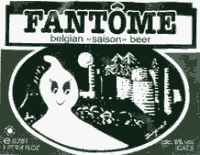 Prignon Fantôme Saison ABV: 8%
Origin: Soy, Luxembourg, Wallonie
Website: www.fantome.be
Date: 8 September 2000
Another review from the archive written for the pioneering Oxford Bottled Beer Database (OBBD). I’ve left it uncorrected — so please read it in that historical spirit.
Dany Prignon is still brewing his eccentric beers today: indeed it appears hey have had far more influence on international craft notions of ‘saison’ and ‘farmhouse ale’ than more straightforward examples like Dupont. Re-reading my notes on the vegetal hop aromas and an ‘acidity bordering on rough cider’ I’m no longer quite as convinced if this influence was quite such a good thing!
A cult following attends this tiny farmhouse brewery in the Belgian province of Luxembourg, which looks like a tourist brochure study in rurality: it has even inspired a ‘Confrèrie’ who dress up in white cloaks and sashes to celebrate both the beer and other local produce. Some bottles appeared at the 2000 Great British Beer Fesitval and a glass of the product, with its friendly ghost label, quickly demonstrates its appeal.
As a bottle-conditioned artisanal blond beer in a champagne-type bottle from rural Wallonia, it is often lumped in with the Saisons but it is really an idiosyncratic speciality of its own, flavoured with locally-collected herbs and surely also including some wheat. It’s light amber in colour, with a thick sediment that makes it pour very cloudy, and an intense estery nose with a pungent hops and yeast aroma that borders on the vegetal.
The condition is lively, the first swallow conveying an explosion of fudgey malt and a summery fruitbowl of flavours including strawberry, raspberry and blueberry. There is also some straw-like character, and an acidity reminiscent of rough cider. The long finish affords numerous return appearances from the berry fruits, along with an elusive hint of spicy hops.
It is also dangerously drinkable – the label had soaked off the bottle and I was taken aback when I looked up the ABV after drinking the stuff. Just the sort of beer you hope will emerge from the bucolic idyll depicted on the website: I’m sending off for my white cloak and sash right now.
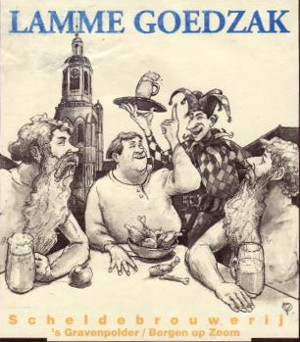 Former label for Scheldebrouwerij Lamme Goedzak. ABV: 6.5%
Origin: Bergen op Zoom, Noord-Brabant, Netherlands
Website: www.scheldebrouwerij.com
Date: 8 September 2000
Another review from the archive written for the pioneering Oxford Bottled Beer Database (OBBD). I’ve left it uncorrected — so please read it in that historical spirit.
Scheldebrouwerij, founded in 1994 and named after the Schelde river, became one of the few border-crossing microbreweries in 2007 when it moved to Meer, just across the Belgian border in Antwerpen province. It remained in Dutch ownership, brewing the same brands largely aimed at the Dutch market, but the kudos of being a Belgian brewer resulted in a marked increase in sales.
Lamme Goedzak is still in the range, though its ABV has been raised to 7%. It is indeed named after the character from the Tijl Uilenspiegel stories that I describe, although not from the original folk tales but from their 1867 retelling by author Charles de Coster. Once again I seem to have had a notable sensitivity to hops.
This Zeeland [actually Noord-Brabant]-based craft brewery seems to have become a regular fixture at the Great British Beer Festival and 2000 brought another batch of specialities. Lamme Goedzak is, if I remember rightly, a fat and jolly character who plays comedy sidekick to Flemish folk hero Tijl Uilenspiegel in the traditional stories, and there he is on the label against a backdrop of the towers of Bruges, stuffing his face with chicken legs and about to quaff a foaming mug of ale.
The beer inside, however, is far too austerely hoppy and also rather too strong for jolly quaffing fodder. Though described as a golden ale, it’s deep enough to be a pale and its hop character edges it in that direction too. Poured without the sediment as recommended on the label, the beer throws a thick and persistent head that offers up a rich aroma of spicy hop with some phenolic notes, reminiscent of ginger marmalade on toast.
The condition is lively, and the hops are immediately prominent in the mouth as well, set against a background of honeyed malt (the beer contains candy sugar) and hints of perfumed fruitiness with lime and pineapple. The hops continue to assert themselves through a grapefruit-dry finish, and linger long after the last swallow. The overall effect isn’t dissimilar to one of those ultra-hoppy pale ales from the USA, though the candy sugar and aromatic German hops give it a Belgian abbey flourish that ventures into Orval territory, but with little of the latter’s complexity.
A well-made beer, then, but it could do with being either more subtle or, given the cheerful presentation, less forbidding in its bitterness.
|
|
