Promoting an international beer culture that recognises and celebrates beers of quality, distinctiveness and local character, brewed with care and passion.
Etiam pulvinar consectetur dolor sed malesuada. Ut convallis
euismod dolor nec pretium. Nunc ut tristique massa.
Nam sodales mi vitae dolor ullamcorper et vulputate enim accumsan.
Morbi orci magna, tincidunt vitae molestie nec, molestie at mi. Nulla nulla lorem,
suscipit in posuere in, interdum non magna.
Suspended brewery, no visitors please New Barnet EN5 (Barnet) urban-alchemy-brewing.co.uk First sold beer: December 2019 Brewing suspended: March 2023
Four friends who had been homebrewing together for 10 years – Simon Morley, Matt Javes, Neill Boscoe and David Boldrin – drew on their mix of brewing, engineering, chemistry and IT skills to launch a commercial brewery at the very end of 2019.
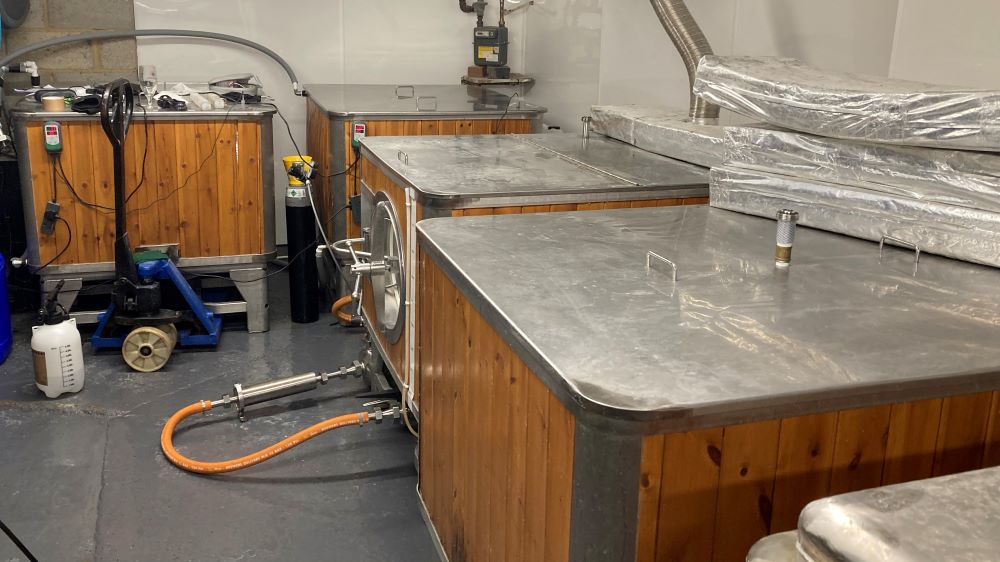
They produced 5 hl batches on a home-based kit they designed themselves, with a custom-fabricated brewhouse and German-built Speidel fermentation and conditioning vessels, controlled by a bespoke Raspberry Pi computer system. Brewing waste was used as fertiliser on local allotments.
A mobile bar visited local markets and the brewery organised charity fundraising events where the beer was sold. The brewery added an offsite taproom in central Barnet in July 2022, though this had to close in March 2023.
Brewing was suspended in 2023 due to building work. The team announced at the time that it was working with a partner to establish a new craft beer outlet in Barnet in 2024, with an aspiration to resume brewing eventually. So far, though, there have been no new developments.
Beers in cask, keg and bottle were naturally conditioned and vegan, combining both traditional and contemporary craft influences.
Brewery 21 Resolution Way SE8 4NT (Lewisham) villagesbrewery.com First sold beer: 9 December 2016
Currently the only actual brewery in a cluster of beer-friendly venues around Deptford station, Villages occupies two arches, with space extending into a lean-to at the back, under the same historic railway as in Bermondsey but a little further east.
Its rustic-sounding name in fact refers to the founders, Heriot-Watt-trained brothers Archie and Louis Village. Archie once worked at London Beer Factory and Fourpure, Louis at Gipsy Hill, and the latter brewery helped get the brothers started by selling them its old 25 hl Malrex kit. This has since been replaced by a smaller but higher spec bespoke 15 hl kit.
Archie and Louis moved on in July 2022 in the interests of “a change of pace, lifestyle, and some new experiences”. They sold the business as a going concern to new directors Simon Baldwin and Malcolm Elliot, who are also involved in two breweries outside London: Backyard in Walsall and Grasshopper in Nottingham. Activities have so far continued as normal.
The taproom is in the arch adjacent to the brewhouse.
Closed brewery Original site: Hillfield Lane, Aldenham WD25 (Hertfordshire, outside London) Second site: Unit 2A, 6 Greycaine Rd, Watford WD24 7GP (Hertfordshire, outside London) Final site: 8 Triumph Trading Estate, Tariff Road N17 0EB (Haringey) watlingstreetbeer.com First sold beer: January 2015 (at original site) Ceased brewing: by June 2020
As London’s brewing scene continued to boom into the late 2010s, one Tottenham industrial building witnessed a particularly rapid shuffling of brewery projects. The unit at Triumph Trading Estate, close to Bohem, One Mile End and Redemption, was already partly occupied by a drinks packaging business, Brew and Bottle, which in 2018 invited Oddly brewery to occupy spare space, with the host company also cuckoo brewing under the name Trial and Error.
In September 2019, they were joined by a second brewery, Watling Street, founded almost five years before by Rudi Keyser as the Radlett Beer Co and previously at locations just outside London in Aldenham and Watford, taking its current name from the Roman road that runs through these areas. The intention was to form a partnership called Tottenham Brewing but this didn’t work out. By December 2019, Oddly had left and Brew and Bottle reclaimed its spare space.
Watling Street meanwhile moved its 16 hl kit, originally supplied by Pallet Brew in Bolton, to a neighbouring unit, planning to add a taproom. But progress was interrupted by the 2020-21 Covid-19 lockdowns and by summer 2020 the brewery had ceased trading. Its host, Brew and Bottle, itself went into administration in February 2021.
Closed brewery Original site: 12 Platts Eyot, Hampton TW12 2HF (Richmond upon Thames) Second site: 6 Triumph Trading Estate, Tariff Road N17 0EB (Haringey) Last site: Friern Barnet N11 (Barnet) First sold beer: March 2017 Ceased brewing: by early 2023
Taking his brand name from expressions such as ‘oddly delicious’, Brian Watson began cuckoo-brewing in 2015 at Clouded Minds in Oxfordshire, itself a former cuckoo at London’s Gipsy Hill. From 2017, he had his own brewery with a 10 hl kit on Platts Eyot, a privately-owned island in the Thames at Hampton which is still home to Tiny Vessel.
Though in many ways an idyllic place to work, the location posed numerous practical challenges. Its only fixed link to the mainland is a suspension footbridge, so deliveries and dispatches had to be accomplished either laboriously in stages using a handcart, or by boat – the brewhouse arrived by the latter mode.
A move in February 2019 to a unit in Tottenham adjacent to Watling Street (since closed) didn’t work out, with Oddly vacating the site by the end of the year. Brian subsequently found a new way of working, creating bespoke experimental beers for specific clients, events and bottle clubs, either on his own small kit or as a cuckoo elsewhere.
Beers, possibly cuckoo brewed, were briefly available on a small commercial scale again in 2022 but activity appeared to have ceased by early 2023 and the company was dissolved in July 2024.
Brewery, no visitors please 505 Platts Eyot, Hampton TW12 2HF (Richmond upon Thames) tinyvessel.co.uk First sold beer: December 2016 Brewing suspended: by November 2021 Brewing resumed: March 2022
One of London’s most unusually located breweries as well as one of its smallest, Tiny Vessel is in a small workshop on Platts Eyot, a privately-owned island in the Thames at Hampton on the edge of the capital. The only link to the mainland is a suspension footbridge so anything substantial has to be moved by boat.
The project is the brainchild of Ivailo Penev, a Bulgarian-born brewer who had been cuckoo-brewing botanically-flavoured beers under the name Rose Brew since 2014, and business partner Neal Durrant.
Tiny Vessel received an early boost when its coriander-infused English IPA Summit Else (5.2%) won a competition organised by hop supplier Simply Hops in January 2017 and was poured at several European showcases.
Ivailo also runs a Brentford pub, the Northumberland Arms (11 Northumberland Road, Brentford TW8 8JB). The beer is regularly on sale in cask here and is also hand-bottled.
The Northumberland closed for several months for a major refurbishment in autumn 2021 and brewing was suspended due to the loss of the main outlet. Production resumed on a small scale in March 2022, and the pub reopened in October that year.
Closed brewery Hither Green SE6 (Lewisham) wrongsideofthetracks.beer First sold beer: 8 August 2019 Ceased brewing: by end 2021
Daniel Jackson was a frustrated IT professional and homebrewer who began working commercially on a part-time basis using a small scale using a 1 hl kit in a garage on the edge of the Corbett Estate, Hither Green. He had a long term ambition of going full-time and upscaling to a bigger brewery with taproom.
Production faltered during the Covid-19 lockdowns in 2020 and 2021 and by the end of 2021 had temporarily halted. Daniel hoped to restart at some point in 2022 with a new business partner though this was delayed. Some cuckoo brewing subsequently took place at Dogs Grandad, but in April 2024 the kit was sold and the company wound up.
Beers were hand-bottled and in keg, sold through a handful of local outlets.
Suspended brewpub Original site: Five Miles, 39B Markfield Road N15 4QA (Haringey) Second site: 7 Almond Road SE16 3LR (Southwark) Most recent site: Grosvenor Arms, 17 Sidney Road SW9 0TP (Lambeth) First sold beer: 10 December 2016 (at original site) Brewing suspended: by March 2024
Founded by Steve Grae, ex-Brew by Numbers, and Ben Duckworth, this socially conscious brewery began with Anspach & Hobday’s old 4 hl kit in two half-sized shipping containers in the yard of Five Miles, a bar and venue in a former industrial building in Tottenham. Rapidly running short of space, it relocated in October 2017 to one of two small adjacent Bermondsey arches previously occupied by Partizan. The brewery’s previous home in Tottenham was eventually taken over by Hale (see Exale).
The Bermondsey arch was open as a taproom selling stock brewed in Tottenham before a 10 hl kit, originally at Long Arm in Ealing, came online early in 2018, the year the brewery began running the remarkably successful Cask festival in March. Steve and head brewer Stirling Mitchell also used a home-made grist case and old school open fermenters formerly at Pressure Drop. The brewery’s distinctive visual style was created by artist Tida Bradshaw.
During summer 2020, Ben moved on, and Steve relocated the brewery to the cellar of the Grosvenor Arms pub in Brixton. This was once a large pub with a ballroom noted for punk gigs in the 1970s and 1980s, but was closed in 2014 with its interior ripped out in preparation for conversion into a convenience store and flats. A campaign to protect it as an Asset of Community Value only partly succeeded when the Planning Inspectorate overruled Lambeth council in restricting the designation to the ground floor only, allowing flats above. Now much reduced in space, the pub was reopened in March 2019 by the owners of another nearby beer-friendly pub, the Priory Arms in Stockwell.
When Affinity found itself struggling following the loss of its taproom business in the 2020 lockdowns, the management of the Grosvenor invited the brewery to relocate to the cellar of the pub, which effectively became a brewpub. The Bermondsey brewhouse was too tall for the cellar so was sold to Three Hills brewery, the new occupants of the arch. A new brewhouse, sourced from Ryedale, had the same capacity but made use of unusual square-shaped vessels in more cellar-friendly dimensions.
An additional bottle shop outlet opened in Crystal Palace (22 Church Road SE22 2ET) in summer 2020 but closed in summer 2023. Ben moved on in 2021 and is no longer based in London.
Sadly, the new arrangements didn’t restore the brewery to long-term viability. By March 2024 brewing had ceased and the company was in the process of being wound up. Steve now works for other brewers including Anspach & Hobday.
The pub acquired the kit, which remains in place, and there’s a long-term plan to revive brewing for the pub and its stablemate.
The unusual brewing kit at Affinity’s Grosvenor Arms site.
Beers were in cask, keg and 440 ml cans filled by hand and sealed using a self-built seamer. Cask beers were sold mainly in the Grosvenor and its sister pubs while keg and cans were distributed more widely.
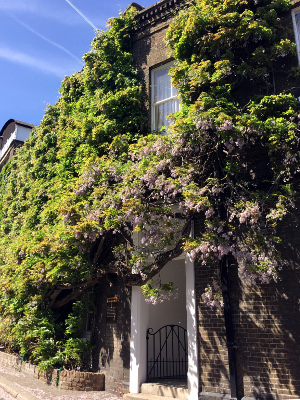
The famous wisteria on the Brewer’s House at Fuller’s., London W7.
The 2010s saw an astonishing growth in the numbers of London breweries. When Young’s ceased brewing on its historic Ram Brewery site in Wandsworth in 2006, only nine commercial breweries were left in the capital, close to the lowest number ever recorded. By the end of 2020, the numbers were above 130. While the Covid-19 pandemic of 2020-21 and the subsequent lockdowns didn’t immediately halt the upward trend, its aftershocks, combined with the economic difficulties of the early 2020s, have seen the numbers declining again, though they remain much higher than they were at the start of the century.
Brewery numbers are of course a different matter from output. In the early 1970s, a much smaller number of much bigger breweries were producing over 10 million hl a year. Today, overall output is likely around 1.5 million hl. Many of the most recently opened breweries are very small, some of them home-based operations working in 100 l batches or less.
Below, you’ll find total end-of-year figures for commercial breweries operating in London from 1971 onwards
The table includes annual changes (+ for breweries revived or opened, – for those suspended or closed), numbers owned or part-owned by national (N) or multinational (M) groups, and numbers of brewpubs (BP) included in the total. In some years, brewpubs made up a high proportion of the numbers, particularly in the 1990s heyday of the Firkin chain. Click on a year to find the full list of breweries operational at the end of the year.
‘Commercial breweries operating in London’ means businesses with their own physical brewing kit, on a distinct and separate site within the official Greater London boundary, producing beer that is on sale to the public. Separate brewery sites under the same ownership are counted individually. Where two or more companies share a kit, this is counted as a single brewery. ‘Brewers without breweries’ like cuckoos and contractors, are not counted.
The locality names given after postcodes in each list refer to London boroughs, and don’t necessarily correspond to the locality in common use.
I’ve compiled these lists from a variety of sources, including
in recent years my own primary research into London brewers and breweries. Key secondary
sources are:
I’m also grateful to John Cryne at the London Brewers Alliance and John Paul Adams and the London CAMRA brewery liaison officers for sharing records and information.
17 openings and revivals, 12 closures and suspensions, net change +5.
By the end of 2019, there were 130 commercial breweries operating in London, including 28 brewpubs. 14 were parts of multinationals (M). These breweries were:
Closed brewery Original site: 6 Georgiou Business Park, Second Avenue N18 2PG (Enfield) Final site: 2A-4 Uplands Business Park, Blackhorse Lane E17 5QJ (Waltham Forest) beerblefish.co.uk First sold beer: October 2016 (at original site) Ceased brewing: January 2025
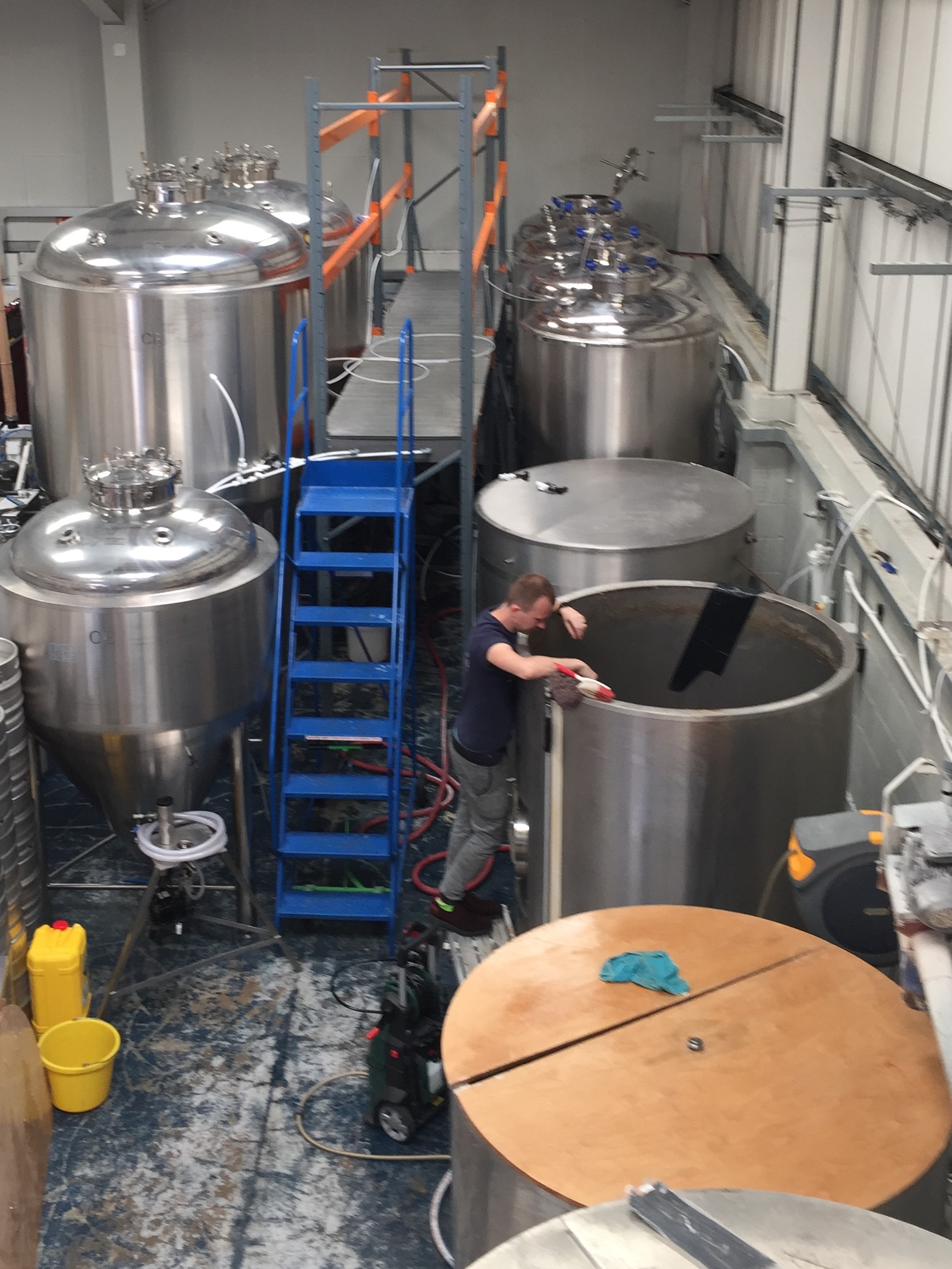
Homebrewer James Atherton first brewed commercially as Beerblefish at UBREW late in 2015, but quickly decided he needed his own commercial-sized equipment. A year later, James and his partner Bethany Burrow were producing beer in an industrial unit in the Lea Valley on a 1970s-vintage 8 hl brewhouse made from converted Grundy tanks and sourced from the defunct Cox & Holbrook brewery in Suffolk.
Struggling to balance brewing with their day jobs, they brought in another UBREW user, Australian-born Glenn Heinzel, as a full-time brewer and operations manager. Glenn also has his own brewing operation, Tankleys.
Outgrowing the original site, in 2021 Beerblefish leased a larger space in the rapidly-growing brewing cluster along Blackhorse Lane in Walthamstow, next door to Exale. This opened as a taproom in July, with the brewing equipment relocated and production restarted in September. In November, the brewery added a larger brewhouse formerly at BBNo, though this wasn’t commissioned until spring 2022. Michaela Charles, formerly at Enefeld, Alphabeta and Clarence and Fredericks (see Volden), was taken on as head brewer.
The business aimed to be ethical and socially useful, for example helping retrain ex-Forces personnel. The origin of the name Beerblefish will be obvious to anyone familiar with the babel fish in Douglas Adams’ Hitchhiker’s Guide to the Galaxy.
Since then, the brewery has sadly gone the way of many others overwhelmed by the challenging conditions of the mid-2020s. It brewed its last in January 2025, with the taproom closing in March
Beers were mainly in cask and hand-bottled, with some keg, and all were vegan-friendly. Styles often nodded towards historic recipes and several used a mixed fermentation with Brettanomyces claussenii, a different wild yeast species to the more familiar B. bruxellensis which tends to produce a milder flavour profile.