A sample text widget
Etiam pulvinar consectetur dolor sed malesuada. Ut convallis
euismod dolor nec pretium. Nunc ut tristique massa.
Nam sodales mi vitae dolor ullamcorper et vulputate enim accumsan.
Morbi orci magna, tincidunt vitae molestie nec, molestie at mi. Nulla nulla lorem,
suscipit in posuere in, interdum non magna.
|
Beer sellers: Scottish Real Ale Shop; Top Tastings 2011
ABV: 4%
Origin: Larbert, Falkirk, Scotland
Website www.trystbrewery.co.uk
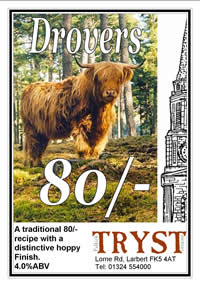 Tryst Drovers 80/- Tryst is a strong candidate for the list of the most underrated breweries in the UK — I don’t think I’ve ever had a bad beer from this micro just outside Falkirk. The wide range of accomplished bottle conditioned beers is particularly rare and noteworthy among Scottish brewers. A good number of the beers are unusual and innovative for Scotland, but brewer John McGarva can also turn his hand to traditional styles, as with this impressive take on an 80/-.
The beer is a rich mid-brown with a creamy beige head and a slightly yeasty and varnishy aroma yielding spice cake, malt and figgy fruit tones. The toasty malt palate has a lightly fruity note with sweetish cinder toffee flavours and a suggestion of sage in a dab of herbal hops, the result of a modest but noticeable late addition to the kettle. A gentle hop burr emerges from a comforting, lightly roasty sweetish malt finish with the slight crack of burnt toast.
There’s some more background to the brewery in my review of Brockville Dark and Carronade IPA.
Read more about this beer at ratebeer.com: http://www.ratebeer.com/beer/tryst-drovers-80–aka-wheel-ale/71979/
Beer sellers: Scottish Real Ale Shop
ABV: 4.5%
Origin: Throsk, Stirling, Scotland
Website: www.traditionalscottishales.com, www.theladeinn.com
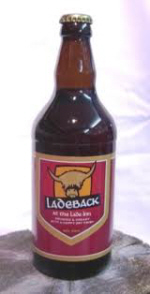 Traditional Scottish Ales Lade Inn LadeBack In 2003, the owners of the delightful Lade Inn in the Trossachs near Callander decided to add to the pub’s attractions by opening a microbrewery in an outbuilding, developing a range of own brand beers in collaboration with Douglas Ross of Bridge of Allan Brewery. In the event the brewery proved problematic and shut down a year later, the building later being converted into specialist off license the Scottish Real Ale Shop, but the beers endured, brewed under contract by Douglas at what’s now Traditional Scottish Ales. They’re available in cask in the pub, but also in filtered, bottled form as an additional point of interest in the shop.
LadeBack is business owner Frank Park’s particular favourite, a well balanced and accessible amber Scottish ale which I enjoyed on cask at the pub. A biscuity, slightly whiskyish and orange tinged aroma rises from a smooth and persistent yellowy-white head. The palate is malty and smooth with sweet fruit and controlled rooty hop notes. The finish is subtly fruity and creamy with a touch of powdery dryness in a careful balance of malt and hops. You can almost forgive it the groan-inducing name.
Read more about this beer at ratebeer.com: http://www.ratebeer.com/beer/trossachs-ladeback/34499/
Beer sellers: Scottish Real Ale Shop
ABV: 4.5%
Origin: Pitlochry, Perth & Kinross, Scotland
Website: www.moulininn.co.uk
 Moulin Brewery Real Ales Special Brews From one of Scotland’s (and the UK’s) smallest and most scenically situtated breweries comes this bottle conditioned rarity in an intriguingly screen printed bottle. It’s from the village of Moulin, actually the historic centre of an ancient parish that includes nearby Pitlochry, the latter now bigger and better known since its days as a Victorian tourist resort.
In 1995 the owners of the Moulin Inn, a pub at least three centuries old, opened a brewery in the old stables and coachhouse opposite, with most of the production sold through the pub both as draught cask and carry out bottles. Occasionally the beer does venture further afield, as evidenced by this example which popped up at the Scottish Real Ale Shop, though the cask beer is usually limited to nearby outlets.
Ale of Atholl, a pun on the name of nearby geographical feature the Vale of Atholl, was the first regular brew. Pleasingly, though the pub owners’ background was in brewpub management in England, they opted for a beer more in tune with local tastes, adopting the slightly sweeter, darker, maltier profile of a traditional Scottish ale.
This is a dark ruby beer with a thick and creamy beige head. The aroma is slightly cakey with mineral malt and a hint of dark fruit, setting up a date-tinged palate with a big bite of biscuity cakey malt enlivened by fruity esters and a definite, but not too troubling, acidic note — I woudn’t advise storing the beer for too long before drinking. The finish is complex and chewy with tart fruit and nutty malt notes. The bitter balance is more thanks to roast than hops, and there’s a slightly powdery, pursing character at the end.
Read more about this beer at ratebeer.com: www.ratebeer.com/beer/moulin-ale-of-atholl/16040/
Beer sellers: Scottish Real Ale Shop
ABV: 6%
Origin: Swannay, Orkney, Scotland
Website: www.highlandbrewingcompany.co.uk
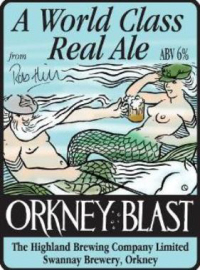 Highland (Swannay) Orkney Blast One of Britain’s most northerly breweries and one of its more ambitious, the Highland Brewing Company’s Swannay Brewery was established by Rob Hill, formerly with the Orkney Brewery, originally as a beer firm that contracted out to English breweries. Since 2006, however, it’s had its own small plant, recently expanded, on a Orcadian farm. “World Class Ales” claim the labels, and the beers certainly do their best to live up to it.
Orkney Blast is a notably strong and characterful golden ale that in 2010 won CAMRA’s Champion Beer of Scotland competition — although it’s brewed from the decidedly English ingredients of Maris Otter pale malt and hops from south of the border. The result is a rich gold brew with a fine just off-white head.
On cask at the 2010 Great British Beer Festival, I found it had a cereal fruit aroma with plentiful esters and slightly farmyardy, almost pooey notes. A rich and weighty but dry and quite hoppy palate was generously fruity and mouth-filling with impressions of apricot tart and pine resins. A slick of nectary malt underlined a slow developing piney bitter hop finish with more apricot fruit and chewy tannins. Overall a big beer, but it didn’t really cohere and take flight with me.
Although it was the cask version that won the award, I found myself more impressed with a bottled version bought in 2011 at the Scottish Real Ale Shop. The beer isn’t bottle conditioned but the light haze was suggested of a basic filtration and there was no obvious pasteurisation. There were no musty notes on the aroma which had fruit salad, citrus and pale malt with hints of tropical fruit emerging. Again the palate was firm and big and almost Tripel-like, very fruity and slightly sweetish — I picked up peach notes, some sulphur and pine and a a grapefruit bitterness emerging from the fruity wash. The beer bittered further on the swallow with peppery hops building up far back in the mouth over a fruity wash in the finish with notes of orange malt.
In both forms this is an accomplished and tasty beer but I suspect it needs to be really pristine in the cask for the freshness of the fruit notes to soar over the rather burly malt and hops. The extra carbonation in the bottled version helps too. Dare I say it — this might be a good candidate for a craft keg.
Read more about this beer at ratebeer.com: http://www.ratebeer.com/beer/highland-orkney-blast/60258/
First published in Beers of the World April 2009
 mi orge mi houblon I’m particularly proud of this piece as it was the first time I interviewed someone in a language other than English. Christophe Gillard speaks English more than well enough to offer assistance to the international customers in his shop, but talking in greater depth about the business and the local beer culture, he was clearly more comfortable in his native French. What you’re reading below are my translations.
When you’re researching great beer shops and get a personal recommendation from Tim Webb, compiler of the authoritative Good Beer Guide Belgium, you don’t take it lightly. And so I find myself one chilly early spring day on a lengthy but scenic train journey from Brussels to Belgium’s hilly far southeast. My destination is the country’s oldest town, Arlon, provincial capital of Belgian Luxembourg, and the last stop before entering the Grand Duchy of the same name.
It’s a pretty little town rich in Celtic, Roman and mediaeval heritage, with terraced streets clinging to a hillside. Brewing traditions in this rural region are also deep rooted. Sadly few of the once prolific village breweries survived to the 1970s but the past couple of decades have seen a number of intriguing new micros appearing.
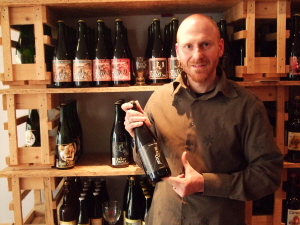 Christophe Gillard, propriètaire de mi orge mi houblon, Arlon. In 2005, local beer enthusiast Christophe Gillard left his job in a Luxembourg bank to “do something I’d enjoy”, opening the town’s first ever beer shop, Mi-Orge Mi-Houblon (Half Barley Half Hops). It’s been a great success, and by the time you read this he’ll have relocated to a new custom-built environmentally friendly wooden building at the bottom of the hill, near the station. As well as bigger and better storage for his range of around 250 beers from 40 breweries, the move will provide better parking for customers that come from far and wide. This might particularly please his patrons among the US troops stationed in nearby Luxembourg, who have been known to turn up in armoured Hummers.
 Présentation des gueuzes artisanales à mi orge mi houblon The shop’s 100% craft-brewed range has good showings for young, small but dynamic local micros like Rulles, Sainte Hélène and Millevertus, all of whom balance appreciation of tradition with healthy innovation. It extends to great beers from other parts of French-speaking Belgium (Caracole, Dupont, Vapeur), some good Flemish choices (Dolle, Anker), a comprehensive range of Trappists (Orval is the province’s sole significant surviving pre-war brewery) and a cellar of fine lambics from the likes of Cantillon and Drie Fonteinen.
Astonishingly for Belgium, there’s a small range of imported beer too. “Belgium has some of the best beers,” says Christophe, “but it’s no longer the case that ‘if it’s Belgian, it’s good’. There are some excellent beers from other countries that Belgians just don’t know about. I find different beer cultures interesting. Breweries in Colorado are brewing Belgian-style beers, while Britain has porters that once influenced Belgian beer styles.” His customers agree as beers from the likes of Thiriez, Unibroue and Flying Dog sell well.
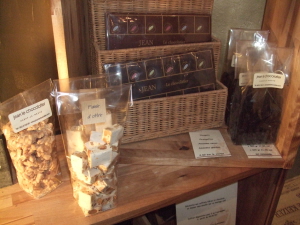 Des chocolats artisanales à mi orge mi houblon Christophe’s second passion is chocolate, and the unrealised potential for food matching it with beer. He’s teamed up with artisanal chocolatier Jean-François Vaux, originally from the South of France but now based nearby, and the Rulles brewery to create JeanChris Numéro 1, not a chocolate beer but a beer designed to taste with chocolate. Numéro 2 is soon to follow, this time from the Sainte Hélène brewery. You’ll find Jean’s chocolates and several other artisanal food goodies on sale, including as part of beer and chocolate gift packs.
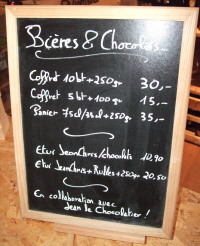 Des prix des bières et chocolats à mi orge mi houblon Christophe’s enthusiasm for sharing knowledge extends to a tasting club, currently with a waiting list, and a beer (and beer and chocolate) tasting service, as well as the guidance he volunteers as a matter of course to curious customers. And amazingly the shop remains a second job: he also teaches business studies full time, thus the limited opening hours. “I love beer because the tastes are so varied,” he says. “Gueuze is acidic, there’s the bitterness in hoppy beers that you don’t find in any other products, there’s a different beer and a different pleasure for every occasion. It’s la richesse gustative de la bière, beer’s richness of taste”.
Fact file
Address: 56 rue du Gazomètre, 6700 Arlon
Phone: +32 (0)63 677673
Web: www.miorgemihoublon.be
Hours: Tue-Fri 1600-1900, Sat 0900-1830
Drink in? No
Mail order: No
Manager’s favourites: Cantillon & Drie Fonteinen Gueuze, Rulles Estivale, Saison Dupont, Borgo Re Ale
Beer picks
All from Belgian Luxembourg
- Fantôme 8%, Soy-Erezée. Idiosyncratic saison from an eccentric but erratic brewer, dosed with hand-picked local herbs and bursting with berry fruit, toffee and cider notes.
- Millevertus Mère vertus 9%, Toernich. Orange golden triple indulging Belgium’s new taste for hops alongside caramel, toast and spicy citrus. Brewery suggests saying six Our Fathers and three Hail Marys after each swallow.
- Orval 6.2%, Villers-devant-Orval. The most noncomformist of the Trappist beers, at its mature best a taste extravaganza of orange, peach, incense, Indian spice and a slug of sourness.
- Rulles Jean-Chris No 1 6%, Rulles. Soft, clean and fruity amber ale with a lightly roasty finish, designed to be drunk with chocolate but excellent in its own right.
- Saint-Monon Brune 7.5%, Ambly. Tasty brown from a delightfully rustic brewer, with soft rich malt, pastilley winey red fruit, liquorice and herbal hops.
Beer sellers: mi orge mi houblon
ABV: 9%
Origin: Tintigny, Luxembourg, Wallonie
Website: www.millevertus.be
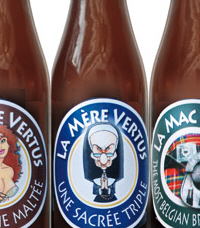 Millevertus La mère vertus This interesting and very small brewery from rural Wallonia was launched in Toernich in 2006 by an ex-banker with the aid of a retirement bonus. It’s since done well enough to expand in July 2011 to a new and better site in the hamlet of Breuvanne in Tintigny commune. There are three strands to its product range: traditional Belgian ales, beers with unusual ingredients including a tasty wheat beer with mirabelle plums, and commissioned commemoration and event beers.
Mère vertus, originally known as Mère supèrieure (Mother Superior), is one of the first class, a strongish twist on an abbey tripel made with barley malt, wheat and four undisclosed hop varieties. It’s a hazy golden bottle conditioned beer with a foamy off-white head and a complex spicy hop aroma with some slightly medicinal phenolic notes. A cheerful palate is fruity, spicy, seedy and lightly marmaladey with obvious alcohol. It’s a little on the hoppy side for the style, with a controlled but coating bitterness on the finish with herbs and black pepper emerging over apricot syrup.
“After every swallow you will say six Our Fathers and three Hail Marys,” demands the forbidding looking nun on the label. I’m not a religious or a guilt-ridden type, but I can see how a beer like this might make you feel self indulgent.
Read more about this beer at ratebeer.com: http://www.ratebeer.com/beer/millevertus-la-mere-superieure/84796/
“Anything but history, for history must be false.”
Robert Walpole (1676-1745)
 Old mash tun -- though probably not 200 years old -- at Lindemans, Vlezenbeek. Beer culture is a form of popular culture, and suffers similarly from a less than scrupulous approach to its history. Authoritative histories of high art, politics, economics and other worthier fields of human endeavour are written by academic historians from carefully researched primary sources under the discipline of peer review. In contrast, the history of beer, like that of, say, popular music or TV comedy, seems often to have been dreamed up by the marketing department and passed into folk knowledge through the medium of pub anecdote.
I’m often reminded of this when I read the work of genuine and meticulous researchers into the history of British beer and brewing, like Martyn Cornell and Ron Pattinson, heroically fighting a rearguard action against the many misconceptions around classic British beer styles like porter and India pale ale. But a similar problem afflicts the beer histories of other countries too.
For example, a fascinating piece by Raf Meert in the current issue of De Zytholoog, the magazine of Belgium’s beer consumer organisation Zythos, was prompted by the ‘200th anniversary’ of Lindemans, the lambic brewery in Vlezenbeek, Flemish Brabant, which was celebrated with some ballyhoo earlier this year. According to Meert’s researches, however, Lindemans’ official founding date of 1811 is 20 years too early.
The article quotes the standard account of the brewery’s origins, as given in the book Geuze en Kriek: de Champagne onder de Bieren (‘Geuze and Kriek: champagne among beers’) by respected Flemish beer writer Jef Van den Steen, generally considered one of the authoritative texts on lambic brewing.
Here the author states [writes Meert — my translation] that seven generations ago the Lindemans family ran a brewery at their farm, which was known then as it is today as the Hof te Kwadewegen. Brewing at the site was even older: in 1655, Jan Van Overstraeten was brewing beer there. The Van Overstraeten family established the brewing tradition at the Hof te Kwadewegen more than 150 years before Frans Lindemans, the bailiff of the New Land of Gaasbeek, married into that family in 1780. According to this account, he took over the business from his father-in-law in 1809.
In fact, says Meert, there were originally two breweries in Kwadewegen, then a small hamlet near Vlezenbeek. The larger was run by the Van Overstraeten family, the smaller, a completely different brewery, by another family with the name of Van Dorselaer. The current Lindemans site was formerly the property of the Van Dorselaers, not the Van Overstraetens. In 1795 the brewer’s daughter, Maria Anna Van Dorsealaer, married a man called Jacobus Vandersmissen, who eventually took over the tiny brewery. It came into the Lindemans family because Joost Frans Lindemans, the nephew of bailiff Peter Frans Lindemans but not a bailiff himself, married Maria Anna and Jacobus’s daughter, Josina Vandersmissen, in 1822. Joost Frans soon became the boss when his father-in-law died a few months later. He and his wife presided over a significant expansion of the business, eclipsing their competitors the Van Overstraetens, who are recorded as having ceased brewing by 1824. Counting back from the current incumbents to Joost Frans is only six generations, not seven.
Assuming Meert is right, the first question is, why is the established history so inaccurate? Presumably it simply hadn’t been thoroughly researched before, and Van den Steen simply went with the received wisdom, perhaps from family legend — though it would be odd if family legend implicated another family which turns out not to have any connection at all! But it’s also notable that the standard story, with only one rather than two inheritances through marriage and picturesque details like the brewing bailiff, is an easier and more appealing one to tell, particularly for someone churning out “creatives” for a marketing campaign or press release. And it’s all too common in the beer world that the author of a standard text simply takes this kind of stuff at face value.
The second question is, does it matter? Are the details of brewery inheritance in an obscure part of the Low Countries at the turn of the 19th century, before today’s Kingdom of Belgium had even been created, really that important compared to, say, understanding the reasons why Lindemans abandoned traditional lambic production in favour of sweetened fruit beers in the more recent past?
In my view, yes, it does very much matter. Heritage is a valuable asset in the world of brewing, and most breweries dating from before the resurgence of craft brewing are quick to boast of their lengthy pedigree. The authenticity thus sought is admittedly limited as a brewery’s history does not necessarily reflect on the way it operates today — many a family business has ruthlessly torn up the rule book — but history does help provide the context in which specific beers are appreciated, particularly if they come in a style as ancient and rare as lambic.
I doubt in this case there was an intent to deceive, and this was by no means the most egregious example of a contested brewing history. It’s common practice among German brewers, for example, to quote foundation dates going back to mediaeval times, though often the events commemorated turn out to be only very indirectly connected to the present day company and site. Still, however, when a major anniversary celebration ends up two decades early through a failure to check facts, the very commitment to heritage the event was intended to celebrate is exposed as embarassingly shallow.
More generally, the sloppy, anecdotal and unsubstantiated nature of much of what passes as beer history — yarns spun by advertising agencies, folk reminiscences parroted uncritically by beer writers — undermines the importance and significance of beer, brewing and beer culture and sets back the cause of its advocates. I admit I’m not immune for this sort of sloppiness — I’ve echoed the occasional beer style myth and relied far too much on brewery websites for background detail. Of course most beer writers and bloggers aren’t expert historians — our role is more to interpret for the benefit of an audience more interested in enjoying beer than understanding it — but we need to start paying more attention to the people who really are historians, and less to the appealing stories that emerge from the marketing departments.
First published in Beers of the World, February 2009
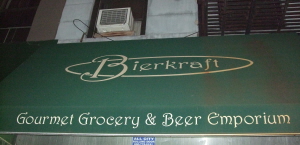 Bierkraft: Sometime in New York City... “Gourmet Grocery and Beer Emporium” reads the strapline atop Bierkraft, one of several specialist shops that cluster in Brooklyn’s leafy Park Slope neighbourhood, and the beer emporium of your imagination may very well look something like this. The well-stocked shelves and fridges lining the walls house a dazzling array of zythological delights, with well over 1,000 beers in stock at any one time, each one from a craft producer, while three beer engines and nine pressurised taps dispense fresh draught beer, including exclusive dry hopped caskings.
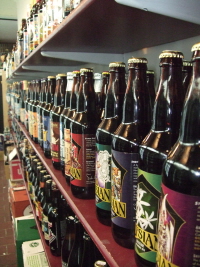 Shelves at Bierkraft, New York City Unsurprisingly, brewers from the northeast corner of the USA account for just under half the beers – you’ll spot names like Allagash, Ithaca and Southern Tier, as well as Brooklyn micros Sixpoint and Kelso. But there’s wide representation from the rest of the US and an excellent international range, including tiny Wallonian micros like La Botteresse, small UK producers like BrewDog and Burton Bridge, and even Japanese craft brews, plus a good real cider selection.
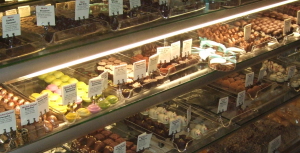 Chocolates with beer? Bierkraft, New York City. And as if being arguably the best specialist beer outlet in New York City wasn’t enough, owner-managers Daphne and Richard Scholz and Benjamin Granger ensure they live up to the “Gourmet Grocery” bit too. Their food lines include 250 cheeses, a range of charcuterie, and a seriously sweet-toothed collection of artisanal chocolates and candies. Numerous items boast a beer connection, including their own brown ale-dosed Shameless Ice Cream Sandwiches.
This approach helps emphasise the quality of the beer by positioning it alongside products that are more readily accepted as gourmet fodder. And there are sure some fine and special beers here, including several US-brewed rarities in wine-size 750ml bottles that command wine-sized prices of $30 or more. Standard US 12oz (355ml) bottles are mostly $2.25 each – higher than the supermarket, but you’re paying for the tender loving care and good advice, and all are available singly rather than in the obligatory six-packs that so often frustrate North American beer hunting expeditions.
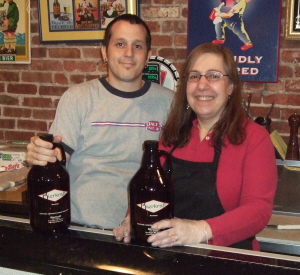 Ben Granger (left) and Daphne Scholz, Bierkfraft, New York City Richard was a Wall Street financial analyst and an avid home brewer whose beers were so good a friend offered to invest in his hobby. But he and freelance writer Daphne found establishing a brewpub too expensive so went for a store instead, opening Bierkraft in 2001. Four years later they were joined by Ben, a former pastry chef and cheese specialist at a swanky Manhattan restaurant and also a home brewer with a useful sideline in DIY skills – he built the new cask beer engines out of cutting boards and skateboard parts.
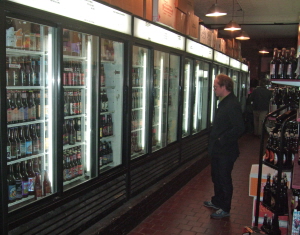 Fridges at Bierkraft, New York City The trio have built up a dedicated regional following as well as welcoming regulars from other parts of the country and Canada and visiting beer lovers from elsewhere. BBC America ordered a huge gift basket for the cast of The History Boys when there were on Broadway, “because those boys love beer,” says Daphne. The community feel is underlined by regular and very informative tastings twice a month, in the back yard if the weather’s warm enough and usually matching beer with current food lines.
 Congratulations to New York GABF winners They’ve worked hard to track the astonishing development of US craft brewing. “Brewers are becoming a lot smarter and very experimental, and there’s now a huge variety of beers,” says cellar manager Jonah Scholz. “But ‘local’ is now a big word, and craft beer has caught on so much brewers don’t need to send out of state, so it’s becoming more of an effort to source them”. Long may that effort continue, and the shelves of the emporium continue to bulge.
Fact file
Address: 191 Fifth Avenue, Brooklyn, NY 11217
Phone: +1 718 230 7600
Web: www.bierkraft.com
Hours: Mon-Thu 1130-2030, Fri 1130-2100, Sat 1100-2100, Sun 1100-2000
Drink in? No (except tastings)
Mail order: Yes, online (USA only)
Manager’s favourites:
Ben: Russian River Pliny the Elder, Ithaca Flower Power, Sixpoint GNT
Daphne (“How could you?!! It’s like choosing between your kids!”): Lagunitas Hairy Eyeball, Southern Tier Phin and Matt’s Extraordinary, Vapeur Cochonette
Richard: Fullers 1845, Shmaltz He’Brew Bittersweet Lenny’s RIPA, Duvel-Moortgat Maredsous Brune
Beer picks
- Allagash Victoria 9%, Portland, Maine. Refined and expensive golden ale brewed with Chardonnay grapes to give a well-balanced and elegant liquorice- and rose-tinged crisp malt flavour.
- Keegan Mother’s Milk 6%, Kingston, New York. Decent creamy coffee, chocolate and charred wood milk stout that’s also refreshing and tangy, if a little dry for the style.
- Southampton Cuvee des Fleurs 7.7%, Southampton, New York. Typically imaginative American fusion, a saison style ale dosed with lavender, chamomile, marigold and dog rose: complex, perfumed and lightly tart.
- Southern Tier Hoppe 10%, Lakewood, New York. Imperial pale that’s floral rather than forbiddingly bitter, with pineapple, tobacco, malty peach and cleansing pine notes.
- Victory Prima Pils 5.3%, Downington, Pennsylvania. Well-established award-winning craft brewed lager with pineapple aroma, crisp vanilla biscuit palate and long, chewy and bitterish finish.
Beer sellers: Bierkraft
ABV: 5.3%
Origin: Downington, Pennsylvania, USA
Website: www.victorybeer.com
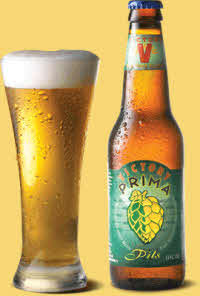 Victory Prima Pils Victory founders Bill Covaleski and Ron Barchet are two old school friends that became home brewers and later moved into brewing professionally at pioneer craft brewers like the Baltimore Brewing Company and Old Dominion. Both trained in Germany — Ron at world renowned Weihenstephan — so it’s not surprising that when they got together to start their own brewpub and brewery in a former bakery in 1996, German-style beers featured heavily. They now brew in a variety of styles, with considerable success — the most recent major expansion was in 2008 and the output is now approaching 100,000hl a year. They’re now one of the US craft brewers regularly exporting to the UK.
This accomplished take on a quality German pils is one of Victory’s most impressive beers, brewed from German pils malt and generous but not overwhelming quantities of whole flower Czech and German noble hops.
The yellow-gold beer has a fine white head and an intensely floral aroma with notes of pineapple. The floral burst continues on the palate but yields to crisp and biscuity vanilla malt and a fruity hop blast with a peppery bitterness. A long, dry and elegant finish remains scented and flowery with a chewy bitter nugget far back. Overall a well-crafted, accessible and refreshing beer with plenty of character.
Read more about this beer at ratebeer.com: http://www.ratebeer.com/beer/victory-prima-pils/619/
Beer sellers: Bierkraft
ABV: 6% (not officially declared)
Origin: Kingston, New York, USA
Website: www.keeganales.com
 Keegan Mother's Milk Located in a building from the early 1800s in the former capital of New York state, the Keegan Ales plant previously enjoyed a life as the Woodstock brewery. This closed in 2001 and was simply abandoned in situ, and in 2003 Tommy Keegan bought the lot, cleaning and refurbishing the kit and launching his own range of ales, with award winning results.
One of the first beers was this rather unusual speciality, a sweet oatmeal stout, which remains a signature product and was named as one of the ten best stouts in North America by the New York Times in 2010. The exact ingredients aren’t declared but I assume they include lactose. The ABV is also not mentioned on the brewery website, and I’ve given the percentage most often seen elsewhere, including on Beer Advocate, though other sources range from 3% to 5.5%.
I tasted the bottled version, which pours a very dark ruby with big bubbles forming in a thick, deep fawn head. A leathery coffee, malt and creamy spice aroma yields deeper vegetal notes, while the palate is equally creamy, suggestive of oats, with more coffee, tangy fruit and a bite of roast. The beer slips unctuously down the throat, leaving notes of charred wood and dark chocolate offsetting sticky malt. To be honest it isn’t that sweet, considerably less so than a traditional milk stout, but it’s beautifully silky, and curiously refreshing.
Read more about this beer at ratebeer.com: http://www.ratebeer.com/beer/keegan-ales-mothers-milk-stout/29342/26018/
|
|
