A sample text widget
Etiam pulvinar consectetur dolor sed malesuada. Ut convallis
euismod dolor nec pretium. Nunc ut tristique massa.
Nam sodales mi vitae dolor ullamcorper et vulputate enim accumsan.
Morbi orci magna, tincidunt vitae molestie nec, molestie at mi. Nulla nulla lorem,
suscipit in posuere in, interdum non magna.
|
 Gueuzerie Tilquin There are few circles of brewing so exclusive that most serious beer enthusiasts could recite their membership from memory. One is the roll call of Trappist breweries, currently seven strong (though shortly to increase to nine). Another, slightly longer, is the list of artisanal lambic producers in and around Brussels, the dedicated band that creates some of the world’s finest and most complex beer using some of its most primitive brewing methods. Once, lambic brewing was ubiquitous in the region, but post-World War II the industry appeared to be in terminal decline. Developing international appreciation of beer in the 1970s and the 1980s saw the list of surviving artisans stabilise, though it’s rarely grown since. Until May this year, De Cam was the most recent addition, in 1997. But now connoisseurs have a new name to learn: Gueuzerie Tilquin.
Like De Cam, Tilquin is a maturer and blender rather than a brewer. Lambic techniques are such that, though the initial contact with wild yeast is a key defining feature of the style, many of the crucial processes that contribute to the distinct character of the final result begin immediately after this seeding, when the beer undergoes lengthy fermentation in wooden casks, usually followed by blending and sometimes steeping with fruit (see my article on the Toer de Geuze for more details). In many cases the entire process takes place within a single enterprise, but there’s also a longstanding custom of taking day-old wort, already infected with wild yeasts, by tank to a separate business for maturation and blending, resulting in beers with their own signature, distinct from the brewer’s own versions.
In the Pajottenland, the rural heartland of the style west and southwest of Brussels, it was relatively common for local pubs to mature and blend their own lambic, alongside a few independent standalone blenders, the lambic equivalent of the Burgundy négociant or the blender and bottler of Scotch whisky. Tilquin joins four current blenders, only one of which is a surviving historic independent.
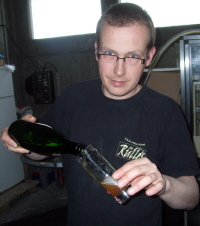 Pierre Tilquin Behind the new venture is 37-year-old Pierre Tilquin. His name, pronounced in the French with a nasalised final vowel (‘Till-KAN’), derives from tilleul, ‘lime tree’, explaining the arborial silhouette that now serves as his company logo. Despite his relatively young age, Pierre boasts impressive experience of both lambic and conventional brewing. He trained as a bio-engineer, earning a doctorate in statistical genetics at Louvain-la-Neuve, then decided to turn towards a “more concrete and passionate” occupation. Just up the road from Louvain, but on the other side of Belgium’s language boundary, he took a 15-day course in malting and brewing science at K.U.Leuven (Catholic University of Leuven). Both universities share a tradition of excellence in brewing science, unsurprisingly as Leuven also happens to be the home town of what’s now the world’s biggest brewer, Anheuser-Busch InBev.
After a stint of just over a year at Huyghe, of Delirium Tremens fame, in Melle, Pierre was drawn to the lambic industry, first at pub-blender-turned-brewer-turned-blender 3 Fonteinen in Beersel, then at the legendary Cantillon in Brussels itself. It’s an interesting career path for someone with a background in hard applied science, indicating an obvious thirst for constant challenge. Of course in a very real sense brewing is a form of bio-engineering, but lambic is of necessity the closest to traditional craft, consciously rejecting many of the techniques of control that conventional industrial brewers take for granted.
 Bottling equipment at Gueuzerie Tilquin Pierre’s next step, setting up his own lambic business, threw up a challenge of a different kind, and one which very few others were willing to meet, helping explain why, though there’s now a significant worldwide demand for artisanal lambic beers, new producers emerge so infrequently. A top quality geuze, the lively blend of old and young lambics that is seen as the true test of the lambic producer’s art, requires supplies of beers matured over one, two and preferably three summers.
“My business plan was unusual,” says Pierre. “For the first two years all I could do was spend money, without being able to sell anything.” He bought his first worts in March 2009, and sent his first beers to market in May 2011. That’s an extraordinary test of commitment and confidence, not only for the owner of a business but also for his or her investors: explaining the long wait for a return on the investment to a bank manager would be challenging enough in boom times, let alone in the current economic environment. Pierre has already been criticised by some lambic aficionados for taking the “short cut” of blending a geuze at just over two years, but it’s difficult to see how he could have got up and running otherwise.
The financial challenges also partly explain another remarkable fact about the new arrival. Despite the French-sounding names of some of the best known brands, lambic brewing today is largely a Flemish occupation. All the established producers are in Dutch-speaking Flanders, except for Cantillon in the officially bilingual Brussels Capital Region, in the decidedly Flemish-tinged western suburb of Anderlecht. Tilquin, by contrast, has been set up on the other side of the language boundary in Wallonia, in an isolated industrial unit on the N7 main road in the hamlet of Bierghes, Walloon Brabant, not far from Enghien. Though fluent in both languages, and in English, Pierre himself is francophone by birth, from Namur, and the marketing makes a certain virtue of the French language, coining the term ‘gueuzerie’ as an equivalent to the Dutch ‘geuzestekerij’ for an independent non-brewing lambic blender.
But his choice of location had less to do with ethnic pride than with economics. Wallonia is generally the poorer of Belgium’s two major regions and offers subsidies and tax breaks to new enterprises that aren’t available in Flanders: in fact the Walloon regional government has invested so heavily it owns a quarter of the business. Another quarter is held by a private investor, while the well-respected Rulles brewery in Belgian Luxembourg has a small stake. The rest is in the hands of Pierre and his family.
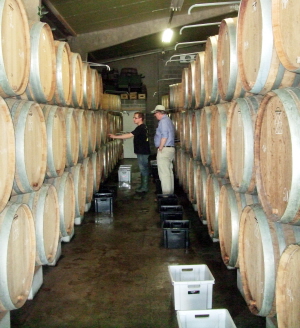 Rows of French oak wine casks at Gueuzerie Tilquin. Spot the lambic blender and the Belgian beer guru. Like other such establishments, the bulk of the space is packed with large wooden barrels, in this case 220 former wine casks from Bordeaux (Saint-Estèphe and Saint-Emilion) and the Rhône valley (Hermitage, Cornas and Crozes), all of which have previously been filled with wine three or four times. There are none of the monster barrels found in some lambic facilities – all Tilquin’s are a standard 400l. But they still make for a mouthwatering sight, tantalisingly chalked with traditional symbols identifying the brewer, and the brewing date. Some of the newer ones are still oozing yeasty barm from their bungs – lambic is the only commercial beer that undergoes the vast majority of its primary fermentation in wooden casks, as well as ageing in them. The wood might be relatively new but the design and concept is ancient, and even in this modern concrete warehouse the barrels seem to resonate with centuries of craft.
The beer inside the barrels comes from four different producers: alongside Boon, Lindemans and Girardin, Pierre is privileged to have secured supplies of Cantillon lambic, which is rarely sold on to others for blending. The total capacity is 500hl per year, but only 200hl will go to market this year, and 400hl next, ensuring the stock progressively ages, so next year that all-important three-year-old lambic can be present in the blend.
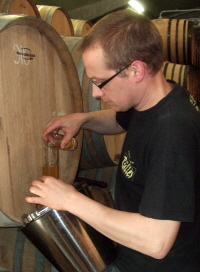 Sampling a single unblended lambic direct from the barrel at Gueuzerie Tilquin. When I visited, with renowned Belgian beer expert Tim Webb in early May 2011, Pierre was gearing up for his first open day at the end of May and the official launch of his oude geuze, or gueuze a l’ancienne as he prefers it, aged six months in bottle after blending. We were treated to a taste of this traditional sparkling lambic, and despite the relative youth of the component beers, it was already demonstrating notable finesse. Excitingly, Pierre also picked out casks of single unblended lambics for us to sample, including Boon’s low gravity Meerts, which is used almost exclusively in blends and fruit beers.
Besides the bottled geuze, available in both 375ml and 750ml sizes, blended but unrefermented lambics and faro are being released to selected outlets and festivals, and fruit beers are planned too. Much more unusual is a draught geuze making significant use of the Meerts, refermented for three months in tall 20l kegs for Belgian pubs and 30l KeyKegs for export. Indeed US importers have already pre-ordered much of Tilquin’s stock: the gueuzerie expects to sell 40% of its products in the USA, with 30% to the Belgian market and the remainder to Italy, the rest of Europe and Japan.
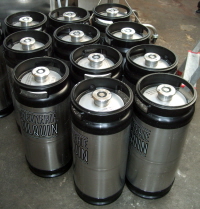 Geuze in kegs at Tilquin -- or are they just big aluminium bottles? The draught geuze is proving a popular novelty even in the local market, but has provoked a further controversy, as some experts insist geuze has to be bottled by definition. Some brewers even claim it is technically impossible. “The keg and bottled products are different, and I don’t call my draught geuze ‘gueuze à l’ancienne’ [oude (old) geuze, the official designation for the most artisanal bottled products] as by law that has to be in bottle. Personally I consider a keg to be nothing more than a big bottle. If I put geuze in a 15l nebuchadnezzar it would be considered gueuze à l’ancienne, so why is it no longer geuze if I put it in a 10l keg?”
The gueuzerie is only Wallonian by a few hundred metres. Its entrance looks out over rolling fields where horses roam. Pierre points into the middle distance, across the railway line to some woods on a low ridge. “That’s the Pajottenland, in Flemish Brabant,” he says, “and we’re still in the Senne valley, closer to the river itself than some other producers.” The legal definition of lambic has no geographical restrictions. But whether or not HORAL, the artisanal lambic brewers’ trade association, agrees to admit Tilquin to its ranks remains to be seen, as Pierre’s application for membership is still up for debate.
As anyone familiar with Belgian society will know, linguistic geography matters in a country that has now spent over a year attempting unsuccessfully to form a government after a general election in June 2010 and now holds the world record for post-election stalemate, as politicians representing the distinct speech communities fail to agree on the common interest of the country as a whole. It’s often said that beer culture is one of the few things that unites Belgians, and while that’s true to a certain extent, craft beer promotion and appreciation still tends to take place in monolingual silos.
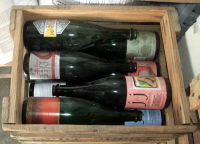 Discarded bottles of other people's lambics at Gueuzerie Tilquin, demonstrating great taste and discernment. Currently, of course, Pierre is not attempting to brew the base lambics himself, but you can’t help thinking that next challenge will come round at some point. “From a technical point of view,” he says, “I think it’s possible to produce lambic outside the favoured geographical area, as it’s above all a question of the buildings and the equipment becoming colonised with adequate microflora through successive brews. As a blender, I don’t have to face this problem as I buy my wort already seeded with wild yeast from lambic breweries. So the yeasts will progressively install themselves in my barrels and in my building.
“Besides,” he smiles, looking across to the woods again as if beckoning the yeast spores in, “I don’t believe that Brettanomyces bruxellensis and lambicus stop at the language boundary and only speak Dutch.”
Beer picks
Website: www.gueuzerietilquin.be
Thanks to Tim Webb for inviting me to join him on this visit.
Gueuzerie Tilquin; Top Tastings 2011
ABV: 6%
Origin: Rebecq-Bierghes, Brabant-Wallonie, Wallonie
Website: www.gueuzerietilquin.be
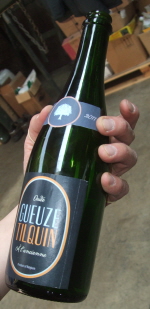 Tilquin Gueuze à l'ancienne 2011, à la main de M Tilquin soi-même. This is the first release of new lambic blender Tilquin’s Oude Geuze, or Gueuze à l’ancienne as the Wallonian-based enterprise prefers to label it. A little controversially, the oldest component lambic in it is only two summers old, rather than the more normal three, but the taste certainly doesn’t seem to suffer for it. Read more about Gueuzerie Tilquin here.
It’s a blend of 40% 2-year-old and 60% 1-year-old lambics originating at no less than four breweries — Boon, Cantillon, Girardin and Lindemans, matured in Bordeaux and Burgundy barrels, unpasteurised and bottle aged for six months before release. The complex blend seems to have made up well for the absence of older lambics, while still retaining a light touch.
The result is a slightly cloudy yellowy-blond beer with a dense and creamy yellow-tinged head. A lightly spicy aroma has stewed apple and cream notes, while a dry, tart and slightly funky palate has orange peel and a developing fruity and slightly sugary marmalade quality. Perfumed peel lingers on a light but tasty finish with notes of nuts, pastry and apricots. This highly accomplished and distinctive debut beer from Tilquin is an instant addition to the top rank of geuze and points to what should be a very promising future.
Read more about this beer at ratebeer.com: http://www.ratebeer.com/beer/oude-gueuze-tilquin-a-lancienne/144762/
Gueuzerie Tilquin
ABV: 4%
Origin: Lembeek, Vlaams-Brabant, Vlaanderen
Website: www.gueuzerietilquin.be, www.boon.be
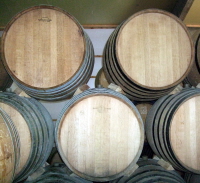 Wooden former wine barrels at Gueuzerie Tilquin Meerts is something of a forgotten member of the lambic family, though a couple of centuries ago it was ubiquitous in the historic brewing region. It’s the spontaneously fermented equivalent of small beer, made with the last, low gravity, runnings from the mash tun as an everyday refresher. It was drunk in place of water in the days when the latter in its unboiled state was often unhealthy, and like many of its equivalents elsewhere, declined as a beverage in its own right once safe water and soft drinks became widely available.
Still it’s remained in use as a blending beer, and Frank Boon in particular makes a virtue of brewing meerts for inclusion in his faro and lighter fruit beers. Boon Meerts is made from the third runnings of the mash (the first runnings comprise the liquid in which the grains were mashed, so the third runnings are the results of a second rinsing with further hot water). Boon beers are on the strong side — the standard lambic comes out at 6% — so the meerts is still a respectable 4%.
The beer as matured at the Boon brewery occasionally surfaces at festivals, but I got to taste a version at the new Wallonian lambic blender Gueuzerie Tilquin, where Pierre Tilquin uses it as a key component of his draught geuze. My sample was less than a year old and dispensed straight from one of Tilquin’s 400l French oak barrels.
The pale yellow beer was dead flat, with a grapefruity aroma yielding notes of agricultural funk and a perfumed whiff of pineapple. The palate was lightly tart and gently but definitely sour, with a light milky texture, notes of grapefruit and straw, and some lambic complexity. A very refreshing and tangy finish mellowed with a bit of nuttiness, and a lingering slightly sugary note.
Read more about other versions of this beer at ratebeer.com: http://www.ratebeer.com/beer/boon-meertse/73618/
Gueuzerie Tilquin
ABV: 5%
Origin: Vlezenbeek, Vlaams-Brabant, Vlaanderen
Website: www.gueuzerietilquin.be, www.lindemans.be
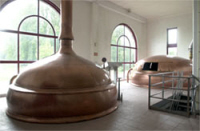 Brewhouse at Lindemans, Vlezenbeek The Lindeman family began brewing lambic as a sideline on their cereal farm at Vlezenbeek, just outside Brussels, in 1809, and only finally gave up farming to concentrate on beer in 1950. In the 1980s the brewery achieved significant commercial success by following the lead of the big brewers’ lambic subsidiaries in pushing its filtered, sweetened fruit beers, with lambic matured in steel tanks rather than wood, though it has since revived an oude geuze and oude kriek and re-installed oak barrels. Now under the control of seventh and eighth generation Lindemans, it’s also a longstanding and respected supplier of unblended lambics to others. One of its newest customers is Tilquin, where I sampled this delicious two-year-old lambic from one of the new blender’s Bordeaux barrels.
The orange-yellow, near-flat beer had an intense jammy and spicy aroma, and a sweetish and fruity complex palate with orange the keynote flavour. The smack of brettanomyces was eased by soft malts, and very estery, fruity sensations. Straw and farmyard notes were evident in a nicely rounded spiced orange marmalade finish with a lingering nuttiness.
Read more about other versions of this beer at ratebeer.com: www.ratebeer.com/beer/lindemans-oude-lambik/16466
 The One Show Tonight (Friday 19 August) I should be featured on the One Show on BBC One, talking about the resurgence of British brewing with One Show reporter, Observer restaurant critic and Brixtonian Jay Rayner.
They’ve also asked me to recommend some beers to match with particular foods, sticking as much as possible to beers that are readily available. I thought my readers might be interested in reading what I told them, just in case they get it wrong!
This is what I first sent them:
IMPORTANT: The beer suggestions below are limited to beers that are widely available across the country in supermarkets and the like. Many of the more interesting beers are available only regionally or locally, or through specialists. As with any food matching suggestions there are no hard and fast rules and it’s always good to experiment!
Best to serve the beers lightly chilled, not too cold (around 10°C). Serve in large wine glasses in smaller quantities, not in pint pots.
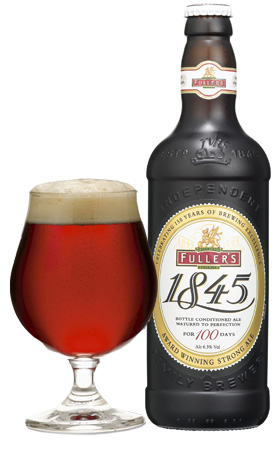 Fuller's 1845 Note many of the beers suggested are bottle conditioned (‘Real Ale in a Bottle’) – bottled with live yeast and still naturally fermenting, so they may well contain a yeast deposit, like a wine ‘sur lie’.
- Fish: Sharp’s Chalky’s Bite (6.8%) is a Belgian-inspired Cornish hazy wheat beer specially developed to go with fish dishes, originally for Rick Stein’s seafood restaurant in Padstow (named after Stein’s late dog). It’s partly fermented with Belgian yeast and subtly spiced with Cornish wild fennel. Like Belgian wheat beers it is spicy and slightly milky with citrus zest, flavourful enough to cut through oily food but subtle enough to highlight fish flavours. Its higher strength also gives it body. Bottle conditioned but meant to be served cloudy.
- Curry: One of the few food matches where most people think of beer rather than wine, as curried foods overwhelm many wines, but sadly the beer of choice is usually a rather characterless Indian brand of lager (which has probably been brewed in the UK under license!) I suggest Thornbridge Jaipur (5.9%) from one of Britain’s best small breweries, in Bakewell, Derbyshire. This is one of numerous revivals of the very hoppy style of India Pale Ale (IPA) which was exported from the UK to India in the 18th and 19th centuries – but inflected by the very hoppy interpretations of IPA now popular among US craft brewers. It uses US Chinook and Cascade hops to give a very fruity, piny flavour in which I detect grapefruit, apricot and coconut, with a distinctly peppery-bitter though still quite distinct finish that should withstand all but the fieriest curry flavours. May be bottle conditioned: if so pour carefully for best appearance.
- Meat pie and mash: This calls for a robust and malty traditional British ale. If in the pub I’d suggest a pint of the best traditional cask ‘brown bitter’ they have on. From the bottle, a great choice is Fuller’s 1845 (6.3%), originally recreated from a historic recipe to mark this London-based company’s 150th anniversary in 1995. This is a big beer with the characteristic orangey tang of Fuller’s yeast and chewy, biscuity, burnt toast notes from amber and crystal malts. Its fruitiness and slightly bitter bite should offset the pie filling, while the malty biscuit character complements the pastry. Bottle conditioned so pour carefully for best appearance.
- Chocolate: This is a flavour characteristic of many darker beers, arising from the use of highly roasted malts, one of which is actually called chocolate malt. Oddly, it also matches well with milder amber ales, but for a full-on complimentary flavour try Wells & Young’s Luxury Double Chocolate Stout which adds real chocolate bars and chocolate essence to a typical dark, dry stout made bitter with dark malts and roasted unmalted barley. A luxurious creamy texture has fruity raisin-like flavours, but the liqueurish sweetness is dried by a roasty bite and a gentle burr of hops. Now brewed in Bedford.
I was then asked: why serve beer in wine glasses?
For the same reasons it’s a good idea to serve wine in wine glasses.
- They are more elegant to look at than traditional beer glasses.
- They are plain glass and show off the colour and consistency of the beer and the head.
- They have a stem so you can hold them without warming up the contents with the heat of your hand (or cup them in your palm if the contents needs warming up)
- They are tapered inwards at the top to concentrate the aroma
- They contain a smaller quantity of liquid which is more appropriate when dining, especially with higher gravity beers as some of these are.
Something like a decently sized Bordeaux glass would do, with a capacity of around 500ml. It’s important as with wine not to fill the glasses to the brim but to leave space both for the head and for the aroma to develop. The habit in southern England of serving beer in brim measures doesn’t compliment it.
Please don’t serve it pub style in dimpled jugs or “noninck bulge” pint pots!
You can watch the show online after it has been broadcast at www.bbc.co.uk/oneshow.
 Great British Beer Festival 2011 The Great British Beer Festival (GBBF) remains a phenomenon, the biggest event of its kind. This year’s attendances were down slightly, but still around 62,500 over five days. That’s small beer, perhaps, compared to the Munich Oktoberfest’s 375,000 per day, but that event is hardly a beer festival in the way most readers of this website would understand it. Compared to Munich’s handful, there was a choice of over 1,000 beers at this year’s GBBF. And perhaps most impressive of all, this vast event is run almost entirely by volunteers — around 1,200 of them.
With various commitments in connection with my London book as well as my usual volunteering and beer sampling, this year was my longest continuous stint at the festival yet, with Tuesday, Wednesday and Thursday all spent at Earls Court. Once again working behind the Dutch-Belgian-Italian bar was fascinating and rewarding, but I also spent some time in the press room on the first floor, from where there is a panoramic view of the festival floor that really brings home the size of it all, and presented a tutored tasting in the welcome natural light of one of the multitude of hospitality suites on the same level (more about this successful occasion will appear later).
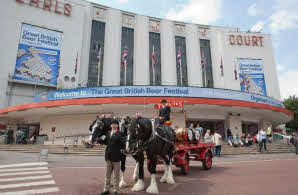 Thwaites dray outside Earls Court, possibly for that last time? Great British Beer Festival 2011. Pic: CAMRA Much of the extensive piece I wrote here about last year’s event is still relevant as the format, scale and character were essentially the same, though the imported beer bars, Bières sans frontières, had been split up and distributed round the space, like a clique of disruptive schoolchildren forcibly scattered to different corners of a classroom. Belgians were in one block of bars, Germans and Czechs in another, Americans and others in a third. This caused some disgruntlement among volunteers, and there were dark mutterings about why it had been done, but I can see no reason to disbelieve the official explanation — that it was to improve crowd flow and to better distribute the areas where drinkers were likely to congregate.
There is a more serious issue, though, involving the BSF bars, one which I mentioned last year and which was even more pronounced this year: the gulf in variety and interest between BSF and the British bars is getting wider still. Showcasing British beer is supposed to be the raison d’être of the festival, and BSF began as a bonus extra — comparable events, such as Belgium’s Zythos Bierfestival and the Great American Beer Festival, concentrate entirely on native brews. Yes, BSF has the whole world to choose from, but the British bars should have the advantage of home turf.
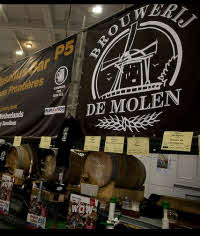 Bières sans frontières Belgian, Dutch and Italian bar, Great British Beer Festival 2011. Pic: CAMRA This year the selection at the BSF was astounding. In partnership with the Brewers Association, the USA/Rest of the World bar was expanded to two bars side by side, one of them dedicated to US cask beers, with over 115 on offer, the biggest range yet. Another 70 international rarities were supplied in small quantities courtesy of the International Beer Challenge, alongside a much expanded range of bottles from craft breweries in Australia, New Zealand and Japan. As well as two draught unblended lambics from Cantillon and Girardin were lambics aged in spirit casks from eccentric Italian beer firm Revelation Cat, while De Molen from the Netherlands sent three big Bordeaux casks of extreme beers. The Czech offering, weak in recent years, was strengthened significantly with the inclusion of unfiltered and unpasteurised delights from several small breweries including new craft brewers Kocour and Matuška. Indeed I wouldn’t be surprised if this was the most dazzling collection of world beer ever assembled for public sale.
It has to be said: the British cask and ‘real ale in a bottle’ bars looked dowdy by comparison. This year each bar was surmounted by a banner listing the beers on sale, making it easy to run one’s eye down the long litany of low gravities, where anything a little stronger twinkled like a lonely star. Of over 400 cask choices, I counted around 32 at gravities over 5%, and three of those were from Greene King. The range of breweries represented was huge, but most with only one beer, and that one often a conservative choice. For example, Dark Star, one of the best breweries in the country in many the view of many connoisseurs, was represented only by its 3.8% Hophead and 4.2% Hylder Blond, both great beers but hardly the brewery’s most diverting products, and in the case of Hophead, already relatively widely available through the free trade.
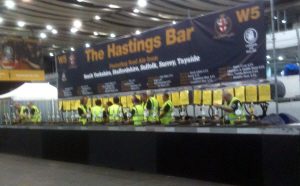 One of the cask ale bars, still under hi-vis before the public is admitted. Watch out for falling gravities! Great British Beer Festival 2011. The results of the Champion Beer of Britain (CBoB) competition also caused some negative comment for their staidness. This year’s winner was a dark mild, for the third time in five years — Mighty Oak’s Oscar Wilde (3.7%). It’s a great beer, a fine example of its style, but its annoucement fuelled the criticism from some quarters that CBoB judges are a conservative lot who prefer weak, traditional beers. Certainly some of the other choices were less than scintillating, and veteran beer writer Roger Protz, chair of the judging panel, apparently had a hard time defending some of them at his always oversubscribed tutored tasting of the finalists. He later expressed concern about the plethora of dull golden ales laid before the judges.
Now, I fully appreciate the fact that British brewing has traditionally focused for much of the last century on low gravity session beers. I’m the first to defend the honoured place of such beers in world beer culture. The ability of British brewers to squeeze great flavour and complexity out of 3.5% quaffers can be one of the highest expressions of the brewer’s art. GBBF should certainly continue to provide a strong showcase for these styles, and I would certainly not want to see a festival dominated by geek-pleasing rare specialities and turbo strength hop bombs.
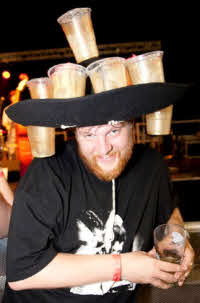 No article about a beer festival would be complete without a photograph of someone in a silly hat. Great British Beer Festival 2011. Pic: CAMRA But brown bitters, dark milds and easygoing golden ales never did tell the whole story about British craft brewing, and that’s even more the case today, as a newly innovative and eclectic sensibility is starting to galvanise sections of the brewing and beer drinking community. Currently this may be a relatively limited and largely metropolitan phenomenon compared to the core cask session ale market, but surely it should be part of the function of an event like GBBF to highlight the latest trends within a broader picture, celebrate variety and diversity and encourage drinkers to broaden their palates, much as its transatlantic sister the Great American Beer Festival (GABF) does. There could also usefully be more space for the numerous traditional and historic British styles that don’t fit the session ale model, such as strong old ales and barley wines — and I know the National Winter Ales Festival in Manchester in January does this very well, but GBBF is the main national annual showcase and can’t afford to rely on a much smaller event to plug its gaps.
Craft lager is another obvious omission, and, as British brewers’ interest in the style grows, one that I imagine will pose the biggest challenge to GBBF traditions. The Czech and German bar was well-equipped this year with a decent air pressure system dispensing unfiltered, unpasteurised lagers well primed with natural carbon dioxide from continental-style narrow kegs and keykegs, some even served from beneath proper Bernard and Budvar bar mounts, so such beers can be dispensed effectively while sticking within CAMRA rules (On the Belgian and Dutch bar we were still struggling to serve Christoffel Blond and IJ Plzeň using hand operated air pumps which have a tendency to produce 90% of the beer as foam. On a hot day when a group of suited corporate guests has decided this is the closest available substitute for six pints of Carling, this is no fun.) Now there are a number of British brewers able to supply good quality unfiltered lagers naturally carbonated in keg, it seems absurd that the only examples on sale at the Great British Beer Festival are from the Czech Republic, Germany and the Netherlands.
I suspect the key to the disparity is in the different ways in which BSF and the British bars manage their buying. The list at BSF betrays the signs of a controlling intelligence — overall manager Andy Benson and his team of bar managers, all volunteers, use their formidable collective expertise in ordering the beers, and make it their business to keep abreast of trends and developments in international beer culture, determined to bring the best of it to London every August. This year was Andy’s last in the job, but he’s confident the bar managers will keep up the standard between them.
The beer list on the British bars, in contrast, emerges in a much more complicated fashion in which the many individual CAMRA branches play a part — recommendations from branches and local tasting panels and recognition at local festivals are key routes to consideration. I’ve no doubt that while many CAMRA branches conscientiously strive to ensure there’s a strong representation from across their area’s breweries and beer styles, others tend to pick only the personal favourites of committee members, which may well err in favour of the traditional. The various bar managers also have an input and there is some account taken of beers that win recognition from other organisations, like SIBA. Ultimately, CAMRA’s press office tell me, decisions are down to judgements about expected consumer demand. Yet there is as far as I know no systematic market research into what GBBF visitors actually do drink and want to drink, so it’s not impossible these judgements are based on unwarranted assumptions about the ‘typical’ punter.
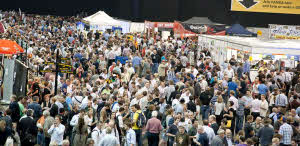 65,000 drinkers can't be wrong. Great British Beer Festival 2011. Pic: CAMRA Even the brewery bars aren’t immune. I’m sure most visitors who think about these things assume (as I did until Thornbridge put me right last year) that the brewers who rent and staff these have a free hand in deciding what beers to sell, so long as they keep within the general CAMRA guidelines (and I don’t want to dwell here on the unhelpful antics of CAMRA-baiting Scottish brewer BrewDog which a few weeks beforehand stage managed its own banning from the festival). But no, the exact beers stocked on these bars are determined by what CAMRA describes as “a negotiation process”.
It’s easy to see how this combination of beer picking by committee and estimating demand on an anecdotal basis could produce a beer list that combines illogicality and inconsistency with risk aversion and the favouring of conservative, traditional styles. It can’t be helped by the decision taken last year to reorganise the bars by alphabetical order of “counties” (or, in Scotland and Wales, arbitrary geographical groupings that don’t seem to relate to either historic counties or modern local authorities), bringing beers from all over the UK randomly together on a single bar. This doesn’t only confuse the punters, it also prevents bars developing distinct regional indentities that might contextualise styles and encourage specialist knowledge among bar staff and managers.
I suspect the response to such criticisms would be “if it ain’t broke, don’t fix it.” So long as the tens of thousands of visitors keep on coming back, there will be little appetite to stir up the hornet’s nest of local and individual sensitivites that is inevitably invested in the process. But honestly it could do with a bit of benign — and informed — dictatorship if GBBF is to remain the best possible showcase for the best of British brewing.
There was something else in the air this year too: a tinge of nostalgia, as this may well have been the last such event in the 1930s concrete bunker of Earls Court Exhibition Centre, the festival’s home for several years. Next year, the regular dates coincide with London’s hosting the Olympic Games. CAMRA has taken the brave, and I suspect ultimately the right, decision to carry on regardless, though from conversations with officers from Transport for London I judge many have underestimated the logistical challenges of navigating London during ‘Games Time’.
But Earls Court is unavailable as it’s already booked for Olympic volleyball, so GBBF is returning at least temporarily to its previous home at Olympia (ironically, as its name suggests, a former Olympic venue). After the Games, Earls Court is slated for demolition as part of redevelopment of the site and adjoining railway lands into a mixed residential, office and retail quarter, though the planning permission for this still hasn’t been granted, so no decision has yet been taken on the whereabouts of the festival in 2013. I hope the organisers ignore the well-intentioned but misguided calls to move it outside London.
Next year’s festival might be interesting for reasons other than trying to share London with the world’s biggest sports day. Partly inspired by the development of Denver Beer Week as a fringe event around GABF, the suggestion has gone out among the bloggerati for a properly coordinated GBBF fringe. To some extent this already happens — events like the White Horse’s American beer week, the annual single weekend opening of Olde Mitre and the ratebeer European meetup, and a number of smaller events in pubs and bars, already take advantage of the increased numbers of beer connoisseurs around town that week. Pulling this together into a more coherently promoted beer week for London would be a quick win, and would further bolster GBBF’s position as the mother of all beer festivals.
Beer picks
- Boon / Revelation Cat 3 year old Marsala Lambic 6% Lembeek, Vlaams-Brabant, Vlaanderen
- Broumov Opat Kvasničák Pepper 5% Broumov, Králové Hradecký kraj, Czech Republic
- Devils Backbone Barclay’s London Dark Lager 5.8% Roseland, Virginia, USA
- Fuller’s Brewer’s Reserve No 3 9% London W4, England
- Little Valley Organic Hebden’s Wheat 4.5% Hebden Bridge, West Yorkshire, England
- Molen Hot & Spicy 10.2% Bodegraven, Zuid-Holland, Netherlands
Great British Beer Festival 2011
ABV: 6%
Origin: Lembeek, Vlaams-Brabant, Vlaanderen (matured in Roma, Italy)
 Revelation Cat Craft Brewing Rome-based gyspy brewer Alex Liberati has been doing some strange stuff with unblended lambics from Boon and Girardin over the past few years. I wasn’t convinced by his single hop dry hopped lambics — traditionally lambic brewers have used hops aged to lose their characteristic bitterness for good reason, as it’s extremely difficult to meld the bitter and sour flavours successfully. But lambic is matured for long periods in wooden barrels in any case, so using vessels previously filled with something else seems a logical development.
Two of these experimental lambics reached the Great British Beer Festival, for some reason on the ‘New World’ rather than the Belgian/Dutch/Italian bar. One, which I missed, had been matured in a Laphroaig Islay malt whisky cask; this three year old lambic, originally brewed at Boon, had spent time in a barrel previously used for the Sicilian fortified wine Marsala.
The beer is cloudy gold, with a little fine white head, though generally flat. An obvious wet plastic lambic aroma is tinged with spirit and wood notes and softended by ripe fruit. The palate is lightly tart but very fruity and slightly vinous, complex with apricot notes and a sweetish touch. The beer finishes citric, slightly peppery and chewy, with orange tones and more hints of spirit and wood, lingering at leisure with a fine balance of tartness and vinous fruit.
Read more about this beer at ratebeer.com: http://www.ratebeer.com/beer/revelation-cat-marsala-lambic/150724/
Great British Beer Festival 2011
ABV: 10.2%
Origin: Bodegraven, Zuid-Holland, Netherlands
Website: http://www.brouwerijdemolen.nl/
 De Molen Hot & Spicy in its Bordeaux cask at the Great British Beer Festival, Earls Court, London August 2011 The big wooden barrels full of weird and wonderful beers that De Molen’s Menno Olivier brings to the Belgian/Dutch/Italian bar at the Great British Beer Festival every year are becoming something of an attraction in their own right, and this isn’t the first time one of them has yielded one of my picks of the festival. This year there were three, all in Bordeaux casks: a brettanomyces-infused version of wood aged session strength golden ale Hout & Hop (‘Wood & Hops’), another appearance for the wonderful wood matured version of imperial stout Tsarina Esra; and this, which must be one of Menno’s most extreme beers yet.
Hot & Spicy, which has also made an appearance at numerous other festivals, is a blend of two of De Molen’s numerous imperial stouts, Hel & Verdoemnis (‘Hell & Damnation’) and Hemel & Aarde (‘Heaven & Earth’), the latter made with Bruichladdich peated whisky malt. That in itself would lead you to expect a bold taste experience, but this already potent blend has been aged in the cask over a generous quantity of whole Madame Jeanettes, a variety of exceptionally hot chilli pepper from Suriname.
I’ve had a few chilli-infused beers in the past where the quantities and varieties used are sufficient to deliver a merely gentle spiciness to the finish. No such pussyfooting for Menno — this beer lives up to its name with an obvious near-immediate chilli burn in the mouth. The word “DANGER” and a drawing of flames had been chalked on the barrel, but even so, when I did my day’s volunteering behind the bar on the Wednesday, I took to advising potential customers to try a taste first. A good half subsequently turned down the offer of a more substantial quantity, but others loved the stuff.
I’m in the latter category. Chilli, like hop bitterness, is one of those tastes you acclimatise to, and my own limits have been substantially stretched over the years. As your palate recalibrates, you start to discriminate subtleties in flavours that were initially merely painful. Such was the case here, with an intriguingly fruity character to the flavour and good matches to the chocolate and smoke notes in the base beers: chilli and chocolate is already a recognised and very appropriate flavour match, given the new world origins of both plants.
The beer is ebony with a very light beige head and a sticky brown malt aroma that’s perfumed with richly spicy vegetal tones. At first the palate is chocolatey rich with more dark, unami-laced malt, but immediately the complexity starts to develop you’re hit with vivid, chilli-hot and peppery spice, with fruity berry and coffee flavours just detectable beneath. There’s an oily quality too (chilli oil?) and perhaps a note of tomato. Inevitably the heat dominates the long and very lasting finish, but is wonderfully softened by richly sappy, caramel malt and luxurious chocolate flavours, and a touch of peated smoke.
“That’s knocked my tastebuds out for the next half an hour,” I commented to Menno on first sampling the beer. “Now try some lambic — that will clear it,” he replied, and he was right.
Read more about this beer at ratebeer.com: http://www.ratebeer.com/brewers/brouwerij-de-molen/4448/
Great British Beer Festival 2011
ABV: 4.5%
Origin: Hebden Bridge, West Yorkshire, England
Website: www.littlevalleybrewery.co.uk
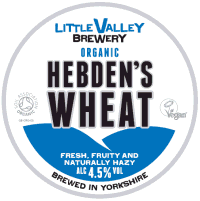 Little Valley Organic Hebden's Wheat My day of sampling British cask beers at this year’s Great British Beer Festival turned out to be rather lacklustre, but one pleasant surprise was this tasty organic Belgian-style wheat beer from the South Pennines. The brewery also produces a range of bottle conditioned beers, although the bottled version of this seems notably less highly rated online than the cask.
The cloudy yellow beer has a white, relatively sparse head and a slightly varnishy, estery and very fresh aroma. Coriander is clearly detectable and there’s an orangey, slightly plasticy scent too. A light, refreshing and subtly aromatic palate has citrus, coriander, cream, wheat and a tangy slightly acidic quality, holding its spicy, orange-lemon zest well in the mouth. A long and tangy finish delivers a hint of aniseed. One of the best British cask interpretations of the style I’ve yet encountered.
Read more about this beer at ratebeer.com: http://www.ratebeer.com/beer/little-valley-hebdens-wheat/59600/
Great British Beer Festival 2011
London beer tastings 2011
ABV: 9%
Origin: London W4, England
Website: www.fullers.co.uk
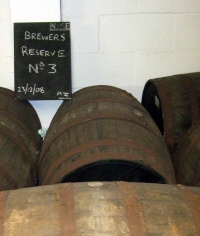 Brewer's Reserve No 3 maturing in whisky barrels in a spare corner of the Fuller's brewery, London W4, January 2011 I make no apologies for choosing a release of Fuller’s Brewer’s Reserve as one of my GBBF beer picks for the second year running (see Fuller’s Brewers Reserve No 2). I was particularly intrigued to sample it as I’d spotted the barrels tucked away in odd corners of the brewery during a visit early this year (see photo left).
The Brewer’s Reserve series has so far lived up to its name: these really are extraordinary beers, and this latest version, stronger than before and matured for 800 days in former Auchentoshan Lowland single malt whisky barrels, is the best one yet. It was available in limited quantities in cask at the festival and has just been released in a limited edition bottled version available from the Fuller’s brewery shop.
The beer I sampled from cask at the festival was warm amber with a very light head. A spiritous whisky-tinged aroma had some nice smooth malt and a characteristic orangey Fuller’s note. The very complex, richly malty and slightly syrupy palate had notes of sultanas, angelica, cherries and menthol, with developing hints of chewy lightly tannic wood. A woody vanilla finish had the sweet malt quality of the whisky and late hints of cedar smoke. The whole was very approachable and hid its strength perilously well.
A sample of the bottled version, supplied by the brewery (bottle 02793), was orange-amber, with a fine but not especially big off-white head. The aroma was rich, smooth, malty woody and whiskyish with raisin hints. There was more raisin fruit in a sweetish, slightly thin palate, alongside complex woody and mineral tones, and a spiritous note propelled more complex impressions up the nasal passages. A mellow warming finish was smooth but not too coating, with earthy whiskyish wood and the brewery yeast’s sappy orange signature.
Made at the nearest malt whisky distillery to Glasgow, Auchentoshan is a particularly smooth, sweet whisky that notably omits from its grists the peated malt so familiar from more strongly flavoured examples. It turns out to be a particularly well matched partner for this blend of Fuller’s characterful strong ales.
Read more about this beer at ratebeer.com: http://www.ratebeer.com/beer/fullers-brewers-reserve-limited-edition-no-3/150236/
|
|
