Promoting an international beer culture that recognises and celebrates beers of quality, distinctiveness and local character, brewed with care and passion.
Etiam pulvinar consectetur dolor sed malesuada. Ut convallis
euismod dolor nec pretium. Nunc ut tristique massa.
Nam sodales mi vitae dolor ullamcorper et vulputate enim accumsan.
Morbi orci magna, tincidunt vitae molestie nec, molestie at mi. Nulla nulla lorem,
suscipit in posuere in, interdum non magna.
Brewpub 29 Montpelier Vale SE3 0TJ (Lewisham) zerodegrees.co.uk First sold beer: August 2000
Remarkably, this popular local beer and pizza venue is now the capital’s oldest-established independent brewery as well as its longest-serving brewpub. It was one of the first in the UK to draw inspiration from the US craft brewing scene, following a trip across the Atlantic by a member of a family of local restaurateurs.
An automated 10 hl kit was supplied by BTB in Germany and the regular beers were first devised by a head brewer from the US. Several other brewers have presided since, most recently Dario Marcianese. The company went on to open further brewpubs in Bristol, Cardiff and Reading, sharing the same name even though, unlike the original, they’re considerably further from the prime meridian.
Beers rarely travel beyond the premises, which may be one reason they’re often overlooked among London’s current proliferation. They’re served by air pressure from polythene-lined maturation tanks, with some minikegs and very occasional kegs for special events
Brewery 8 College Fields, Prince Georges Road SW19 2PT (Merton) wimbledonbrewery.com First sold beer: 10 July 2015
The original Wimbledon Brewery, and the last in the area for over a century, stood in the High Street between 1832 and 1889, when it burned down: somewhat ironically, a fire station was built on the site which still stands today, though converted to shops and flats.
The brewery’s legacy was reclaimed at the 2015 AFC Wimbledon beer festival when beers bearing the phoenix logo of a new Wimbledon brewery went on sale. This new operation, sizeable by the standards of modern London brewing, was the brainchild of Mark Gordon and Richard Coultart, who wisely appointed veteran London brewer Derek Prentice, formerly of the old Truman’s, Young’s and Fuller’s, to oversee the operation.
Derek devised the initial recipes and specified the new 50 hl brewhouse, supplied by OAL Engineering and installed in a sizeable industrial unit near Merton Abbey Mills, on land that once belonged to the abbey, which like similar institutions maintained its own brewhouse until it was dissolved in 1538.
Since then fermentation capacity has more than doubled, with some space for further growth on the site. Unusually at this scale, the set-up includes a gas-fuelled steam plant, so the vessels are steam-heated as in many much larger breweries. Derek is still involved on a part-time basis, and his son Michael became joint head brewer in 2020.
Two-thirds of production is cask beer, the rest keg and a small number of bottles (filtered and reseeded with conditioning yeast) and cans (unfiltered and unpasteurised), which are packaged off-site. The main malts are supplied by Crisp, and the focus is on well-balanced beers with good drinkability under locally-inspired names. There’s a shop and taproom on site.
Closed brewery Original site: 7 Ravenswood Industrial Estate, Shernhall Street E17 9HQ (Waltham Forest) Final site: 2 Lockwood Way E17 5RB (Waltham Forest) wildcardbrewery.co.uk First sold beer: April 2014 (at original site) Ceased brewing: October 2024
Wild Card was the creation of three university friends, Andrew Birkby, William John Harris and former chemical engineer and current head brewer Jaega Wise, originally from Nottingham. It began in January 2013 with an amber ale, Jack of Clubs, developed on homemade equipment in a garage and cuckoo brewed just outside London at Brentwood brewery.
For a few months from June 2013, the three friends were based in the cellar of Walthamstow’s Warrant Officer pub (formerly the Higham Hill Tavern, 318 Higham Hill Road E17 5RG, Waltham Forest: see Solvay Society), at first intending to install a small brewing facility there. Realising this was impractical, in the autumn of that year they took on a characterful unit on the Ravenswood industrial estate close to Walthamstow Village, already something of a public attraction thanks to neon sign specialist God’s Own Junkyard and Mother’s Ruin, producer of fruit gin. Here, from early in 2014, a modest 10 hl brewhouse from Oban Ales shared space with an increasingly popular taproom.
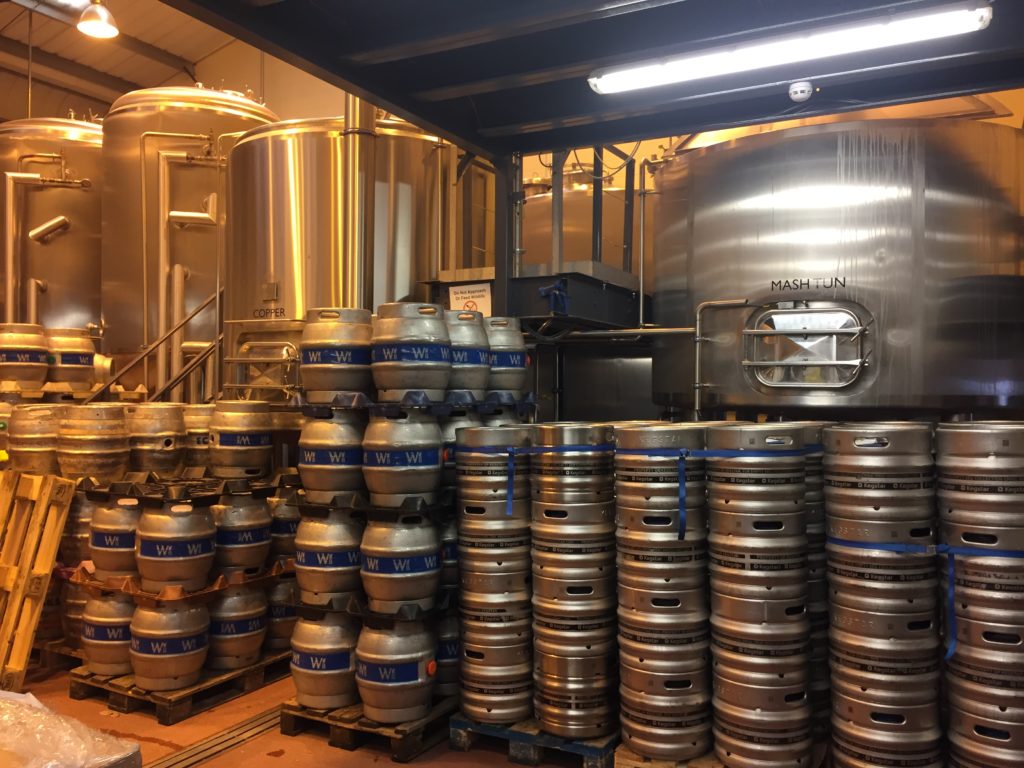
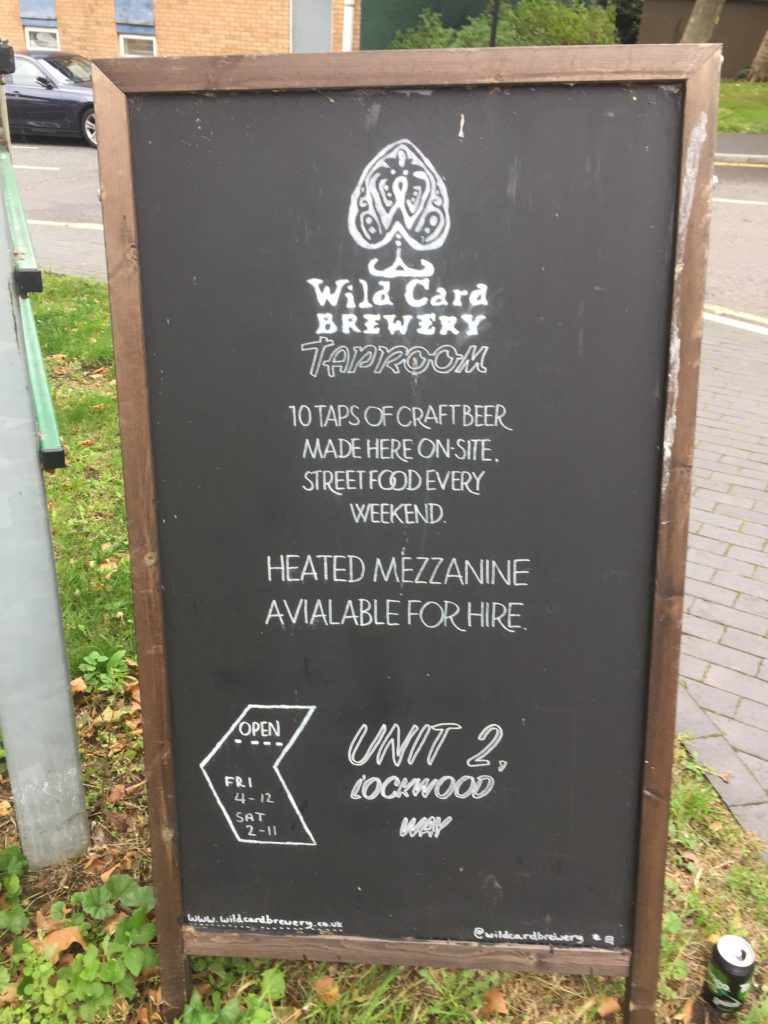
Following a crowdfunding round, in April 2018 Wild Card expanded to a bigger site on the Lockwood estate, becoming the first of several breweries to establish itself in the swathe of industrial estates along Blackhorse Lane in the west of Walthamstow, adjacent to the Walthamstow Wetlands. At first, the old brewing kit was retained while fermentation capacity was substantially increased, with a small canning line and then a new 20 hl brewhouse, also from Oban, added during 2019.
Wildcard, Lockwood E17
The Ravenswood site became a bar and barrel-ageing facility known as the Barrel Store, with a taproom at Lockwood too. Following the easing of lockdown restrictions in April 2021 the brewery set up a separate company to open its first ‘proper’ pub — appropriately enough, the Warrant Officer, now renamed the Tavern on the HIll.
Jaega, meanwhile, had become something a brewing celebrity, not only for her great beers and extensive brewing knowledge but for her tireless campaigning for diversity in the industry.
Unfortunately, post-Covid trading conditions proved tough for Wild Card, and in early October 2024 its Lockwood site was repossessed by the landlord, Waltham Forest council. A few days later the brewery, which according to its most recently filed accounts was around £500,000 in debt, confirmed it had entered liquidation, citing ‘the pandemic and the extended cost of living crisis’ as insurmountable challenges.
Both the Ravenswood and Lockwood sites were confirmed closed, though the pub, with its different ownership arrangements, remained open. Ravenswood has since been reopened by neighbours Pillars as a bar known as the Malthaus. East London Brewing took over the pub in July 2025; they’ve also leased the Lockwood unit which they plan to reopen as a taproom in early 2026.
Beers were in keg and in can, some of which are sold in major supermarkets. Cask was discontinued in 2019 but revived in 2021, primarily to supply the pub.
Brewery Original site: Ryecroft Works, Edwin Road, Twickenham TW2 6SP (Richmond upon Thames) Current site: 18 Mereway Road, Twickenham TW2 6RG (Richmond upon Thames) twickenham-fine-ales.co.uk First sold beer:November 2004 (at original site)
Now something of a London veteran, Twickenham Fine Ales is the fourth oldest of all the London breweries and the oldest independent standalone brewery in the capital. When opened on redundancy money by former IT professional Steve Brown in 2004, it was the first brewery in Twickenham since Cole & Burrows closed in 1906 but passed under the radar of all but a few drinkers by selling only to very local outlets.
All that changed late in 2012 following a major expansion from its original site to long-sought new premises near Twickenham Green. The brewery has continued to grow since, most recently in 2016 when a new 40 hl kit and more fermenters were added. The first head brewer was Tom Madeiros, who joined from Grand Union, a failed Hillingdon micro; he was succeeded by Stuart Medcalf, formerly of W J King, and, since January 2018, Stephen Holland.
Though the beers are now sold widely, the brewery retains a strong local base, and Steve is determined any future expansion would require a site that’s also in Twickenham. Much is made of the locality’s association with rugby union, a sport where real ale is the traditional tipple of choice. Taproom openings on match days at the main Twickenham stadium or at local team Harlequins’ Stoop ground nearby have become a local institution. In August 2019, the company realised a long-held ambition by taking on the Rifleman, a corner pub only a few streets away.
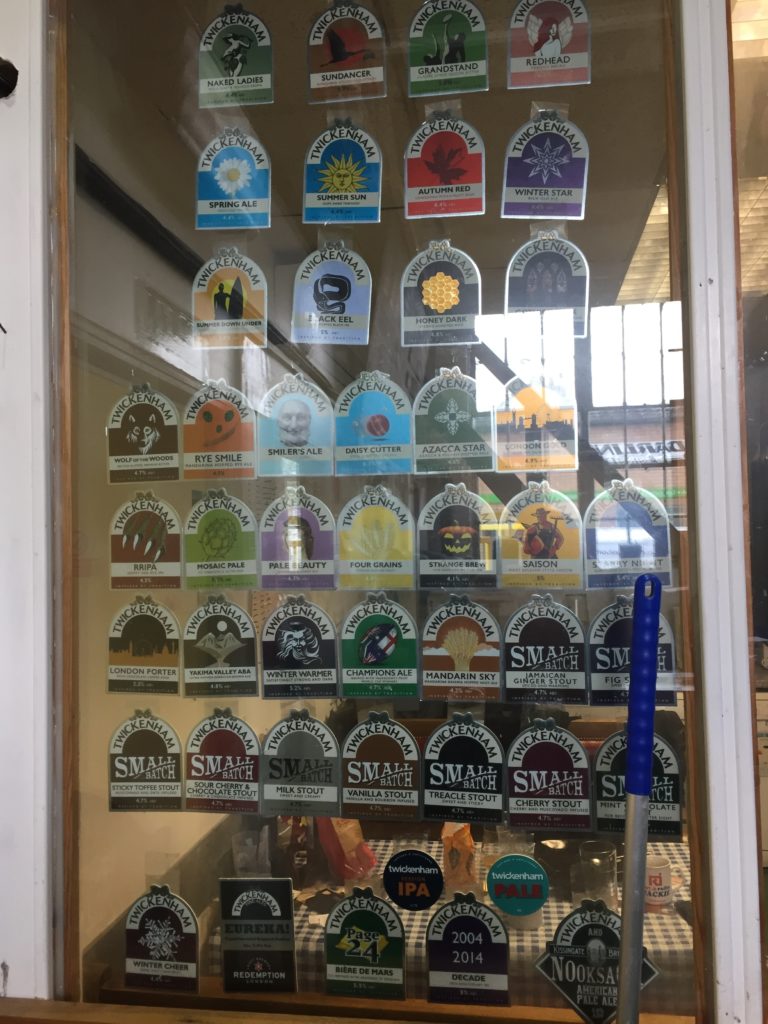
Pump clip display at Twickenham to provoke the thirst of any rugby fan.
Beers tend towards the traditional with a modern twist, with cask still an important part of the business, alongside keg and off-site bottling and canning.
Closed brewery Black Eagle Brewery, Hanbury Street E1 6QR (Tower Hamlets) First sold beer: by 1669 (as Bucknall’s) Ceased brewing: 1989
Brick Lane was little more than a country track through open fields when, sometime between 1666 and 1669, Thomas Bucknall opened his small Black Eagle brewery on Lolsworth Field, just off Brick Lane north of Spitalfields. Bucknall soon appointed Joseph Truman as brewer, and when he died in 1679, Truman leased and later bought the business.
Truman’s prospered in the following century under Joseph’s shrewd and ambitious grandson Benjamin (1700-80), who joined the board in 1722. By 1760, it was the third biggest porter brewery in London, producing almost 100,000 hl a year. Sampson Hanbury (1769-1835) became a partner in 1789: a skilful manager, he was a member of an extended network of Quaker bankers and merchants, and a relative of the Barclays who had recently invested in the Anchor brewery at Bankside (see Courage). In 1805, when output stood at 160,000 hl, the brewery was expanded to diversify into ales and a new steam engine installed.
Hanbury’s nephew Fowell Buxton (1786-1845) began working at the brewery in 1808, becoming a partner in 1811. Later an MP, he was a leading campaigner against slavery, an associate of prison reformer Elizabeth Fry, an opponent of the death penalty and a founder member of the Royal Society for the Prevention of Cruelty to Animals (RSPCA). Alongside its owners’ espousal of progressive causes, the brewery was noted for treating its workers relatively well by the standards of the day, offering free education to their children for example.
By the 1830s, Truman Hanbury & Buxton was producing 330,000 hl a year, and its Black Eagle trademark was known throughout the country. In 1873, when its capacity had grown to over 900,000 hl, it followed several other London breweries in extending production to Burton upon Trent, taking over a site on Derby Street built between 1860-65 by Phillips Brothers of Northampton and rebuilding it into a second Black Eagle Brewery. The company provoked criticism from London drinkers by blending beer brewed at both sites.
The London site continued to develop into the 20th century, with much of it rebuilt in neoclassical style in 1924, and a large cold store added in the 1950s. In 1970, it began brewing Tuborg lager, originally from Hellerup, Denmark, under license from Carlsberg, which had just bought the brand. With a new, modern brewhouse under construction in London, the Burton site was closed in 1971.
The old Truman Black Eagle brewery in Brick Lane. Pic: Christine Matthews for Geograph. Creative Commons license.
By now, Truman’s was London’s last big independent brewery: all the others of comparable size had become part of national groups. Given its size, and its estate of around 1,100 pubs not only in London but all over southern and eastern England and as far afield as the northeast, it was a prime target for takeover.
In 1971, both major brewing group Watney Mann, which was short of capacity, and hotel group Grand Metropolitan, which was keen to break into brewing and also had its eye on Watney, made bids for Truman’s. Grand Met was able to buy up almost 50% of the shares, pushing Watney out and taking over completely by the end of the year. The new brewhouse was commissioned as planned in 1972, by which time Grand Met had also acquired Watney, by 1974 merging both companies into Watney Mann Truman.
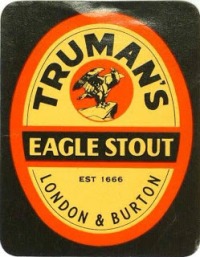
By this time, Truman’s brewed three cask ales, Special Mild (also called Prize Mild, 3%), Special Bitter (3.9%) and No 7 Prize Brew, and a keg bitter called Titan Keg (4%) as well as Tuborg (3.1%). It was also noted for a bottled pale ale, Ben Truman Export (5%), which had originated in Burton. Other bottles included light ale (3.4%), brown ale, Eagle stout and barley wine, plus a light pale ale in large cans known as Barbecue, inspired by similar products from Watney.
Following the takeover, cask was soon discontinued, but in 1977, in response to growing demand for the format, Truman’s launched Tap Bitter, a cask conditioned beer dispensed under air pressure. The initiative didn’t meet the approval of the executive committee of the Campaign for Real Ale (CAMRA), which promptly banned air pressure dispensed beer from all mention in CAMRA publications, provoking a major row with the Campaign’s Scottish branches, as this form of cask dispense was still widespread in Scotland. All cask beer was withdrawn again in 1981.
The axeing of cask, a widely disparaged rebrand and declining quality and investment as Grand Met began to lose interest in brewing all contributed to the decline of Truman’s, and in 1989 the brewery was finally closed, a decision also influenced by the obvious value of the land it occupied.
Where are they now?
The vast brewery site remained derelict until 1995 when it was sold to the Zeloof family. They had built a business in the East End rag trade into a successful clothing and fashion group, and also had interests in art and sculpture. Brick Lane has been a particularly multicultural and vibrant corner of London since at least the early 18th century, with successive waves of French Huguenot and then Eastern European Jewish settlers. By the 1980s it was a centre of the Bangladeshi community, noted for its restaurants, with the southern end officially renamed ‘Banglatown’ in 1997. The Zeloofs added another layer by initially encouraging artists and independent traders to rent space in the old brewery buildings, alongside more corporate clients like tech companies and data centres.
The area rapidly became a particularly ‘hip’ destination, noted for its buskers, street art, street food and lively nightlife. Gentrification inevitably followed, with longstanding residents increasingly challenged by rising rents and prices. In 2020, Truman Estates, the company set up by the Zeloofs to manage their property, submitted a development proposal for high rise offices and chain retail on part of the site. Amid major controversy, Tower Hamlets Council approved the proposal, sidelining an alternative plan developed by the local community. As of 2024, this decision is the subject of an appeal to the Supreme Court.
Though some Truman’s brands were subsequently brewed at Watney breweries, just two years after the brewery’s closure, in 1991, Grand Met sold its remaining brewing interests to Courage. Though a few brands were then sold to a management buyout known as Refresh UK (see Manns), most, including Truman’s, were quietly dropped. As explained elsewhere, Courage became Scottish Courage in 1995, the UK side of which was bought by Heineken in 2008. It seems nobody recognised the brand value of a name that was still fondly remembered particularly in East London and which was still displayed prominently on hundreds of pubs.
In 2009, two young professionals who worked on the brewery site conceived the ambitious idea of reviving Truman’s as an active beer brand. Initial negotiations with Heineken proved difficult — it seems staff weren’t initially aware they controlled the brand — but eventually it was licensed and later bought outright. Cuckoo-brewed beer first appeared in 2010, with the new Truman’s opening its own brewery, the Eyrie, in Hackney Wick in 2013, using the Truman yeast, retrieved from the National Collection of Yeast Cultures. Most beers were new recipes but included recreations of classic stouts and porters and Ben Truman Export.
The company struggled during the 2020 lockdowns and returned to cuckoo brewing in 2022. Later that year, it sold the brand to the owners of the old brewery site and renamed itself Big Penny. The new brand owners, who since 2020 sold a range of cuckoo-brewed beers under the Brick Lane brand at outlets on the site, have since revived the Truman name for these.
Things to see
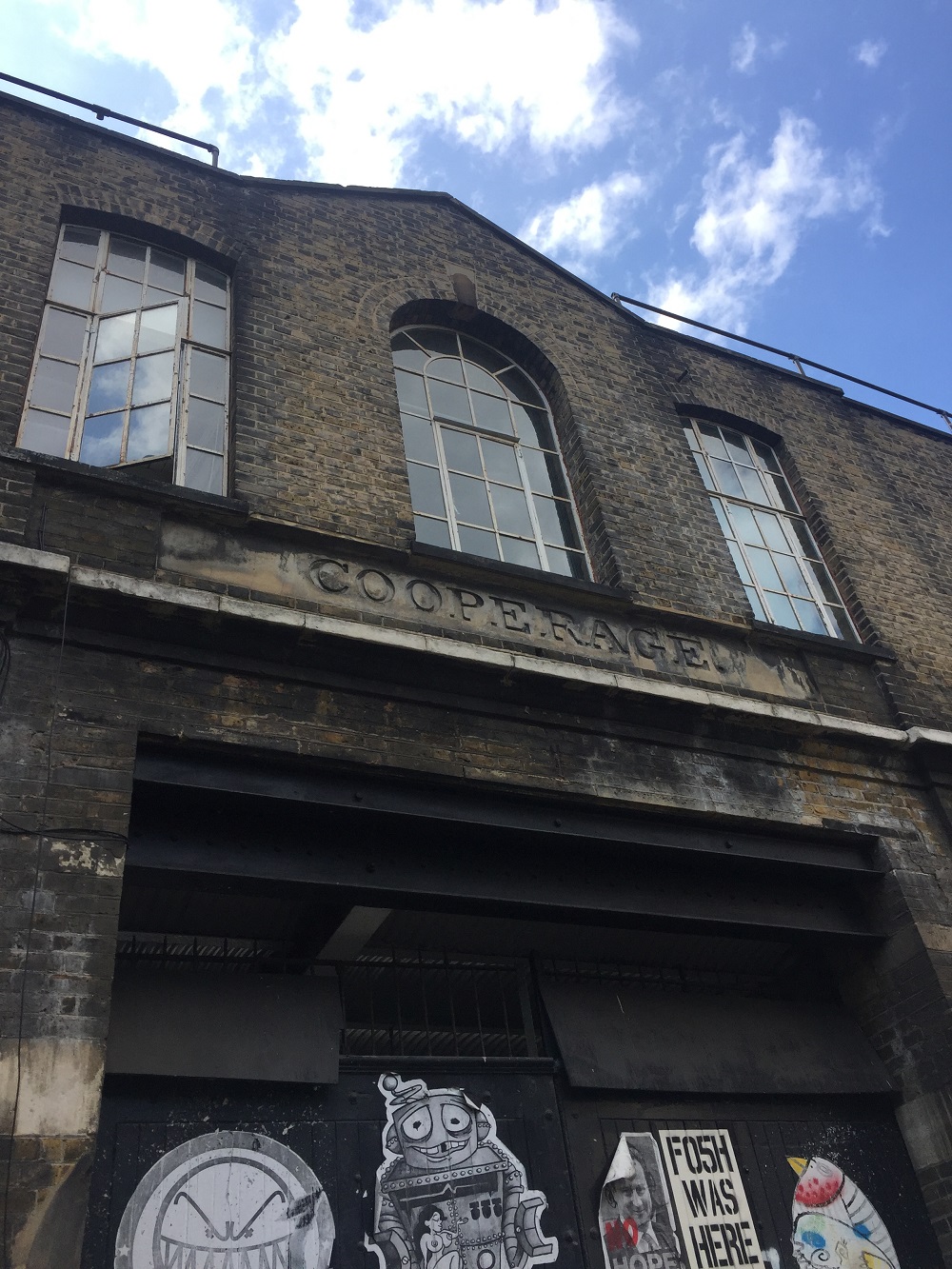
The entrance to the former Truman’s cooperage in Spital Street.
Remarkably, nearly all the Truman buildings still stand as they did in 1989. The site sprawls across both sides of Brick Lane, and you can get a good idea of its impressive 4.5 ha extent by walking round it.
Following Quaker Street from the direction of Shoreditch High Street station, the brewery site begins at the corner with Grey Eagle Street, where large brown brick and glass 1970s buildings are visible behind the wall on the right. Further along you pass the side walls of a block from earlier in the 20th century.
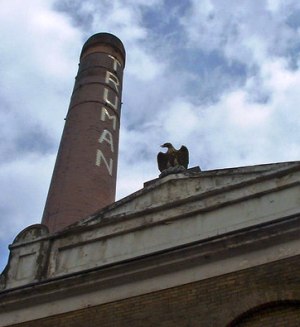
Cross Brick Lane and continue on Buxton Street, past the former stables. Reaching the corner of Allen Gardens, look back for a view of the landmark 48 m Truman chimney, added in 1929. The lower wall a little further along surrounds the coopers’ yard, and turning right on Spital Street you pass the still-labelled entrance to the former Cooperage on the right.
A hole in the large black gates a little further on gives a glimpse of the extent of the yard, still largely undeveloped. This was the location for the initiation ceremony of ‘trussing the cooper’, when staff who had successfully completed their apprenticeship were covered in beer, spent grains, charred oak ashes and sundry other substances and rolled around in a large cask to mark their graduation to journeyman. Watch a film of this rather barbaric practice at Truman’s in 1954.
Turning right along Woodseer Street you pass more brewery walls and buildings on the right. On the left is a terrace of modest but attractive 19th century cottages built for brewery workers. Opposite these is the area currently proposed for development.
At the next corner you reach Brick Lane again: the buildings opposite are also part of the brewery site and you can see how the lane runs through the heart of it. The distinctive covered overbridge at 1st floor level to your left was a 1920s solution to uniting the two sides. The development plans envisage converting this into a restaurant.
Following Brick Lane under the bridge takes you into the heart of the site. Just past the bridge on the left, an arch gives access to an alleyway lined with restaurants, bars and independent shops. This is now known as Dray Walk, after the drays that once delivered beer and collected empty casks, but follows the line of the former Black Eagle Street. Lolsworth Field, site of the original brewhouse, was to the north of this lane. Dray Walk leads to a large yard, once used for logistics and now a street food market, known as Ely’s Yard after Ely Zeloof, the founder of the current owning company. The yard is now home to several artworks, described here.
The site’s most historic buildings are clustered a little further north, back along Brick Lane, past a blue plaque commemorating Fowell Buxton on the left (west) side. Stepping inside a small yard surrounded by decorative ironwork (91-95 Brick Lane E1 6QL), in front of you is a building with a glass frontage, considered inspirational when it was added by architects Arup in the 1970s as a grand entrance. Just inside this is a charming decorative canopy that was part of a previous entrance, but sadly this is off-limits in private space.
Immediately left is the Grade-II* Director’s House with its Black Eagle sign hanging over Brick Lane. This is likely an enlargement of an early 18th century counting house completed around 1745. There’s a story that Ben Truman ordered the improvements in an unsuccessful attempt to persuade his son to stay in London and take over the business. Later, it became Buxton’s principal residence. Facing it across the yard on the right is the Grade II-listed Brewer’s House, built in 1834.
Also from the 1830s is the Grade II-listed Engineer’s House (150 Brick Lane E1 6QL), opposite the yard on the east side of the lane. This incorporates a carriage entrance which is sometimes open, giving another view into the coopers’ yard. The buildings flanking the house, also Grade II-listed, partly date from the mid-18th century expansion overseen by Ben Truman, though with subsequent additions. The lengthy facade of the 1837 stable block stretches left: it’s surmounted by a pediment overlooked by a black eagle sculpture, but in gold. It was converted to a boiler house when the chimney was added in 1929. To the right of the house, a clock in a tympanum and a louvred cupola with weathervane top the vat house with its large first floor windows, built around 1800 for maturing porter. Inside is a forest of cast iron supporting columns.
Retracing your steps along Brick Lane, it’s worth continuing a little further south to turn right along Princelet Street, which was originally developed by Joseph Truman in 1705 as a sideline to brewing. Ben Truman once lived at the far end at no 4 (E1 6QH): the Grade II-listed Georgian house, now known as the ‘Red House’ for its rust-coloured shutters, remains part of the brewery estate.
Returning to Brick Lane, the brewery footprint clearly extends further south on the west side than on the east. To complete your circumambulation, turn left on Hanbury Street, by the 1960s glass and brick corner building with its impressive black eagle branding. This is used as a car park on weekdays and a market at weekends.
You pass the other end of Dray Walk and turn right along Corbet Place, with more branding visible on the building above the corner wall. Zigzagging to follow Grey Eagle Street, now noted for its street art, you walk under another overbridge which connects an outlying former brewery building on the left before returning to Quaker Street.
The Burton brewery, in contrast, was completely demolished following its closure, and replace with housing and light industrial buildings.
Closed brewery Original site: Bethnal Green Working Mens Club, 42 Pollard Row E2 6NB (Tower Hamlets) Final site: 339 Mentmore Terrace E8 3PH (Hackney) threesodsbrewery.com First sold beer: January 2015 (at original site) Brewing ceased: August 2022
Three business partners created this small but interesting brewery late in 2014, adopting its apparently self-deprecatory name from the old Irish practice of displaying a sod of peat on houses selling illegal poitín. It began with a basic 6 hl kit in a cramped and steamy space in the cellar of the Bethnal Green Working Men’s Club. Two of the original founders then became less involved, but the business continued to expand under brewer Rich Ekins, formerly at Canopy and London Beer Factory, and his colleague Wilson Digby.
The original location overlooking the small green space of Pollard Square is one of very few surviving working men’s clubs in London, purpose-built in 1895,. It almost closed due to a dwindling membership in the early 2000s before it was rescued by a promoter who operates it mainly as an events venue. But the brewery had only a tiny corner and eventually needed more space.
During the Covid-19 lockdown in June 2020, it relocated to a railway arch beneath London Fields station, expanding to a 10 hl kit formerly at Wild Card. The new site also had room for a dedicated taproom, though this was rarely open as, following the departure of Rich in late 2021, one of the founders returned as interim head brewer but was only available to work at weekends.
Casks outside Bethnal Green Working Men’s Club in the days when it was home to the Three Sods Brewery.
80% of the beer was produced in cask, with some keg and canning.
Sadly, in July 2022, partly as a legacy of the lockdowns, the owners concluded that continued operations were unsustainable and the company was due to be placed into liquidation in early August.
Brewpub 7 International Square, Westfield Stratford City E20 1EE (Newham) tapeast.co.uk First sold beer: 10 November 2011
When Westfield opened its massive Stratford City shopping mall adjoining the Queen Elizabeth Olympic Park in September 2011, it invited the team at Utobeer to create a brewpub for the Great Eastern Market, the requisite ghetto of specialist independents nestling amid the globalised brands. Despite being created at very short notice, it’s become one of London’s most notable beer venues, with a glass-fronted 4 hl copper brewhouse at the side.
The original head brewer was Eddie Baines who had long worked for Utobeer and was previously a brewer in Firkin pubs. In March 2012 he was replaced by former Brentwood brewer Jim Wilson, who reshaped the brewery’s output and diversified the styles. He was succeeded by Jonny Park, then Josh Walker, formerly of Camden Town and Brewhouse & Kitchen. More recently, former assitant brewer Terry Kinsella has been promoted to head brewer.
Beers, sold in house and at sister pub the Rake in Borough Market, are in cask and keg, with occasional hand bottlings.
Brewery 46 Druid Street SE1 2EZ (Southwark) southwarkbrewing.co.uk First sold beer: October 2014
Unusually for the owner of a new London brewery, Southwark co-founder Peter Jackson is an industry veteran, with many years at Whitbread and Marston’s on his CV, including as marketing director at the latter. He created this brewery, the fifth in Bermondsey and the closest to central London, with the help of another long-serving industry figure, Rooster’s founder Sean Franklin, a key early UK champion of New World hops.
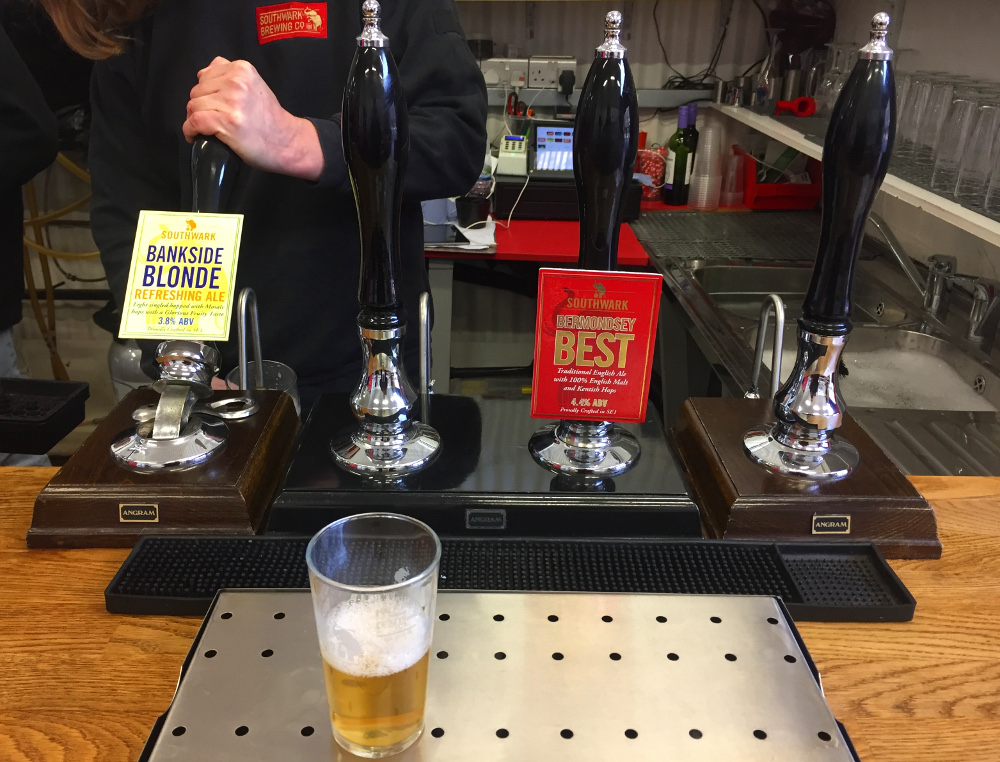
The biggest range of cask on the Bermondsey ‘mile’: Southwark brewery.
It’s rather smaller than Peter’s former employers, with a 13.5 hl brewhouse in a single arch, just behind a lively taproom which holds the welcome distinction of offering the widest choice of house-brewed cask beer on the ‘beer mile’.
Beers in cask and keg are sold relatively widely outside the brewery including in various chain pubs. They are also hand-bottled and packaged in minikeg and can, for sale mainly from the brewery itself. The names usually have a local connection.
Previously the brand Big Bear was used for some of the keg beers but this has since been dropped.
Brewery Original production site: 25 Leyton Business Centre, Etloe Road E10 7BT (Waltham Forest) Current site: 15 Uplands Business Park, Blackhorse Lane E17 5QJ (Waltham Forest) signaturebrew.co.uk First sold beer: January 2014 (at Leyton site)
Beer and music lovers Tom Bott and Sam McGregor, the latter also a musician, originally conceived Signature as a way of challenging the hegemony of industrial beer on the music scene by bringing together performers and brewers to create special edition brews. At first, they developed beers at a pilot brewery in Hackney (45 Hackney Downs Studios, Amhurst Road E8 2BT), which were then brewed commercially at Titanic in Stoke-on-Trent, owned by Tom’s father and uncle, Dave and Keith Bott. Their first beer, the General, created with the Rifles, was launched in September 2011.
The brewery gained its own production site in Leyton late in 2013 and added a core range, some of it commercially brewed on the pilot kit, though with larger runs made at various host breweries. Brewing moved in house following a major upgrade in 2015 to a 16 hl brewhouse previously used by Five Points. By 2018, the business had taken on two neighbouring units, with much-expanded fermentation capacity, but was again struggling with space
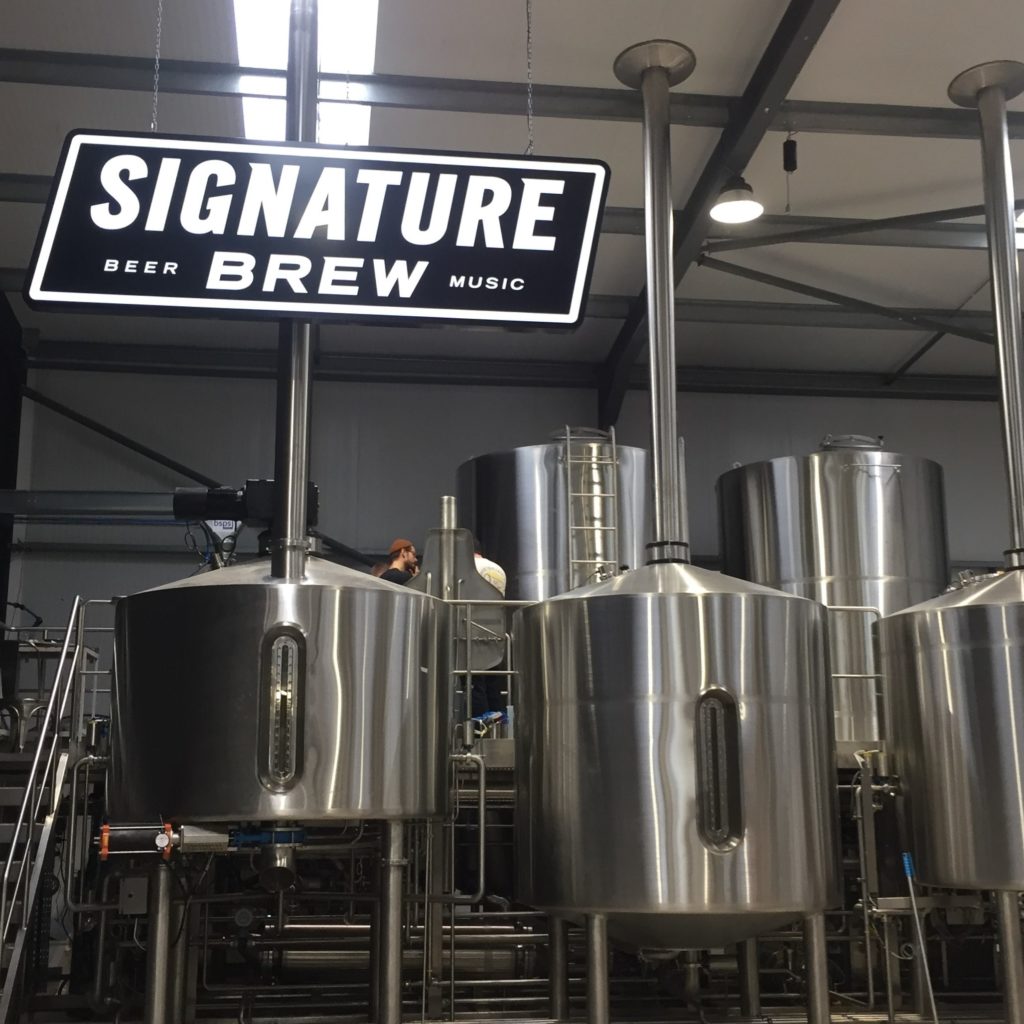
A further crowdfunded expansion to the current address in the growing brewing hub of Walthamstow’s Blackhorse Lane in 2019 has involved the installation of a new 32 hl brewhouse from SSB, with water filtering, a facility for lager-style step mashing and new kegging and canning lines. The ambition is to grow production to 20,000 hl a year. The site incorporates a taproom known as the Brewer’s Bar, which joins an existing remote taproom in Haggerston, opened in September 2018, and a burger bar, the Collab, in partnership with We Serve Humans, opened in central Walthamstow in March 2019.
Signature was named Brewery of the Year by trade organisation SIBA in 2021.
Brewpub, no longer brewing 68 Wandsworth High Street SW18 4LB (Wandsworth) theraminnsw18.co.uk First sold beer: October 2019 (as SlyBeast, see also Ram Brewery under Sambrook’s) Brewing suspended: May 2022 Brewing resumed: Autumn 2022 (by Coalition) Brewing ceased: January 2024
Commercial brewing returned to the historic Ram brewery in central Wandsworth in October 2019 with the reopening of the landmark Ram Inn as a brewpub, joined in 2021 by Sambrook’s in some of the historic buildings around the corner.
The pub, on the northwest corner of Ram Street and Wandsworth High Street, is on the site of the original Ram Inn where brewing is thought to have taken place as far back as the 16th century. As the Ram developed into a substantial commercial brewery, its footprint gradually spread west and north towards the river Wandle, but the pub was retained a a brewery tap. The current Grade II-listed building dates from 1883, and was remodelled in the 1930s when it was renamed the Brewery Tap.
The pub, renamed the Brewery Tap in 1974, was closed and boarded up when Young’s closed the brewery in 2006, but though most of the site was then sold for redevelopment, the successor pub company retained the pub itself. With redevelopment nearing completion, it was leased to Keris and Lee De Villiers, who already leased two other popular local Young’s pubs. They refurbished it, installed a brewery and reopened it in October 2019 under its original name the Ram Inn.
Head brewer Alex Leclere presided over a 10 hl brewhouse from PBC behind glass in one corner, working under the SlyBeast brand. This was named after two dogs belonging to Keris’s sister: their stylised profiles appeared on the logo.
Beers were in keg and cask, sold in the pub and in some other outlets.
In July 2021, Young’s sold the pub, along with almost all the rest of its leased estate, to major pub owner Punch. On 15 December, Punch was bought in turn by US-based investment company Fortress. Sadly, Punch decided not to renew the lease and to run the Ram Inn under new management in May 2022. Brewing ceased, but Keris and Lee hope to resume elsewhere.
The kit remained in place, and in autumn 2022 Charlotte Cook of cuckoo brewer Coalition, which had long been looking for its own site in London, began using it on a cuckoo basis. The arrangement continued when the pub was refurbished and rebranded in January 2023 as one of Punch’s Laine pubs (which have some brewing tradition of their own), with beer available in the pub. But it ended at short notice in January 2024.
Laine have since confirmed they have no intention to revive production and are in the process of remvoing the kit and converting the space to other uses. All house brand beers are now brewed at Laine’s main brewery in West Sussex.
For more on the long story of brewing on the Ram site, as well as notes on the heritage still visible today, see Young’s.