A sample text widget
Etiam pulvinar consectetur dolor sed malesuada. Ut convallis
euismod dolor nec pretium. Nunc ut tristique massa.
Nam sodales mi vitae dolor ullamcorper et vulputate enim accumsan.
Morbi orci magna, tincidunt vitae molestie nec, molestie at mi. Nulla nulla lorem,
suscipit in posuere in, interdum non magna.
|
Originally published in BEER July 2006 as part of a page about beers from the USA available in the UK
ABV: 5.6 per cent
Origin: Chico, California, USA
Website: www.sierranevada.com
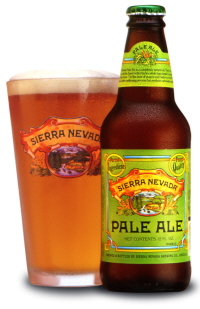 Sierra Nevada Pale Ale With 4 July imminent, I’m raising a toast to life, liberty and the pursuit of happiness with a trio of great beers from that most remarkable of brewing countries, the United States of America.
As with everything else, the USA does beer in a big way. Following the decisive break in the development of the industry caused by Prohibition between 1920 and 1933, and the huge expansion of the market after World War II, concentration and homogenisation got off to an early start.
By the 1970s US brewing was dominated by a handful of huge companies like Anheuser-Busch, Coors and Miller, churning out oceans of nationally marketed bland pale lager derivatives to slake the thirst of what was then the world’s biggest beer market.
The backlash came in the 1980s with a growing movement of home brewers, microbreweries and brewpubs inspired by pioneers like San Francisco’s Anchor Brewery (see below), the success of CAMRA in Britain and the example of the USA’s own increasingly inventive and confident winemakers, who in the 1970s had begun to win international acclaim.
The new wave of brewers have looked across the Atlantic for inspiration in styles and techniques. But as with other cultural borrowings, they’ve applied native verve and enthusiasm to create beers that are distinctively American.
The most obvious national characteristic is the generous use of hops. The assertive fruity and citric flavours derived from local varieties like Cascade and Chinook are the brewers’ equivalent of the vivid fruitiness associated with particular grapes in the country’s varietal wines.
With over 1,500 craft breweries and even the megabrewers reviving specialities, the choice for American consumers is now much improved, especially in big cities. But many craft brewers’ products are unavailable outside their own region, or even their own pub. And only a tiny finds its way to the UK.
One exception is Sierra Nevada Pale Ale, from the Sacramento Valley in northern California. This was the brewery’s launch brand back in1979, and its uncompromising hoppiness helped establish the love affair between US speciality brewers and humulus lupus. It’s still the brewery’s best-selling brand.
With a capacity approaching 1 million hectolitres a year, Sierra Nevada is no longer a micro but still retains impressive quality. The Pale is made from two-row pale and cara-malts and whole hops: Magnum and Perle for bittering and Cascade for aroma. It’s bottle conditioned, though with a very light sediment.
It pours a rich and slightly hazy golden colour, with a bubbly white head that soon subsides. The inviting aroma is rich with spicy pineapple fruit and glycerine.
A light but firm malty palate has pineapple chunks in syrup, gingery spice and a twiggy hop note. But the bitterness saves itself for the swallow, becoming assertive with resin and pepper in a dry finish over spicy sweetish malt.
Though undeniably bitter, the beer stays well-balanced and is far more approachable than some of the “hophead” beers produced by subsequent generations of US craft brewers. It remains a fresh and lively introduction to the country’s reimagining of pale ale.
See the next post for more beers from the USA.
Read more about this beer at ratebeer.com: http://www.ratebeer.com/beer/sierra-nevada-pale-ale-bottle/365/
 Zythos Bierfestival 2010 The Zythos Bierfestival is the flagship event of the Belgian beer consumers’ organisation Zythos, earning multiple stars, a three line whip and a smudge of highlighter pen in many a beer diary, and a great way to get a rounded view of the multifaceted Belgian brewing scene in one fell swoop. It’s also become the focus for several other “fringe” events that take advantage of Belgium’s compact size and good transport and the presence of a solid corps of visiting beer geeks up for a very bleary weekend. Thursday kicked off with the Night of Whisky and Beer, Friday brought the Pré-ZBF Festival and the lambic-themed Nacht van de Grote Dorst (Night of the Great Thirst), while early birds could catch an open brewing day at the legendary Bruxellois lambic brewery Cantillon on Saturday morning before heading off for the first of two days of the ZBF itself. Energetic beer tour organiser Chris “Podge” Pollard was even offering a coach tour that took in the lot and some brewery visits besides.
I’m afraid your author’s alcohol capacity wasn’t up to such a pounding, but I did extend my regular visit to the ZBF proper with a jaunt to the Pré-ZBF, organised, like the Night of Whisky and Beer, by self-proclaimed “picobrouwerij” (picobrewery) Alvinne and in the same location, the Kasteel der Lakenbosschen on the edge of Ruddervorde, a little way south of Brugge. It’s a charming location – an eccentric little rustic castle, in fact a late 19th century romantic architectural confection overlooking a goose pond, with an adjoining orangery that provided a home to the main bars – even if reaching it while remaining within the drink driving laws involves a stretch on the bus from Brugge. Shuttle buses were organised for the occasion as an alternative to the regular service but where they stopped could have been more obvious.
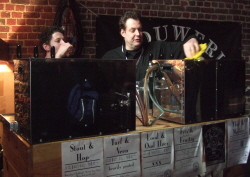 Menno Olivier of De Molen brewery polishes the bar while his colleague gets down to the real business, Pré-ZBF, Ruddervorde March 2010. Beers on offer at the event are from a limited number of breweries but include some rare and special stuff you’d find very difficult to obtain elsewhere, and there’s the added novelty that some of the participants come from outside Belgium. Alvinne invite like-minded breweries to partner – Struise and De Molen have been regulars and in this third year they were joined by Urthel and two from the UK, Aberdeenshire’s BrewDog and Derbyshire’s Thornbridge. In fact that’s only one genuine Belgian brewer, Alvinne itself. Struise are a Belgian brewing firm that rents equipment at other Belgian breweries, principally Deca; De Molen is a Dutch brewer, from Bodegraven in Zuid-Holland; and Urthel are a Belgian firm that contract brew at Koningshoeven, the semi-secularised Trappist brewery at Berkel-Enschot in Dutch Noord Brabant.
If you know anything about this bunch you’ll realise this was primarily a beer geek event drawing an international crowd, and indeed there was a ratebeer / Beer Advocate / Burgundian Babble Bent tent providing “bring and taste” accommodation, and as much English being spoken as Dutch. Most of the brewers are known for small runs, limited editions, high gravities, no-holds-barred experimentation and a penchant for wood ageing in refill casks – the sort of beers that tend to score highly among the regular raters of the online beer world. In this company, Urthel, whose beers are normally thought of as eccentric, looked almost ordinary.
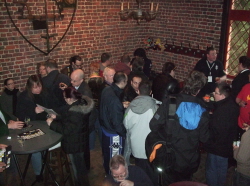 The crowd enjoying Thornbridge beers, Pré-ZBF 2010, Ruddervorde March 2010. Alvinne had the biggest range with versions of their strong beers from various casks, and, at a slightly more sessionable strength, the rather decent Chelmsford Smoked Porter (see tastings). Struise had supplies of their cult hits like Pannepot and Aardmonnik and lots of more unusual stuff too. De Molen had a dazzling eclectic range including some special versions of their regulars. BrewDog brought their silly gravity Tactical Nuclear Penguin, at 36% and €15 a shot, as well as their low gravity beer Nanny State, but all in filtered bottles. Thornbridge were overwhelmed with the popularity of their beers, particularly the cask aged Alliance and St Petersburg specials.
I was glad to have made the trip – I tasted some very impressive beers, bought some interesting rarities at the onsite offie and had some great conversations. But while I’m full of praise for brewers so full of energy, inspiration and a determination to push the envelope, I found myself longing just a little for beers aimed at ordinary mortals, and ones that are likely to be readily available for some time to come, so that writing about them doesn’t just feel like showing off.
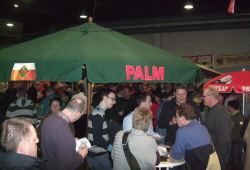 Under the palms on a freezing Flemish day, ZBF 2010, Sint-Niklaas, March 2010. That’s certainly not a problem at the main ZBF, now in its seventh year. It’s the Belgian equivalent to CAMRA’s Great British Beer Festival and although it can get very busy and lively it’s still on a notably smaller and more approachable scale. The venue is the Stadsfeestzaal (The Town Festival Hall) almost opposite the station at Sint-Niklaas, on the line between Antwerpen and Gent and with regular services to many other Belgian towns. It’s a bit of a soulless municipal venue that must look like a vast concrete-floored barn when empty, but it soon comes alive with drinkers of all kinds. Yes, it’s got an obvious following among members of Zythos, CAMRA and Dutch beer organisation PINT, and pulls a good few beer fans across the Atlantic, but like all good festivals it attracts its fair share of ordinary people too– folk who enjoy good beer without being obsessed with it making it a day out from Bruxelles, Antwerpen or Eindhoven, and curious locals just passing by. The latter will be encouraged by the fact that there’s no admission charge, just a €3 deposit on the tasting glass. To get it filled you need to buy a supply of jetonnetjes, plastic tokens that are the only form of currency accepted at the bars, at the cost of €1.20 a 150ml measure.
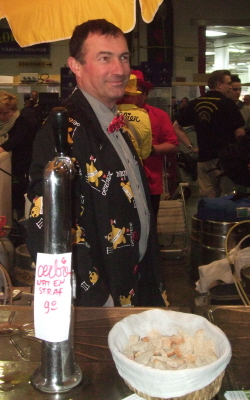 Kris Herteleer models Dolle Brouwers chic, ZBF 2010, Sint-Niklaas March 2010. Unlike British festivals, where long bars staffed by volunteers offer a range from different brewers, ZBF has a series of small stands for each brewery or beer firm — ‘bierfirma’ being Zythos’ term for brewers without breweries that contract brew or hire other people’s kit, of whom there are quite a few in Belgium. The stands are staffed by the breweries, though Zythos volunteers do everything else. Often you’ll find the brewers themselves behind the taps – Kris Herteleer from De Dolle Brouwers is a mainstay at their stand in his trademark novelty jacket and bow tie. This year there were a record 61 brewers represented, just about half of all the brewers in Belgium, offering over 280 beers.
The beers cover a huge range. It’s always a pleasure to see some of the smaller older-established independents like SAS (formerly known as Leroy) and Strubbe offering traditional everyday beers that can be particularly hard to find outside their own core distribution areas. Rarer still are the handful of unblended lambics that the festival can always be relied upon to exhibit. Newer micros are well represented, often with something unusual to showcase as well as their regulars, and it’s particularly good to see some of the excellent Wallonian craft brewers such as Écaussines, Jandrain-Jandrenouille, Rulles and Sainte-Hélène at what is still a slightly Flemish-dominated event.
Off on a side hall where the seating is less hotly contested are a number of food stands all doing rather basic fast food – filled rolls, burgers, and the inevitable paper cones of chips drowned with industrial mayonnaise. The veterans come prepared with their own packed lunches, snacks and large bottles of water, vital for soaking things up and pacing yourself given the strength of some of the beers.
One thing that will irritate British and North American first-time visitors is that Zythos recoup some of their investment by demanding 30c for every visit to the loo. Charging for public toilets is of course the norm in Belgium as in a number of other countries, but charging for them at a beer festival is a bit like charging hens for laying eggs, and considerably more of a dead cert as a fundraising initiative than skittles or tombola. That niggle aside, this is one of my favourite beer events.
Among other people I bumped into beer historian extraordinaire Ron Pattinson, who gave me a fascinating book on beer recipes in Britain in 1907. Ron’s writeup of the event is on his blog at http://barclayperkins.blogspot.com/2010/03/zbf-2010.html.
Selected tastings:
Pré-ZBF
- [intlink id=”630″ type=”post”]Alvinne Chelmsford Oak Smoked Porter[/intlink] 5.3%, Heule, West-Vlaanderen
- [intlink id=”634″ type=”post”]Deca / Struise Aardmonnik[/intlink] 8%, Woesten-Vleteren, West-Vlaanderen
- [intlink id=”637″ type=”post”]Thornbridge St Petersburg Whisky Reserve[/intlink] 2006 8.8%, Ashford-in-the-Water, Derbyshire, England
ZBF
- [intlink id=”640″ type=”post”]Dochter van de Korenaar Noblesse[/intlink] 5.5%, Baarle-Hertog, Antwepen, Vlaanderen
- [intlink id=”648″ type=”post”]Écaussines Ultrabrune d’Écaussines[/intlink] 10%, Écaussines d’Enghien, Hainaut, Wallonie
- [intlink id=”644″ type=”post”]Oud Beersel Oude Lambik[/intlink] 5%, Beersel, Vlaams Brabant, Vlaanderen
Zythos Bierfestival 2010
ABV: 10%
Origin: Écaussines d’Enghien, Hainaut, Wallonie
Website: www.brasserieecaussines.be
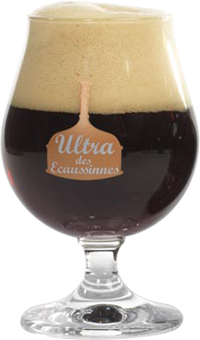 Ultrabrune d'Écaussines This new generation farmhouse brewery, founded in 2000 by Hugues and Isobel Van Poucke, tends to pop up more in the export market than in Belgium, so it was great to see them represented with a full range of bottle conditioned ales among a number of Wallonian micros at the Zythos Bierfestival.
Ultrabrune is a big sweetish brown ale, reminiscent of the high alcohol brown Trappist and abbey beers such as Rochefort 10, though with rather more overstated flavours. It’s brewed using pale malt, two different caramalts and torrefied malt, and comes out a cloudy deep ruddy-brown with a creamy yellowish head and an intoxicating dark malt and herb aroma. A full and dark malty and herby palate has lots of flavoursome estery notes, some fresh fruit, raisins and chocolate.
Red fruit rises on the swallow, and there’s more chocolate on a notably sweet, roasty and generously fruity finish that’s very light on hops. I suspect this could mature into something even more interesting.
Read more about this beer at ratebeer.com: http://www.ratebeer.com/beer/ultrabrune-10/11031/
Zythos Bierfestival 2010
Top Tastings 2010
ABV: 5%
Origin: Beersel, Vlaams Brabant, Vlaanderen
Website: http://www.oudbeersel.com
 Oud Beersel brouwerij en geuzestekerij Oud Beersel in the heart of Pajottenland’s lambic country was the brewery that unexpectedly came back. Originally named Vandervelden after the owning family, it closed its doors in 2002 when the last Vandervelden retired, but two beer enthusiasts, Gert Christiaens and Ronald de Bus, started a campaign to reopen it, buying the brand name and the brewery and contract brewing a non-lambic beer, Bersalis, to bring in a cash flow rather more quickly than the long maturation period of new lambic beer would have provided. At first the relaunched Oud Beersel acted as a geuzestekerij, blending old Vandervelden lambics and beers from other lambic brewers, but in Autumn 2007, as the brewery marked its 125th anniversary, the owners announced new lambics were once more being produced.
I’m not sure quite where the mature unblended lambic being served from polycask at the Oud Beersel stand at this year’s Zythos Bierfestival originated — it’s just possible it was one of the early revival brews, which would now have had over two years to mature. In any case it was a very rich and complex beer, and notably rounded and mild for the style.
It poured a still deep golden with no head, giving off a malty, woody, slightly petrolly aroma with grape juice and rough cider notes. A thick fruity sweet-sour palate started with peaches and then turned tart, lemony and woody, with a wonderfully animated sense of developing flavour. A citric swallow led to a rounded and full sappy finish with notes of apricot, mature cheese and nuts. Definitely a lambic on the mellower side but none the worse for it.
Read more about this beer at ratebeer.com: http://www.ratebeer.com/beer/oud-beersel-oude-lambik/23561/
Zythos Bierfestival 2010
ABV: 5.5%
Origin: Baarle-Hertog, Antwerpen, Vlaanderen
Website: www.dedochtervandekorenaar.be
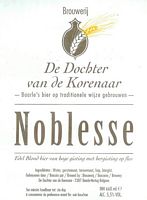 De Dochter van de Korenaar Noblesse De Dochter van de Korenaar — the Ear of Grain’s Daughter — is one of the remote outposts of Belgian brewing, in boundary boggling Baarle-Hertog, a tiny and irregularly shaped enclave of Belgium — less than 8km² divided over 24 seperate pieces of land, sometimes with buildings straddling the border — entirely surrounded by the Netherlands, the legacy of mediaeval land grabs between the rulers of Breda (now the Netherlands) and Brabant (now Belgium). In the early days of this brewery I had a couple of dodgy bottles, but there was no problem with this delightful easy-going blond ale, the brewery’s first beer, sampled on draught at the Zythos Bierfestival.
It’s a warm, hazy gold with a little off-white, slightly pinkish head and a creamy, malty, fairly restrained aroma. A firm and smooth malty palate has a slight herbal note, with bitter hops and citrus developing, offset by a gentle sugary touch. A creamy mouth-coating finish has herbal and flowery notes and a gentle bitterness, finishing dry, a testament to the Belgian brewing’s tentative rediscovery of the hop. My decision certainly wasn’t split: it’s notably complex for the ABV, but very well balanced, and altogether a refreshing delight.
Read more about this beer at ratebeer.com: http://www.ratebeer.com/beer/de-dochter-van-de-korenaar-noblesse/78107/
Pré-ZBF Festival 2010
Top Tastings 2010 (Highland)
ABV: 8.8%
Origin: Ashford-in-the-Water, Derbyshire, England
Website: www.thornbridgebrewery.co.uk
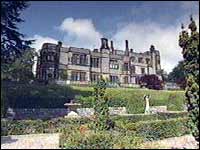 Thornbridge Hall Thornbridge are emerging as a world class new brewery, offering a solid range of excellent everyday beers but also knowing how to push at the boundaries of style while still retaining good taste and balance. Witness the popularity of these wood-aged imperial stouts at the Pré-ZBF event this year, where they lined up alongside cult iconoclasts BrewDog, Struise and De Molen.
St Petersburg is Thornbridge’s regular imperial stout and back when this batch was brewed in 2005 it was made from Maris Otter pale, Pilsner, dark crystal and chocolate malts, roasted barley and Bramling Cross and Galena hops. The beer was then aged in whisky barrels for around nine months, and bottled in mid-2006, since when as a bottle conditioned beer it has continued to evolve.
St Petersburg Speyside Whisky Reserve was matured in a cask from the Mortlach distillery, and now emerges almost black, with a fine foamy beige head. A treacly, very lightly sour and oaky aroma has a touch of smoky whisky, heralding a thick and rich palate, smooth and tasty despite the obvious alcohol, with chocolate, coffee, raisin and sherry notes. A beautifully mellow finish is lightly oaky with dark malt, a building woody dryness and a slightly bitter note.
If the Speyside is a refined and mellow beer, the Highland Whisky Reserve version, matured in a Macallan cask, is better still, full of vivid and unusual flavours but well-integrated and satifsying. This has a smooth and creamy but very dark and tarry aroma, with notes of varnish and a slight hint of cardboardy oxidation. A slick, sherried and honeyed malt palate has handfuls of fruit and nuts as well as wood, and there’s a minty, slightly cedary disinfectant-like note on a long developing finish that’s coffee bitter and slightly phenolic, ending with pursing tannins and an impression of sucking on wood.
Following a conversation at the festival, I’m delighted to discover it was partly my positive review of the standard version of St Petersburg that encouraged Kelly Ryan, then newly arrived from New Zealand, to apply for a job at Thornbridge following the departure of Martin Dickie to found BrewDog — Kelly is now a key member of their brewing staff.
Read more about these beers at ratebeer.com:
http://www.ratebeer.com/beer/thornbridge-st-petersburg-imperial-russian-stout-highland-whisky-reserve/100203/
http://www.ratebeer.com/beer/thornbridge-st-petersburg-imperial-russian-stout-speyside-whisky-reserve/100179/
Pré-ZBF Festival 2010
ABV: 8%
Origin: Woesten-Vleteren, West-Vlaanderen
Website: http://struise.noordhoek.com
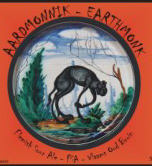 De Struise Aardmonnik De Struise Brouwers, a beer firm that work mainly on the plant of the Deca brewery, are the enfants terribles of Belgian brewing, more appreciated by the international “extreme beer” crowd than within Belgium itself for their eccentric, often strong and sometimes barrel-aged ales. The name means “ostrich”, recalling the fact that the owners’ other enterprise is an ostrich farm, but the word is also slang for “tough”, explaining their self-translated English strapline “the sturdy brewers”.
Aardmonnik, or Earthmonk, is a rare occasional strong brown ale aged in oak for 18 months — it’s not been around for a while but it appeared on draught at the Pré-ZBF event this year. It’s a very dark brown beer with a generous foamy beige head and a sourish bretannomyces-laced brown malt aroma, evidence of its long ageing. A lightly balsamic palate has chewy cherry and vine fruits, wood tones, toffee and a slight nuttiness, with just a hint of smoky bacon. A lovely sappy moreish finish has a smack of burnt plastic and some subtle smokiness, staying nice and tart around the mouth. Despite its wacky reputation this is actually ends up quite a traditional Flemish brown ale, albeit on the very strong and vivid side, and given the shrinking ranks of that particular style, is most welcome. A shame it’s limited to 5,000 bottles every two years.
Pré-ZBF Festival 2010
ABV: 5.3%
Origin: Heule, West-Vlaanderen
Website: www.alvinne.be
 Picobrouwerij Alvinne The latest collaboration between the Alvinne “picobrewery” and beer writer, tour organiser and all-round personality Chris “Podge” Pollard is this beer intended primarily for the Chelmsford Beer Festival, a combination of Belgian flair and some decidedly local links to Podge’s Essex stomping ground. The malt was procured from Bairds’ Witham plant, smoked in Colchester and taken across to West Flanders late last year by Podge on one of his tours, with the beer first making its appearance at Alvinne’s Pré-ZBF event, where it was one of the lower gravity offerings, served bottle conditioned from the bottle.
Surrounded by extreme beers with big flavours, this one turned out to be remarkably restrained and modest. It poured a cloudy dark brown with a foamy fawn head and relatively gentle dark malt aroma with light smoke and banana yeast hints. A very dry woodsmoke palate was very nicely balanced with toast, oaky notes and a nice fresh and relatively light texture, and also some phenolic and banana esters. The sappy finish turned notably dry, the smoke offset by burry hop flavours (the beer has a relatively generous 50EBU), with some late ash and cindery tones. A subtle beer that riffs well on the smoky theme already inherent in some porters — if you’ve found smoked beer just too odd in the past, this might be your way in.
Read more about this beer at ratebeer.com: http://www.ratebeer.com/beer/alvinne-chelmsford-oak-smoked-porter/119281/
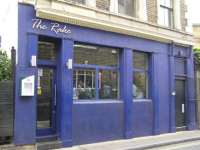 The Rake, London SE1 The Rake, a tiny pub on the edge of London’s Borough Market, is a serious specialist beer venue that in a few short years has become one of the UK’s main attractions for the international beer appreciation circuit, a must-do on the itinerary. The first day of the pub’s annual Welsh beer festival on the Sunday before St David’s Day saw a surprisingly high concentration of brewers, beer writers and bloggers and sundry geeks mixing with those ordinary folk who simply like a good pint. There were even brewing visitors from Hawaii – Garrett and Melanie Marrero of the lauded Maui brewpub.
The day included a Meet the Brewer tasting event, part of a series run upstairs at the pub by the irrepressible beer writer, TV personality and blogger Melissa Cole under the banner lovebeer@borough. The brewer in question was Justin “Buster” Grant of Breconshire Brewery, a true expert (among other things he’s a mainstay of CAMRA’s technical panel) as well as enthusiast, and an articulate and engaging presenter of his own beers, demonstrating the intelligence and imagination behind them. Buster guided us through six of his beers, five bottle conditioned and the sixth an advanced polycask sample of the remarkable cask only Ysprid y Ddraig, a subtle and luscious wood-aged blond.
Downstairs an impressive selection of around 20 Welsh cask beers, mainly served straight from casks out on the heated terrace, demonstrated just how far the country’s brewing scene has developed since the days of dry counties and big beer factories. The likes of Breconshire, Otley, Conwy, Mŵs Piws and Bryncelyn toasted St Dewi in with style.
Selected tastings:
- [intlink id=”620″ type=”post”]Breconshire Ysprid y Ddraig[/intlink] 6.5%, Aberhonddu, Powys, Cymru
- [intlink id=”623″ type=”post”]Tudor Blorenge[/intlink] 4.4%, Y Fenni, Sir Fynwy, Cymru
Rake Welsh Beer Festival February 2010
ABV: 4.4%
Origin: Y Fenni, Sir Fynwy, Cymru
Website: http://www.tudorbrewery.co.uk/
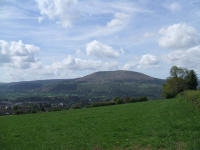 The Blorenge. http://www.flickr.com/photos/jemwilliams/ / CC BY-NC-ND 2.0 I must confess I’d not heard of this brewery, one of a number of new Welsh micros, and chose the beer from the cask selection at the Rake festival largely on the grounds of its relatively low ABV, not wanting to undermine my faculties before a serious tasting. I was mightily pleased with what I got. British micros have become adept at churning out session strength golden beers they hope will lure the lager drinkers, and some of them are becoming rather uninspired and uninspiring, so Blorenge was a particularly pleasant surprise.
The beer poured a slightly hazy mid-gold with a foamy white head and a lightly perfumed elderflower aroma. The dry and lightly bitter palate had firm malt and refreshing herbal notes, bitter but not overly so, leading to a herby finish that was surprisingly smoky, given the colour, and slightly gritty, with biscuit and mineral flavours. A light-hearted, refreshing and very well made golden ale.
I’ve since discovered it originates from a brewery established in 2007 at the Kings Arms pub in Y Fenni / Abergavenny, taking its name from the town’s Tudor gate. Like Blorenge, the other beers are named after mountains in the nearby Brecon Beacons national park — if this example is anything to go by, they’re certainly aiming for the heights of brewing skill.
Read more about this beer at ratebeer.com: http://www.ratebeer.com/beer/tudor-blorenge/99524/
|
|
