A sample text widget
Etiam pulvinar consectetur dolor sed malesuada. Ut convallis
euismod dolor nec pretium. Nunc ut tristique massa.
Nam sodales mi vitae dolor ullamcorper et vulputate enim accumsan.
Morbi orci magna, tincidunt vitae molestie nec, molestie at mi. Nulla nulla lorem,
suscipit in posuere in, interdum non magna.
|
Bières sans frontières, Great British Beer Festival 2007. Top Tastings 2008. For more selections see previous post.
Beer sellers: De Bierkoning
ABV: 7%
Origin: Uithoorn, Noord-Holland, Netherlands
Website: www.schansbier.nl
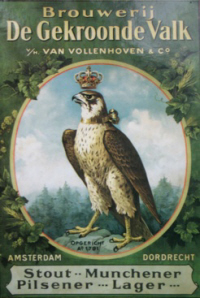 Van Vollenhoven poster Van Vollenhoven’s Extra Stout is arguably one of the best beers currently produced in the Netherlands, and it’s also a piece of genuine brewing heritage that links back to pre-war industrial brewing. The story of its remarkable survival begins in 1733 when Jan van den Bosch opened a brewery and vinegar factory, De Gekroonde Valk (The Crowned Falcon), on Hoogte Kadijk in Amsterdam’s docklands, southeast of the Dam. The Van Vollenhoven family of Rotterdam took over the business in 1791 and started to use the family name to brand the beers, with the crowned falcon becoming a familiar trademark through its depiction on the labels. The business reached the peak of its success in the late 19th century under the stewardship of philanthropist and politician Willem Hovy, partly thanks to the monopoly it exercised on beer exports to the Dutch East Indies. The Van Vollenhovens marked a century of ownership in 1891 by installing a statue of the falcon on a 5.5m-high pillar at the entrance to the brewery, which by 1900 was the biggest in Amsterdam, ahead of both Heineken and Amstel.
Like many Dutch breweries of the time, Van Vollenhoven was open to influence from neighbouring country’s brewing traditions. Hovy himself was responsible for introducing a strong stout inspired by British and Irish models in the 1860’s, motivated partly by social concern for the harm caused among the urban poor by the overconsumption of spirits. A strong, robust and full-bodied beer, reasoned Hovy, could provide a healthier alternative to jenever: the brewery’s own workers were issued with a free crate of it every week, and, like similar products in the English-speaking world, it was promoted for its medicinal benefits, including for nursing mothers. When at the end of the century the brewery, like most other major breweries in the Netherlands, began to adopt German-inspired lager brewing as its mainstay, the strong stout remained a key product.
Van Vollenhoven struggled to secure its success into the 20th century, however — the retreat of colonialism threatened its export markets and the 1930’s recession and World War II dealt twin blows from which it never recovered. In 1949 the business was sold to Heineken, one of the key early stages of that brewery’s post-war development into the global giant it is today, and the plant on Hoogte Kadijk finally shut its doors in 1956. The brewery was demolished, but the falcon remained perched on its pillar until 1967, when Hovy’s descendants, who had since emigrated to South Africa, had it moved to their garden near Johannesburg.
But perhaps thanks to its social traditions the brewery wasn’t forgotten and remained a source of neighbourhood pride. The neighbouring “sibbelwoningen”, brewery workers’ model houses dating from 1828 and now listed buildings, were renovated in the 1970’s and came under the management of a very active and campaigning social housing cooperative. Some local people then formed the Stichting De Gekroonde Valk, an enthusiasts’ organisation keen to document the brewery’s legacy, who were partly responsible for the crowned falcon returning to its historic perch when a replica was installed in situ in 1993 that still stands today.
Meanwhile Heineken continued to brew some of the inherited brands, including the stout, which limped on for a surprisingly long time, though inevitably as a cold-fermented and lagered beer rather than as a genuine warm-fermented stout. By the turn of the century it was still emerging occasionally from Heineken’s ‘s-Hertogenbosch plant, still an interesting speciality but generally regarded as a shadow of its former self. I tasted a bottle in 2001 with a declared ABV of 6.5%, and noted a very dark brown, near-black beer, with a coffeeish, lacy and shortlived head and a fruity tobacco, cream and leather aroma. There were marmite notes on a malty, milky palate that was initially sweetish with gentle carbonation, with hops building slowly to a firm long finish with burnt toast, coffee, ash and rum-like alcohol.
Specialities with low and dwindling turnovers don’t generally sit well with megabrewers so it was no surprise that shortly after this Heineken announced the withdrawal of the brand, with the last brew at Den Bosch in 2002. But the stichting, determined to preserve the Van Vollenhoven name, approached the global brewer and negotiated to license the brand, in the end paying only a “symbolic” amount. The stichting were keen to revive the old recipe, warm fermented and bottle conditioned at 7% ABV, with pale, brown, black and coloured malts, sugar and hops, as passed from the Van Vollenhoven brewers to the new owners in 1949 and retrieved from Heineken’s archive. Their search for a brewery with suitable kit led them to De Schans, established in 1998 by former IBM technician and home brewer Guus Roijen at Uithoorn, only 15km from Amsterdam and in the same province of Noord-Holland. The revived stout, complete with a label based on a historic design, first flowed from here in 2006.
My sample of the 2007 version was a near black beer with a fine deep fawn head and a complex fruity dark malt aroma with blackcurrant, coal, chocolate and vinyl hints and a savoury bacon smoke bite. The complexity and the bacon hints continued into a sweetish dark chocolate, caramel and raisin palate with brooding fruity tones and a satisfying nuttiness, before a fruity swallow heralded a roasty finish with tangy notes, charred wood and quite mild malt, notably smoother and less hoppily drying than the lager version. De Schans’ own beers are interesting, if occasionally inconsistent, but this was heads above them, and well on its way to becoming a minor world classic.
The brewery and the brand owners have agreed to keep the beer as a limited edition brew, giving its annual release a sense of occasion. The 2009 batch was launched in November so should still be around from selected specialists at the time of writing in May 2010 — the Bierkoning beer shop in Amsterdam is one of the more reliable sources. It’s well worth seeking out, not only for its heritage but as an excellent and enjoyable contemporary gem.
More Bières sans frontières selections in the next post.
Read more about this beer at ratebeer.com: http://www.ratebeer.com/beer/schans-van-vollenhovens-extra-stout/67281/
Bières sans frontières, Great British Beer Festival 2007. For more selections see previous post.
ABV: 5.1%
Origin: Bamberg, Franken/Bayern, Germany
Website: www.schlenkerla.de
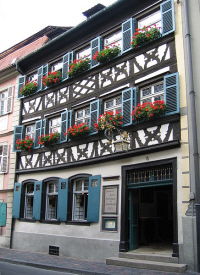 Brauerei Heller: Wirtshaus zum "Schlenkerla" in Bamberg. Photo: Asio otus, Wikimedia commons. Heller-Trum Schlenkerla is the most prominent of the two breweries in the classic Franconian brewing city of Bamberg specialising in the singular art of brewing smoked lager, and this beer, one of three variations that also include a wheat beer and a bock, is the straightforward benchmark of the style. The brewery was founded as a brewpub in the city centre back in 1678, and acquired its nickname from that of one of its landlords who was ridiculed in the local dialect for having an ape-like shambling gait, but since 1936 has brewed on a more peripheral site on Stephansberg site with its own lagering caves tunnelled into the hill. It incorporates its own maltings where the malt is smoked over beechwood before being brewed with the addition of Hallertauer hops, fermented in open vessels and lagered for 6-8 weeks.
The result is a deep chestnut brown with a thick and close yellow-white foamy head. The somoky bacon and vanilla aroma has hints of yoghurt, fresh sawdust and paint. The palate is smooth, creamy and lightly fruity but dry with rich nutty smoky notes, light caramel and marmalade. The hopping is quite firm, and there’s a peaty malt whisky-like character to the finish with dark marmalade and astringent hops. Yes, it’s smoky, but excellently balanced, with rich malt and firm hops offsetting the woodsmoke whiff.
Nonetheless the smoke character is powerful and, though the Heller beers are more obviously beer-like than some other rare traditional styles such as lambic, be warned they’re still an acquired taste — not everyone will immediately appreciate beer that reeks of bonfires, kippers and Islay malts.
More Bières sans frontières selections in the next post.
Read more about this beer at ratebeer.com: http://www.ratebeer.com/beer/aecht-schlenkerla-rauchbier-marzen/1269/
Bières sans frontières, Great British Beer Festival 2007
ABV: 4.9%
Origin: Jever, Niedersachsen, Germany
Website: www.jever.de
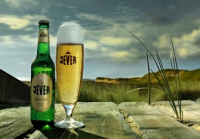 Jever Pilsener This characterful pils-style lager from the German part of historic Fryslân is one of the driest and hoppiest of the established German lagers. Founded by the König family in 1848, the brewery passed through other family hands before being acquired in 1923 by the successful Hamburg-based group Bavaria-St Pauli, and subsequent investment turned it into a national brand. A series of mergers among German regionals from the 1980’s onwards saw Jever split off from St Pauli (now part of Carlsberg) and merged with one of the country’s biggest brewery groups, Radeberger Gruppe, now part of the major food group Oetker, but the brewery, modernised in the 1990s, has been retained and its flagship beer still boasts a distinctive character.
The clear delicate light golden beer has a fine white head and a strong earthy, herbal aroma. The lively palate is very smooth and bone-dry, with clear hoppy giving a grapefruity tang, with a feint yeasty note. The bitterness develops in the finish with late softening hints of vanilla and cream. “Friesisch herb,” it says on the label, actually meaning Frisian dry, though the aromatic herbal character invites the English reading too.
More Bières sans frontières selections in the next post.
Read more about this beer at ratebeer.com: http://www.ratebeer.com/beer/jever-pilsener/4003/
First published in BEER July 2007 as part of a piece on French beer. For more French beers see previous post.
Beer sellers: Cave à bulles
ABV: 5.8 per cent
Origin: Esquelbecq, Nord, France
Website www.brasseriethiriez.ifrance.com
 Thiriez La Rouge Flamande Like most place names around Dunkirk, the name Esquelbecq is originally Dutch – it means “acorn brook”. The village once boasted five breweries, all closed by World War II, but mash tuns steamed again in 1996 thanks to Daniel Thiriez. His is a determinedly artisanal operation producing bottle conditioned speciality ales made from entirely natural ingredients.
La Rouge Flamande is a superb example, named after the Flemish Red breed of dairy cattle and first brewed in 1999 to mark the unveiling of a statue of such a beast in nearby Bergues.
It’s a slightly hazy ruby amber colour with some yellowish bubbly head, and a malty nutty aroma with dense spice and a touch of hop resins. The palate is sweetish but beautifully biscuity with a sappy, meaty note of crystal malt and hints of red fruit and smoke.
A wash of hops heralds more roast and biscuity notes on the finish, with a very faint touch of coal dust in a soft, satisfying finish. Lovers of maltier, milder British bitters should find this very much to their taste – so do have a cow, dude.
Read more about this beer at ratebeer.com: http://www.ratebeer.com/beer/thiriez-la-rouge-flamande/12097/
First published in BEER July 2007 as part of a piece on French beer. For more French beers see previous post.
NOTE: This brewery may since have closed.
ABV: 6.5 per cent
Origin: Saint-Amand-les-Eaux, Nord, France
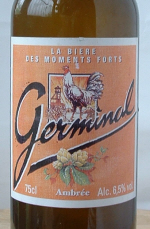 Sources St-Amand Germinal Ambrée The village of Saint-Amand, in a regional park southeast of Lille, was the location for the 1994 film adaptation of Emile Zola’s novel Germinal. When shooting wrapped, director Claude Berri and stars including Gérard Depardieu decided to give something back to the local community by founding a small brewery.
That brewery has had a bumpy history since, sold on due to financial difficulties in 1998, put into liquidation and then resurrected in 2005. But it’s also produced some interesting beers that depart from the traditional model, including this very distinctive bottle conditioned ale which makes a feature of speciality malts.
Deep golden in colour with a thick persistent white head, it has a sappy, herbal aroma with a slightly perfumed cedary note. A sweetish, woody palate once again brings to mind Belgian styles, but with a good hoppy bite. Finally there’s a drying, chewy, slightly wheaty finish with a roasty note and spiced orange emerging.
For more French beers, see next post.
Read more about this beer at ratebeer.com: http://www.ratebeer.com/beer/saint-amand-germinal-ambree/13492/
First published in BEER July 2007 as part of a piece on French beer.
ABV: 8.5 per cent
Origin: St-Sylvestre-Cappel, Nord, France
Website www.brasserie-st-sylvestre.com
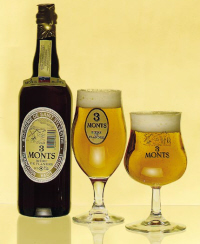 Saint-Sylvestre 3 Monts Think of French booze and you first think of wine. But pride in fine regional food and drink is deeply embedded in French culture, and extends to the grain as well as the grape.
Admittedly the key beer regions tend to the marches of the French hexagon. The most active craft brewing territory is in the north, and in particular a slice of the Nord department around Lille. Bordering on Belgian Flanders, the area was once Dutch speaking, an influence still obvious in place and personal names. The beers, many of them still warm fermented ales, come with a Flemish accent too, as well as an obvious link to the saisons of the nearby French-speaking Belgian province of Hainaut.
France’s commercial brewing powerhouse is Alsace in the east, facing Germany across the Rhine. The region has changed hands between the neighbouring states several times, and the Germanic influence on its beers (and excellent wines) is obvious – though the biggest brands are now controlled from Edinburgh and Amsterdam.
The northwest peninsula of Brittany boasts a cluster of innovative new micros proud to assert their own distinct national identity in this still-Celtic-speaking region. Brewers here have drawn among other influences from their Celtic cousins on the big island just across the Channel.
That big island is cuddling up a bit closer this summer by hosting the grand départ of the Tour de France on 8 July, so I’ve a good excuse to feature French beers this month, focussing on examples from the Nord department since I can’t do the whole country justice in the space. And once the cyclists have waved goodbye to the White Cliffs of Dover, the 14 July might provide another excuse to pull a cork or two.
Unfortunately finding French craft beers in Britain can be challenging – overshadowed by wine, and not helped by the tendency of even the high strength ones to come in big expensive 750ml bottles, they’re regarded by retailers as a difficult sell.
Bigger, but not necessarily better, Northern brands like Jenlain and Ch’ti occasionally find their way into supermarkets here. Beers of Europe in Kings Lynn (www.beersofeurope.co.uk) and Utobeer at London’s Borough Market (www.utobeer.co.uk) usually have a small range of rarer lines, and imported bars at beer festivals are often worth a look.
Although a filtered beer, St-Sylvestre 3 Monts is one of the very finest examples of a traditional blond bière de garde (beer for keeping), with shades of a Belgian abbey blond. The brewery in the village of St-Sylvestre-Cappel dates back to pre-revolutionary times and since 1920 has been in the hands of Ricour factory.
In the early 1980s the current generation thankfully reversed their 1950s predecessors’ decision to move the cold fermentation, and revived traditional brewing techniques. The beers are marketed as sharing in a distinctive French Flemish heritage – thus the Lion of Flanders roaring over the French tricouleur on the neck label.
The name “Three Hills” celebrates the countryside – unusually rolling for Flanders – around the brewery’s home village, St-Sylvestre-Cappel, between Dunkerque and Lille. This is a hop country – the famous Belgian hop centre of Poperinge is just across the border – and a proportion of the hops and most of the malt are sourced locally.
The beer emerges a beautiful burnished gold with a fine bead and a persistent close white head. A rich and estery malt aroma has cream and tangerine flavours with a hint of banana.
There’s smooth oily malt on a perfumed palate with pear-like notes and a dry sacky hop flavour emerging over mouth-tingling alcohol. A long and spicy finish integrates hop bitterness superbly with barley sugar notes, vanilla and grapefruit.
For more French beers see next post.
Read more about this beer at ratebeer.com: http://www.ratebeer.com/beer/st-sylvestre-3-monts/7321/
First published in BEER June 2007 as part of a piece about Threshers off licence chain’s Local Ale scheme. For more Threshers Local Ales see previous post.
ABV: 6.5 per cent
Origin: Basford, Nottinghamshire, England
Website www.alcazarbrewery.co.uk
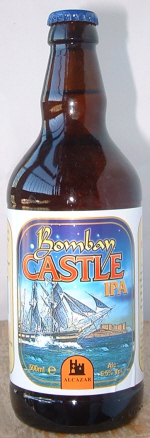 Alcazar Bombay Castle IPA Brewing at the Fox and Crown pub since 1999, Alcazar takes its name from a Moorish-Spanish word meaning “the castle” which according to a lengthy etymology on the brewery website may also be the origin of the English word “ale”.
The quality of the brewery’s take on a traditional India Pale Ale is much easier to substantiate. This golden pure pale malt beer, hopped with Progress and Goldings, pours with a thick white head and a creamy, citric and slightly mineral-tinged aroma.
The crisp palate has light juicy malt and a zesty perfurmed note, but it’s dominated by rooty, earthy hops which persist in a peppery finish, softened by strawberry fruit and sweet malt. A touch of alcohol in the finish is the only hint of the strength in this otherwise dangerously quaffable beer. Watch you don’t fall from the ramparts.
Read more about this beer at ratebeer.com: http://www.ratebeer.com/beer/alcazar-bombay-castle-ipa/40439/
First published in BEER June 2007 as part of a piece about Threshers off licence chain’s Local Ale scheme. For more Threshers Local Ales see previous post.
ABV: 4.6 per cent
Origin: Corfton,Shropshire, England
Website www.suninncorfton.co.uk
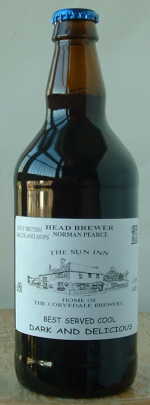 Corvedale Dark and Delicious It’s particularly gratifying that alongside several names familiar on supermarket shelves, the Threshers initiative extends to tiny craft brewers like Corvedale, hand bottling in a shed behind the Sun Inn pub in the Shropshire Hills.
Dark and Delicious, originally a Christmas special, is an unusual beer described by its inventor, landlord and brewer Norman Pearce, as a black bitter. Crystal and chocolate malt colour a Maris Otter pale malt grist, with a touch of wheat malt and Northdown hops.
The result is a very dark amber-brown, with a loose off-white head and a roasty, nutty aroma with a slight whiff of sulphur. There’s a complex palate rich in sappy autumn fruit and nuts, a splash of orange and pineapple acidity, hints of cola and caramel sweetness.
Roasty, slightly burnt, notes assert themselves in a tangy finish, with emerging chewy hops offset by a touch of brown sugar. A very tasty beer that’s a genuine original.
For more Threshers Local Ales see next post.
Read more about this beer at ratebeer.com: http://www.ratebeer.com/beer/corvedale-dark-and-delicious/38225/
First published in BEER June 2007 as part of a piece about Threshers off licence chain’s Local Ale scheme. For more Threshers Local Ales see previous post.
ABV: 5.2 per cent
Origin: Feniscowles, Lancashire, England
Website www.threebsbrewery.co.uk
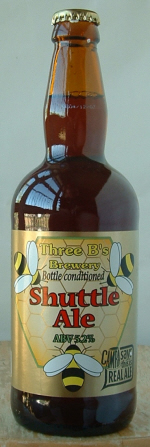 Three B's Shuttle Ale Based on an industrial estate at the edge of Blackburn, Three Bs was founded in 2001 by former home brewer Robert Bell. His dedication to quality is well demonstrated in this excellent special bitter, named like all of Robert’s beers to commemorate the local industrial heritage of the weaving industry.
It’s a burgundy-coloured beer with a good orange-tinged head, made from Maris Otter pale and crystal malts, flaked maize and Fuggles hops. There’s a hint of earthy hops – but not as much as promised on the label – over honey and biscuit malt on the aroma, leading to a smooth biscuity palate with juicy blood orange and firm hop resins.
A slightly astringent swallow yields to a long, fruity finish with blackcurrant, pepper and a hint of burnt toast rounding off a richly satisfying beer.
For more Threshers Local Ales see next post.
Read more about this beer at ratebeer.com: http://www.ratebeer.com/beer/three-bs-shuttle-ale/36509/
First published in BEER June 2007 as part of a piece about Threshers off licence chain’s Local Ale scheme.
ABV: 5.3 per cent
Origin: Sudbury, Suffolk, England
Website www.mauldons.co.uk
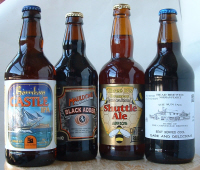 Threshers Local Ales: Alcazar Bombay Castle IPA, Mauldon's Black Adder, Three B's Shuttle Ale, Corvedale Dark and Delicious A couple of decades back, home drinkers looking for life beyond Liebfraumilch and nips of Gold Label would turn to the high street off license rather than the supermarket. But the relentless expansion of the multiple grocers in the carry out sector has now squeezed off licenses’ market share to 18% as opposed to the supermarkets’ massive 66%.
Two survival strategies have emerged for the beleaguered off licenses. The first is convenience – the local offie filling the gap with popular brands when you fancy a drink at home but don’t have anything in. The other is specialisation at the upper end of the market, which until very recently meant fine wine, with the odd dabble in single malts and trendy spirits.
But as you may have read elsewhere in What’s Brewing over the past couple of months, the Thresher Group – now Britain’s biggest off license chain with around 2,000 stores – is experimenting with a new kind of offer to the discerning customer looking for quality booze that’s locally sourced: Local Ale.
The giant retailer is working with independent brewers’ organisation SIBA on a direct delivery scheme, enabling store managers to stock a modest range of locally brewed specialities alongside global brands.
A mouthwatering list runs to over 200 beers, almost half of them Real Ale in a Bottle, from over 100 breweries, tiny craft micros and well-established independents alike. If all these were available together in one place they’d pretty much wipe out the wants list of the average British beer hunter in one fell swoop, but the point is to keep things local, so you’d need to do a lot of travelling to collect the set.
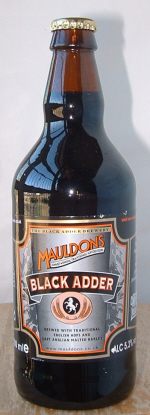 Mauldon's Black Adder From the list I’ve picked out four outstanding bottle conditioned lines that demonstrate the breadth of this laudable initiative, yet another sign that the big retailers are taking notice of the discriminating consumer interested in quality local produce, including decent beer. Check the brewery websites for details of other outlets.
Mauldon’s is a resurrected brewery: the family began with a brewpub in Sudbury in 1795 and built up an estate of 30 tied houses before selling out to Greene King in 1960. 22 years later, Peter Mauldon, himself a brewer with Watney, decided to revive the family business. Peter has now retired,but current owners Steve and Alison Sims still do the family name proud.
The strapline “The Black Adder Brewery” makes clear which of Mauldon’s excellent range of beers is the most widely celebrated: a dark ruby “bitter stout”, brewed from Maris Otter and Pearl pale malts, crystal and black malt and Fuggles hops.
A roasty, slightly salty aroma with a hint of olives and fruit introduces a milk chocolate palate that’s very light textured for the strength, with gravy, red fruit, coffee and spicy bitterness emerging.
An equally drying finish has big roast notes, slightly sharp hops and cocoa powder on the tongue. This is a great example of a big dry roasty beer, fully deserving of its star rating in the Good Bottled Beer Guide.
For more Threshers Local Ales see next post.
Read more about this beer at ratebeer.com: http://www.ratebeer.com/beer/mauldons-black-adder/2905/
|
|
