A sample text widget
Etiam pulvinar consectetur dolor sed malesuada. Ut convallis
euismod dolor nec pretium. Nunc ut tristique massa.
Nam sodales mi vitae dolor ullamcorper et vulputate enim accumsan.
Morbi orci magna, tincidunt vitae molestie nec, molestie at mi. Nulla nulla lorem,
suscipit in posuere in, interdum non magna.
|
Top Tastings 2008. A shorter version appeared on facebook, January 2009.
ABV: 4.5%
Origin: Sunderland, England
Website: www.durhambrewery.com
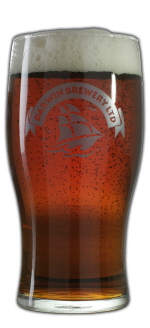 Darwin Brewery This brewery specialising in historical recreations has an interesting history itself. It began in 1994 as a teaching facility at Brewlab, the University of Sunderland’s well reputed brewing school, initially expanding to take over the old Hodge’s Brewery in Crook and moving back to Sunderland in 2002 to take over the brewing kit of the well respected but sadly defunct micro Butterknowle. Operated as a commercial undertaking but still with links to Brewlab, it’s since become an multi-award winner in its own right.
Richmond Ale is based on the traditional strong dry brown ales of northeast England that originally developed in the late 19th century — this particularly recipe comes from Richmond, North Yorkshire. It’s brewed from Yorkshire malts, including specialist crystal malts, and Fuggles hops. There are cask and filtered bottled versions but a Real Ale in a Bottle occasionally emerges — I caught one at the bottle conditioned bar at the Great British Beer Festival in 2008.
The more widely available filtered version is nonetheless a great beer, a deep bronze colour with a fine off-white lacy head and a pleasant chestnut cream and vanilla malt aroma. The sweetish toffee palate has a touch of fruit and notable roasty smoky flavours, and twiggy, herbal hops emerge on a soft rounded finish that makes for a dry but very drinkable beer.
The bottle conditioned version is a more complex proposition, with a more fruity and nutty aroma, with raisins and figs tinged with yeasty esters reminiscent of Belgian abbey browns. A sappy, slightly roasty palate has plenty of orange and blackcurrant fruit, subtle resins and a hint of belt leather. The hops are burry but subtle and gentle, again developing a pleasant dry bitterness in a long, sappy and fruity finish with more mineral, cindery roast flavours.
Read more about this beer at ratebeer.com: http://www.ratebeer.com/beer/darwin-richmond-ale/1080/
 Great British Beer Festival 2010 The Great British Beer Festival (GBBF), organised annually by the Campaign for Real Ale (CAMRA), is a remarkable event. This year almost 67,000 people, about 5% more than last year, drank about 114,000l (200,000 pints) of over 700 beers, faciliated by over 1,000 volunteers. This makes it the biggest event of its kind in the world. Its nearest competitor, the Great American Beer Festival (GABF), taking place in just over a month’s time, is expected to welcome 49,000 people — the beer choice will be much wider, but only available for tasting in miniscule measures.
The event easily fills the windowless cavern of Earls Court, Central London’s biggest exhibition venue, to occasionally uncomfortable levels, with an impressively broad spectrum of beer drinkers. It’d be silly to pretend you don’t see anyone conforming to the popular stereotype of the CAMRA member, but they are very much the minority. The crowd covers a range of ages, a decent balance of gender (though still a bit heavy on the XY chromosomes) and even makes a respectable stab at ethnic diversity. Beer bellies in worn ‘Afraid you might taste something Lagerboy?’ T-shirts and twitchy ticking geeks rub shoulders with normal people out with mates and colleagues; suits and power frocks mix with punky-haired surf types. The dressers for fun range from fabulously stylish — a file of women in glamorous vintage evening wear wafted down the escalator from the members’ lounge — to embarassing — the business suited young man dressed to appear as if he had a giant furry penis stuck through his head hit a new nadir in the unfortunate festival tradition of “wacky” headgear. But everyone gets on in a good natured way. It’s signficant that, given the amount of alcohol consumed, this huge event is remarkably trouble-free, a fine advertisement for our capability to drink responsibly if we choose.
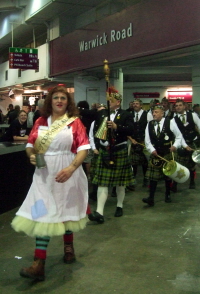 The festival inevitably embodies some of the contradictions of the organisation that runs it. CAMRA’s official priority is to promote British cask beer, with bottle conditioned and/or imported craft beers, plus real cider and perry, as a footnote. But the festival has become an international celebration of beer itself, with the imported beer bars, Bières sans frontières (BSF), an attraction in themselves, a rallying point for the worldwide craft brewing community, of which more later. CAMRA does recruit at the festival — this year it signed up about 1,000 new members — but it still struggles to connect with the majority of visitors. Most are there to enjoy good beer in good company, in the same way they enjoy other fine things in life, and aren’t too worried about matters such as the amount of foam on their pint, or whether or not Marstons’ new Fast Cask system of jellied yeast pellets counts as real ale. The festival inevitably embodies some of the contradictions of the organisation that runs it. CAMRA’s official priority is to promote British cask beer, with bottle conditioned and/or imported craft beers, plus real cider and perry, as a footnote. But the festival has become an international celebration of beer itself, with the imported beer bars, Bières sans frontières (BSF), an attraction in themselves, a rallying point for the worldwide craft brewing community, of which more later. CAMRA does recruit at the festival — this year it signed up about 1,000 new members — but it still struggles to connect with the majority of visitors. Most are there to enjoy good beer in good company, in the same way they enjoy other fine things in life, and aren’t too worried about matters such as the amount of foam on their pint, or whether or not Marstons’ new Fast Cask system of jellied yeast pellets counts as real ale.
These contradictions are contained — just — by the de facto overlap between “real ale” and fine beer in the UK, but that is increasingly coming under (CO2) pressure. This year I went for the first time to the British Guild of Beer Writers’ pre-festival reception on the Monday night. On a temporary stillage in the large back room at Brew Wharf in the Borough was a good range of casks from brewers in and around London, and at the end of these a couple of lonely keg taps which piqued my curiosity. They were dispensing beers from the Camden Town brewery, an outfit newly expanded from a small plant at the Horseshoe pub in Hampstead. One was an excellent Helles, the other an American-style pale ale. I was introduced to the Australian brewery owner and his head brewer, a young Dane, neither of whom have any special loyalty to cask, but they do have a determination to produce quality characterful beer. The fact that it wouldn’t be allowed at a CAMRA festival on technical grounds while clearly inferior products would is one thing I hope the forthcoming review of CAMRA’s policy and direction will have the courage to address.
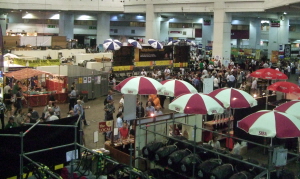 The Great British Beer Festival 2010. It was big. That’s not to say that the quality of good cask beer is anything less than breathtaking. The offer at the Beer Writers’ evening included some winners: East London’s Brodie’s continued to dazzle me with their Summer Stout, absolutely packed with flavour and yet only 2.7% ABV. The Champion Beer of Britain (CBoB) final, which takes place at GBBF, also affirms the potential of British cask ale at its best. This year’s list of category winners was impressively diverse in number and type of breweries. The overall gold and silver medallists, respectively Castle Rock Harvest Pale and the well-known Timothy Taylor’s Landlord, are both outstanding, and contrasting, examples of top notch cask.
And yet, regarding the massed ranks of pale and golden ales of between 3.5% and 4.8% ABV that still form the majority of beers on offer at the British bars, this year arranged rather bafflingly according to “counties” of the organisers’ own devising, I couldn’t help but think British brewing needs an injection of excitement, experimentation and pizzazz. There’s a buzz to the BSF bars, a sense of adventure and discovery, that doesn’t quite extend to the rest of the hall (I can’t speak for the cider and perry bar as it’s beyond my expertise). There are plenty of British brewers among the drinkers but the BSF bars attract brewers and brewing personalities to volunteer. Menno Olivier of De Molen at Bodegraven near Rotterdam is a regular visitor and this year brought three giant wooden casks of special editions. Alex Liberati, of Rome’s cutting edge Brasserie 4:20 beer pub and the Revelation Cat beer firm, was conducting informal tastings of Italian craft brews. And thanks to an expanded partnership with the Brewers’ Association, GBBF this year had its biggest ever range of US craft brews, including around 100 in cask.
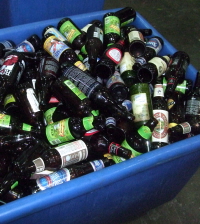 Great British Beer Festival 2010. Hundreds of unusual US craft brews but the punters still go for the tried and tested! More special and unexpected attractions such as this could be strategically spread around the festival — genuine ones, not the ticker beers that blight some CAMRA festivals. The British Real Ale in a Bottle Bar, though staffed by hard working volunteers and with a great selection which always claims some of my carry out allowance, could do with some more unusual brews and perhaps some spontaneous tastings and brewer involvement. Fuller’s did its bit by releasing a firkin a day of the rare cask version of Brewers Reserve No 2 aged in cognac barrels at its brewery bar. Thornbridge, one of the most adventurous British brewers, had a brewery bar for the first time but played safe by concentrating on its cask session ales, rather than the amazing wood aged imperial stouts it had at the Pré-ZBF event in Flanders back in March.
One new perspective I enjoyed this year was volunteering for the first time — I spent the Wednesday behind the BSF Belgian, Dutch and Italian bar. As you’ll recall from the statistics quoted above, that makes me one of over 1,000. If you’ve been to GBBF you’re probably at least dimly aware that it’s run by this huge army of volunteers, but you may well not have thought through exactly what that means. I hadn’t either, until I became a volunteer and started thinking about the immensity of it all. It’s physically brought home to you when you walk through the staff entrance opposite West Brompton tube and go up to the 5300m², 2000-capacity Brompton Hall on the first floor, which serves during the festival as the Volunteer Village, complete with its own bar, the Volunteer Arms.
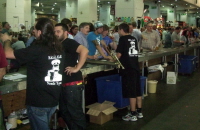 Great British Beer Festival 2010: the view from the other side of the bar, in this case the BSF Dutch/German/Italian one. The festival organiser, Marc Holmes, is himself a volunteer, and under him is a well organised structure of coordinators, managers and rank and file, all working with the sort of efficiency and smoothness that would do a professional events company proud, except that a company would charge serious money for delivering something of this size. Sometimes activities run by long standing volunteers can be a bit cliquey and unwelcoming, but at GBBF quite the reverse was the case. Everyone was lovely — and I know some of them recognised my name, but I genuinely think they would have been as nice to anyone.
Working behind the bar was both an enjoyable and a beneficial experience. Bar manager Roger explained that the customers split broadly into two groups: seasoned beer hunters who know exactly what they want, and people trying new things that need advice and recommendations. I was glad to deal with both, but it was good to meet those in the latter group, given that most of the people I discuss beer with are geeks like me. I knew for example, about the popularity of fruit beers with people who aren’t hardened beer drinkers, but it was very instructive to see it in action. It’s made me realise that one day I really must try a bottle of Drie Horne Bananatana. I was hoping to serve one to Penis-Head, but he asked for the best beer on the bar and my honesty compelled me to sell him a bottle of Rochefort 10.
Festival web pages: http://gbbf.camra.org.uk
Beer picks
- Brodie’s Summer Stout 2.7% London E10, England
- Camden Town Helles 4.8% London NW5, England
- Rebellion IPA 3.7% Marlow, Buckinghamshire, England
- Fuller’s Brewer’s Reserve No 2 7.7%, London W4, England
- Port Older Viscosity 2009 12.5% San Marcos, California, USA
- Molen Revelation Cat Whole Milk Mild 3.5% Bodegraven, Zuid-Holland, Netherlands
Top Tastings 2008. A shorter version was first published on facebook January 2009.
ABV: 6.8%
Origin: Piozzo, Piemonte, Italia
Website: www.baladin.it
 Baladin Nora Birra Egizia The restlessly creative Teo Musso is one of the pioneers of the new wave of Italian craft brewers: his brewpub Baladin dates back to 1996 and originally showed a strong Belgian influence attributed to the Flemish background of Teo’s Lille-born wife Nora. But since then he’s really pushed the envelope with unusual grains, flavourings and techniques, the last including playing music to maturing casks. Eccentricities aside, he seems incapable of producing a beer less than interesting.
This ‘Egyptian beer’ named after Nora is an organic wheat beer made partly from the ancient Egyptian kamut variety of wheat, and following other fragments of what we now about the brewing practices of the civilisation that built the pyramids, is flavoured with ginger and myrrh.
It’s a cloudy orange with a thick slightly orange-tinted head and an unusual very grassy and chaffy aroma with notes of aniseed, lemon, camomile and liquorice. The palate is smooth and lightly citric with date-like fruit and distinctive herbal notes, finishing mild but refreshingly grainy with summer grass and a dash of hops, very easy drinking for its ABV. Bought at the Great British Beer Festival.
Read more about this beer at ratebeer.com: http://www.ratebeer.com/beer/baladin-nora/14552/
Great British Beer Festival 2010
ABV: 3.5%
Origin: Bodegraven, Zuid-Holland, Netherlands
Website: www.brouwerijdemolen.nl
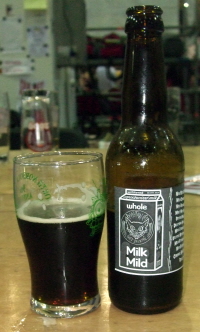 Revelation Cat Whole Milk Mild This is a beer deserving of the description ‘eclectic’: a cross between two traditional and somewhat neglected English beer styles, mild and milk stout, commissioned by an Italian and brewed by a Dutchman. The idea was dreamed up by beer guru Alex Liberati, of Rome’s celebrated beer bar Brasserie 4:20, for his Revelation Cat beer firm. Like some of the cutting edge brewers now doing the rounds in Europe, Alex doesn’t have his own kit, but works at other people’s breweries. For this beer, he approached Menno Olivier at De Molen, no stranger to collaborations on unusual beers, and Menno perfected the recipe.
It involved obtaining supplies of proper English mild ale malt, once a mainstay of British brewing but now something of a speciality line, and expensive to ship across the North Sea in small quantities. The hops are the Czech varieties Premiant and Sladek, the latter one of the Žatec hybrids. The beer is also dosed with lactose, the unfermentable sugar that lends a characteristically sticky sweetness to milk stout — the label states 25kg was added per 800l, which by my reckoning works out to about 31g/l.
The result is a dark brown beer with a fine, thick yellow-beige head. The rather oily and inviting aroma is tinged with drinking chocolate powder and dark malt, leading to a big bodied, sweetish and aromatic palate with the quality of milk chews, lifted by tangy, lightly acidic fruit and a touch of roast. A soothing, decently chewy and very lingering finish has cinder toffee notes and a light touch of roast.
The beer attracted deserved interest at the Great British Beer Festival — all that trouble to source the mild malt was clearly worthwhile. I’ve a soft spot for dark, sweetish low gravity beers anyway, but even if you don’t, this is well-balanced enough to please, and that indulgent oily lactose note is enough to make a cat purr.
Read more about this beer at ratebeer.com: http://www.ratebeer.com/beer/revelation-cat-milk-mild/110751/
Great British Beer Festival 2010
ABV: 12.5%
Origin: San Marcos, California, USA
Website: www.portbrewing.com
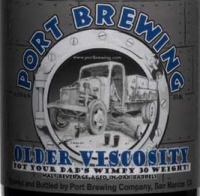 Port Older Viscosity Port Brewing is one of the leading lights of West Coast craft brewing, particularly for the Lost Abbey series of special beers created by its head brewer Tomme Arthur. At GBBF, Older Viscosity was labelled a Lost Abbey beer, but it’s actually a plain Port production — in as much as an extraordinary 12.5% wood aged barley wine can be described as plain. Older Viscosity began life as a mere component in the brewing process of Old Viscosity, a more commonly available 10.5% strong dark ale that draws on the technique of ageing and blending inspired by traditional but now near-vanished European processes. Old Viscosity is a blend of 80% of a fresh beer fermented in stainless steel from two row pale, US and English crystal, Carafa III and chocolate barley malts, wheat malt and German Magnum hops, blended with 20% of the same beer matured in refill Bourbon barrels. Older Viscosity is the neat Bourbon-matured stuff, two vintages of which were available in cask at the Great British Beer Festival as part of that event’s most impressive array yet of US craft beers.
I sampled the 2009, a jet black beer that smelled of typewriter ribbons (remember them?), its aroma an intoxicating burst of vivid scents including dark malt, blueberry, mint and whiskyish hard liquor. A lovely slick palate was lightly chocolatey and oily, with rich fruit cake and sultanas, more berry fruit and some definite bourbon notes. A grainy swallow heralded a warming, sticky, fruit cake and rye bread finish that was long and alcoholic but very soft, gently and soothing, with a just a hint of wood. A beautiful, world class special beer that brought my first day at GBBF to a perfect close.
Read more about this beer at ratebeer.com: http://www.ratebeer.com/beer/port-brewing-older-viscosity/66624/
Great British Beer Festival 2010
ABV: 7.7%
Origin: London W4, England
Website: www.fullers.co.uk
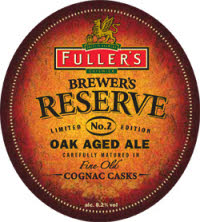 Fuller's Brewer's Reserve No 2 Limited Edition Oak Aged Ale The Brewer’s Reserve series is Fuller’s head brewer John Keeling’s limited edition of wood aged beers, starting with a Glenmorangie whisky cask version in 2008. The second edition uses the same beer recipe but matured for a year in oak Cognac barrels. Though primarily intended for limited edition bottling, some of the beer has been put into draught casks, and Fuller’s were tapping one firkin a day at their brewery bar at this year’s Great British Beer Festival. I’m grateful to the neatly suited blokes from the brewery who spotted my Fine Ale Club polo shirt and pointed me in the right direction at the right time.
The beer is a pale Tizer-like amber, with only a little bubbly head. The aroma has that instantly recognisable orangey Fuller’s note that blends with the spirity notes from the Cognac to give an impression of orange liqueur. It’s quite intoxicating and also includes wafts of wood and oaked chardonnay. A rich, complex and sweetish palate is honeyed and thick, with more wood, tangy orange and spirit notes well blended with the malty beer character. A long and chewy finish is generously fruity and mouth coating.
This matches its predecessor in being a very interesting, enjoyable and well made beer, fine but approachable. John has raised the bar very high with mind-blowing masterpieces like his Vintage Ales, especially when they’re given some age — while not quite reaching that level, these Reserve beers are a very welcome addition to an impressive range.
Read more about this beer at ratebeer.com: http://www.ratebeer.com/beer/fullers-brewers-reserve-no-2/127709/
Great British Beer Festival 2010
ABV: 3.7%
Origin: Marlow, Buckinghamshire, England
Website: http://www.rebellionbeer.co.uk/
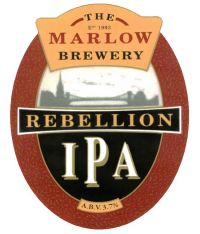 Rebellion IPA Rebellion, founded in 1993 and now a decently sized and highly respected micro, has kept the flag flying for brewing in the Thamesside town of Marlow since Whitbread closed the historic Wethereds brewery –its founders originally hoped it could be incorporated in the redevelopment of the old brewery site but this was not to be. Its beers show a flair for memorable and distinctive flavours which has secured it a good distribution in the free trade. The multi-award winning IPA is its best seller — not a true IPA in the historic sense but a beer of good hop character and an impressive amount of flavour for a low strength. I finally got round to trying it on cask at this year’s GBBF.
It’s a lovely amber colour, with a little just off-white head. A creamy and fruity aroma has toffee and nut notes, leading to a tasty, nutty and lightly sappy palate, marvellously balanced, which in my sample was in perfect condition. There are complex notes of leafy hop and a chewy, drying, lightly mouth coating finish with emerging grittiness, autumnal fruit and a late hop sting. A British real ale classic.
Read more about this beer at ratebeer.com: http://www.ratebeer.com/beer/rebellion-ipa/14258/
Great British Beer Festival 2010
London Beer Tastings 2011: Revised October 2011.
Hells Lager was featured in a piece on bottle conditioned beers from London in BEER August 2011. Read more about London bottle conditioned beers.
ABV: 4.8%
Origin: London NW5, England
Website: http://www.camdentownbrewery.com/
 Camden Town Brewery Australian-born Jasper Cuppaidge owns the Horseshoe pub in Hampstead, and in 2006 installed a tiny microbrewery in the cellar. In doing so he was following in an honourable tradition, as his family once owned the McLaughlin brewery in Rockhampton, Queensland, bought by Carlton & United (Fosters) in 1961. He grew up with brewing and pubs in his blood, and his first brew at the Horseshoe, a birthday present for his mother, revived both an old family recipe and the McLaughlin brand.
Perhaps unexpectedly, given that this was not some real ale boozer but a stylish gastropub attracting a young and trendy crowd, the own-brewed beer proved a hit, holding its own against the British and imported craft beer classics on sale and suggesting there was a growing market for locally brewed quality beer. Jasper originally planned a moderate expansion but was persuaded to seek investment on a much bigger scale. He recruited Danish head brewer Troels Prahl, a renowned yeast expert who runs what’s essentially the European branch of US yeast supplier White Labs, and in 2010 a gleaming computer-controlled German-built 20hl brewhouse was installed under five arches at Kentish Town West Overground station. Since then demand has rocketed and the kit has expanded further.
I first met both men soon after the commissioning of the new brewery at the pre-GBBF 2010 reception hosted by the British Guild of Beer Writers at Brew Wharf. Their dedication to and enthusiasm for the cause of good beer was obvious but it was clear they weren’t heading down the traditional British micro route of beer festivals, guest ales and free houses, instead looking for other outlets including style bars and food venues. Though they both love cask beer, it didn’t occupy top priority in their business model. To the disappointment of a few real ale stalwarts, both offerings at the reception were craft keg beers, early adopters in a market that’s becoming increasingly important in London.
These beers were an American pale ale that’s since become the brewery’s flagship, and an already very impressive crack at a cold fermented and properly matured traditional German unpasteurised lager, Camden Town Hells. I noted this at the time as a slightly hazy yellow beer with a fine white head and an aroma that was both lightly flowery and floury, with that flour-and-water-paste note boasted by some of the leading German-brewed examples of the style.
Hoppy floweriness continued into a nicely malty, refreshing and slightly citric palate, pebbly on the tongue — its creators told me it had a bit too much hops to be a true Helles and shaded towards pils but I found a good firm malt there too. The shortish finish was pasty and lightly hoppy. Overall it was a refreshing, decent and very promising.
Since then the recipe has been tweaked and, according to Jasper, improved still further. A sample unpasteurised bottled version the brewery sent me early in 2011 turned out to be a very accomplished beer. This was clear gold with a fine just off-white head, and a very honeyed malty aroma with an undertow of lime. Again there was that full, firm malt I look for from a helles, juicy and honeyed with subtle citrus, a tingle of noble hops and tasty, slightly spicy notes at the back of the mouth. The finish stayed honeyed with lightly fruity cereal, and a sprinkling of lightly metallic hops.
The Pale Ale may be more popular, but to me this has become Camden Town’s most accomplished beer.
Read more about this beer at ratebeer.com: http://www.ratebeer.com/beer/camden-town-hells-lager/127856/
Great British Beer Festival 2010
ABV: 2.8%
Origin: London E10, England
Website: www.brodiesbeers.co.uk
Brodie’s, the in house brewery at the William IV pub in east London, continues to impress with an imaginative range of beers including plenty of the dark stff. Served from cask stillage at the British Guild of Beer Writers’ pre-GBBF reception at Brew Wharf in Borough, this low gravity dry stout is one of their latest wonders.
It’s an almost black beer with a few red flecks and a nicely thick and bubbly yellowy-beige head. A rich aroma of blackcurrant and liquorice is accompanied by some casky notes, leading to a palate that c0ntrives to be bitingly dry, roasty and tarry and also light and drinakable at the same time, a great balancing act. A slightly thin and watery swallow betrays the low ABV, but there’s some fresh chaff and plenty on the remarkably long finish: bitter chocolate and roast, chewy herbs, leafy blackcurrrant and coffee. A simple but very fitting name, and a noteworthy brewing achievement.
Read more about this beer at ratebeer.com: http://www.ratebeer.com/beer/brodies-summer-stout/127186/
Top Tastings 2008. A shorter version was first published on facebook January 2009.
ABV: 9%
Origin: New York City, New York, USA
Website: www.brooklynbrewery.com
 Brooklyn Local 1 Celebrity brewer Garrett Oliver of the influential Brooklyn brewery has excelled himself with this stylishly bottled and bottle conditioned premium treat, and New Yorkers should think themselves lucky their local brew, available widely in supermarkets throughout the city, is as good as this. It’s a Belgian inspired ale made with German ingredients — Bamberg two-row pils malt, German Hallertauer, Perle and Styrian Goldings hops – with a dose of Madagascan first pressing Demerara cane sugar and, as the publicity has it, some “Brooklyn fortitude.”
The beer is a hazy gold with a lively bead and a fine white head, from which emerges a complex apple, marmalade, phenol, vanilla and fig aroma. The palate is very firm with mouth numbing alcohol, slightly sweetish but lifted by bitter orange and a hint of fruity green herbs, with some chewy hops too. There’s a slightly burnt note creeping into a tangy, chewy and lasting orange finish. It’s a big beer, but dry, crisp and very distinctive.
Read more about this beer at ratebeer.com: http://www.ratebeer.com/beer/brooklyn-local-1/70492/
|
|
