A sample text widget
Etiam pulvinar consectetur dolor sed malesuada. Ut convallis
euismod dolor nec pretium. Nunc ut tristique massa.
Nam sodales mi vitae dolor ullamcorper et vulputate enim accumsan.
Morbi orci magna, tincidunt vitae molestie nec, molestie at mi. Nulla nulla lorem,
suscipit in posuere in, interdum non magna.
|
Top Tastings 2010 (JJJ IPA)
ABV: 7.5% and 9.5%
Origin: Pitney, Somerset, Engand
Website: www.moorbeer.co.uk
An extended review of a beeer featured as a strong and special beer on the bottled beer review page in the November 2010 issue of BEER magazine, sent free every quarter to CAMRA members, who can also view it online. The magazine is additionally available in selected newsagents.
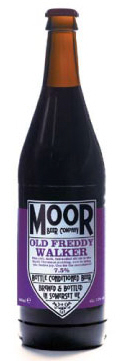 Moor Old Freddy Walker For some reason I’d missed out until recently on the products of one of Britain’s gold starred Real Ale in a Bottle producers, Moor Beers, established in 1996 near Glastonbury but relocated to Pitney in 2008. Since 2007 the brewery has been run by Californian Justin Hawke with his wife Maryan, and they’ve unashamedly pursued a policy of incorporating the vivid flavours of Californian brewing into the British microbrewed real ale tradition. All the beers are well presented in generous 660ml bottles with attractive art nouveau-style labels.
Moor’s best known beer is Old Freddy Walker, an old ale dating back almost to the brewery’s beginning, with a string of awards to its credit. Brewed from pale, lager, crystal and black barley malts and wheat malt, and hopped with Liberty and Bramling Cross, it’s bottle conditioned for at least a month before release and Justin reckons it’s at its peak at least a couple of months after that.
It’s a near-black beer with a thick orangey-beige head and an aroma of chocolate coated raisins with leathery spice and dark malt. The estery, freshly fruity and full bodied malty palate has a leady chocolate note and a sting of roasty, ashy dryness, though within an overall smooth texture also yielding some complex rooty flavours. A dry and bitterish malt cake finish has quite a roasty note developing, with tart fruit, soothing chocolate and lightly spicy hops. The label’s reference to “liquid Christmas pudding” implies something a bit sweet and sickly – but although rich this is a beautifully smooth and fresh beer with a pleasant tart edge.
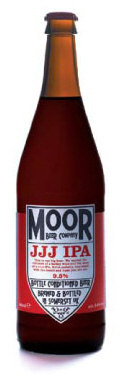 Moor JJJ IPA JJJ IPA is even more impressive if only since it’s an unusual style for a British brewery, though it’s dead on for a Californian “hophead” double or triple IPA, and would hold its own among the more celebrated examples of the style. The three J’s are Justin himself, and James and Josh from a nearby pub, who between them developed the beer, which now has a list of awards in its own name to rival Old Freddy Walker.
This deep amber beer has a fine thick yellow head, with toffeeish resiny hops immediately apparent on the aroma, laden with roses, fresh hay and fruit. A lovely rich toasty palate supports a big citric, caramel, cracked pepper and coconut spicy hop bite. The alcohol is warming in the mouth with spirity esters. A long peppery hop finish is warming and slightly tannic with peach stone, artichoke and burnt rubber notes, but plenty of malt to support the bitterness and lend subtlety. A very impressive beer and actually one of the best of its type I’ve encountered.
Buy this beer from http://AlesbyMail.com as part of a special pack containing all the beers featured on my beer review page in BEER this month. BEER readers receive a special discount by entering the voucher code shown in the magazine.
To download BEER if you’re a CAMRA member, see http://www.camra.org.uk/page.aspx?o=beer.
To find out more about CAMRA membership, see http://www.camra.org.uk/page.aspx?o=joinus.
Read more about these beers at ratebeer.com:
http://www.ratebeer.com/beer/moor-old-freddy-walker/29824/
http://www.ratebeer.com/beer/moor-jjj-ipa/83911/
ABV: 8.7% and 10.7%
Origin: Manchester, England
Website: www.marblebeers.co.uk
An extended review of a beer featured as a strong and special beer on the bottled beer review page in the November 2010 issue of BEER magazine, sent free every quarter to CAMRA members, who can also view it online. The magazine is additionally available in selected newsagents.
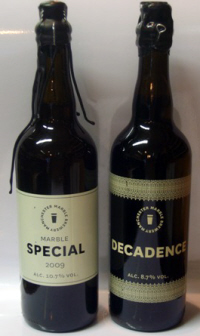 Marble Special and Decade. Pic from the Beer Emporium: www.thebeeremporium.com In a city with more than its fair share of great pubs and bars, the Grade II listed Marble Arch, in rather unpromising surroundings just north of the city ring road at Ancoats, is one of the real stars. Connoisseurs of historic pubs will admire the narrow but high-ceilinged single bar with its impressive ceramic tiling, and diners the excellent food, but the highlight is the first class beer. Most of the cask choices are supplied by the in-house brewery, which is also winning a reputation for itself in the free trade as one of the most imaginative and reliable micros in northern England.
This reputation can only be enhanced by a relatively new line of very special strong limited edition beers, conditioned in 750ml Bordeaux-style bottles with wired and waxed corks, the elegant presentation matching the quality of the content. Many drinkers will raise their eyebrows at the price tag – around a tenner a bottle from the pub, but I for one am glad to see a British brewer daring to up the stakes by putting a realistic price on a fine, rare, artisanal product, a practice now relatively common among the craft brewers of the USA and Italy.
I tasted both Special Barley Wine and Decadence Imperial Stout – both were excellent but the stout impressed the most. It’s near black, with a deep beige head and a dark malt and spice cake aroma with notes of Marmite and tropical fruit hops. A malty, cakey and very smooth palate develops rich fruity flavours – pineapple syrup, lemons, raisins, plums and crystallised ginger – but all with an intriguing bitterish hop lift. More bitter hops assert themselves in a long, drying, lightly roasty finish that develops pineapple, chocolate and charcoal notes. There’s a touch of American influence at work in this very fine example of the style that could clearly withstand some ageing. Frambozen (raspberry) and kriek (cherry) versions are also available.
The barley wine pours a hazy, reddish amber with a fine orangey-white head. There are coconut, farmyard, glucose, grapefruit and boot dubbin notes on very American-influenced hop dominated aroma, and the palate is rich in tropical fruit, pineapple and peach with a lightly bitter and very distinct hop bite. A mouth coating swallow leads to a long-building finish with peach fruit, grapefruit zest, nuts and some alcoholic weight. The hops are firm but not overpowering. The best before date is set 10 years in advance – December 2019 for my sample of brew 1500 from 2009 – and I suspect that with five years in a good cellar the beer will be an absolute knockout, but it’s well worth drinking young.
Buy this beer from http://AlesbyMail.com as part of a special pack containing all the beers featured on my beer review page in BEER this month. BEER readers receive a special discount by entering the voucher code shown in the magazine.
To download BEER if you’re a CAMRA member, see http://www.camra.org.uk/page.aspx?o=beer.
To find out more about CAMRA membership, see http://www.camra.org.uk/page.aspx?o=joinus.
Read more about these beers at ratebeer.com:
http://www.ratebeer.com/beer/marble-decadence/82621/
http://www.ratebeer.com/beer/marble-special/115557/
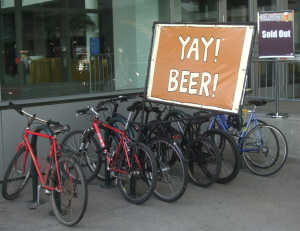 Beer gets on the bike at Denver Convention Center. As a veteran of the Great British Beer Festival (GBBF) visiting the Great American Beer Festival (GABF) for the first time, you’re inevitably drawn to make comparisons. And the one that comes spontaneously to my mind is that the GABF is, well, sexier. Although the GBBF is starting to shift a bit in terms of demographics, at GABF there’s a younger, trendier feel. It’s still predominantly a male crowd — my impression was that the British event is doing rather better in terms of gender balance — but there are notably less beards, beer bellies and decaying T-shirts and notably more strapping crop-haired and heavily tattooed twentysomethings in combat shorts. And though some of my dearest friends have beards and beer bellies, I confess the latter group are easier on the eye.
Curiously, women seem better represented among the ranks of orange T-shirted, Samuel Adams-sponsored Brewers Association volunteers. They, too, are a notably youthful bunch. And before I find myself up on charges of ageism, I should add that it’s not just the age but the buzz — the exhilirating feeling that the event is part of something cuttting edge and brimming with energy. It’s not that the GBBF doesn’t buzz in its way, but it could do with an injection of GABF-style adrenalin.
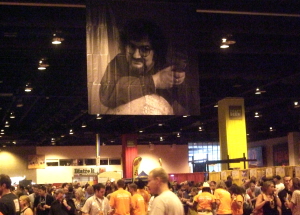 The iconic Michael Jackson presides in spirit, Great American Beer Festival 2010. Such comparisons are apt as the American festival is historically the daughter of the British one. As is well known, GABF founder and US home brewing guru Charlie Papazian got the idea while visiting GBBF in the company of the great Michael Jackson. A much quoted but possibly apocryphal account of their conversation has Charlie saying they should do something like this in the States and Michael replying, in his dry Yorkshire way, “Good idea, Charlie. But what would you do for the beer?” A photo of Michael in his twinkling prime, leaning on a globe with beer glass in hand, now hangs over the extensive bars in the Denver Convention Center, like a beneficient founding father. He’d no doubt take great pride in what they’ve done for the beer since then.
At the 29th GABF, the beers came in over 2,000 varieties from over 460 breweries, and that’s still not even a third of the total breweries now operating in the United States. According to the latest Brewers Association figures, there are 1,640 working breweries, of which almost 1,000 are brewpubs and a mere 20 are big industrial plants. As in Britain, while the overall beer market is shrinking, exacerbated by the recession, sales of craft beer are expanding. The dollar value was up last year by over 10% from 2008, and early figures for this year show the upward trend persisting. But craft beer is still a small fish in a very large pond of yellow rice-based fizz, accounting for only $7billion of the US total of $101billion of beer sales in 2009.
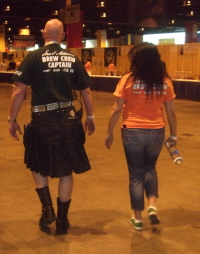 Brew Crew Captain and friend With their native brewing tradition obliterated by Prohibition and the subsequent rise of the megabrewers, American craft brewers started from a clean slate, and the original tendency to clone Old World styles has long since passed into history. US versions of India Pale Ales, laden with the oily bitter grapefruit and pineapple kick of Cascade hops, have become the signature products of the craft brewing movement, and they’re still the biggest sector of the market. But there’s much, much more. Stouts, porters and even pilsners are likely to have their hopping rates and gravities cranked up to 11. Beers of all styles are regularly dosed with wild yeasts and aged in Bourbon barrels and/or flavoured with anything from cocoa pods, chilli and coconut to spruce tips and white sage.
GABF also includes a beer competition, which is more integral to the event than Champion Beer of Britain is to GBBF, and occupies several days of judging time. The competition is style-obsessed to say the least, and to accomodate the burgeoning imagination of brewers there are now 79 recognised style categories, from American-style India Pale Ale to Wood-and-Barrel-Aged Strong Stout. Pity the poor judges who receive a thick volume of definitions before starting work. The home brewing heritage, so important in a country where opportunities to develop the craft professionally were once very limited, is reflected in a Pro-Am strand where home brewers team with commercial brewers to enter newly created beers.
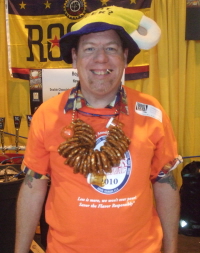 Some aspects of beer festivals are universal. The Convention Center, with its landmark sculpure of a giant blue bear peering through the plate glass, is a vast space, the bigggest indoor venue in the state, bigger than the GBBF’s Earls Court but considerably less crowded. Even so, the atmosphere is hectic. Queues, or ‘lines’ in the local parlance, rapidly form for certain breweries. They also form for the toilets, or ‘rest rooms’ if you prefer the delightful American euphemism, and it’s indicative of that gender imbalance I mentioned earlier that this is the only big event I’ve ever attended where the girls stroll straight in while the blokes line up uncomfortably.
As at GBBF, raucous football crowd roars sweep in waves across the space whenever anyone drops a glass, with somewhat less justification as the “glasses” are made of tough plastic. And as at GBBF there’s a weird thing about daft headgear which runs to foam hats made to resemble hop cones as well as the more usual comedy Viking helmets and beer glasses. Necklaces of empty beer cans and pretzels are other ill-advised fashion accessories.
The format of the festival is rather different, however. Admission to a four hour session is a steep $55, but all the beer is free, so long as you consume it in tiny one ounce servings — 30ml or two tablespoons. In my view that’s too small to appreciate fully both palate and finish. Of course, lines permitting, you can always go back for another pour. Notices on the bars insist pours are accurate, and some servers clearly take pride in being dead on the line, but others, particularly brewers, are more generous. Numbers are strictly limited and in recent years the event has been selling out — this year a record five weeks in advance. I understand the Brewers Association are considering expanding into additional space within the Convention Center.
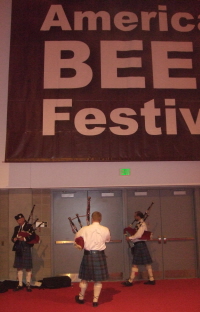 So this is what they meant by making sure your pipes are clean. My press badge got me into all sessions for free, but had I paid, I think I’d have found it a frustrating experience in some ways, making you feel you need to get your money’s worth by working round as many tiny tastes as possible within a limited time. And such small quantities don’t lend themselves to getting a beer and taking it away somewhere to sample at leisure: instead they encourage constant circulation around the bars.
Still there are some very positive and responsible aspects to the way the event is delivered. Designated Drivers get in at a hefty discount, and are treated to free artisanal soft drinks and a massage in their own reserved area. GBBF could learn from the plentiful water stations, where water coolers provide not only drinking water but also the opportunity to rinse your glass.
Like many such events, GABF is catalysing its own fringe festival, with both formal and informal events, often organised by third parties, taking place beside the main one. This is particularly fitting in a city that likes to bill itself as the ‘Napa Valley of beer’, where the Mayor and Democrat candidate for state governer John Hickenlooper is himself the founder of the local Wynkoop brewpub. The various side events in bars and other venues are now being marketed by beer enthusiast and tourism professional Rich Grant of Visit Denver as the Denver Beer Fest.
My press badge got me into a couple of events featuring beer and food pairing. In the Farm to Table Pavilion at the back of the main Convention Center hall, the Culinary School of the Rockies matched chefs with brewers to showcase local ingredients and some truly stunning beers. And the media lunch at the Marriott City Center hotel matched an impressive four courses with beers that were very much fit for table. Following this the press pack — from national newspapers to beer bloggers — were whisked on a coach tour that included the veteran Breckenridge Brewery and Stranahan’s distillery next to the Rackhouse specialist beer pub. I’d love to write about the the smooth, clean, sweetly malty and inexplicably sherryish Colorado whiskey made from 100% Rocky Mountain malt by irrepressible brewer-turned-distiller Jake Norris, but it’s strictly speaking off topic.
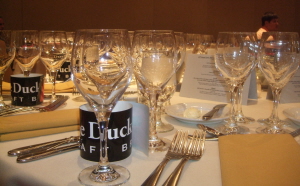 Glasses waiting to filled at the media lunch. We ended up at Wynkoop in the city’s LoDo (Lower Downtown) district for the annual charity fundraising rare beer tasting, this year billed as Pints for Prostates. Most of the beers had gone by then, but it was good to drink what was left in measures bigger than two tablespoons, and in the very pleasant and interesting company of New York City beer and pub videocasters the Happy Hour Guys.
On the Saturday I decided to forego my free admission in favour of drinking proper measures in proper pubs, but found myself at Denver’s leading specialist beer pub, the Falling Rock, just as another special event was getting into gear. For several years now, military medic turned beer expert and all-round character “Doctor” Bill Sysak, now a beer consultant for California brewer Stone’s flagship pub-restaurant, has run a rare beer tasting during GABF week featuring selections from his own 2,000-strong cellar alongside rare beers brought along by participants. For $30 per person, Bill was offering tastes of over 100 rare beers, and I couldn’t refuse.
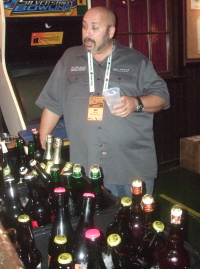 The Doctor is in -- Bill Sysak marshals his rare beers at Falling Rock. Fellow beer writer Patrick, editor of the Albuquerque Beer Scene blog based in New Mexico, heroically took notes on everything, but I abandoned myself to the fireworks display of flavour from Bill’s pours, which included imported delights such as Achel Extra 9.5 Bruin and a limited edition Dupont saison alongside American beer geek pleasers like Lost Abbey Angel’s Share, New Belgium La Folie and a barrel aged version of Ten Fiddy from local heroes Oskar Blues. If anyone still doubts beer can offer a greater spectrum of flavours than wine, I’d recommend a few choice bottles from Dr Bill’s cellar.
Denver wasn’t on my must visit list and I came here only because of the event. But I was pleasantly surprised to discover a fascinating city in its own right. It stands “mile high” at 1600m above sea level on the last westward stretch of the Great Plains, in the shadow of the Front Range of the Rocky mountains. Historically, it’s a frontier town with a history embedded in the less than honorable European colonisation of the North American West. The Colorado Soldier’s Monument just below the Mile High markers on the steps of the State Capitol is scarred by attempts to erase the name ‘Sand Creek’ from its inscribed list of battles — in truth this 1864 “battle” was a massacre of peaceful Cheyenne and Arapaho, mainly women and children.
Something like a natural environment has been restored in the chain of parks that surround the confluence of the South Platte river and Cherry Creek, at the point of the original European settlement. The area is now the focus of a delightful network of off-road walking and cycling trails that, alongside a compact size, good public transport and a cycle hire scheme on the Paris/London model, makes this an easy city to explore without a car.
You can just about get an idea of how it once looked to both Native American and European travellers coming upon these little rivers threaded through the arid plains, and shivering in the looming shadow of the Rockies, their jagged red and purple peaks a wall across the world. The locals shook their heads to see the crazy whites building permanent homes on the riverside, and sure enough the floods came down from the mountains and swept the first town away. Denver today seems rather better prepared for the annual flood of craft beer and the people that drink it.
Beer picks
Great American Beer Festival website: http://www.greatamericanbeerfestival.com
Denver Beer Fest: http://www.denver.org/denverbeerfest
Great American Beer Festival 2010
Top Tastings 2010
ABV: 8.2%
Origin: Harrisburg, Pennsylvania, USA
Website: http://www.troegs.com
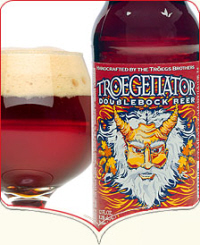 Tröegs Troegenator Doublebock Beer Most of the more celebrated American craft brews are warm fermented ales, but here’s an East Coast microbrewer making a very convincing fist of an original European extreme lager style, the Doppelbock. The name of the brewery exemplifies the delightfully dilettantish multiculturalism of the US craft brewing scene: it’s partly derived from the family name of brothers John and Chris Trogner, who founded the brewery in 1996, but blended with Dutch ‘kroeg’, pub, with the intrusion of a completely unwarranted Scandinavian-style umlaut.
The beer name, meanwhile, apes the German tradition of back-forming Bock brand names with ‘-ator’ on the model of Paulaner’s Salvator. It’s made with Pilsner, Munich and chocolate malts and a relatively modest dose of imported Hallertau and Žatec hops.
This amber beer has a fine yellowy off-white head and a surprisingly light malty aroma. A crisp and biscuity malty palate tastes authentically Bock-like but turns quite dry and yeasty with fruity esters and a chewy nutty note. It’s obviously strong but not overbearingly so. A smooth, tasty, creamy and lightly nutty finish signs the beer off in a well-integrated flourish. Worthy of consideration alongside its German models.
Read more about this beer at ratebeer.com: http://www.ratebeer.com/beer/troegs-troegenator-doublebock/13174/
Great American Beer Festival 2010
Top Tastings 2010
ABV: 9%
Origin: Atlanta, Georgia, USA
Website: http://www.sweetwaterbrew.com
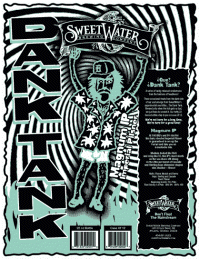 SweetWater Dank Tank Magnum IP Imperial Pilsner If the beers I tried from below the Mason-Dixon Line at the GABF are anything to go by, the craft breweries of the Deep South are quickly catching up with their northern colleagues — although the Dixie credentials of SweetWater brewery are challenged by the fact that Freddy Bensch and Kevin McNerney, who founded it in Atlanta in 1997, originally met as students at the University of Colorado, Boulder.
The Dank Tank series is their range of limited edition beers “from the dark side of our brewers’ souls”. One of them, Magnum IP, was being served in the Culinary School of the Rockies’ Farm to Table beer and food matching pavilion at the GABF alongside some roasted vegetable Napoléon on spent grain crackers with sweet onion jam and micro greens. I admit I’m not a beer and food expert but, while the food was sensational, the beer would have stood out without it.
Magnum IP typifies the American flair for taking an established European style and giving it a merciless twist. IP stands for Imperial Pilsner, for this is a blond lager beer given a turbo boost of alcohol and hops in a manner usually reserved for pale ales and stouts. The hops in question are Cascade and Sterling at 2 pounds per barrel (0.9kg per 117l or 7.7g/l). A brewery representative at the stand admitted to me that they’ve ended up having to brew it at a slightly higher temperature than is typical for lagers, but it does use a cold fermenting yeast and it is properly matured before release.
The beer looks like a classic pilsner, with a rich gold colour and a fine thick white head. A smooth and notably middle European spicy hoppy aroma — Sterling is a recognised American-grown close substitute for Žatec — leads to a wonderfully flowery and smooth palate, rich with vanilla cream offsetting the big hop bite. The finish is bitter but not excessively so, its 100 IBU hopping nicely offset by the high gravity and a creamy malt note. The beer lingers long with a peppery dry bite and a touch of spice. Ovearll it’s a really impressive beer that shows that when it comes to hop colouring, there’s lots of territory still to explore.
Read more about this beer at ratebeer.com: http://www.ratebeer.com/beer/sweetwater-dank-tank-magnum-ip/125585/
Great American Beer Festival 2010
ABV: 5.7%
Origin: Lahaina, Hawaii, USA
Website: http://www.mauibrewingco.com
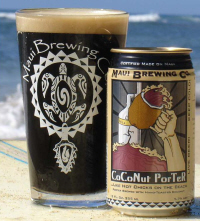 Maui CoCoNut PorTeR I’ d been wanting to try this celebrated speciality beer since I met its brewer, the charming Garrett W Marrero, at the Rake in London earlier this year, when he was over to brew a cask version of it for the Wetherspoons beer festival. I never got to taste that version, brewed at Banks’s in Wolverhampton, so I was delighted to run into both Garrett and his beers at the Great American Beer Festival in Denver.
Maui is, perhaps surprisingly, not the only significant player in this far flung outpost of American craft brewing, but has certainly caused a stir far beyond the Hawaiian archipelago since being founded as a modest brewpub in 2005. Among other things it’s noteworthy as one of the US breweries challenging received opinion about canned beer. When the decision was taken to package the beer, cans were chosen principally for environmental reasons and in line with a policy on local sourcing — cans are made on Hawaii while bottles have to be imported from the mainland. They also recycle more easily and using less energy than bottles, and are much lighter to export. Canning technology has improved enough to eliminate concerns about “tinny” taste — over the course of GABF I got to try several craft beers from cans and was impressed to find they were none the worse for it.
CoCoNut PorTeR implements the local sourcing policy by using Hawaiian toasted coconut alongside six varieties of pale and dark malts and a relatively light sprinkling of Cascade and CTZ hops. The result pours a very dark ruby, with a bubbly light beige head. A luxuriously creamy coffee and chocolate aroma extends its smoothness to a big but refreshing palate, very well integrated with toasty brown malts, subtle hops and a definite coconut note. A dry, roasty finish still has that lovely rich coconut touch which compliments the dark malt flavours splendidly, with a powdery dry hop note emerging at the very end. It might sound as a gimmicky as all that erratic capitalisation, but it works amazingly well. A new classic.
Read more about this beer at ratebeer.com: http://www.ratebeer.com/beer/maui-brewing-coconut-porter/59330/
Great American Beer Festival 2010
ABV: 9.75%
Origin: Winston-Salem, North Carolina, USA
Website: www.foothillsbrewing.com
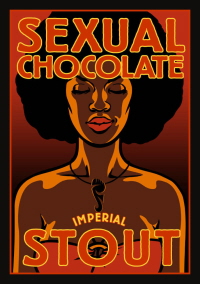 Foothills Sexual Chocolate Imperial Stout If this beer is anything to go by, craft brewing in the US has gone south with a vengeance. A small production brewpub with a penchant for cask ale and a nifty line in bold poster-style graphics, Foothills opened in 2005 as an offshoot of Blue Ridge, the first brewpub in the neighbouring state of South Carolina.
Part-owner, head brewer and former archaeologist Jamie Bartholomaus created Sexual Chocolate as a Valentine’s Day special in 2007, adding whole organic cocoa pods to the secondary conditioning tank, about 3/4 pound (340g) per barrel (117l, or about 3g/l). It also contains a hefty 85IBU of hops and comes with a funky label that suggests the accompaniment of a wah-wah guitar. I tasted it on draught at Pints for Prostates, the rare beer tasting event held at the Wynkoop brewpub, Denver, during the Great American Beer Festival.
This black beer has a very dark mid-brown head that’s bubbly and rich, with an assertive, slightly stinky and worty brown malt aroma hinting of oily chocolate. The oily and rich but dry palate has toast, fruit cake and minerals, turning burnt and chewy in the mouth with resiny hop notes. A slick of intense roast and chocolate coats the mouth in a vivid finish with developing peppery hops and emerging tannic notes. Sexy, perhaps, but with claws.
Read more about this beer at ratebeer.com: http://www.ratebeer.com/beer/foothills-sexual-chocolate-imperial-stout/69930/
Great American Beer Festival 2010
Top Tastings 2010
ABV: 7.5%
Origin: Tampa, Florida, USA
Website: www.cigarcitybrewing.com
 Cigar City Humidor Series As the crowds poured into the Colorado Convention Centre on the opening night of the Great American Beer Festival, the queues soon began to form at some predictable locations, such as Lost Abbey and Russian River. But I also noted a long line for Cigar City, a brewery from Tampa, Florida, that I’d not encountered before, who were presenting their beers on an intriguing display of real tobacco leaves. The next day I discovered the reason for the interest, when 750ml bottles of this extraordinary IPA turned up as a match to the main course at the Brewers’ Association media lunch.
Brewer Wayne Wambles introduced the beer by explaining that, as well as bringing top quality brewing to what had previously been thought of as a craft beer desert, founder Joey Redner also aimed to celebrate Tampa’s unique culture and history as a gateway to Cuba and a major centre of the cigar trade. Thus the beer names and the propensity for ageing in wood also used to make cigar boxes.
This bottle conditioned and slightly hazy light amber ale, which pours with a thick and creamy pinkish-white head, is based on the brewery’s Jai Alai India Pale Ale. The beer is aged on Spanish cedar, a wood that is neither Spanish nor cedar but a member of the mahogany family native to the tropical and sub-tropical Americas, more correctly called cedrela. Still, it has a definite cedary note that contributes to a very pronounced, unusual and distinctive aroma — spicy and leafy with figs, herbs, dried grapefruit peel and a paraffin and furniture polish note that reminded me of a well-used garden shed.
A beautiful malty palate is also very complex with more dried herbal flavours, seed and orange peel notes and rich wafts from a well-stocked wooden spice cupboard. A lightly marmaladey and nutty malty finish is mature and balanced, with developing but not overstated pepper and grapefruit hop notes. As expected for an American IPA, the hopping is assertive, but wonderfully offset and mellowed by intriguing nutty and woody flavours. The beers was a gorgeously indulgent sensual pleasure to drink, and one of the best I’ve tasted in a long time.
Only established in March 2009, the brewery has almost quadrupled its production, based on a philosophy of constantly pushing boundaries. “Beer is food,” said Wayne, “not a replacement for food”, quite an intriguing observation to make at a beer lunch. He went on to comment that the day he gave up experimenting should be the day he gave up brewing. Let’s hope it’s a long time coming.
Read more about this brewery’s beer at ratebeer.com: http://www.ratebeer.com/brewers/cigar-city-brewing/9990/
Great American Beer Festival 2010
ABV: 8.5%
Origin: Kansas City, Missouri, USA
Website: www.boulevard.com
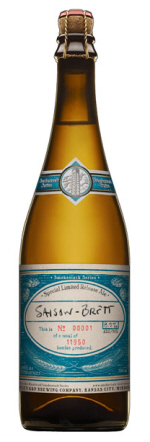 Boulevard Smokestack Series Saison Brett Boulevard, founded by John Macdonald on Kansas City’s historic Southwest Boulevard in 1989, now claims to be the biggest speciality brewer in the Mid-West and the second largest brewer of any type in Missouri. Impressively, though, it’s built this success on some seriously specialist brewing. All the bottled beers in a very large range are bottle conditioned and besides popular pales, ambers and wheat beers there’s a mouthwatering selection of eclectic and imaginative specials, some of them known as the Smokestack Series after a historic brick chimney at the brewery site.
Such a beer is Saison-Brett, normally only available in 750ml bottles and then only in limited quantities, but during the Great American Beer Festival I caught it on draught, tapped by head brewer Steven Pauwels as a GABF special at Denver’s very pleasant Belgian-themed beer café The Cheeky Monk. Based on Tank 7, the brewery’s more regular saison-style beer, it’s been souped up with dry hopping (though still only at 38 IBU) and tweaked with unusual yeasts including, as the name suggests, Brettanomyces.
The beer came out a hazy warm gold with a fairly low bubbly white head. The distinctive wet vinyl note imparted by the brett was immediately evident on an estery, slightly tarry and medicinal aroma, alongside piny hop notes. A very unusual smooth palate had very complex brett “funk”, light lemon juice, wet stone, spiced orange and a touch of liquorice well supported by creamy blond malt. I noted a low carbonation which is probably specific to this draught version, as the notes I’ve read online on the bottled equivalent say the opposite. The finish slowly built tangy and chewy notes, with fennel spice and a trace of brown sugar. For all its complexity, the beer has a refreshing, easy drinking quality that easily belies its strength. Remarkable.
Read more about this beer at ratebeer.com: http://www.ratebeer.com/beer/boulevard-saison-brett/61449/
First published in Beers of the World February 2008
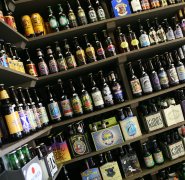 San Francisco is a vibrant and cosmopolitan place with a reputation for both alternative lifestyles and fine food and drink, and a major tourist destination located in the heart of the one of the world’s most innovative and exciting beer regions. So it’s curious that city dwellers had to wait until May 2006 for their first speciality beer retailer. San Francisco is a vibrant and cosmopolitan place with a reputation for both alternative lifestyles and fine food and drink, and a major tourist destination located in the heart of the one of the world’s most innovative and exciting beer regions. So it’s curious that city dwellers had to wait until May 2006 for their first speciality beer retailer.
Craig Wathen and his wife Beth opened City Beer Store precisely to fill that gap in the market, and because they believed in the contribution small businesses can make to the community. And a mixed and colourful community it is too, in the South of Market (SoMa) district where arty shops and cafés mix with light industry and the raunchier side of the city’s celebrated gay scene. The Folsom Street Fair at the end of September is billed as “the world’s largest leather event”.
“It happens right outside our door,” says Craig. “Easily our most memorable experience since opening, no competition!”
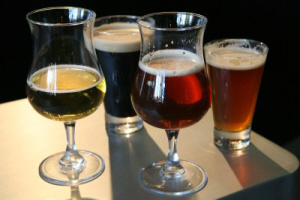 A board on the sidewalk guides you down a few steps to a basement space – small according to the locals, but generous enough by European standards – with a scattering of comfortable seating, a bar with six regularly changing draught taps and shelves and fridges crammed with about 300 different bottled beers, almost half bottle conditioned. A board on the sidewalk guides you down a few steps to a basement space – small according to the locals, but generous enough by European standards – with a scattering of comfortable seating, a bar with six regularly changing draught taps and shelves and fridges crammed with about 300 different bottled beers, almost half bottle conditioned.
The range splits more-or-less down the middle into North American and Belgian products, with a smattering of other imports. The American beers are almost all from West Coast craft brewers, with an unsurprisingly strong showing for the region’s signature hoppy IPAs and a changing roster of rarities, limited editions and sought-after cask-aged bottlings. The Belgian range is well-chosen too, with beers from tiny brewers like Rulles alongside more familiar Trappists and independents, and a bias towards abbey triples.
All are available as single bottles – if you’ve ever been frustrated by some US supermarkets’ refusal to split six packs you’ll appreciate this – and may be enjoyed on the premises for a $1 corkage charge, accompanied if you wish by a plate of artisanal bread, cheese and sausage.
 The Wathens also offer glassware, and host regular Thursday night tastings, themed around styles, breweries or new products. Craig reckons half his customers are locals and most of the remainder domestic tourists, but he’s been pleased to welcome a steady stream of overseas visitors, mainly from Europe and Japan. The Wathens also offer glassware, and host regular Thursday night tastings, themed around styles, breweries or new products. Craig reckons half his customers are locals and most of the remainder domestic tourists, but he’s been pleased to welcome a steady stream of overseas visitors, mainly from Europe and Japan.
The beer scene is buzzing by the Bay right now, with craft breweries expanding and a growing interest in beer and food matching, so this friendly shop is a great place to catch up on what’s happening and taste some of the results. And most readers will be glad to know that full leather is optional.
Fact file
Address: 1168 Folsom Street, Suite 101, San Francisco CA 94103, USA
Phone: +1 415 503 1033
Web: www.citybeerstore.com
Hours: 1200-2100 (1900 Sundays, closed Monday)
Drink in? Yes
Mail order: No
Manager’s favourites: Bear Republic Racer 5, Orval, AleSmith Speedway Stout
Beer picks
- Bear Republic Racer 5, 7% ABV, Healdsburg. Fruity, sturdy deep golden IPA with pine, blue cheese and violet notes, bitter orange finish, hoppy but much subtler than many other West Coast IPAs.
- North Coast Old Rasputin, 9% ABV, Fort Bragg. Excellent Imperial Stout with authentic gravy-like aroma, thick and smooth dark malt and cherry yoghurt palate and roasty black coffee finish.
- Port/Lost Abbey Red Barn, 6.7%, San Marcos. Refreshing saison-inspired cloudy golden ale with spicy aroma, creamy wheat, basil and orange liqueur palate and a chewy, chaffy herbal finish with late hops.
- Russian River Damnation, 7.7% ABV, Santa Rosa. Complex Belgian-style blond from an outstanding speciality brewer: seedy fennel aroma with hint of bacon smoke, herby tangerine palate and tangy, twiggy, grapefruity finish.
- Stone Ruination, 7.7%, Escondido. Classic West Coast IPA in aggressive hophead style, pungent strawberry-scented aroma, thistly hop and citrus peel palate, even hoppier long, peppery and resinous finish.
|
|
