Promoting an international beer culture that recognises and celebrates beers of quality, distinctiveness and local character, brewed with care and passion.
Etiam pulvinar consectetur dolor sed malesuada. Ut convallis
euismod dolor nec pretium. Nunc ut tristique massa.
Nam sodales mi vitae dolor ullamcorper et vulputate enim accumsan.
Morbi orci magna, tincidunt vitae molestie nec, molestie at mi. Nulla nulla lorem,
suscipit in posuere in, interdum non magna.
Formerly Fuller, Smith & Turner. Includes information for the original Lamb Brewery
Brewery Chiswick Lane South W4 2QB (Hounslow) fullersbrewery.co.uk First sold beer: 1701 (as Mawson’s)
Shockwaves ran through the London brewing scene on 25 January 2019 when Fuller, Smith & Turner, London’s biggest brewery and its oldest by far, announced it was following in the footsteps of former fellow London brewer Young’s and many other old-established UK family breweries by ditching brewing to concentrate on pubs.
The beer business, including the historic Griffin brewery, was sold for £250 million to Asahi of Japan, becoming its second brewery in London after Meantime, while Fuller’s shifted focus to its pub estate, where 87% of its profit had been generated. Asahi has undertaken to continue brewing at the Griffin, which is now London’s only historic brewery in continuous commercial production: all the others were founded or revived in the 21st century.
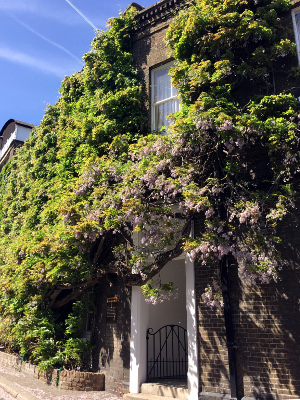
The famous Wisteria on the brewer’s house at Fuller’s.
Brewing on this riverside site on Chiswick Mall can be traced back to the 1650s domestic brewery attached to stately home Bedford House on Chiswick Mall. Thomas Mawson founded the Griffin brewery as a commercial operation in 1701, and the Fuller family became involved in 1829. The currently quoted founding date of 1845 is when a new partnership took over, involving John Bird Fuller, Henry Smith (formerly of Ind & Smith in Romford, later Ind Coope), and John Turner.
Fuller Smith & Turner became a limited company in 1929. Descendants of the original partners remained involved until the recent sale and retain their position in the successor pub company.
As one of only two independent breweries left in London as the beer consumer movement gathered pace in the 1970s, Fuller’s was persuaded not to convert to keg production and to revive traditional cask conditioning and handpump dispense. It grew substantially from an output of around 100,000 hl and an estate of 100 pubs to 550,000 hl and 400 pubs just before the Asahi deal.
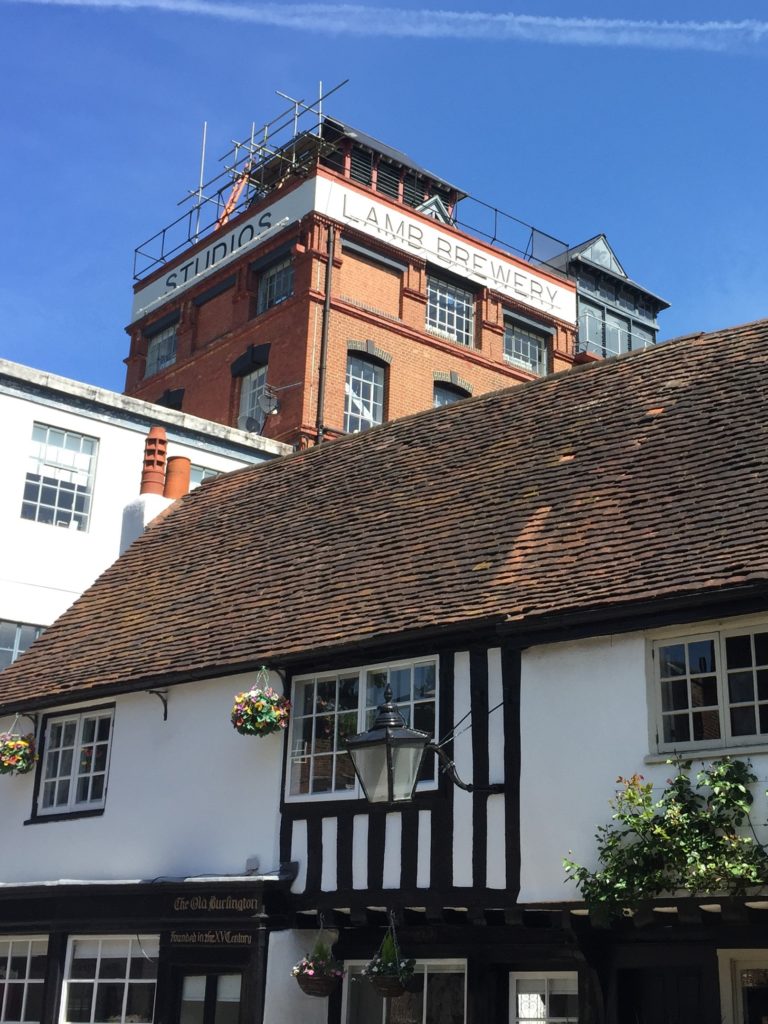
Chiswick’s other brewery, the Lamb, once a Fuller’s store.
In 2005, Fuller’s bought another old-established family brewer, Gales in Horndeam, Hampshire, and closed it the following year, retaining some of the brands. In February 2018, the brewery bought Dark Star, based in Partridge Green near Horsham, West Sussex, with the intention of retaining it as a working brewery, though its flagship Hophead was soon shifted to Chiswick. Both these assets were included in the Asahi deal.
Dark Star’s roots go back to London in 1982 when Pitfield’s Brewery was founded by microbrewing pioneers Rob Jones and Martin Kemp in Pitfield Street, Hoxton. Their best-known beer was a porter called Dark Star which became the first microbrew to win Champion Beer of Britain in 1987, and when in 1994 Rob collaborated with the landlord of the Evening Star pub in Brighton to set up a microbrewery in the cellar, he revived the name.
Dark Star played a major role in popularising the use of New World hops in the UK and expanded twice before the Fuller’s acquisition, though Rob left in 2016. Sadly, Asahi opted to close Dark Star in December 2022. Originally, its brands other than Hophead transferred to Meantime, though that brewery is also due to close in 2024, with all production centred at Chiswick.
Fuller’s brewhouse was renewed in the mid-1990s with a modern twin mash tun system which brews in 520 hl batches, and nearly all fermentation is now in cylindro-conical closed fermenters. In July 2018 a new 16 hl pilot brewery was installed as part of a major refurbishment of the visitor centre. Drink-in facilities here were added in 2021, replacing longstanding brewery tap the Mawson Arms around the corner. World-renowned brewing director John Keeling retired in October 2018 though still acts as a brewery ambassador.
Under the new arrangement, the Griffin still supplies beers to Fuller’s pubs, while Asahi is free to use Fuller’s trademarks to market the beer elsewhere. The Japanese company has said it respects the brands and their heritage and is particularly keen to increase international sales. But the deal has inevitably raised worries about the future of the site, which given its location could be extremely valuable if redeveloped.
Beers are in cask, keg, can, bottle conditioned and in filtered bottles, with some minicasks. Several of the core brands are related through the technique of ‘parti-gyling’, taking multiple runnings at different gravities from the same basic mash and tweaking the hop additions. All Fuller’s-branded beers are fermented using a longstanding house yeast, while Gale’s and Dark Star beers use different yeasts.
Things to see
As London’s only remaining working historic brewery and on an attractive riverside site in the Old Chiswick Conservation Area, Fuller’s is particularly worth a visit. It’s possible to view some of the historic buildings from the street or the non-gated section of the brewery yard. The site with its prominent branding provides a landmark on the busy Great West Road (A4) on the approach to the Hogarth Roundabout, so called because artist and illustrator William Hogarth (1697-1794), well-known to brewing historians for his satirical diptych of Gin Lane and Beer Street, lived in a house nearby, now open as a visitor attraction.
The brewery’s current main entrance with its decorative ironwork opens onto Mawson Lane, the sliproad parallel to the main road on its south side, with several late Victorian industrial buildings visible. The corner building to the left forms one end of a terrace of five town houses which continue round the corner along Chiswick Lane South (110-118, W4 2QA), built around 1715 for brewery founder Thomas Mawson and now Grade II* listed. The poet Alexander Pope (1688-1744) lived at the corner building between 1716-1719 and is commemorated with a blue plaque. The small two-storey Grade II-listed Garden House, which presents a gable end to Mawson Lane just to the right, may have been built for him, though was much altered in the 19th century.
Around 1897, the corner house was converted to a brewery tap, initially the Fox and Dogs, later the Fox and Hounds. It then acquired a second name, the Mawson Arms, though both names continued in use, perhaps as a legacy of two sections of the pub having separate ale and spirits licenses. On the deal with Asahi, the pub remained with the legacy pub company, who opted not to reopen it following the 2020 lockdowns, though it was advertised as to let in 2024 so may yet reopen under a new operator.
Along Chiswick Lane South you pass the brewery shop and visitor centre, with the pilot brewery visible behind glass at the back. This is the starting point for the highly recommended brewery tours (book in advance, charge payable). Further along is the particularly attractive cobbled yard with a terrace of three 18th century houses (130-134 Mawson Row) wrapped around the corner.
A little further into the yard on the right is the Brewer’s House, actually built as the owner’s house sometime in the 18th century and later used as offices and a boardroom. The wisteria climbing its walls was grown from the earliest cuttings to arrive in Britain from China in 1816: another cutting went to Kew Gardens but died. Opposite is the Hock Cellar, a former wines and spirits store named after the brewery’s mild ale, now used as part of the visitor experience. It’s an atmospheric space with numerous interesting exhibits but is usually only open to guests on brewery tours.
The rest of the site is also only accessible to tour guests. Although today the brewery uses almost entirely modern equipment, numerous pieces of vintage kit have been retained. The oldest vessel is an 1823 domed London copper with calandria, embedded in brick. Other highlights include 1930s grist mills which are still in use, an 1863 mash tun with an unusual segmented copper lid, a smaller Victorian copper once used for melting brewing sugar, and a double drop fermenter with a round wooden vessel arranged over a copper square equipped with a water-based attemperator.
The small buildings by the directors’ car park now used for technical services are some of the earliest on the site, predating commercial brewing: they originated as outbuildings for the houses fronting Chiswick Mall.
Back in the public realm, continuing along Chiswick Lane South towards the river Thames you pass a succession of brewery walls and buildings on the right. Turn right to follow the Thames Path upstream along Chiswick Mall, where numerous grand houses, many of them listed, back onto the brewery’s southern perimeter. Two adjoining imposing Grade II*-listed mansions, Eynham House and Bedford House (W4 2PJ), are set a little back from the street about halfway along to the next junction. Originally a single property occupied this plot, Bedford House, built for the Russell family, earls (later dukes) of Bedford, around 1650. Brewing began in an outbuilding at the rear of this, perhaps one of those still in brewery use for technical services. The house was rebuilt in the early 18th century and split into two. Note that particularly high tides sometimes render Chiswick Mall impassable.
Turning away from the river again at the next corner along Church Street, you pass Grade II*-listed St Nicholas Church on the left. This early 14th century parish church was rebuilt 1882-84 with funds largely donated by brewery partner Henry Smith. Hogarth is buried in the churchyard.
A little further along on the right, set back from Church Street around a narrow yard (W4 2PD), are the remains of a second Chiswick brewery, the Lamb, dating from at least the 1770s and once at least as big as the Griffin. Since at least 1790 it was owned and operated by the Sich family and was later known as Sich & Co. In the 1850s some of the family lived in Bedford House. The tower brewhouse built around 1900 still stands, though hasn’t brewed since 1920 when Sich & Co merged with the Isleworth Brewing Company, later absorbed by Watney.
The Lamb site was subsequently used by Fuller’s for storage and later by the Standard Yeast Company but is now offices. The pretty 18th century pink stucco and weatherboard building on the left corner here, now known as Burlington Corner, is the former Lamb brewery tap and likely where brewing began on the site. On the opposite corner is a charming 16th-century timber-framed building, The Old Burlington, one of the oldest in the area. This was also once a pub, the Burlington Arms, but both it and the Lamb lost their licenses in 1924 following the brewery closure.
The Lamb name was briefly reused between 2012-13 for a brewpub in central Chiswick: see Brewhouse and Kitchen.
Closed brewery 25 Bermondsey Trading Estate, Rotherhithe New Road SE16 3LL (Southwark) fourpure.com First sold beer: October 2013 Ceased brewing: September 2024
Always one of London’s most ambitious new breweries, Fourpure became one of the biggest. Founded as the fourth Bermondsey brewery by former City technology firm executive Dan Lowe and his brother Tom, both homebrewers, it rejected the railway arch model in favour of the less restricted space of a conventional industrial unit. Located between the diverging lines near South Bermondsey station and Millwall FC’s New Den stadium, for over a decade it marked the southeastern extremity of the Bermondsey ‘mile’. The name refers to the four traditional ingredients of beer.
The Lowes recruited John Driebergen, formerly of Meantime, as head brewer and installed a 30 hl kit bought second-hand from Purity in Warwickshire, alongside a 1 hl pilot kit. From the start, the brewery was equipped with a canning line in a nearby unit, one of the first in a new London brewery.
It subsequently expanded several times, with additional warehousing, a 2017 enlargement into an adjacent unit to make space for a new 50 hl German-built GEA Craft Star brewhouse and three outdoor silos for base malts and spent grain. The old kit was sold to Brockley Brewery for its expanded site at Hither Green.
In July 2018, Fourpure became the sixth London craft brewer acquired by a multinational, the Japanese group Kirin, as part of its Australian-originated Lion Little World Beverages subsidiary, though with the same management as before. Further expansion into two more adjacent units followed in summer 2019, one of them entirely occupied by an extensive taproom.
In 2022, John Driebergen and his assistant Ollie Parker left to found Great Beyond.
Following the trend of multinational breweries reducing their craft-style interests in the UK, in August 2022 Lion Little World sold all its UK breweries, including Little Creatures Regents Canal in London and Magic Rock in Huddersfield. The new owner was In Good Company, also known as Odyssey Inns, founded by Stephen Cox, a co-founder of Utopian Brewing in Crediton, Devon, who stepped down from his role there to run the new group.
Fourpure was for some years also the major production centre for Big Drop cuckoo-brewed low alcohol beers, and in May 2023 invested in that company.
In March 2024, Fourpure announced it was seeking a Company Voluntary Agreement (CVA) with its creditors, but this apparently proved unsuccesful as the brewery confimed in August that it was soon to close. Both brewery and taproom had closed by late September, with production of both Fourpure and Big Drop shifted to Magic Rock. CEO Steve Cox expressed regret at the closure and confirmed there would be job losses, but said it was necessary to ‘safeguard the brand for the future’. The subsidiary that owned the Fourpure brand was then put into voluntary administration.
In January 2025, In Good Company announced it was now seeking administration for Magic Rock. Soon afterwards, that brewery was closed and both the Fourpure and Magic Rock brands bought by Keystone, which had already bought and closed former London craft brewers BBNo and Brick. Like these, Fourpure is now brewed at the company’s plants at Black Sheep in North Yorkshire and Purity in the West Midlands.
Beers were in keg and can, with much sold through supermarket chains.
Includes information for Hackney Brewery and Squeeze (40FT).
BootyardOriginal 40FT brewery Bootyard, Abbot Street E8 3DP (Hackney) 40ftbrewery.com First sold beer: 5 July 2015
BlackhorseMain 40FT brewery 10 Lockwood Way E17 5RB (Waltham Forest) First sold beer: Early 2021 (as Hackney Brewery) Brewing suspended: April 2025 Brewing resumed: October 2025 (as 40FT)
Original Hackney brewery 358 Laburnum Street E2 8BB (Hackney) First sold beer: June 2012 (at original site) Ceased brewing: Early 2021 when production transferred to Lockwood Way above
Squeeze planned brewpub 130A Kingsland High Road E8 2LQ (Hackney) First sold beer: December 2020 (as Kraft Dalston, part of German Kraft) Brewing suspended: December 2024 Brewing expected to be resumed: Early 2026
The brainchild of German-born former London Fields and Truman’s head brewer Ben Ott and three homebrewing business partners, brothers Fredrik and Andreas Pettersson and current chief executive Steve Ryan, this outfit was named after its original home in a converted 40 foot (12.2 m) shipping container.
This is located in a former car park managed by the Bootstrap economic development charity behind Dalston’s Arcola Theatre, where several other small and lively businesses flourish, including a bakery and restaurant. Other containers have since been added, including two converted into a taproom in 2019, which deservedly won a regional SIBA award in 2020. The site is ultimately due for redevelopment but that’s several years away.
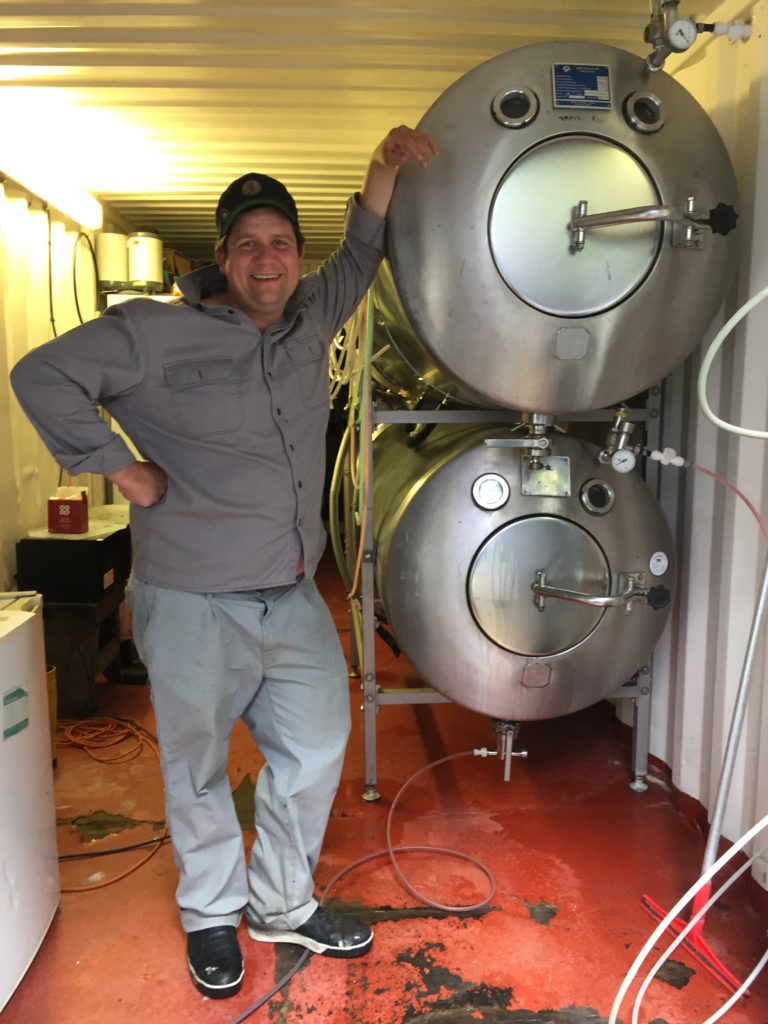
The brewery uses a 10 hl kit from Oban Ales, old-fashioned open fermenters and, unusually for a UK brewery, several horizontal lagering tanks: most beers on sale in the taproom are dispensed direct from these. There’s also a pilot kit for small runs.
Ben Ott of 40FT with horizontal tanks.
40FT announced major expansion plans in July 2025, acquiring a bigger production site, with a 20 hl brewhouse, canning line and taproom, at the former Hackney brewery in Walthamstow (see below). The taproom reopened in August, but the resumption of brewing was delayed as some of the kit had been stolen or vandalised while the unit was unoccupied. The brewery was finally back on line in October.
The original Bootyard site remains in operation for now, though the long-term plan is to shift production to Walthamstow and turn this into an expanded taproom.
In September 2025, 40FT became a partner in the reopening of the former Kraft Dalston brewpub under the name Squeeze. This ultra-modern brewpub was created by German Kraft and partners in December 2020 in Dalston’s new Locke ‘aparthotel’. The building changed hands and was rebranded as Staycity Aparthotel in December 2024 and the bar closed as part of the general contraction of German Kraft in London. On reopening it sold beer brewed at other 40FT sites, including an exclusive house brand, though 40FT plants to revive the German-style 5 hl brewhouse behind glass in the basement early in 2026, to take over the house beer and perhaps provide some rotating specials.
They’re also working to revive the currently closed Dalston Roofpark open air venue on top of the Print House building (18 Ashwin Street E8 3DL), round the corner from the original brewery site in the Bootyard. This has long stocked 40FT beer and will now become a 40FT-managed venue.
Unpasteurised and unfiltered beers are brewed for tank, keg and can: originally canning was accomplished using a mobile line but moved in house with the acquisition of the former Hackney site.
Hackney Brewery
First sold beer: June 2012 (at original site) Ceased brewing: April 2025
Former homebrewers Peter Hills and Jon Swain both worked at Islington pub the Charles Lamb when they decided to join the growing ranks of East London brewers in 2011. They began with a small 8 hl kit which they ended up using twice a day to fill the growing number of fermenters squeezed into their railway arch under the Kingsland viaduct.
In 2015 the brewery expanded into a neighbouring arch and in 2016 was reconfigured following advice from consultants, with a new 20 hl brewhouse fabricated to the bespoke designs of Jon and head brewer Darren Walker. Further tanks were added to raise production to 5,000 hl a year.
With no space to increase production further nor for a taproom, the brewery began looking for a new site. In November 2020, the business moved into an industrial unit in the rapidly growing brewing hotspot of Blackhorse Lane, Walthamstow, immediately opposite Wild Card. A well-appointed taproom, known as the High Hill Taproom, opened here following the end of the lockdowns in May 2021.
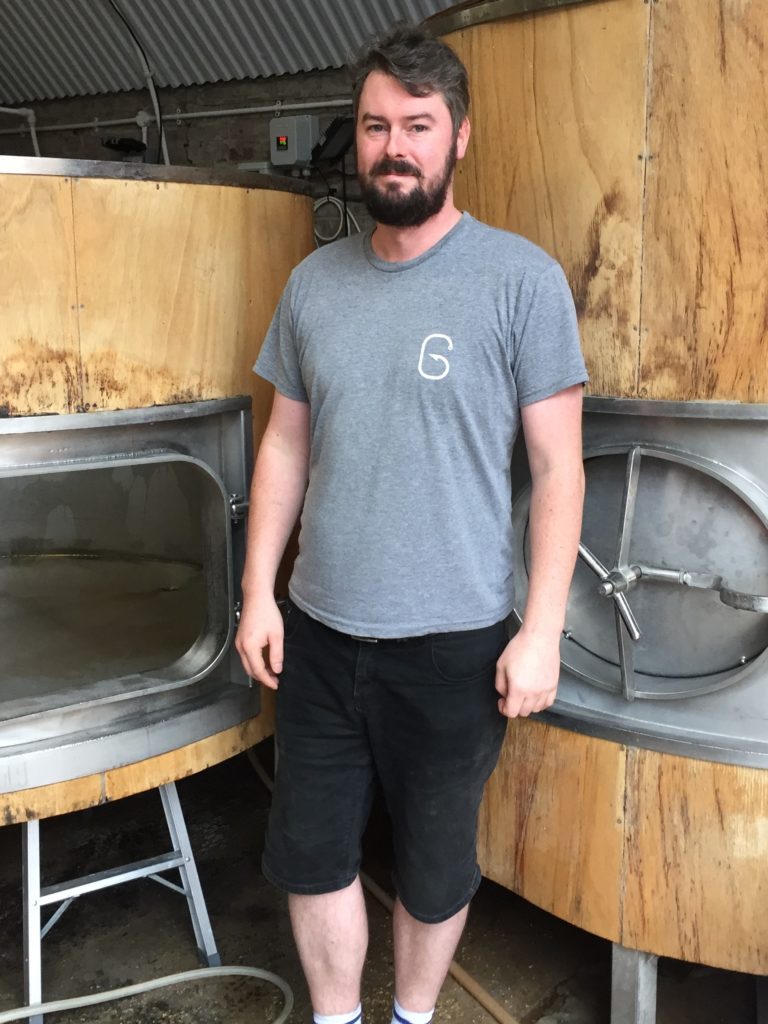
Jon Swain pictured at Hackney’s original site.
Despite landlords Waltham Forest council’s initial encouragement of small food and drink businesses on the estate, the company struggled to agree repayment terms of post-lockdown arrears. It was forced at the end of March 2025 to close its onsite taproom. Initially it hoped to sustain brewing, but in April confirmed that the brewery was closing too.
In July 2025, as explained above, 40FT acquired the site, soon reopening the taproom and starting work on restoring brewing.
Nearly all Hackney beers were sold in keg and can. Regular cask beers were discontinued early in 2018 though a small amount was still sold to selected pubs and bars.
Brewery Original site: 3 Institute Place E8 1JE (Hackney, brewing ceased March 2021) Current site: 61 Mare Street E8 4RG (Hackney) fivepointsbrewing.co.uk First sold beer: 22 March 2013 (at original site)
Five Points is one of the claimants to the title of London’s biggest independent brewery, producing around 18,000 hl in 2019 with a staff of around 45. It was founded by pub operator Ed Mason with proceeds from the sale of pioneering craft beer bar Mason & Taylor, which became BrewDog Shoreditch. Head brewer Greg Hobbs was recruited from East London Brewing and a 16 hl brewhouse installed in a railway arch under Hackney Downs station, named after the busy five-way road junction at the crossing of Amhurst Road and Dalston Lane only metres away.
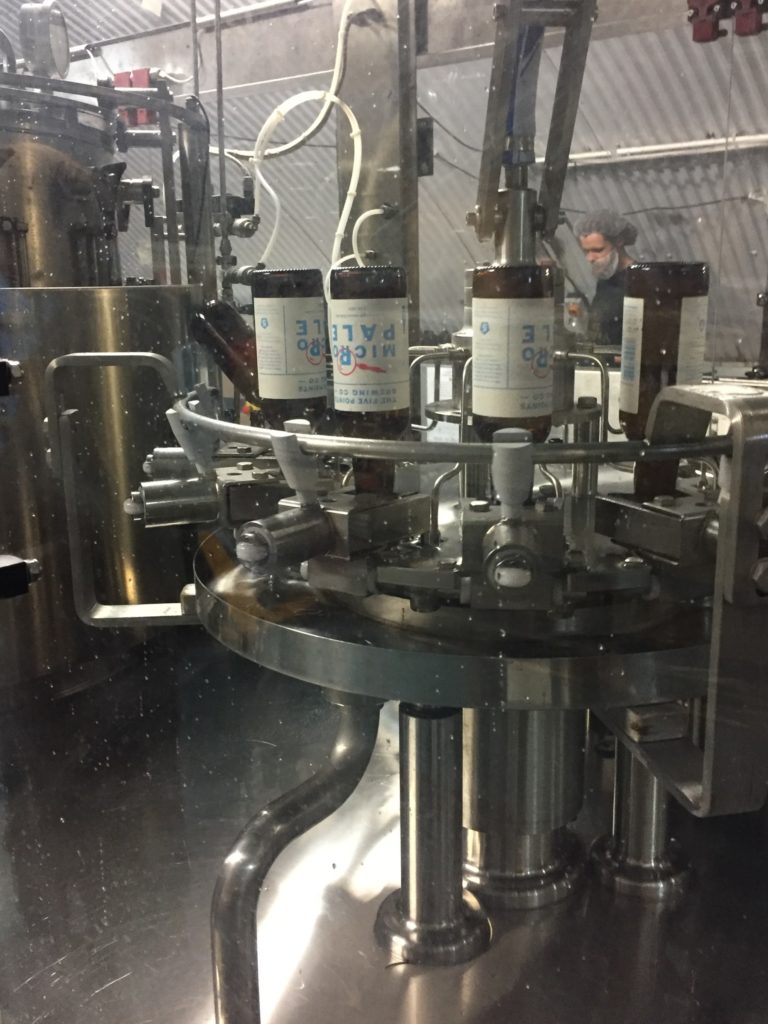
A new 32 hl brewhouse from OAL was commissioned in 2015, with the old kit sold to Signature Brew. As well as taking on an adjoining arch and installing outdoor fermenters, Five Points added warehousing and offices at a separate site on Mare Street, a little to the south, in 2016. Unusually, it has both a bottling and a canning line, the former from Beavertown, the latter bought new from ABE LinCan.
The former Beavertown bottling line, in action at Five Points’ first site.
Long lacking a taproom because of its restricted accommodation, in 2018 it bought landmark pub the Pembury Tavern, located right on the eponymous junction, from the Milton brewery in Cambridgeshire.
Following a 2018 crowdfunding campaign that raised £1.1 million against a target of £750,000, the brewery began a frustrating search for a more expansive site. Finally in March 2021 it reconfigured its Mare Street warehouse, transferring brewing there and opening a well-appointed taproom in November, with extensive outdoor space, while continuing to operate the Pembury.
The brewery was also the organiser of the London Brewers Market.
Beers still include a substantial amount of cask in both traditional and contemporary styles, as well as kegs, cans and bottles, with tank dispense for popular brands in the taproom, where specials from a pilot kit are also available. Due to capacity limitations, the Pils has been brewed De Brabandere in Harelbeke, West Flanders, Belgium, but production has since been brought back in house.
Brewpub no longer brewing 46 Essex Street WC2R 3JF (Westminster) templebrewhouse.com/brewery First sold beer: 20 December 2014, as Essex Street Brewing Brewing suspended: March 2020 Brewing restarted: May 2022 Brewing ceased: by June 2025
Pub chain the City Pub Co already had brewpubs in Bath and Cambridge when it added a London branch near the Temple late in 2014. An 8 hl kit was squeezed into a stairwell, with some serious ventilation equipment installed after the lawyers upstairs complained about the smell (their loss). Though the pub was known as the Temple Brew House, the brewery originally traded under the Essex Street brand.
Long claiming to be ‘London’s most central brewery’, it was a lively participant in the local brewing scene under the guidance of longstanding head brewer Vanesa de Blas.
The pub was closed with brewing suspended during the 2020 Covid-19 lockdowns. After some uncertainty about its future, it was finally reopened in Feburary 2022 with brewing restored in May.
By now, Vanesa was based at a sister brewpub the Cambridge Brew House but, as this had a smaller kit, she regularly visited London to brew longer runs. In August 2022, the Essex Street brand was dropped with all beers appearing under the Temple Brew House name.
In November 2023, the pub was sold to the Young’s pub company, along with the other 53 sites in the group. Brewing continued for some time afterwards, but had ceased by June 2025, partly due to the difficulties of working on a cramped site in a busy location, with house beers supplied from other brewpubs in the group outside London.
The pub closed again for refurbishment in August 2025, along with the Davy’s wine bar next door, also owned by Young’s. It reopened in November following radical remodelling, combining the two units into a single large venue, with the brewhouse removed in the process.
Brewing continues at least one of the other City brewpubs owned by Young’s outside London, the King Street Brew House in Bristol, where some Young’s brands have even been revived as one-offs.
Beers were in keg and cask, many of them gluten-free, sold on-site and at other sites in the group. There were numerous collaborations including with Toast Ale.
Brewery 45 Fairways Business Centre, Lammas Road E10 7QB (Waltham Forest) eastlondonbrewing.com First sold beer: September 2011
Former research and development chemist Stu Lascelles switched career paths in the autumn of 2011 by setting up East London Brewing (sometimes known as ELB) with his wife Claire Ashbridge-Thomlinson. It began with a 16 hl plant and open fermenters installed by Dave Porter of PBC in a single unit on an industrial estate near Lea Bridge station, between the railway and the Lee Valley Park.
Stu Lascelles of East London Brewing Co
It later expanded into two other adjacent units. In July 2019, the installation was upgraded to a 40 hl kit with improved fermenters supplied by Johnson Brewing Design. A new head brewer, Adrian Morales-Maillo, formerly of Naparbier in Barcelona, was recruited: he moved on in 2022 to set up Sobremesa Drinks in Monmouthshire, Wales.
Claire and Stu took a step away in 2024: though they’re still shareholders and retain some involvement, day to day management is now down to another shareholder, Ronnie Finch. The current head brewer is George Boustred, formerly of London Brewing.
Due to the limitations of the site, the brewery was long open only for occasional open days and special events, though it sold beer to take away during normal working hours. Several plans for more regular taprooms were frustrated, until in May 2025 the brewery announced that it was taking on the former Wild Card brewery site on Walthamstow’s Blackhorse ‘Mile’ (2 Lockwood Way E17 5RB), plus adjacent units, as a taproom and possibly a brewing facility.
Fitting out the new site has taken some time, but it was open for a couple of special events in late 2025, and is due to start opening regularly early in 2026. The existing Leyton site remains the production facility for the time being.
The brewery also took over former Wild Card pub the Tavern on the Hill nearby (318 Higham Hill Road E17 5RG) in July 2025.
East London initially brewed mainly cask beers and the format still accounts for a good proportion of its output, though it’s since added keg beers too. Most beers are also available bottled or canned, mainly using an off-site contractor, but some are bottle-conditioned at the brewery. Beers are also packaged as bag-in-box.
Brewery now brewing outside London A007 The Chocolate Factory, 5 Clarendon Road N22 6XJ (Haringey) earthale.com First sold beer: July 2015 Ceased brewing in London: November 2021
This project was the brainchild of professional chef Alex Lewis, a specialist in foraged ingredients who began brewing commercially on a very small scale at home for a series of beer and food matching dinners he hosted at various south London venues in 2015.
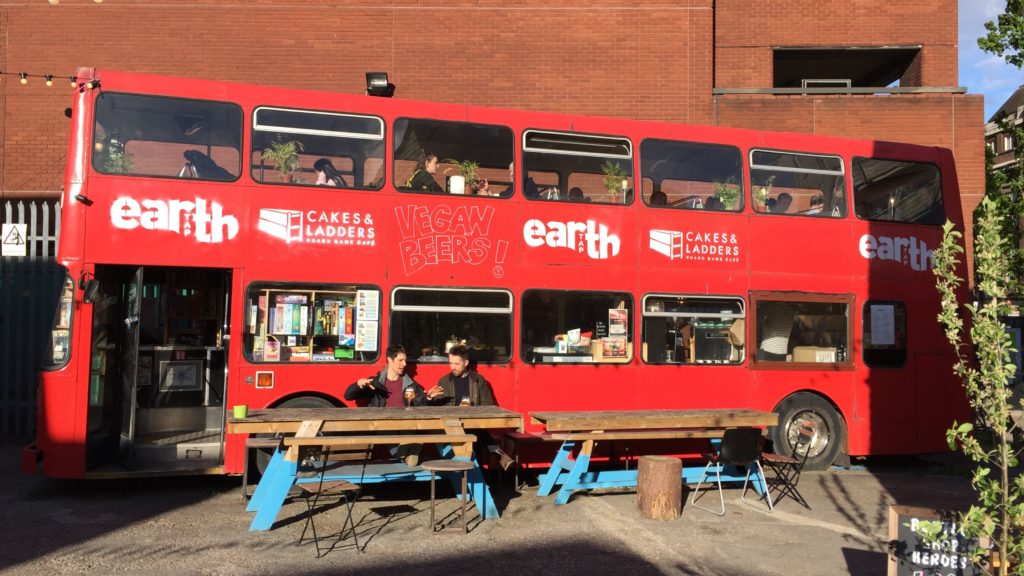
All aboard the beer bus: the former Earth Tap in Wood Green.
Following a period of cuckoo brewing, Alex opened a taproom in the unusual location of a disused double-decker bus shared with a daytime café in Blue House Yard, Wood Green. He found space for his own brewery a short walk from the bus in July 2018, in the former Barratt’s biscuit factory, then known as the Chocolate Factory. A 200 l kit was used as a stopgap until April 2019 when beer began flowing from a more professional 10 hl brewhouse.
Alex had to quit the Chocolate Factory in November 2021 as it was due for demolition and redevelopment. He found a new site outside London at a vineyard near Abingdon, Oxfordshire. The demands of relocation made it impractical to continue with the bus too, so sadly London lost one of its most interesting breweries and quirkiest beer venues.
While most recent brewery start-ups in London are the work of enterprising homebrewers, Portobello was an initiative from the established industry. Back in 2006, Rob Jenkins, formerly at Whitbread, Brakspear, Young’s and Wells, was in discussion with other now-redundant Young’s employees John Hatch and Derek Prentice about setting up a successor to the Wandsworth brewery, but things worked out differently and he ended up creating Portobello with head brewer Farooq Khalid. In 2013 they were joined by Joe Laventure, previously with Whitbread and Budvar UK.
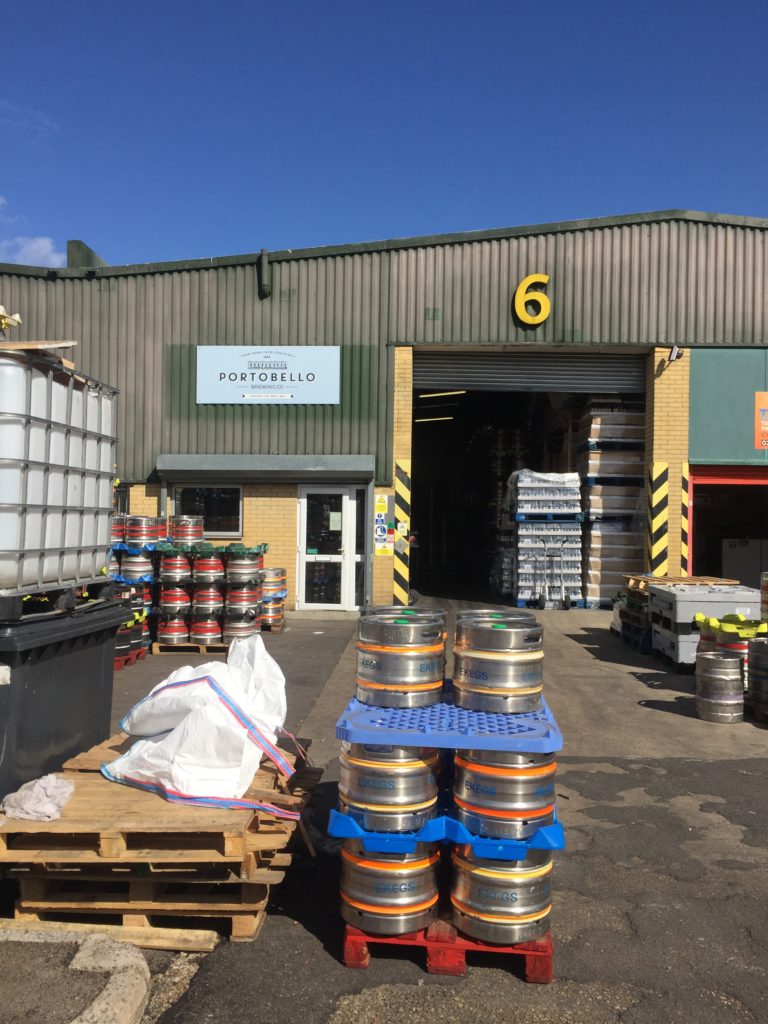
The brewery began with a relatively generous 30 hl kit in an industrial unit on an estate between Wormwood Scrubs and Eurostar’s North Pole depot. In 2014, the original kit was replaced with a larger 50 hl model, with fermentation capacity extended several times. The brewery expanded to the next-door unit in 2021, with plans to increase annual production to 10,000 hl and to open a long-desired taproom in 2022.
Though an arrangement with Remarkable Pubs in 2018 to take over the microbrewery at the George and Dragon in Acton was abandoned soon after it launched, in 2019 the company gained its own first pub, the King and Co in Clapham. It soon added the Hack and Hop in the City of London, though this has since closed for redevelopment. The pub estate increased abrubtly to 15 sites in November 2020 following a deal with property company Downing, adding numerous pubs formerly managed by the Antic group.
Portobello’s substantial unit by the Eurostar depot.
The brewery confirmed on 11 October 2024 that it had been bought by Sunrise Alliance. For the moment, co-founder Rob Jenkins remains in charge, with no job losses and production continuing in London.
The new owner originated in 2006 as St Peter’s brewery near Bungay, and began expanding in 2023 with the acquisition of Curious Brew in Ashford, Kent, which already owned the Wild Beer brand. A few weeks after the Portobello deal, Sunrise acquired an interest in another London brewer, Gipsy Hill.
Beers “brewed the West Way” are in cask, keg, can and bottle, widely sold through pub chains and supermarkets. The original vision was to produce mainly cask, but although still important this is now only 30% of the business, with 60% of production craft lager in keg and can. The brewery cans and bottles offsite, mainly at Marston’s in Burton upon Trent, but this may change with the additional space.
Brewery, beer firm 6 Vulcan Business Centre, Vulcan Way, New Addington, Croydon CR0 9UG (Croydon) titseybrewingco.com First sold beer: 6 August 2012 (as The Cronx) Brewing suspended: by August 2024 Brewing resumed: Summer 2025 (as Titsey)
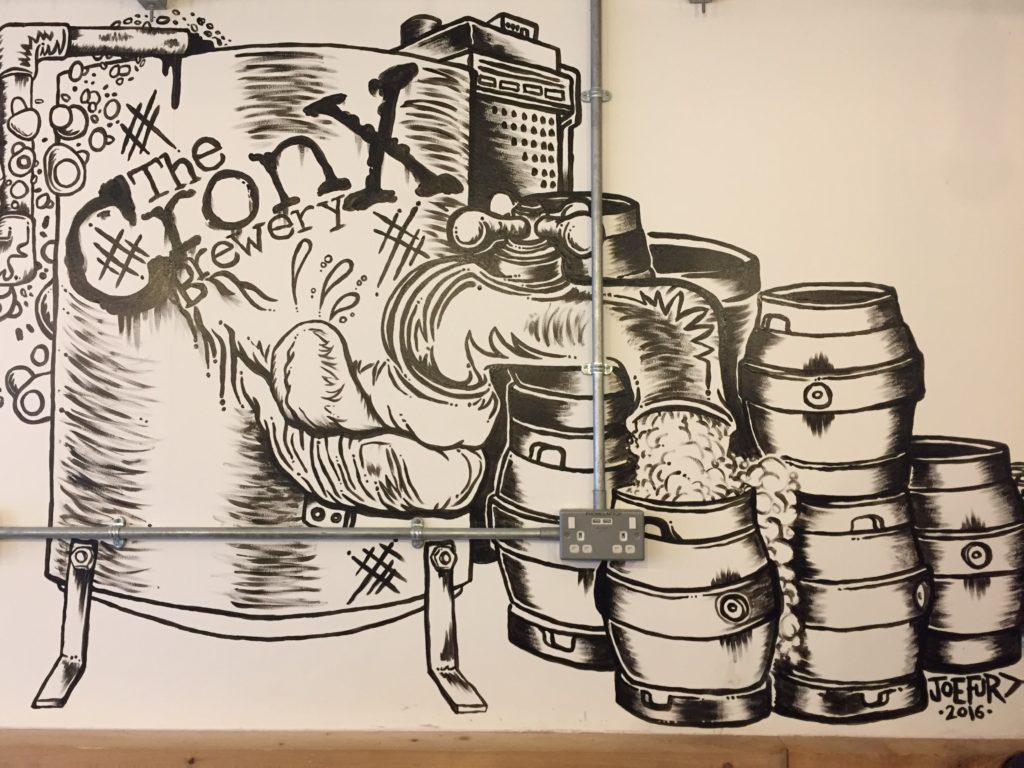
Drinks wholesaler Mark Russell and city worker-turned-brewer Simon Dale founded the Cronx as the first standalone brewery in Croydon since Page and Overton closed in 1954, operating from a 20 hl plant in an industrial estate in New Addington.
The name jokingly blended the name of an equally outlying New York City borough with Croydon’s postcode.
The production site, while open for pre-arranged collection, was unsuitable for a regular taproom. In October 2016, the brewery opened an off-site taproom as one of inaugural businesses at the Boxpark next door to East Croydon station, but a combination of circumstances led to them giving up the lease on this in September 2021. A new taproom finally opened in central Croydon (71 High Street CR0 1QE) in May 2023.
Fermentation capacity increased several times and Simon moved on, but Mark remained as managing director. As a long-time Crystal Palace fan, in 2019 he secured a contract to supply the bars at the football club’s Selhurst Park stadium, creating a specially brewed beer.
A rather simplified diagram of the brewing process at the former Cronx Bar.
Following financial and management difficulties, brewing ceased by August 2024, with voluntary liquidators appointed in November. Mark acquired the brand and recipes and cuckoo brewed, primarily to supply Selhurst Park, but with an intention of restarting production in Croydon.
The central Croydon taproom, which had a separate ownership arrangement, closed in September 2024.
Titsey Brewing subsequently acquired the Cronx site and equipment in summer 2025 as an addition to its own site in the Surrey district of Tandridge. The company began in August 2017 when South African-born Craig Vroom started brewing one cask at a time in the idyllic setting of a 16th century listed farmhouse on the Titsey Estate, at the highest point on the North Downs Way National Trail atop the chalk ridge just south of London. The operation was upgraded in 2019 to an 8 hl kit in a neighbouring unit, and again in June 2023 to a new brewhouse and taproom nearby at Clarkes Lane Farm, Tatsfield TN16 2JU, also on the North Downs Way.
With the former Cronx site back in action, Mark began cuckoo brewing Cronx beers there on his own former kit.
Beers are mainly in keg, with some available in cask, can, bottle, minikeg and bag-in-box,.
Beer firm, former brewpub, no longer brewing 7 Queens Yard, White Post Lane E9 5EN (Tower Hamlets) cratebrewery.com First sold beer: 18 July 2012 Brewing ceased: July 2020
Opened just in time for the 2012 Olympic and Paralympic Games by New Zealanders Tom and Jess Seaton, of the Counter Café nearby, and friend and brewer Neil Hinchley, this brewpub in the White Building, a former sweet factory beside the River Lea Navigation, was the first new brewing initiative in the post-industrial arts and media colony at Hackney Wick.
At first, beers were brewed on an 8 hl kit from AB-UK behind glass in the bar, but in summer 2014, a new 16 hl brewhouse formerly at Ascot Ales was installed together with a pilot kit in a newly renovated location across the yard known as the Brew-Shed. In 2018, the business, by then producing around 10,000 hl a year under the guidance of head brewer Calum Bennett, secured a lease on the entire White Building and crowdfunded for a major refurbishment and expansion. The plan was to revive brewing in the pub itself, making limited edition specials alongside the core brands from the production brewery.
Unfortunately, these plans were severely disrupted by the Covid-19 lockdowns and in July 2020 the brewing side of the business was forced into administration. The Brew-Shed facility was bought by Truman’s, now Big Penny, and subsequently closed. All Crate-branded beers are now cuckoo-brewed outside London.
The original brewpub is still open as a bar and restaurant. The original brewing kit remained in place for some time with a professed intention to revive it, but had been removed by early 2023. In November 2025 the company opened a second bar at Canary Wharf, but the beer brands are still brewed by a third party.
Crate seen across the canal from the Lea Valley Path.
At its peak, Crate brewed contemporary-style ales and lagers in keg, bottle and can which were relatively widely available, including in major supermarkets. It also produced some cask, mainly for sale in the brewpub.