Promoting an international beer culture that recognises and celebrates beers of quality, distinctiveness and local character, brewed with care and passion.
Etiam pulvinar consectetur dolor sed malesuada. Ut convallis
euismod dolor nec pretium. Nunc ut tristique massa.
Nam sodales mi vitae dolor ullamcorper et vulputate enim accumsan.
Morbi orci magna, tincidunt vitae molestie nec, molestie at mi. Nulla nulla lorem,
suscipit in posuere in, interdum non magna.
Closed brewery, former brewpub Original site: White Hart, 1 Mile End Road E1 4TP (Tower Hamlets) Second site: 2 Compass West Estate, West Road N17 0XL (Haringey) First sold beer: June 2013 (at original site as Mulligans; second site first sold beer as Redemption February 2010) Ceased brewing: January 2023
The brewery commenced operations in 2013 on a small 4 hl kit in the cellar of the White Hart in Whitechapel. At first it was known as Mulligans but was very soon rebranded to One Mile End after the address of the pub. Under the skilled guidance of head brewer Simon McCabe, a former musician recruited from Redemption, demand soon grew beyond the pub.
When Redemption expanded to a bigger site in March 2016, One Mile End took over its former Tottenham premises and 20 hl brewhouse. Simon moved on early in 2018 and is now making both wine and beer at the Nota Winery in Finland. His replacement as head brewer was former geologist Pierre Warburton.
The brewhouse at the White Hart remained unused on site for some time, but was removed in September 2022 when the pub was sold to McMullen brewery of Hertford. Soon afterwards, the Tottenham brewery rebranded to OMEBEER as it no longer maintained a link with the pub.
Business under the new brand lasted only a few months before closure early in 2023.
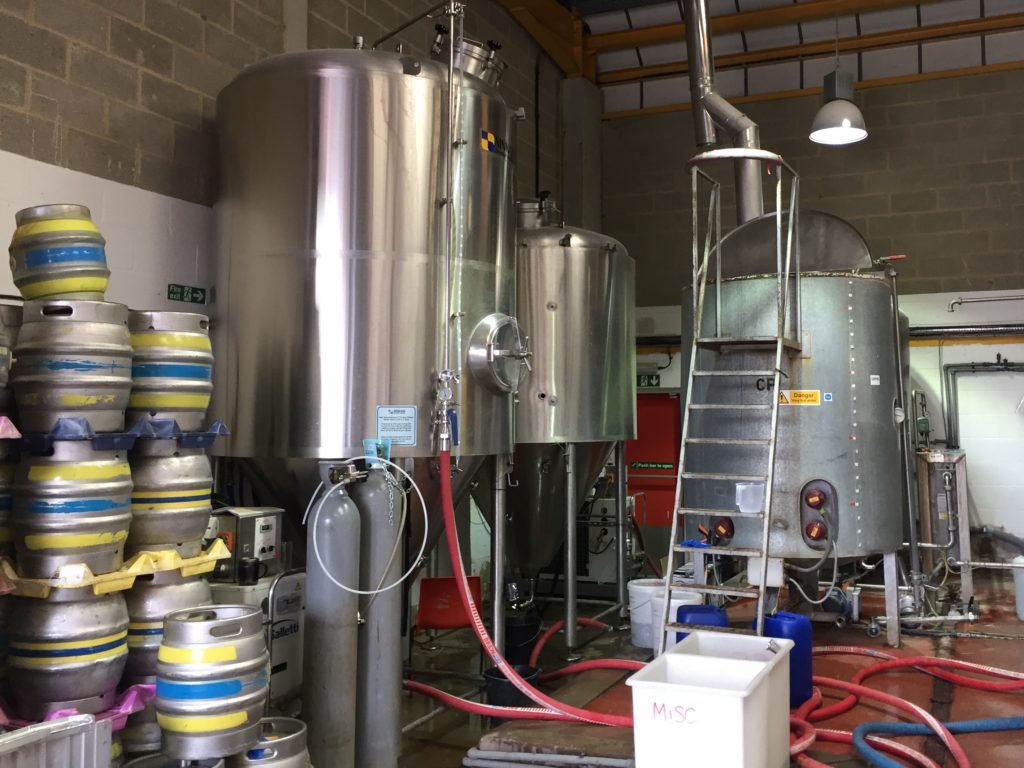
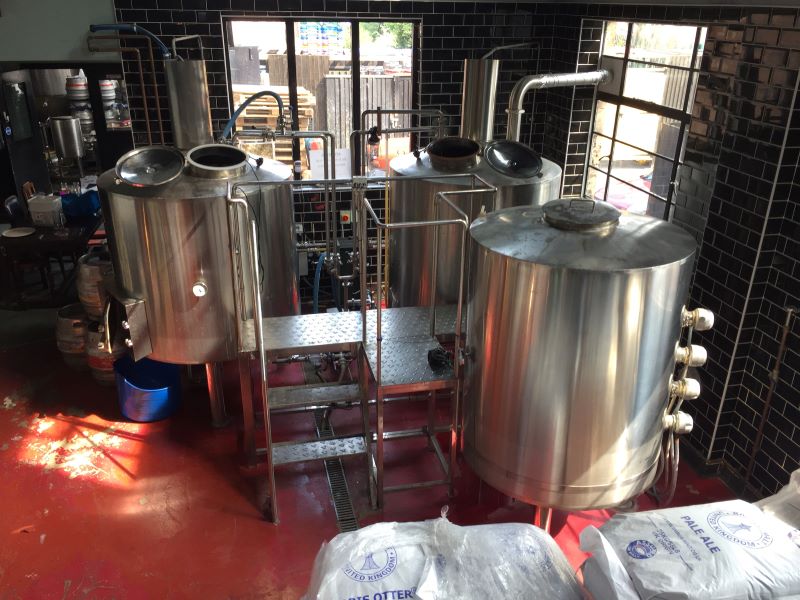
The old Redemption brewhouse still in use at One Mile End.
Beers were in contemporary style in cask, keg and can, using a mobile canning line, with occasional bottle-conditioned specials.
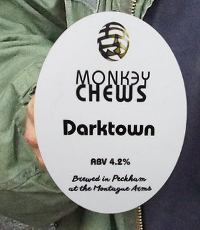
Monkey Chews Brewery, London SE15. Pic: South East London CAMRA.
Closed brewpub Montague Arms, 289 Queens Road SE15 2PA First sold beer: June 2015 Ceased brewing: by end 2015
The landmark Montague Arms, a big roadside pub between New Cross and Peckham which was once renowned as a music venue, was rescued from potential closure in 2014. Brewing equipment was delivered in May 2015 and the first beers were sold shortly afterwards, under the name Monkey Chews after a bar previously run by owner Noel Gale. The experiment proved short-lived, with no house beer appearing beyond the end of that year. The pub closed in January 2018, and the brewhouse had been removed when it reopened under new ownership a few months later. It closed again in July 2019, though may reopen under yet another new owner in 2020.
Brewery 86 Stewarts Road SW8 4UG (Wandsworth) mondobrewingcompany.com First sold beer: April 2015
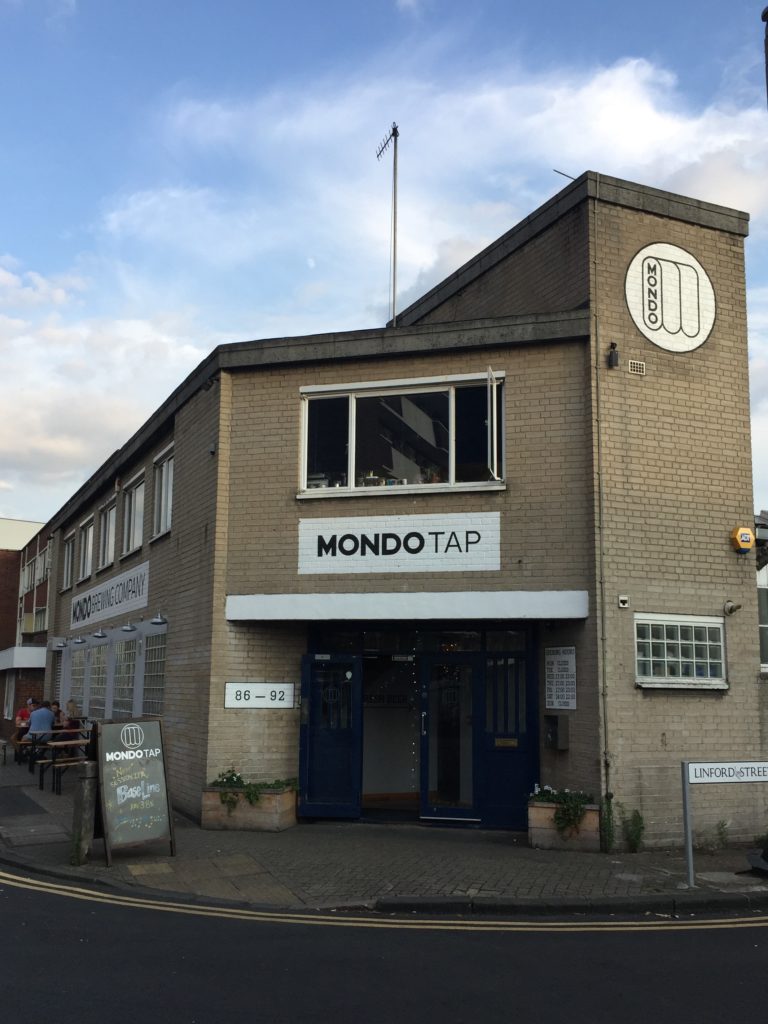
In a distinctive industrial building on a quiet street between Battersea Power Station and Clapham, Mondo was created by two US expat homebrewers, Tom Palmer and Todd Matteson.
After some early pilot beers at UBREW, it began commercial production in March 2015 with a 10 hl kit from Zip Technologies in Hungary. A replacement 20 hl brewhouse was installed in 2017, followed by additional fermentation capacity and a new canning line in 2019. The site has long boasted a dedicated taproom, and in March 2023 a second venue opened at Borough Yards SE1, in partnership with a pizza maker, though this had closed by early 2024.
The company went into a prepack administration in April 2024, becoming a sister business of Hogs Back Brewery in Surrey when the latter’s owner, Rupert Thompson, invested in setting up a new company to buy it out. But there are apparently no plans to move production out of London: the deal is promised to ‘secure the future’ of the Battersea site, where further investment is planned in the taproom.
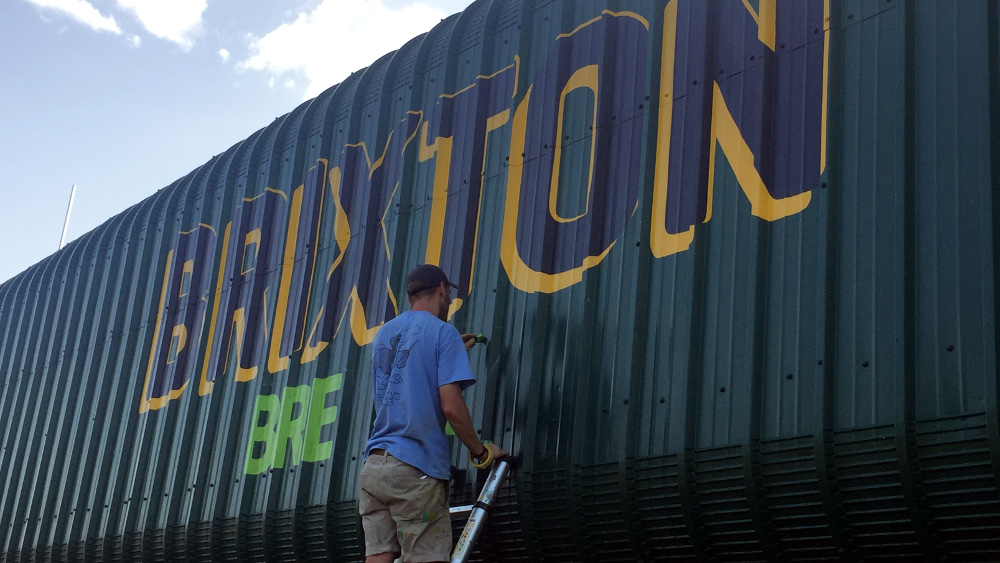
Brixton Brewery brands its new site in August 2018, financed by Heineken.
London’s Best Beer, the book that chronicled the seemingly unstoppable expansion of beer and brewing in the UK’s capital, will soon be back for a third edition. I’m just starting work on completely revising and updating this award-winning guide from CAMRA Books for publication in February 2020, almost five years after the last edition in July 2015.
The
first edition in 2011 appeared at a time when there was much excitement among
London beer lovers but still only 13 breweries – nonetheless a welcome increase
on 2006 when the closure of Young’s had left the city with only nine. I doubt
anyone could then have guessed that when the next edition appeared in 2015, I’d
have to rejig the format to accommodate details of 70 breweries.
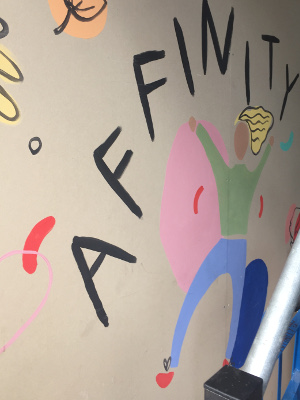
The number has continued to grow since, though at a reduced rate. The ever-reliable Jezza of the Beer Guide London website puts the current total at 120, and I expect a modest increase on this figure by the time the book goes to the printers. They include some really good small and independent producers, like Affinity, pictured left. Encouragingly, only a few have closed, most of them either very small or brewpubs who decided it wasn’t worth the bother. More significant have been the many expansions.
With the threat of a no-deal Brexit in a month’s time, there’s always the possibility that economic catastrophe will torpedo further growth – but brewing has already demonstrated its capacity to expand in difficult circumstances, and the preference for the affordable luxury of good local beer now seems embedded in London’s culture.
For proof of this, look no further than the way the multinational brewing groups have voted with their chequebooks over the past few years. When I finished work on the copy for the last edition, every London brewery was independently-owned except for the Stag in Mortlake, which AB InBev was in the process of closing. Then, just as the guide went to press in May 2015, came the news that SAB-Miller had bought Meantime.
Today,
following the dramatic announcement last month that Fuller’s was selling its
brewing interests to Asahi and concentrating on pubs, the five biggest London
breweries are owned or part-owned by multinationals. Asahi also ended up with
Meantime following the breakup of SAB-Miller while fellow Japanese giant Kirin
owns Fourpure through its Lion subsidiary. Beavertown is near-50% owned by
Heineken, enabling a major expansion to what will potentially be London’s
biggest brewery in Ponders End – just up the River Lee Navigation from AB InBev-owned
Camden Town. The Dutch brewer has also financed a major expansion for Brixton brewery
while Carlsberg now owns London Fields in a joint venture with Brooklyn.
So far,
all these new subsidiaries have kept their distinctive identities and
management teams: unlike in the post-war decades when big breweries swallowed smaller
ones primarily for their pub estates, the multinationals are after credible
brands and businesses that can respond more flexibly to the demands of a new
generation of drinkers. But the megabrewers still have the power to restrict access
to market for the independents and, ultimately, are more interested in shareholder
dividends than the quality of their beer.
And there’s
reason to be particularly concerned about Fuller’s, now London’s only remaining
heritage brewery with roots stretching back to the 17th century –
every other one of those 120 is a 21st century creation. Asahi says
it will continue to brew at the historic Griffin brewery on Chiswick Mall, but
as this is squeezed between the river Thames and the A4 right next to one of
London’s prettiest ‘villages’, someone must have worked out quite how much it
would be worth as a prestige redevelopment site.
The
positive side of this for beer drinkers is the normalisation of ‘craft’ beer in
London. We can now expect to see at least a few decent, and usually
locally-brewed, beers at any new bar or informal restaurant, which means I’ll
have the raise the standards for non-brewing outlets higher still to keep the
book within reasonable proportions. Interestingly, the traditional pub sector, once
seen as the natural home of good beer, is increasingly lagging behind thanks to
the dominance of tied houses and chains.
So I’m now looking forward once again to several hard-working but rewarding months visiting as many pubs, bars, shops and breweries as I can: my ‘long list’ rather dauntingly exceeds 700. If you think you can add to that, you’ll find a suggestion form and guidance on the London’s Best Beer page.
My
mission remains to provide the complete and indispensable guide to great beer
in London, and to celebrate the city’s contemporary brewing scene and its brewing
heritage. Previous editions have been described by reviewers as “probably the
best book about beer in London” and a “detailed and accessible treasure chest
of information”. I hope you’ll agree that I’ve kept to those standards when the
book appears a year from now.
Brewery, taproom Original site: 5 Grand Union Centre, West Row W10 5AS (Kensington & Chelsea) Second site: 1 Buspace Studios, Conlan Street W10 5AP (Kensington & Chelsea) Final site: 37 Humber Road NW2 6EN (Brent) moncadabrewery.co.uk First sold beer: 22 October 2011 Ceased brewing: by September 2021
Former chef Julio Moncada, originally from Argentina, was planning to open a specialist delicatessen. Then he realised that, while a deli requires supplies to be shipped from around the world, all the ingredients for brewing are available close to hand in Britain, so decided to create a brewery instead.
Julio first sold his beer at the inaugural London Brewers Alliance festival near Borough Market in October 2011, produced on a 10 hl PBC brewhouse at the brewery’s original site in North Kensington not far from the Grand Union Canal.
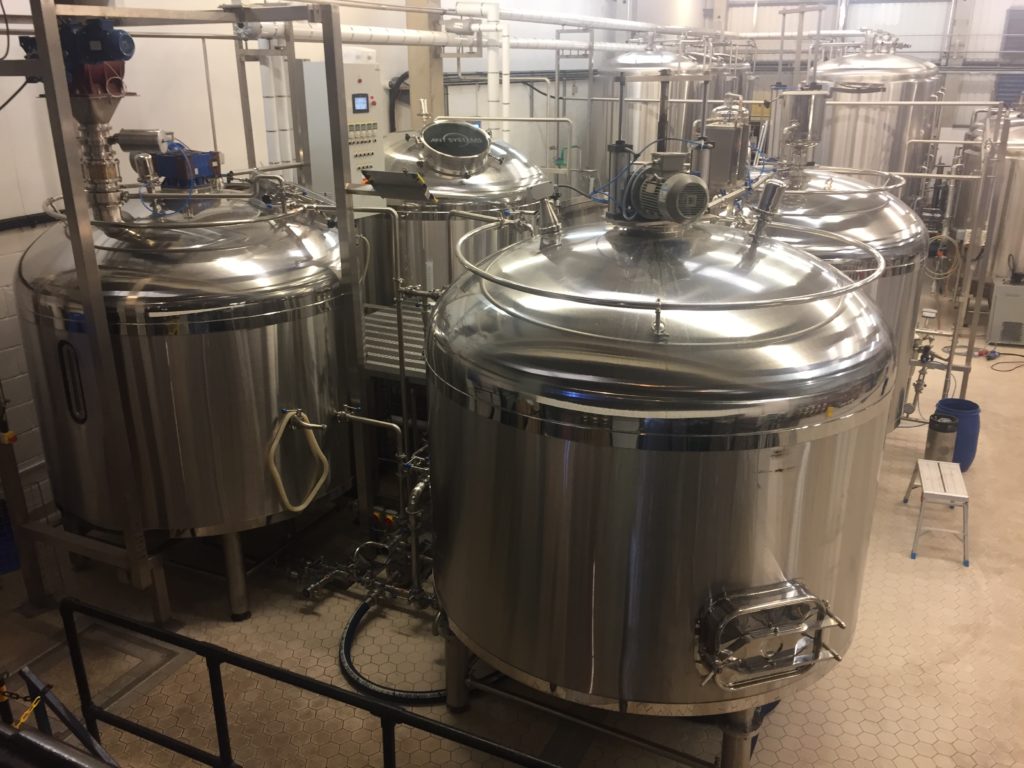
Brewhouse at Moncada
Rising demand rapidly led to expansion, and in January 2013 the brewery moved to bigger premises around the corner in Buspace Studios, with increased fermentation and storage capacity. Moncada expanded again during 2017, moving north into the borough of Brent, with a new brewhouse and taproom at Dollis Hill not far from Staples Corner road junction. For most of 2017, operations were split between the sites but by December everything was based at the new site, now one of London’s more substantial independent operations.
The Dollis Hill site boasted a 30 hl brewhouse custom-designed in Israel by AN Technologies and fabricated in China, plus a bottling line, with a mobile line for canning. There was also an on-site taproom.
Sadly, trade never recovered from the 2020-21 Covid-19 lockdowns. By September 2021, all activity had ceased and the brewery was for sale.
Cask, keg, bottled and canned beers were produced in a range of styles, mostly under the brand name Notting Hill. All the beer was unpasteurised, unfiltered, unfined and vegan-friendly.
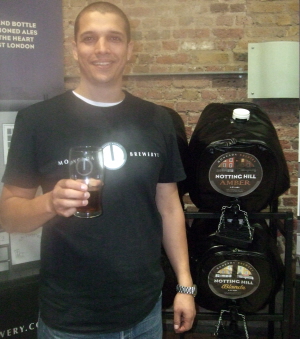
Julio Moncada at the London Brewers Showcase, October 2011
Closed brewery Original site: Units G-H2 Penhall Lane SE7 8RX (Greenwich) Last site: 1 Lawrence Trading Estate, Blackwall Lane SE10 0AR First sold beer: April 2000 Ceased brewing: 1 May 2024
Old Brewery Greenwich Brewpub no longer brewing Pepys Building, Old Royal Naval College SE10 9LW First sold beer: February 2010 Brewing ceased: January 2016
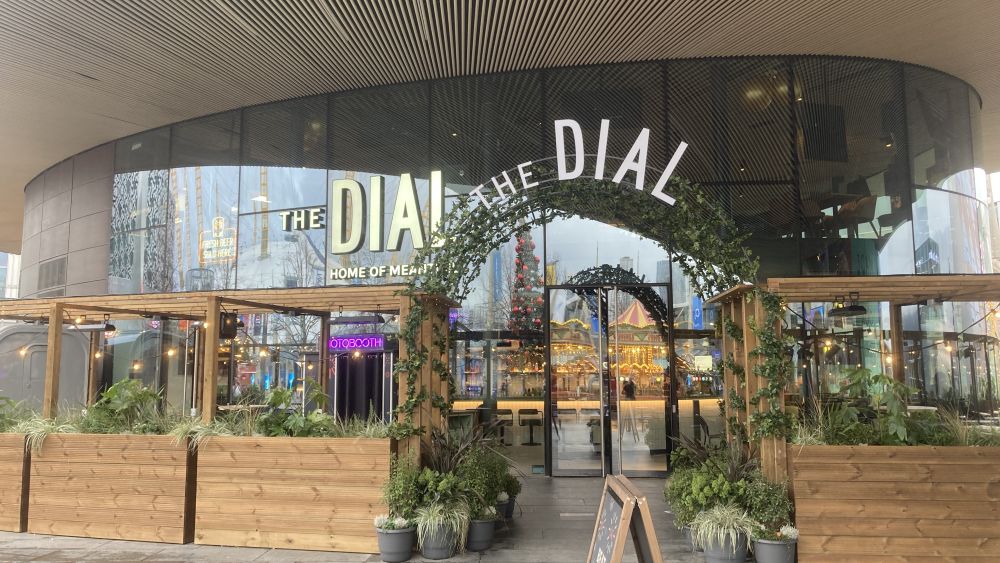
Founded by one of British brewing’s most influential figures, Greenwich-born Alastair Hook, Meantime was a trailblazer of contemporary brewing both in the capital and in the rest of the UK. For a time the second-oldest brewery in the capital, it became the first of the 21st century London brewers bought by a multinational. Though the main production brewery was closed in 2024 with the brands moved elsewhere, Meantime’s link to Greenwich was revived late in 2025 with the opening of a new North Greenwich brewpub which proclaims itself ‘the home of Meantime’.
The Dial, as it’s known, opened its doors in November 2025 in a long-empty circular pavilion strategically placed between the O2 and North Greenwich station, not far from Meantime’s former production site. The large, ultra-modern venue is a partnership between current brand owner Asahi and hospitality company KG.
The Edinburgh-built 6 hl brewhouse, easily viewed through glass, is on the opposite side from the station. Run effectively as an extension of the pilot brewery at Fuller’s, it’s active approximately weekly in the capable hands of Luke McCulloch, who previously worked at the old Meantime, and Sven Hartmann.
House-brewed beer went on sale in early December and the plan eventually is to have two rotating beers available from 500 l tanks, alongside keg and canned Meantime brands brewed by Fuller’s at Chiswick. The first beer was a hazy pale but it’s likely that future brews will include versions of retired Meantime brands.
Meantime brewpub the Dial, Greenwich, London SE10.
More about Meantime
Alastair Hook trained at Heriot-Watt in Edinburgh, but regularly spent summers as a brewing assistant in California and completed his postgraduate studies at Weihenstephan brewing school near Munich, learning to brew quality lager, then a type of beer largely unknown at home. In 1991, he brewed at a pioneering brewpub, the Packhorse, in Ashford, Kent, specialising in German-style beers.
Four years later he helped create Freedom in Parsons Green, London, the first successful and long-lived UK craft lager brewery: it’s still in operation today, although in Staffordshire under different ownership. In 1998 he was involved in setting up two of Britain’s earliest US-style upmarket brewpub-restaurants: Mash and Air in Manchester (closed in 2000) and Mash in Great Portland Street, London (closed in 2007).
Two years later, Alastair opened his own brewery in Charlton, named Meantime for its location near Greenwich and its commitment to properly matured beers. At a time when the ambition of most microbreweries stretched not much further than the local free trade and CAMRA festivals, Meantime pursued the unusual course of concentrating on keg and bottled craft lagers and wheat beer, targeting restaurants and bars more than traditional pubs, making beers for the Sainsbury’s supermarket chain as part of its premium Taste the Difference range, and contract-brewing for Mash and Freedom among others. A range of beers under its own name didn’t appear until 2005.
Meantime main brewhouse, since closed.
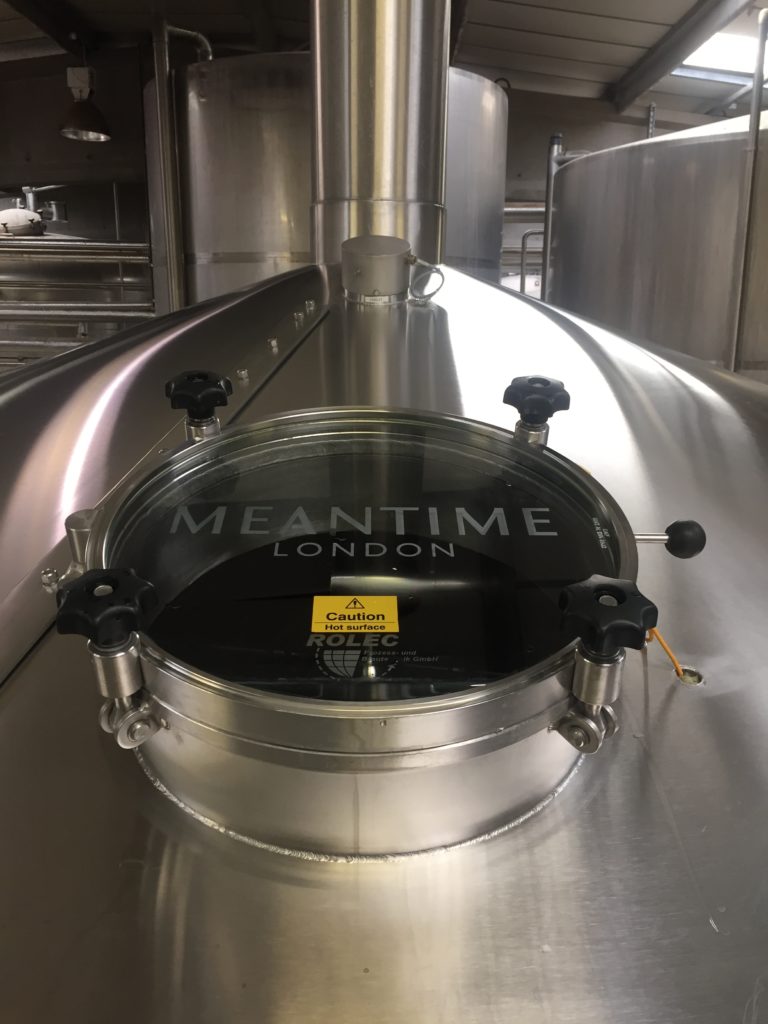
In September 2010, Alastair achieved his long-held ambition to move the main brewery to Greenwich, with an expansion to a site near the Blackwall Tunnel portal, equipped with a new German-built Rolec 100 hl brewhouse. The first modern UK-brewed unpasteurised and unfiltered beer for dispense from 1,000 l tanks, inspired by the Czech model, launched from here in 2013. A new tasting room opened at the front of the site in 2015, next to a 10 hl pilot kit visible from the road and a shop with the first walk-in beer fridge in London, with a cluster of nine outdoor 100 hl tanks further back.
There was also a third brewhouse, a 20 l homebrew kit used internally for tests and experiments. A seminar room next to the main brewhouse, used for tutored tastings and brewery tours, displayed bottles and glasses from the collection of legendary beer writer Michael Jackson. In 2019 Meantime finally occupied two units formerly used as an archive by the National Maritime Museum which had previously separated the tasting room from the main brewery, bringing annual output to around 102,000 hl.
Besides the tasting room at the brewery, Meantime long operated a pub, the Greenwich Union, opened in 2001 just outside the town centre (56 Royal Hill SE10 8RT). This remained closed following the 2020-21 Covid-19 lockdowns and in April 2021 was sold to Young’s, who used it as an extension of their existing pub the Richard I (Tolly’s) next door. The Old Brewery pub at the Old Royal Naval College in the heart of the Maritime Greenwich World Heritage Site was founded as a brewpub by Meantime in 2010 but was sold to Young’s in 2016: it no longer brews, though the kit is still in place and there has been occasional talk of reviving its use.
Meantime was bought by SABMiller in May 2015, a deal negotiated by then-Chief Executive Nick Miller, who formerly worked for the US-South African group. SABMiller was bought out in turn in October 2016 by the world’s biggest brewing group, Anheuser-Busch InBev. To comply with monopoly regulation, ABI sold on the Greenwich business along with Grolsch and Peroni to Asahi, marking the first direct involvement of one of the big Japanese-based groups in the UK industry. Meantime retained its own identity and management for some time, but in 2019 Asahi bought a second London brewery, Fuller’s, and subsequently began integrating the management of both facilities. Alastair went into semi-retirement and eventually relinquished his involvement.
Through Fuller’s, Asahi also acquired the Dark Star brewery in Partridge Green, West Sussex, which had long links back to the emergence of London microbrewing in the 1980s (see Pitfield’s). Asahi closed Dark Star in December 2022, shifting production to Meantime. As the Sussex brewery produced numerous cask beers, this required adding cask facilities at Greenwich for the first time (the cask version of Meantime London Pale Ale available around 2009-10 and subsequently withdrawn was contract brewed by Adnams in Southwold, Suffolk). The exception was flagship brand Dark Star Hophead, which had already been transferred to Fuller’s and remained there.
Then in March 2024, Asahi announced it was closing Meantime completely, and consolidating all its UK brands at the Fuller’s site in Chiswick. The site was rapidly decommissioned and ceased brewing in early May.
Asahi expressed an aspiration to maintain a brewing presence in the area on a small scale as a ‘new standalone consumer retail experience’. In May 2025, Asahi’s partner, hospitality company KG, applied to Greenwich council for planning permission to establish a Meantime-themed brewpub and sports bar on Peninsula Square in North Greenwich. Progress was unusually rapid and, as described above, the venue was open by November with tank beer from the on-site brewhouse on sale a few weeks later.
Aside from the cask Dark Star brands, beers from the old Meantime were in tank, keg, bottle and can: the bottles were filled on site but canning was done at Grolsch in the Netherlands. Some London Lager was also brewed at Groslch in Enschede in 2016 but this ended with the expansion of capacity at Greenwich.
A previous version of this post stated that brewing at the Old Brewery Greenwich was erratic, sparking a discussion in the comments section. This revision makes no observations about the frequency of brewing at the site.
Brewpub Original site: Ealing Park Tavern, 222 South Ealing Road W5 4RL (Ealing) Current site: 20 Worship Street EC2A 2DX (Islington) longarmpub.co.uk First sold beer: March 2015 (at original site)
The brewing arm of the ETM pub group, owned by brothers Ed and Tim Martin, began operations in 2015 with a 10 hl brewhouse from Oban Ales in a former hay store at the Ealing Park Tavern, a location that had seen brewing before but not since the 1850s. Original head brewer Vladimir Schmidt, although from the Czech Republic, was a fan of traditional English styles and the brewery initially focused on cask beers for the pub and others in the group, though some keg and hand-bottling later took place.
In July 2017, the company opened a second more central brewpub in Shoreditch, with a smaller but more sophisticated 5 hl kit and a tightly packed parade of fermentation vessels in a corner of the Montcalm Royal London House hotel.
The original Ealing site was decommissioned by the end of the year and the equipment sold to Affinity: it’s still used by Three Hills. ETM sold the pub lease back to the freeholder in February 2020: the site is currrently closed and awaiting redevelopment.
Cask has been discontinued; beers are sold from tank in the bar and from keg at other outlets in the group. The Long Arm lager is currently outsourced.
Brewpub Original site: The Bull, 13 North Hill N6 4AB (Haringey) Current site: The Bohemia, 762 High Road N12 9QH (Barnet) londonbrewing.com First sold beer: September 2011 (at the Bull)
Dan Fox, former manager of legendary beer pub the White Horse, took over Highgate pub the Bull in 2011, establishing the London Brewing Co with a 4 hl kit in the kitchen. As demand for the beer outside the pub increased, Dan began looking for a second site with more room for a brewery, finding the Bohemia in North Finchley, a big pub that had been an O’Neill’s, a furniture shop, a supermarket and a squat.
The Bohemia reopened in June 2014, though the new 10 hl kit in a convenient lower-level area at the back wasn’t commissioned until early in 2015. London Brewing operated at both sites until July 2016 when the Bull was sold to new owners, who have restarted brewing under the name Gorgeous in new accommodation in the garden.
Dan himself moved on in summer 2017 to take over the Arnos Arms, leaving the Bohemia in the hands of business partner Senan Sexton. Brewers have included Daniel Vane (co-founder of Exale), US-born Rich White, and George Boustred, now at East London.
In November 2025, the company added a second, non-brewing pub when it reopened Ye Three Lords near Aldgate on the edge of the City of London.
Beers are in cask, keg and can, sold through the pub and elsewhere.
Former brewpub, no longer brewing in London The Bull, 13 North Hill N6 4BX gorgeousbrewery.com First sold beer: September 2011 (as London Brewing), August 2016 (as The Bull Brewing Co) Ceased brewing in London: February 2022
Dan Fox, former manager of legendary beer pub the White Horse in Parsons Green, set up on his own in 2011 by reopening the Bull at Highgate as a brewpub with a 4 hl kit. Located in the pub kitchen, this initially produced cask beers mainly for sale in house under the name London Brewing Co. Dan opened a second brewpub, the Bohemia in North Finchley, in 2014, and in July 2016 sold the Bull, complete with brewery, concentrating London Brewing’s operations at the Bohemia.
The Bull’s new owners, Samantha and Rob Laub, were keen to continue with brewing and Reuben Moore, head brewer under the previous ownership, continued in his role. At first the brewing operation was simply known as the Bull Brewing Co, but in March 2017 it was rebranded as Gorgeous Brewery.
Capacity was increased with the objective of increasing sales outside the pub, and early in 2018 the brewery was relocated to a new purpose-built home in the garden, with an increased brew length of 8 hl, more and bigger fermenters and more space.
Early in 2022, the freehold of the pub was sold to Greene King and it was placed under new management, with the brewery forced to suspend operations. Its building has since been converted into additional drinking space.
Originally the kit was placed in storage with the intention of resuming brewing at a new site, with the brands cuckoo brewed in the meantime outside London at Church Farm Brewery, Budbrooke, near Warwick in Warwickshire. But in August 2023, Church Farm announced it had formally acquired Gorgeous and the brands would become a permanent part of its portfolio, ruling out the revival of brewing in London.
Beers in cask, keg and bottle all had names beginning with G and tended towards pale and contemporary in style, though with some more traditional lines.
Brewery no longer in London Brewery: 160 Hamilton Road SE27 9SF (now closed) Barrel vault: The Barrel Project, 80 Druid Street SE1 2HQ thelondonbeerfactory.com First sold beer: August 2014 Ceased brewing in London: August 2022
The London Beer Factory began as an ambitious undertaking just across the yard from Gipsy Hill brewery. It was the brainchild of brothers Sim and Ed Cotton – the latter spent several years in Australian vineyards before moving on to beer. The first head brewer was Archie Village, who went on to found his own brewery, Villages, in Deptford. The facility started with a substantial 32 hl kit, with an additional pilot kit enabling the development of several unusual beers.
Fermentation capacity was extended, and in spring 2016 the brewery became the first in the UK to package in ‘360’ cans with an entirely removable lid. The beer was canned in-house using a micro line supplied by Cask Brewing Systems of Canada.
In summer 2017, London Beer Factory added a barrel vault and bar, the Barrel Project, in Bermondsey, which was refurbished and relaunched in September 2018. During 2019, the brewery added a mobile coolship which was used in collaborations with several other brewers.
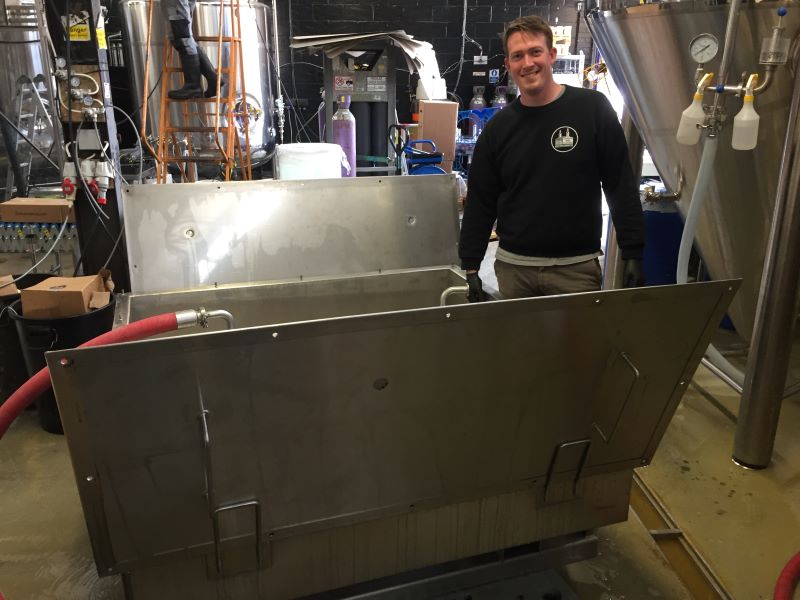
Mobile coolship at London Beer Factory.
In the early days an occasional taproom operated at the brewery site but this was closed to make way for expansion of production. In December 2020, an offsite bar opened at the brewery’s warehouse in West Norwood, but this was closed by October 2021.
Brewing in London ceased in 2022, with operations moving to an undisclosed address in Norfolk. The Barrel Project continues as a retail outlet but there are no brewing facilities there, only fermentation.
Beers are sold in can, keg and cask, with Barrel Project specials hand-bottled in 330ml bottles.