A sample text widget
Etiam pulvinar consectetur dolor sed malesuada. Ut convallis
euismod dolor nec pretium. Nunc ut tristique massa.
Nam sodales mi vitae dolor ullamcorper et vulputate enim accumsan.
Morbi orci magna, tincidunt vitae molestie nec, molestie at mi. Nulla nulla lorem,
suscipit in posuere in, interdum non magna.
|
Originally published in BEER December 2003.
NOTE This review forms part of what was originally published as a single longer article. See previous posts for an introduction to Imperial stouts and some other reviews. See the next post to read the final review.
See all parts of this article: http://desdemoor.co.uk/?tag=imperial-stouts-beer-2003
Origin: Lewes, East Sussex, England
ABV: 9%
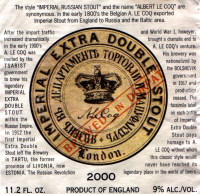 Harveys Imperial Extra Double Stout Harveys Imperial Extra Double Stout (9%), brewed in Lewes but bottled by Gales of Horndean, advertises its authenticity with a reproduction of one of Le Coq’s original labels. While we’ve no way of telling how close this tastes to 19th century brews, my 2000-vintage bottle was certainly an extremely fine beer in its own right. It’s an impenetrable dark brown colour with a cakey, malty and slightly winey aroma, a rich malty and oily palate with hints of strawberries, gravy, coffee and fennel seeds, and a warming roasty mocha coffee finish with earthy hops and late fruit. With the demise of the Courage version, this masterfully complex beer easily deserves recognition as the current flagship of the style.
See the next post to read about more Imperial stouts.
See all parts of this article: http://desdemoor.co.uk/?tag=imperial-stouts-beer-2003
Read more about this beer at ratebeer.com: http://www.ratebeer.com/beer/harveys-imperial-stout/6415/
Originally published in BEER December 2003.
NOTE This review forms part of what was originally published as a single longer article. See previous posts for an introduction to Imperial stouts and some other reviews. See the next post to continue reading about further Imperial stouts.See all parts of this article: http://desdemoor.co.uk/?tag=imperial-stouts-beer-2003
Origin: Lochristi, East Flanders, Belgium
ABV: 8.5%
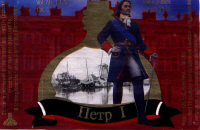 Proef SNAB Петр I More obviously inspired by the Russian connection is Czaar Peter (8.5%), or “Pyotr I” as the front label has it in Cyrillic, commemorating Tsar Peter the Great’s stint as a ship’s carpenter in Zaandam in 1697. Although marketed by SNAB, the North Holland Alternative Brewers’ Association, it is brewed under contract in Belgium, at Proef of Lochristi, East Flanders. Also lighter than the British versions, it has a rich, nicely-balanced biscuity, roasty and coffeeish palate, with a rummy chocolate liqueur finish developing a firm but pleasantly rounded Challenger hoppiness recalling classic Irish stout. From the Netherlands Peter went to Deptford, where he might have sampled the forerunners of porter; later, in founding St Petersburg, he gave Russia access to the Baltic trade that eventually brought London stout to its shores.
See the next post to read about more Imperial stouts.
See all parts of this article: http://desdemoor.co.uk/?tag=imperial-stouts-beer-2003
Read more about this beer at ratebeer.com: http://www.ratebeer.com/beer/snab-czaar-peter/18131/
Originally published in BEER December 2003.
NOTE This review forms part of what was originally published as a single longer article. See previous posts for an introduction to Imperial stouts and some other reviews. See the next post to continue reading about further Imperial stouts.
See all parts of this article: http://desdemoor.co.uk/?tag=imperial-stouts-beer-2003
Origin: Ellezelles, Hainaut, Belgium
ABV: 8.4%
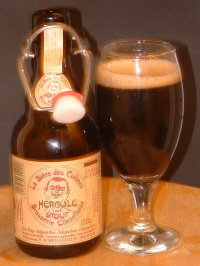 Ellezelloise Hercule Ellezelloise Hercule (8.4%), from a micro in what counts locally as hilly country in the north of Hainaut, Belgium, is slightly lighter, weaker and less leathery than it used to be but still clearly inspired by British strong stouts. It’s a lighter colour — a dark ruby brown — and rather fruitier, with blackcurrant and tar on the aroma and a loganberry touch to the sharpish palate. However the slow developing flavours of roasted coffee, ashy bitter chocolate and tongue-furring hops on the finish are authentically stoutish. The name refers to Agatha Christie’s character Poirot: I guess a Wallonian take on an historic English beer style is an appropriate return compliment for a Wallonian character invented by an historic Englishwoman.
See the next post to read about more Imperial stouts.
See all parts of this article: http://desdemoor.co.uk/?tag=imperial-stouts-beer-2003
Read more about this beer at ratebeer.com: http://www.ratebeer.com/beer/ellezelloise-hercule-stout/6701/
Originally published in BEER December 2003.
NOTE This review forms part of what was originally published as a single longer article. See previous posts for an introduction to Imperial stouts and some other reviews. See the next post to continue reading about further Imperial stouts.
See all parts of this article: http://desdemoor.co.uk/?tag=imperial-stouts-beer-2003
Origin: Bowburn, Durham, England
ABV: 10%
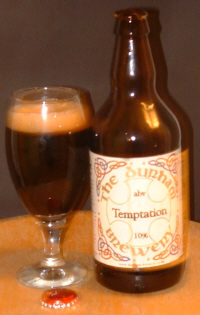 Durham Temptation Durham Temptation (10%) once carried the more transparent name Imperial Russian Stout, but has been renamed in line with the mock-ecclesiastical house style of this brewery from the land of the Prince Bishops. The very dark ruby beer has a tarry, oily and liquoricey aroma and a full sweetish malt loaf and chocolate palate immediately enlivened by roastiness, hops and a splash of alcohol. The smoky, hoppy and espresso coffee finish is particularly pleasant and well-rounded. The brewery should consider smaller bottles, though: half a litre in one go is more a challenge than a temptation!
See the next post to read about more Imperial stouts.
See all parts of this article: http://desdemoor.co.uk/?tag=imperial-stouts-beer-2003
Read more about this beer at ratebeer.com: http://www.ratebeer.com/beer/durham-temptation/28517/
Originally published in BEER December 2003.
NOTE This review forms part of what was originally published as a single longer article. See the previous post for an introduction to Imperial stouts and the first review. See the next post to continue reading about further Imperial stouts.
See all parts of this article: http://desdemoor.co.uk/?tag=imperial-stouts-beer-2003
Origin: Market Weston, Suffolk, England
ABV: 9.6%
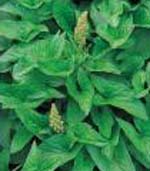 This beer is actually named after a brassica called Good King Henry, which looks like this. Old Chimneys Good King Henry Imperial Stout (9.6%) also originates from a micro that isn’t afraid to experiment, based at Market Weston in Suffolk. Its blackcurrant pastille, marmite and coffee aroma and dense black ruby-tinged appearance are very alluring, but I found the big malty palate a tad too sweet and syrupy. A good roast and hop flavour develops in the lingering finish, where the sweetness turns slightly sherryish.
See the next post to read about more Imperial stouts.
See all parts of this article: http://desdemoor.co.uk/?tag=imperial-stouts-beer-2003
Read more about this beer at ratebeer.com: http://www.ratebeer.com/beer/old-chimneys-good-king-henry/23554/
Originally published in BEER December 2003.
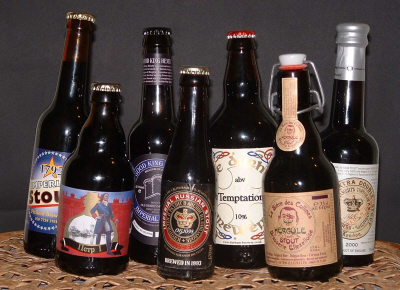 Imperial stouts NOTE This review forms part of what was originally published as a single longer article. See the link at the end to continue reading about further Imperial stouts considered alongside this one.
See all parts of this article: http://desdemoor.co.uk/?tag=imperial-stouts-beer-2003
Origin: London, England (since moved to Epping, Essex, England)
ABV: 9.3%
Imperial stout, sometimes known as Russian stout, is a rare traditional British beer style at a strength for contemplative sipping. Its pedigree goes back to the development of porter in London at the dawn of large-scale commercial brewing in Britain, and somehow it has survived — but only just, a lone potent black brew amidst a pale sea of session-strength guzzlers.
Stout was originally “stout porter” — the adjective “stout” meaning strong was once applied to beer regardless of colour, but in the 19th century it first became wedded to porter and then used on its own. Very strong stouts proved particularly successful in the export trade to the Baltic and Russia: the “imperial” epithet refers to the Russian, not the British, empire, recognising the royal warrant granted to Albert Le Coq, a 19th century Belgian importer of British beer who found favour with the Tsar by donating beer supplies to the army. When Le Coq’s preferential deal ended early in the 20th century, the company opened its own brewery in Tartu, Estonia, which today is once again brewing Le Coq Porter, though as a cold-fermented and pasteurised beer.
Back in London, only Barclay Perkins eventually retained the style: its Imperial Russian Stout was later inherited by Courage, and became one of only a handful of bottle-conditioned beers still around at the founding of CAMRA. When Courage quit London, this niggling anomaly in the corporate strategy went north to John Smith’s in Tadcaster, where it was finally dumped in 1993, although a modified, pasteurised version apparently emerged in 1999 for export to Finland.
Always a style that enjoyed its greatest success outside its country of origin, Imperial Stout survives into contemporary times largely because of overseas interest. In the 1980s John Smith’s neighbour Samuel Smith launched a weaker (7% ABV) brewery conditioned version and at first didn’t even attempt to sell it in Britain, shipping it straight to their US importer instead. The restoration of a bottle conditioned example came in 1999 from another renowned independent, Harvey of Lewes, again on request from the States, and since then a number of micros have entered the fray.
I’ve looked below at a representative selection of bottled conditioned strong stouts, including a couple from Belgium. All these beers are worth trying: it’s unlikely a brewer will attempt such an unusual speciality without coming up with something that’s at least interesting, and some are sublime classics. And given the precariousness of the style’s survival, they are all well deserving of our support.
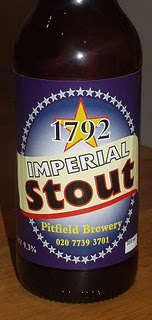 Pitfield's 1792 Imperial Stout Pitfield’s 1792 Imperial Stout
(9.3% ABV) is the only example now brewed in London, just a stone’s throw from Shoreditch, the historic home of porter. The brewery takes full advantage of its attached beer shop to experiment with small batches of unusual styles: this is one of a series of recent historical recreations. It’s an opaque dark brown beer that offers a very well-balanced take on the style, perhaps more accessible than some: big bodied and richly malty but notably light drinking for its gravity, with a good roasted character, complex aniseed, fennel and cherry fruit notes and a tangy and hoppy roast and chocolate finish.
See the next post to read about more Imperial stouts.
See all parts of this article: http://desdemoor.co.uk/?tag=imperial-stouts-beer-2003
Read more about this beer at ratebeer.com: http://www.ratebeer.com/beer/pitfield-1792-imperial-stout/23799/
Originally published in What’s Brewing November 2003
Origin: Malle, Antwerpen, Belgium
ABV: 7 per cent
Buy from supermarkets, specialist shops
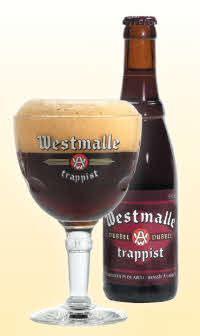 Westmalle Dubbel Westmalle abbey is a member of the beer world’s most exclusive club: the Trappist monasteries that brew beer commercially under the direction of the monks. There are currently only six of these, all in Belgium (a seventh, Koningshoeven in the Netherlands, is now run by secular brewers). All of them offer strong, distinctive, unpasteurised ales of exceptional quality, preserving a link to the monastic brewing tradition that played a vital role in the development of Europe’s beer culture.
It’s an extensive and rather forbidding red brick complex standing in dead flat countryside in the Kempen region, on the main road between Antwerp and Turnhout. Opportunities to visit are rare, but a tree-lined footpath circumnavigates the site and a roadside pub opposite serves the beer. After Chimay, the brewery’s products are the most widely marketed and distributed of the Trappist beers; unlike Chimay, they have not yet suffered accusations of falling quality.
Westmalle is also arguably the most influential of the Trappist brewers. Its pairing of a weaker, sweeter, brown “dubbel” with a stronger, dryer, spicier, golden “tripel” has since been copied far and wide by secular brewers of abbey-style beers. The names refer to the marks once made on beer casks to identify ascending strengths: an “enkel” (single), weaker still and actually known as Extra, is brewed almost exclusively for the monks’ own consumption.
The Tripel is venerated as a world classic, but I’ve always had a soft spot for the Dubbel. This also seems the most widely available in Britain, perhaps because of its lower strength. It’s brewed from German and French pilsner and dark malts, German and Czech hops, “natural groundwater”, the monastery’s house yeast and — characteristically for the style — a dash of candy sugar. The result, served with the yeast deposit if preferred, is a dark ruby brown beer with a soft, fawn coloured head, well exhibited in the traditional Trappist glass goblet.
The restrained aroma is malty and slightly curranty, leading to a rich and complex palate, soft-textured, mildly sweet and quite luxurious. Chocolatey malt and raisins dominate, with hints of banana and toffee and developing almondy hops. A yeasty tang emerges on the swallow, followed by an equally subtle and complex finish with mellow, nutty, powdery hops and a slight touch of spice over fruity and malty tones. All in all it’s a lovely mellow beer, approachable but elegant, and still very much the benchmark of its style.
Try also Affligem Postel Dobbel, Burton Bridge Tickle Brain, De Leckere Dubbel (Netherlands), St Feuillien Brune, Westvleteren Blauw
Read more at ratebeer.com: http://www.ratebeer.com/beer/westmalle-dubbel/2205/
Originally published in What’s Brewing October 2003
Origin: Winstantow, Shropshire, England
ABV: 4.7 per cent
Buy from supermarkets, specialist shops
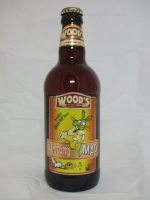 Wood's Hopping Mad Awareness of the ingredients of beers is growing, and the hop, which gives beer its most obviously identifiable and distinctive aromas and flavours, has come in for particular attention. Where once brewers would simply reach for their traditional varieties, now there is a whole repertoire of sensations with which to engage the consumer’s interest.
Single varietal beers, an idea borrowed from the wine world, contain only one, named variety of hop, rather than following the more usual practice of choosing several different varieties to cover the various functions of bittering, aroma and preservative.
One such is Hopping Mad, from a small but successful family-owned micro established in 1980 next to the Plough Inn at Winstantow in the Shropshire Hills, near the celebrated landscape of Wenlock Edge. This is another one of those British real ales in a bottle that’s derived from a draught recipe, in which form it won a silver Beauty of Hops award, though the bold flavours stand up well to the bottling process.
The beer was originally brewed as an easter special — the manic bunny on the label reveals a third meaning to the painfully punning name. The hop is Progress, a milder relative of the familiar British bittering hop Fuggle. However the beer also demonstrates the limitations of analogy; while wine is more-or-less 100% grapes, hops are only one among several ingredients in beer, all of which need to be carefully chosen to show them off to best effect.
The Woods get it right with a grist of pale malt, crystal malt and torrefied wheat (similar to the puffed wheat found in breakfast cereals), giving a warmly amber-hued beer with a thick white head which emerged from my bottle slightly cloudy — but according to the label it’s fine to drink with our without the yeast deposit. The aroma is distinctly hoppy and slightly peachy at first, quickly mellowing out with subtle traces of earthiness, fennel and a touch of liquorice.
The palate is crisp but full, and subtly complex, with touches of demerara sugar and peach softening an overall dry beer with spicy fennel-like hops. My bottle was well-conditioned, with a gentle carbonation supporting the inviting softness. Hops and citric fruit come forward on the swallow, followed by a slowly developing bitterness that becomes quite intense but always well rounded. The beer is finally quite tongue-drying, but with plenty of soft malt and a touch of vanilla in the finish.
Try also City of Cambridge Hobson’s Choice (First Gold), Gale’s Conquest (Fuggle), Iceni Phoenix (Phoenix), Pitfield East Kent Goldings (Golding)
Read more at ratebeer.com: http://www.ratebeer.com/beer/woods-hopping-mad/5882/
Originally published in What’s Brewing September 2003
Origin: Wainfleet, Lincolnshire, England
ABV: 4.5 per cent
Buy from Booths supermarkets
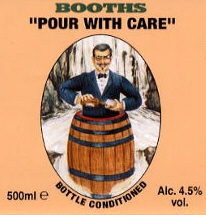 Batemans Booths Pour With Care Batemans Booths Pour With Care
Booths, a regional supermarket chain in northwest England, offers an imaginative range of bottled beers, including bottle conditioned ales, that puts its national competitors to shame. The range is driven by the personal passion of beer buyer David Smith, who believes there’s “a lot of mileage” in real ale in a bottle, so long as you put some effort into educating your customers – a point the larger supermarkets seem slow to grasp.
Booths put that philosophy into practice when it became the first supermarket to launch its own brand bottle conditioned British ale. Pour With Care – its name reflecting its educational mission – was commissioned from Batemans of Wainfleet and launched in May 2001 to great success.
Family-owned independent Batemans – a CAMRA cause célèbre in the 1980s when it was threatened with a hostile takeover – is well-loved for its self-proclaimed “good honest ales” in cask. Its own widely distributed bottled range includes a number of interesting specialities, but all of them filtered, though not pasteurised, since the brewery finds bottle conditioning “too unpredictable”. It has however created the occasional BCA as a special, and worked enthusiastically on the Booths project.
The recipe was developed from scratch, though Stewart Bateman says David had a very clear idea of the kind of beer he was after. It ended up a rubyish amber ale with a grist of 53% Maris Otter pale, 35% wheat and 12% crystal malts, hopped half-in-half with Goldings and Challenger. It’s fermented in open squares and bottled unprimed from racking tanks with yeast in suspension: like all Batemans beers it’s suitable for vegans.
With its big, smooth, yellowish head it actually requires pouring with more care than some BCAs in order to get it into the glass in one smooth movement. Once accomplished, there’s a fruity aroma with generous peppery and slightly earthy hops, chocolate and banana notes (possibly from the wheat?).
The palate is rich, full-bodied and slightly cakey with marmitey malt, marmalade and crystal malt sappiness, turning quite sternly dry but still fruitily aromatic. There are more hops in the lengthy finish, with its malt and chocolate tones becoming dry and bitterish, and mineral, iodine-like hints around the side of the mouth.
Overall this is a big, robust and fruity but elegant glassful in a style that might have come from a new generation micro, except that it’s also unmistakably a Batemans beer – a quality Stewart attributes to the brewery’s dominant yeast strain. It’s great to see this pioneering partnership has yielded such a praiseworthy result.
Try also Butts Barbus Barbus, Hogs Back BSA, Hop Daemon Leviathan
Read more at ratebeer.com: http://www.ratebeer.com/beer/booths-pour-with-care/14310/
Originally published in What’s Brewing August 2003
Origin: Newport, Oregon, USA
ABV: 6.5 per cent
Buy from specialist shops, festivals, Only Fine Beer (tel 020 7265 8388, www.onlyfinebeer.co.uk)
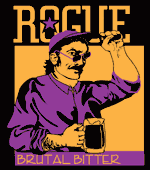 Rogue Brutal Bitter Rogue Ales, based in the Pacific Northwest, a heartland of US craft brewing, is one of the more established of the new generation of North American craft brewers. It began as a brewpub in Ashland, Oregon in 1988, moved to its current home in Newport in 1991 and now operates a handful of pubs around the state.
Its large 650ml bottles with their distinctive screen-printed labels have appeared on British shelves before, during Oddbins’ brief flirtation with North American beers a few years back, and I remembered being impressed with them then, so I was delighted to hear that they now have another British importer.
Strong beers in such big bottles may be offputting to British buyers, however, especially since, to answer recent speculation in these pages, at least some are still fermenting in the bottle, with yeast sediments to prove it. Brutal Bitter is one of these: originally an anniversary beer, it is described by brewer John Maier as a cross between an ESB-style and an IPA. The principal malt is English floor malted Pipkin from Beestons, with Cara Vienna and Cara wheat malt.
Like many new US beers the emphasis is on the hop character – it’s a single varietal brew featuring Oregon-grown Crystal, a hybrid derived from Hallertau capable of giving a huge aroma without dry hopping. But if the beer’s origins and forbidding name lead you to expect something only suitable for dedicated hopheads with cast-iron tongues, you’d be wrong: this is a notably complex and well-balanced beer.
BB pours a slightly hazy bronze-amber, lent a warm glow by the Vienna malts, with a thick white head and a fine bead. The aroma is complex and incontestably huge: citric at first, becoming more restrained and floral with a resiny freshness. Underneath is sticky toffee, dark nutmeg scents and a certain vegetal quality reminiscent of red burgundy. The palate is rich, silky and toffeeish but dry, balancing citric and apple fruit with slightly salty and meaty flavours laced with crackles of resiny hops.
The hops cling to the gums in the swallow, developing a richer bitterness at the back of the throat that dominates a very long finish, with slightly astringent citric flavours on the tongue, hints of bitter herbs and a dryness like very fine dark chocolate, though just softened enough by the underlying fruit and malt. Intense, yes, but certainly not brutal, and more like the beer equivalent of a tough but energising massage!
Try also Freeminer Speculation, Hogs Back BSA, Goose Island IPA (USA)
Read more at ratebeer.com: http://www.ratebeer.com/beer/rogue-brutal-bitter/581/
|
|
