A sample text widget
Etiam pulvinar consectetur dolor sed malesuada. Ut convallis
euismod dolor nec pretium. Nunc ut tristique massa.
Nam sodales mi vitae dolor ullamcorper et vulputate enim accumsan.
Morbi orci magna, tincidunt vitae molestie nec, molestie at mi. Nulla nulla lorem,
suscipit in posuere in, interdum non magna.
|
Top Tastings 2009.
A shorter version was originally published in BEER November 2009 as part of a piece about strong ales for winter.
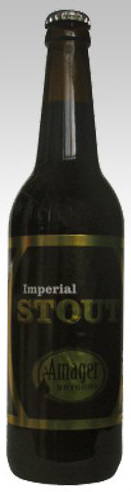 Amager Imperial Stout ABV: 10.1%
Origin: Kastrup, Hovedstaden, Denmark
Website: www.amagerbryghus.dk
No roundup of winter brews would be complete without a real imperial stout, and one of the very best I’ve tasted comes from under the flight path of Copenhagen airport, and the shadow of mighty Carlsberg. The brewery was founded by Morten Valentin Lundsbak and Jacob Storm in a former air raid shelter as the first brewing undertaking in the area for 50 years. Amager Imperial Stout is one of a number of exciting beers now emerging from Denmark, where innovative micros have mushroomed over the last few years.
Brewed from a mixed grain grist of pale and dark barley malts, wheat malt, brown wheat flour and oats, the beer emerges a very dark chocolate brown with a thick fawn head. There’s plain chocolate, vanilla and exotic spice on the aroma, and a creamy dark malt palate with a spicy botanical hop hit over chocolate and petrolly notes, turning pursingly dry but with softening sugar. There’s lots of roast in the lengthy finish but without too much bitter overcharring, and also artichoke notes, sappy malt and luxurious dark chocolate. In fact the hop rate takes the IBUs north of 140, but given the malt and alcohol the beer certainly isn’t challengingly resinous. Overall this is a superb example of the style, packed full of complex flavours.
Read more about this beer at ratebeer.com: http://www.ratebeer.com/beer/amager-imperial-stout/78118/
Top Tastings 2009
ABV: 12%
Origin: San Diego, California, USA
Website: www.alesmith.com
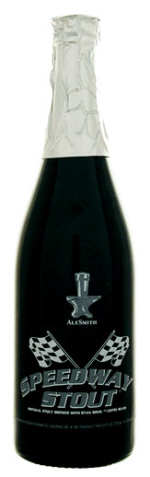 AleSmith Speedway Stout AleSmith brewery, based in the naval city of San Diego in southern California, emerged like many US craft breweries from the home brewing movement and has established itself as one of the most appreciated producers of big, strong “extreme” beers, with a range of specialities, often interpretations of European models with a lively twist, bottle conditioned in 750ml bottles. This huge imperial stout, dosed with coffee from local gourmet coffee roaster Ryan Brothers, is the example par excellence. It’s highly rated by beer enthusiasts — in its wood-aged form it was named best beer in the world on ratebeer, but this standard version is impressive enough.
Chocolate and black patent malts result in an oily black brew with a modest yellowy brown head and a big leathery malted milk and espresso aroma with a slight hint of mushrooms. The palate is equally thick and dark, dense and cakey with rummy brown sugar and light gravy malt notes, a touch of blackcurrant syrup and other red berries. The coffee is obvious but not overwhelming, becoming more pronounced in a chewy finish also bittered by roasted barley, with an effect a little like coffee nibs in chocolate. There’s also a touch of alcohol and a burry hop buzz. A big brave beer, certainly, but subtle, well-balanced and never overwhelming.
I’m grateful to the very generous San Diegan beer traveller who gave me the review bottle from a selection of samples he’d taken to the Zythos festival in 2008. Following the label’s advice that it will mature for 6-12 months, I kept it for around 10 months before drinking.
Read more about this beer at ratebeer.com: http://www.ratebeer.com/beer/alesmith-speedway-stout/14232/
Originally published in BEER June 2006 as part of a piece about beers in Asda supermarkets
ABV: 5 per cent
Origin: St Austell, Cornwall, England
Buy from: ASDA supermarkets
 St Austell Smuggler's Ale I’ve been drinking a lot of St Austell beers recently: a trip deep into the brewery’s territory to research a pub walk coincided with receiving samples of this new bottle conditioned line. I’m not complaining: the Cornish brewery is one of the treasures among Britain’s remaining independent regionals.
St Austell’s credentials as a traditional vertically-integrated family brewery are impeccable. The 1893 Victorian brewhouse is still in use, descendants of founder Walter Hicks still sit on the board, there’s a regional pub estate with numerous long-serving tenants and a dynamic range of well-made and distinctive ales.
Smuggler’s Ale was created for the ASDA supermarket chain’s beer competition and selected by a tasting panel as one of four finalists put on trail sale last autumn. Emerging as the best seller of the four, it’s been rewarded with a national listing until the end of this year.
St Austell head brewer Roger Ryman is no stranger to winning supermarket competitions. His innovative spiced wheat beer Clouded Yellow, also a Real Ale in a Bottle and reviewed in this column a while back, emerged from the Tesco Beer Challenge.
The grist of of Smuggler’s Ale – anyone slightly familiar with the maritime history of Cornwall will require no explanation of the name – is 100% Brewer’s Gold, a malt made exclusively for the brewery from locally grown Optic Barley at Tuckers Maltings. Cascade hops are used for bittering, with Styrian and more Cascade for aroma.
As Roger Protz noted in last month’s Beer, Smuggler’s Ale is cold-filtered before being “dusted” with a special strain of fresh yeast that clings to the bottom of the bottle, making it much easier to pour clear than many other bottle conditioned beers.
While old hands might miss the ritual of careful pouring, many drinkers new to live bottled beer will welcome this and other recent “easy pour” beers, and the technique helps address retailers’ common complaint that customers don’t like too much sediment.
It certainly helps you appreciate the beer’s rich deep red-tinged amber tones, under a soft foamy off-white head. The aroma is flowery and biscuity, with hints of roast and a fresh squeeze of hop resins.
The chewy palate is packed with biscuity, grainy malt with a hop dryness from the start, very much in the brewery’s style, and hints of raspberry and mint. Resiny, peppery hops assert themselves firmly in a long finish over plenty of juicy malt.
Overall this is a delightful strong bitter full of freshness and flavour that well deserves to join Clouded Yellow as a permanent line.
More Asda beers in next post.
Read more about this beer at ratebeer.com: http://www.ratebeer.com/beer/st-austell-smugglers-ale/51672/
Originally published in BEER May 2006. Also featured in BEER August 2008 as part of a piece about beers for summer outdoor drinking.
For more milds see previous post.
ABV: 3.4 per cent
Origin: Rougham, Suffolk, England
Buy from: Specialists, local farmers’ markets
Website www.bartramsbrewery.co.uk
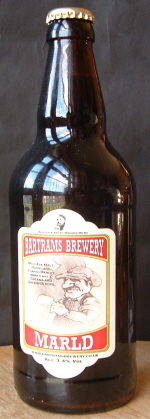 Bartrams Marld I first encountered Marc Bartram’s beers a couple of years back in the now-sadly-closed Pitfield Beer Shop. I picked up a couple because they looked interesting and another customer commented spontaneously: “Really good beers, those”. He wasn’t wrong.
Originally launched at Thurston Granary, just east of Bury St Edmunds, in 1999, the brewery struggled to find suitable premises for a while but since last year has been achieving excellent results at its new home on a nearby former airfield, on the other side of the A14.
The Captain Bill Bartram of the bottle labels is actually the alter ego of Marc himself. There was a real Captain Bill, though no relation, who brewed at Tonbridge, Kent, at the turn of the last century. As well as their distinctive design, the labels have the added attraction of being especially informative about the beers within.
Thus we learn that Marld contains mild ale and amber malt, roasted barley, Galena and Goldings hops. Relishing the stereotype, the label portays a cloth-capped working man standing in the shadow of a giant Soviet Realist spanner.
The beer pours a deep ruby brown with a good thick fawn head. There’s a very distinctive sharp and nettly aroma of roast, geranium and blackberry, slightly sweaty and rather alluring.
A roasty, ash-dry palate is softened by fruity blackberry, elderflower and salad notes, and the texture somehow contrives to mix a lively carbonation with a soft creaminess.
Big dry plain chocolate develops far back and comes to the fore in the finish, which is also coffeeish and chewy with slightly resiny hops, and very long lasting.
Another roasty mild, but done with great panache, adding lots of subtle and unusual tastes and a superb balance to achieve astonishingly full flavours for such a low gravity, with a robustness that works very well in the bottle. If you can’t get to the pub during May, lay in a case of this and you’ll still have a very happy mild month.
Read more about this beer at ratebeer.com: http://www.ratebeer.com/beer/bartrams-marld/44171/
Originally published in BEER May 2006
Note this brewery has since closed. For more milds see previous post.
ABV: 4.2 per cent
Origin: Little Downham, Cambridgeshire, England
Buy from: Brewery, specialists
Mail order: tel 01353 699966, www.elybeer.co.uk
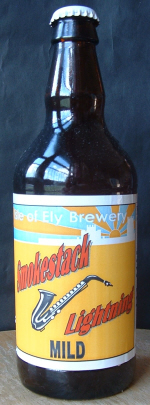 Fenland / Isle of Ely Smokestack Lightning Fenland opened in Chatteris in 1998 and moved to the Isle of Ely in 2004 after a change of ownership, adding a Real Ale in a Bottle range only last year. Smokestack Lightning was a stalwart of the original range but was dropped for a while. Revived in 2005 with a new recipe, it went on to win SIBA’s Eastern region best mild award in its draught form.
A complex grist of Maris Otter pale, crystal, carapils, chocolate and black malts gives the beer a very dark mahogany colour, with a lively carbonation throwing a fawn head that declines to big bubbles. The roasty chocolate aroma has a fresh fruity tang with a hint of spice.
Sharp roast notes on the palate are accentuated by the high condition but with plenty of chewy malt and nuts beneath. A cola, dark chocolate and coffee finish with a moreish fruit tang has an emerging burry hop bitterness from First Gold, Goldings and Fuggles.
Prompted by my enquiries to check the provenance of the saxophone on the label, the brewery discovered it had no connection to Lightning Hopkins, performer of the old blues tunes for which the beer is named, but had only been used because it “looked good”. As a result they’ve designed a new label featuring a steam train!
The name is also appropriate in another way: smoke and roast are clearly “in” for new milds. Modern brewers dosing the grist with roasted barley might be nodding consciously to the past, when technical limitations on malting rendered most beers smoky. On the other hand, they may simply assume their customers expect all dark beers to taste like dry stout
More milds in the next post.
Read more about this beer at ratebeer.com: http://www.ratebeer.com/beer/fenland-smokestack-lightning/34982/
Originally published in BEER May 2006
ABV: 3.6 per cent
Origin: Ickburgh, Norfolk, England
Buy from: Brewery, local farmers’ markets, specialists
Mail order: tel 01842 878922, www.icenibrewery.co.uk
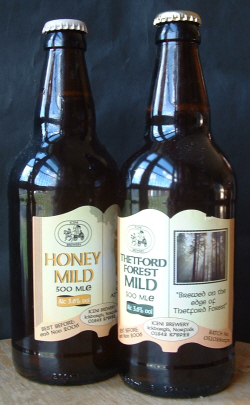 Iceni Honey Mild and Thetford Forest Mild A few years back, each May arrived with a tough challenge for your humble reviewer: finding a new bottle conditioned mild to write about. But in the last couple of years rising interest in both bottled beers and specialist styles has made the challenge easier to meet.
Real Milds in a Bottle are still far from common but there are noticeably more around – this year’s three examples, all at session gravities and all from the East of England, by no means exhaust the current choice.
And a good job too, since world classic Sarah Hughes Dark Ruby remains unavailable in bottle (though the brewery are optimistic it should return soon), Pitfield’s historic 1824 Mild has been relegated to the occasional list, and another stalwart featured in a previous column, Gales Festival, might not survive the move to Fullers.
Real Ale in a Bottle specialist Iceni, founded in the rural Brecklands by former food industry worker Brendan Moore in 1995, is proud of its regional identity: the bottles boast that the beers use Maris Otter barley from Branthill Farm at Wells-next-the-Sea (where there is also a farm shop selling these and other East Anglian brews), floor malted by Crisp at Great Ryburgh.
The Celtic look of the “open book” labels references the Iceni people who formerly inhabited this area and, under Queen Boudicca, famously resisted Roman military might. The local focus and good presentation help the brewery sustain a trade in small runs through their own shop and visitor centre as well as local farmers’ markets.
Thetford Forest Mild, named after a nearby area of woodland and heath, is a deep ruby brown beer with a pungent aroma of roast and cedar smoke alongside dark malt and a faint trace of farmyard. Crystal malt and flaked and roasted barley are used alongside the Branthill pale malt, with Fuggles and Challenger hops.
The smooth, light palate has chocolate, cola and tart plum fruit, leading to a tangily fruity finish drying out with rounded but not bitter hops, and more roast and woodsmoke notes.
A second mild, Honey Mild, is a variant on Thetford Forest but with the addition of – you’ve guessed it – honey. While broadly similar to its parent in taste, this has subtle pollen and honey notes in aroma and finish, with a livelier condition and a slightly sweeter, fuller flavour that seems to both underline and better balance the roastiness.
I have a marginal preference for the honey version, but could happily drink either – they’re both very welcome examples of easy drinking dark beers, made with care from high quality ingredients.
More milds reviewed in following post.
Read more about these beers at ratebeer.com:
http://www.ratebeer.com/beer/iceni-honey-mild/48311/
http://www.ratebeer.com/beer/iceni-thetford-forest-mild/14020/
Here’s a review of BSA and Wobble in a Bottle (also known as Santa’s Wobble) originally published in BEER April 2006, followed by an earlier review of Wobble from pioneering website the Oxford Bottled Beer Database, published on 23 March 2001.
Hogs Back is now one of the most successful breweries in southeast England, but neither of these beers is regularly available anymore as the brewery has gradually concentrated on high volume session beers like TEA. Wobble continued as a seasonal special for a while but hasn’t been seen for some years. The barley wine mentioned below, A over T, is still around however.
ABV 4.5 and 7.5 per cent
Origin Tongham, Surrey, England
Buy from specialist shops, brewery (tel 01252 784495)
Website www.hogsback.co.uk
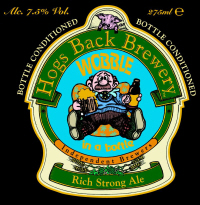 Hogs Back Wobble in a Bottle I’ve long regarded Hogs Back as one of Britain’s most outstanding bottled beer producers, so I was delighted to hear of its success at this year’s CAMRA Champion Winter Beer of Britain competition, where 9 per cent ABV barley wine A over T walked off with the top title.
The prize was awarded to the occasional draught version, but A over T is primarily a bottled beer. Unlike many brewers that simply bottle their draughts at typically British session strengths, Hogs Back is unafraid to offer beers at gravities of 7 per cent and up that show off the potential of unpasteurised ale to develop character in the bottle.
The expertise of Hog Back’s brewster Maureen Zeiher at the upper end of the gravity range invites comparison with the Belgian tradition of hefty regional specialities. Hogs Back’s strong beers, while unmistakeably English in style, are some of the few bottled beers from these islands that, in my view, can hold their own against the best of Belgian artisanal brewing in terms of quality, distinctiveness and complexity.
A comprehensive account of the history and background to the brewery can be found in last month’s Beer, and it’s worth noting from this that at Hogs Back they have always set providing quality and consumer choice above chasing the money by concentrating on mass-appeal brands.
Two other regular strong bottled beers are offered beside A over T: Brewster’s Bundle (7.4 per cent) and Wobble in a Bottle. All three are excellent but Wobble is my favourite. It originated as a Christmas beer, Santa’s Wobble, and has also spawned a draught summer variant, Still Wobbling. It has a classic English recipe of Maris Otter pale malt, crystal and chocolate malts, and Fuggles and East Kent Goldings hops.
It pours a pinkish mid brown, with a fine yellowish head and a delightfully fruity strawberry, orange and banana toffee aroma. The malty palate is sweetish at first but turns assertive and mouth-numbing, with complex spirit notes, figs and a hint of toasted coconut, lifted by nicely balanced hops.
Broad strokes of toasty malt and fig rolls make for a rounded and long-lasting finish with a vivid peppery bitterness far back in the throat. Overall a splendid strong beer: my young sample bottle was already smooth and integrated, but would have developed further for a good year in the bottle.
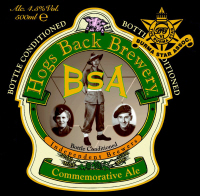 Hogs Back BSA The brewery is by no means limited to beers for sipping as a postprandial or bedtime treat, however: there are also lower gravity brews that still acquit themselves well in the bottle, such as BSA or Burma Star Ale.
Brewed to a similar recipe to Wobble, BSA comes out a brilliant reddish amber with a good white head. A malty aroma with minerally wet stone notes and a squeeze of citrus leads to a crisp biscuity malt palate, with more fruity citrus, crystal malt and tannic hops.
A drying swallow heralds a leafy hop finish with a good dose of peppery bitterness over smooth fresh malt. This is another well-integrated and very drinkable beer with lots to say for itself.
A share of the profits goes to the Burma Star Assocation, a welfare organisation for servicemen and women involved in the Burma Campaign during World War II, such as brewery co-founder Martin Zillwood-Hunt’s father, who features on the label.
Visit the brewery at its attractive site in converted farm buildings near Farnham, right by the narrow chalk ridge from which it takes its name, and you’ll also find one of the country’s best speciality beer shops, stocking an excellent range of British and imported beers. Here, Hogs Back’s own products line up confidently to take a well-deserved place beside some of the best beers in the world.
OBBD review, 26 March 2001:
This Surrey micro, named after a local geological feature, is best-known for its award winning TEA (Traditional English Ale) but also produces a range of bottle-conditioned ales, many of which are on the strong side, including this piece of festive fallout: it originated as a draught seasonal beer called Santa’s Wobble but the bottled version is available all year round.
It’s a rich ruby brown in colour, with a smooth head and a perfumed hoppy aroma featuring spices and raspberry-like esters: whole English hops are used. The palate is very full and malty, smooth and rich and fruity rather than nutty, with traces of brazils and marzipan. The bitterness, when it comes, is well-balanced, and the resulting beer is a little heavy but not really cloying, finishing with lots of hops.
Some strong beers from mainland Europe are very upfront with their complex array of flavours, but Wobble in a Bottle has a very British restraint, and its own subtle complexity unwinds slowly as you sip your way through the glass. It might wobble, but it certainly doesn’t fall down.
Originally published in BEER March 2006
Beer sellers: Meadow Farm Shop
See previous post for more Welsh beers. Note Cwrw Castell has since been discontinued.
ABV 3.8 and 5.6 per cent
Origin Conwy Town, Conwy, Wales
Buy from local outlets, brewery (tel 01492 585287)
Website www.conwybrewery.co.uk
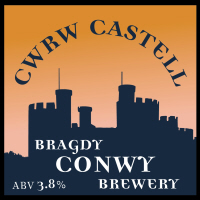 Conwy Cwrw Castell At the opposite, northern end of Wales is another relatively new micro that takes its bottling seriously. Set up by former home brewer Gwynne Thomas in 2003 and originally experimenting with bottling off site, it now boasts its own bottling line installed with the aid of a grant from the Welsh Assembly Government.
Now all the beers are available in both cask and bottle conditioned form, and the bottles do well in local outlets, including restaurants, hotels and even youth hostels, venues that wouldn’t take cask ale but are still keen to offer guests a distinctive quality local product. The Spar convenience store chain has also been helpful and numerous local branches take the beers.
Cwrw Castell, or Castle Bitter for those who can’t handle w’s used as vowels, commemorates Conwy’s most celebrated landmark, the 13th century castle that is now a World Heritage Site. It’s a good ordinary bitter made with traditional floor malted barley, Pioneer hops in the copper and Cascade for the aroma.
This is a rich golden amber beer with off-white lace and a cheerful flowery geranium and blackcurrant aroma with just a touch of sulphur. The light sweetish palate has lots of fruit and a very faint roast note, developing orange and other citrus flavours and ginger syrup with a good brush of hops.
The lingering finish is tangy with the blackcurrant notes returning over biscuity malt and gently bittering hops. Again a straightforward beer, and at a quaffing gravity, but cheerful and very enjoyable.
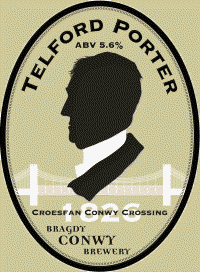 Conwy Telford Porter Telford Porter is a quite different proposition: a strongish brew lent a dark reddish brown colour by dark malts and roasted barley, with a smooth off-white head. The aroma is gently fruity, roasty and slightly oily.
You can taste the roast on a dryish and herbal palate with distinct liquorice notes and a dash of brown sugar – I also detected something like that old fashioned soft drink, Dandelion and Burdock.
The finish starts pleasantly fruity and turns tangily drying, with more roast, burry hops and those persistent herbal flavours again, plus a touch of floweriness. Overall this is a subtle beer that captures the style but lacks the aggressive flavours of some modern porters.
Intriguingly, Telford Porter is subtitled “Historic Ale No. 1” – Gwynne aims to produce a series of beers linked specifically to the history of Conwy. This one pays homage to the beers that might have been drunk when Thomas Telford built the famous suspension bridge across the river Conwy to the castle back in 1826.
Recognising that dark, strong beers based on old recipes might delight knowledgeable beer lovers without setting the mass market alight, the brewery didn’t expect vast sales for the porter – but in fact it’s proved one of their more successful lines.
No doubt one of the reasons was the explicit link to local heritage. The beer is a great example of a microbrewery making the most of its strengths by producing a quality product that unashamedly carries a sense of origin and place, in direct opposition to the sort of brewer that thinks it doesn’t matter if a beer named after its home town of Hoegaarden is brewed in Jupille. Iechyd da!
Read more about these beers at ratebeer.com:
http://www.ratebeer.com/beer/conwy-castle-bitter-cwrw-castell/30814/
http://www.ratebeer.com/beer/conwy-telford-porter/54050/
Originally published in BEER March 2006.
Beer sellers: Meadow Farm Shop
ABV 4.5 and 4.7 per cent
Origin Brecon, Powys, Wales
Buy from specialist shops, brewery (tel 01874 623731)
Website www.breconshirebrewery.com
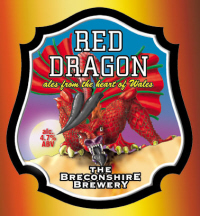 Breconshire Red Dragon With St David’s Day imminent as this issue hits the shelves, this month’s column finds a welcome in the hillside for real ale in a bottle with two small breweries that are relatively new and notably enthusiastic exponents of fine bottle conditioned beers.
The Breconshire Brewery, in the idyllic setting of the northern edge of Brecon Beacons national park, originated in 2002 when well-established distributor and wholesaler C H Marlow decided to experiment with offering its own beers alongside other people’s.
With kit from the defunct Pembrokeshire Brewery and a brewer, Justin Grant, rescued from the ruins of Brakspear, the brewery was soon winning prizes for its tasty draught beers: its standard bitter, Brecon County Ale, was recently named best in class at CAMRA’s Champion Beer of Wales competition for the third year running.
Bottling followed in 2004, originally off site, and the range has expanded with a number of imaginative and interesting lines, most of which I tasted for this column. Given my other life as an employee of a national walking organisation, I was tempted to feature strong bitter Ramblers Ruin (5 per cent ABV) but the two most enjoyable of the bottles turned out to be a great best bitter and an unusual red ale.
Brecknock Best is a celebration ale brewed to mark the 250th anniversary of the Breconshire Agricultural Society, the oldest organisation of its kind in Britain. Like all the brewery’s beers it features floor malted Optic barley, in this case hopped with Pilot and the distinctive Bramling Cross.
It’s a classic deep amber colour, showed off to good effect with my bottle which poured obligingly clear. An inviting fruit salad aroma with hints of yeast and sulphur leads to a beautifully fresh palate that’s chewy and malty with roasty and spicy notes.
A tingly swallow is followed by a rounded, well-balanced finish that develops a lightly bitter sting and some juicy, slightly astringent grapefruit notes. Some cherry flavour and close maltiness are apparent later.
This is a straightforward and not especially complex beer, but it’s beautifully balanced and provides easy and delightful drinking. The Agricultural Society should feel complimented by such a fine brew, which has now become established as a regular line.
More unusual is Red Dragon, which links the mythical beast from the Welsh flag with wider Celtic references by nodding to the Irish tradition of malty red ales, throwing in a hint of the dry, sappy red-brown ales of northeast England for good measure. The recipe includes generous quantities of crystal malt, alongside Pioneer and 93/50 hops.
The beer pours a slightly cloudy rich cherry red, with a foamy off-white head. A complex nutty, spicy and fruity aroma includes almond tones. It’s smooth in the mouth, nutty, woody and slightly musty, reminiscent of the signature of wild yeast with a sprinkling of twiggy fennel notes.
A chocolatey swallow leads to a hoppy roasted peanut finish that develops an astringent dryness and deep spicy notes. A pleasingly distinctive bottleful that doesn’t taste quite like anything else I’ve encountered, although the influence of the likes of Double Maxim and Newcastle Brown is evident.
More Welsh beers reviewed in next post.
Read more about these beers at ratebeer.com:
http://www.ratebeer.com/beer/breconshire-brecknock-best/46512/
http://www.ratebeer.com/beer/breconshire-red-dragon/34606/
Originally published in BEER February 2006.
To read about more beers stocked by Morrisons, see previous post.
ABV 7 per cent
Origin Arcen, Limburg, the Netherlands
Buy from Morrisons
Website www.hertogjan.nl
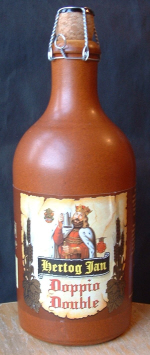 Hertog Jan Dubbel The Arcense Stoombierbrouwerij (Arcen steam brewery) in hilly Limburg dates back to 1915. Relaunched with a management buyout in 1981, it was at first prevented under the terms of the sale from making lager-style beers, so the new owners concentrated on developing the speciality ale market, becoming pioneers of the new wave of Dutch brewing.
The brand, Hertog (Duke) Jan, underlined a Belgian influence by alluding to Duke John I of Brabant (ruled 1267-94), also known as Gambrinus, the King of Beer. With its beers stocked in supermarkets throughout the Netherlands as a home-grown answer to imported Belgian brews, the brewery soon caught the beady eye of the multinationals and is now in Interbrew’s hands.
Dubbel, now stocked by Morrisons in 50cl ceramic crocks, is an abbey-style dark ale made with roasted malt, malted wheat, brewing sugar and caramel colouring. It pours a deep reddish brown, with a nice soft fawn head and a chocolate roast aroma with herbal notes and a sharp tang.
The palate is soft but dry and coffeeish, with restrained doses of sharp hops, roast and herbs and a touch of chocolate syrup. There’s a malty, tangy finish with faint roast tones and some pleasant raisiny notes. Not the best example of an abbey double by any means, but new to the UK market, bottle conditioned and decent enough.
Among others worth investigating on the Morrisons list are Vienna-style 1664 Premier Cru, Schneider and Franziskaner wheat beers from Bavaria, and California’s Sierra Nevada pale ale. British Real Ale in a Bottle is currently limited to Coniston Bluebird, Brakspear Organic and Hopback Summer Lightning, good beers all, with Innis & Gunn and Marstons Old Empire noteworthy among the filtered ales.
Read more about this beer at ratebeer.com: http://www.ratebeer.com/beer/hertog-jan-dubbel/5303/
|
|
