A sample text widget
Etiam pulvinar consectetur dolor sed malesuada. Ut convallis
euismod dolor nec pretium. Nunc ut tristique massa.
Nam sodales mi vitae dolor ullamcorper et vulputate enim accumsan.
Morbi orci magna, tincidunt vitae molestie nec, molestie at mi. Nulla nulla lorem,
suscipit in posuere in, interdum non magna.
|
London Drinker Beer Festival March 2010
ABV: 5%
Origin: South Woodham Ferrers, Essex, England
Website: http://www.crouchvale.co.uk/
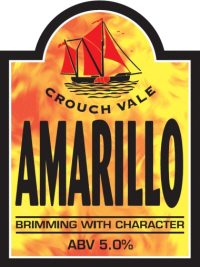 Crouch Vale Amarillo Beer blogger Mark Dredge, of Pencil & Spoon fame, pointed me in the direction of this fine hoppy golden ale at the London Drinker beer festival. From one of Britain’s oldest and most respected new generation micros (founded in 1981), it makes a great feature of the distinctively fruity US hop variety from which it takes its name.
My sample was a rich gold with very little head and a rich, almost whiskyish aroma, with floral and fruity notes that brought to mind Lucozade and apricots. There were more apricots on a full hoppy palate with a slightly herbal bitterness, a touch of burry hopsack and very full bodied malt that made the beer taste a percentage or two higher in ABV than it actually is. Citric orange and lime notes came to the fore on the swallow, with a long, tingling orange and apricot finish that eventually became firmly peppery-bitter, with plenty of balancing malt and fruit and none of the harshness some of the newer hoppy beers exhibit.
Read more about this beer at ratebeer.com: http://www.ratebeer.com/beer/crouch-vale-amarillo/24922/
London Drinker and Brodie’s Bunny Basher Beer Festivals March 2010
ABV: 12.1%
Origin: London E10, England
Website: www.brodiesbeers.co.uk
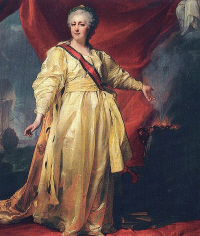 Catherine II The Great (Екатерина II Великая, 1729-96), Empress and Autocrat of All the Russias, by D G Levitsky c1770 The Brodies only revived brewing at the King William IV in Leyton a year and a half ago but already they’re producing a large range of solidly impressive beers. This is currently their strongest and one of their most accomplished — a big Imperial Stout based on a 19th century recipe and named with reference to Empress Catherine the Great of Russia, in fact born a German aristocrat but who ruled Russia when the eponymous William was born, and oversaw the importation of British strong stouts into her empire.
I happened on a bottled version at the Pigs Ear beer festival in December 2009, mistakenly listed as Romanov Express, which sounds like the name of a very romantic train. This was a mahogany-black beer with a fine deep orangey beige head and a chocolate, cofffee and raisin aroma with notes of grapes and smoky roast. The rich strong chocolate palate had grape and blackcurrant coffee flavours and varnish notes, turning tart and mouth-numbering with a restrained roasty quality. A dryer finish became more definitively roasty, with concentrated cocoa and a fruity, viny slick. Although complex, the flavour was a bit close and slow developing, and the beer will almost certainly spread and relax with a little bottle age.
In the brewpub itself for its Easter beer festival, I couldn’t resist sampling Romanov Empress again, this time on draught — particularly since it was on sale at the standard price of all the draught beers. It’s not often that a beer of over 12% is sold at £1 for a half pint. This version was jet black, with a lovely creamy cappucino-like beige head, and a toffee and liquorice aroma. This time the fruity notes brought to mind blackcurrant and blueberry, and there were toffee and spirits too, leading to a thick, rich, sweetish and very fruity toffee palate with a slightly medicinal edge and malt cake. A toffee apple note on the swallow led to a long, slick, warming finish with emerging relatively gentle roast, and a lightly oxidised minty quality. Again a very complex beer, rather sweet but beautifully balanced, and worth at least five times its listed price.
Read more about this beer at ratebeer.com: http://www.ratebeer.com/beer/brodies-romanov-empress-stout/114717/
First published in BEER December 2006 as part of a page about strong beers. See previous post for more strong beers.
ABV: 8.5 per cent
Origin: Stockport, Manchester, England
Website: www.frederic-robinson.co.uk
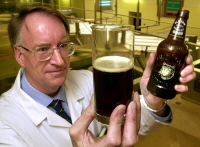 Robinson's head brewer Chris Hellin with Old Tom Strong Ale. Photo: Tony Carter. The Unicorn brewery, in the former hat-making town of Stockport on the suburban fringe of Greater Manchester, began as a pub owned by the Robinson family which started brewing in 1865.
Robinson’s is now one of Britain’s biggest regionals, with an extensive tied estate and a big 1920s red brick brewery complex that contract brews and bottles alongside producing its own brands.
However it’s still family owned and traditionally minded enough to find room for beers like Old Tom in its portfolio. This barley wine with old ale tendencies allegedly gained its name when a brewer annotated a notebook entry with a sketch of the brewery cat back in 1899.
Despite potentially malodorous connotations, both the name and the beer have stuck around. It’s now being marketed afresh, with stylish new embossed bottles popping up in supermarkets a long way from Stockport.
Old Tom is brewed from British pale and crystal malt, touches of chocolate malt and caramel, and Goldings whole hops with a little Northdown; it’s then dry hopped with Goldings pellets during conditioning.
The resulting beer is deep ruby brown with a bubbly, rapidly subsiding head. The cakey aroma has burst of sweetish esters with hints of cherry and marzipan.
A rich palate boasts vine fruits, almonds and sherry, sweetish but well-balanced with a slightly woody dryness and nutty hops. A warming swallow leads to a port-like finish with ripe fruit, rooty hops and more wood.
Old Tom also pops up on draught, in which form it won Champion Winter Beer of Britain in 2005. The bottled version is not bottle conditioned, but is still brimming with quality, tradition and character, and a worthy addition to the supermarket trolley.
Read more about this beer at ratebeer.com: http://www.ratebeer.com/beer/robinsons-old-tom-bottle/16872/
First published in BEER December 2006 as part of a page about strong beers. See previous post for more strong beers.
ABV: 8.5 per cent
Origin: Terrick, Buckinghamshire, England
Website: www.chilternbrewery.co.uk
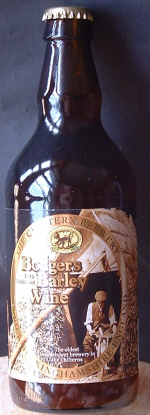 Chiltern Bodgers Barley Wine Launched in 1980 and still run by the Jenkinson family, the Chiltern Brewery near Aylesbury is a rare survivor from the first wave of new micros. As well as brewing beer the company makes and sell a wide range of beer-related products, from Terrick Truckle beer cheese to hop scented cologne.
But its most renowned product is this notable bottle conditioned barley wine, with sepia tinted labels showing a local bodger – a craftsperson who makes chairs and other items from greenwood poles – at work in the 1920s.
A pure pale malt grist results in a rich golden-amber colour, which in my sample poured slightly hazy with a bubbly white head. Challenger, Fuggles and Goldings provide the hop character.
The complex aroma has notes of plummy fruit, olives, coal tar soap and rich malt. The luxuriously malty palate turns beautifully aromatic in the mouth, with phenol, petrol, liqueur marmalade and chewy hops.
The drying finish is lightly bitterish and slightly mouth numbing with chewy orange notes and a touch of mint.
Bodgers demonstrates that strong British beers don’t have to be dark and brooding: it’s essentially a bitter racked up several degrees in strength and complexity, with much to reward the attentive sipper but preserving its drinkability to perilous effect.
One minor niggle is the 500ml bottle which is far too big for a beer of this strength: it deserves a smaller and more elegant package.
NOTE: Partly prompted by this review, the beer has since been made available in smaller bottles.
See next post for more strong beers.
Read more about this beer at ratebeer.com: http://www.ratebeer.com/beer/chiltern-bodgers-barley-wine/13164/
First published in BEER December 2006 as part of a page about strong beers.
ABV: 8.7 and 11 per cent
Origin: Market Weston, Suffolk, England
Website: http://www.oldchimneysbrewery.com/
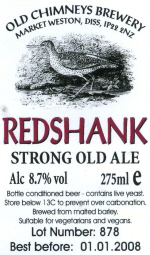 Old Chimneys Redshank Strong Old Ale With the nights drawing in, the weather – at least in theory – getting colder and the festive season approaching, I’m turning this month to the strong specialities – the sort of beers that bear up well to being sipped and savoured late in the evening while relaxing in front of a roaring radiator.
Former Greene King and Broughton brewer Alan Thomson of Old Chimneys has made something of a speciality of unusual and strong real ales in a bottle, hand-crafted near Diss on the Norfolk-Suffolk border with vegetarian-friendly ingredients.
Redshank, a strong old ale named after a red legged wading bird found on nearby wetlands, is created from Fuggles and Challenger hops with crystal and caramalt adding colour to a pale malt mash. The result is a deep pinkish brown, with a light yellowish head and an aroma oozing caramel cream alongside fruit cake, fresh fruit and wine notes.
There’s more caramel whip on a very smooth palate which reveals tingly hops, alcohol and deep port-like fruit. The long finish remains smooth and tingly, with malt loaf, herbs, lightening hops and a touch of tannic red wine, balancing rich dark flavours with a surprisingly refreshing quality.
But Alan’s most elaborately crafted beer is Good King Henry Special Reserve, which evolved from an imperial stout I reviewed in these pages three years back. A stronger version, matured over oak granules for six months and then conditioned in bottle for another 18 months before release, was produced to mark the brewery’s tenth anniversary and is now a regular line.
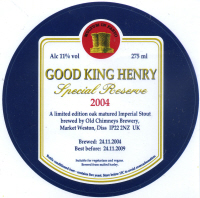 Old Chimneys Good King Henry Special Reserve Pale, crystal and wheat malt and roasted barley make up the grist, with Fuggles and Challenger hops. Vintage dated bottles have best before dates set five years later though it’s probably worth cellaring for longer if you’re lucky enough to get hold of several bottles.
My 2004 sample poured a near-black mahogany colour with a thin but persistent pinkish-brown head. A very heady aroma was rich and sweet with dark malt, blackcurrant fruit and a whiff of sherry-cask single malt whisky.
The palate is thick, potent and sweet with candied and fresh orange fruit, marzipan, subtle wood and claret-style “lead pencil” touches. I caught a very faint whiff of smoked ham, but overall the beer is much less smoky and roasty than most others in the same broad style.
A warming swallow leads to a very long finish with, sweetish sherry notes, faint wood adding texture to the background and tingling alcohol and hops.
The name, incidentally, refers not to a British royal but to an obscure green vegetable also known as “poor man’s asparagus”. If “poor man’s” implies second rate, it’s an inappropriate comparison, for this is an outstanding product that could proudly grace anyone’s table.
See next post for more strong beers.
Read more about these beers at ratebeer.com:
http://www.ratebeer.com/beer/old-chimneys-redshank-strong-ale/23458/
http://www.ratebeer.com/beer/old-chimneys-good-king-henry-special-reserve/67522/
First published in BEER November 2006 as part of a piece about beers stocked by Tesco supermarkets. See previous post for more Tesco beers.
ABV: 4.3 per cent
Origin: Crockham Hill, Kent, England
Website: www.westerhambrewery.co.uk
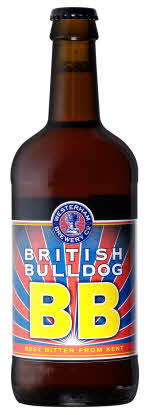 As well as the Drinks Awards winners, Tesco has beers of interest on offer in its “local programme”, which covers 600 stores. The regional approach is particularly developed in Scotland, where Scottish-brewed beers are ousting nearly all the English speciality ales. As well as the Drinks Awards winners, Tesco has beers of interest on offer in its “local programme”, which covers 600 stores. The regional approach is particularly developed in Scotland, where Scottish-brewed beers are ousting nearly all the English speciality ales.
But even south of the border, a few unusual regional lines are popping up. My nearest Tesco currently offers this rather good best bitter from Crockham Hill on Kent’s attractive Greensand Ridge, about thirty miles away.
The Westerham Brewery was launched in 2004 at the National Trust’s Grange Farm, and uses yeast from the former Black Eagle Brewery in Westerham, a takeover casualty of what is now Carlsberg. Some of the beers use hops from the Trust’s Scotney Castle, but BB celebrates another nearby Trust property, Winston Churchill’s former home at Chartwell.
This is a clear amber beer brewed from Maris Otter pale and crystal malts, with a thin but smooth and persistent off-white head, and a fruity, spicy blackcurrant jelly aroma with roast and farmyard notes.
The palate is nicely malty and fruity but dry from the start, with lychee notes and rich resins from local Northdown and Whitbread Golding Variety hops. A light swallow leads to a piney finish with a dose of peppery bitterness over more juicy fruit.
The fact this tasty and full-bodied bitter makes so much of its local provenance can only be a good thing, and it’s great to see it on the shelves of such a behemoth as Tesco.
Read more about this beer at ratebeer.com: http://www.ratebeer.com/beer/westerham-british-bulldog-bb/36415/
Ридна марка Пшеничне Еталон
First published in BEER November 2006 as part of a piece about beers stocked by Tesco supermarkets. See previous post for more Tesco beers.
ABV: 5 per cent
Origin: Radomyshl, Zhytomyr Oblast, Ukraine
Website: www.etalon-beer.com.ua
 Ridna Marka Pshenychne Etalon In 2005 the Beer Challenge added a category for imported beers and the first winner was a genuine, and rather pleasing, surprise – a Bavarian-style unfiltered wheat beer from, of all places, Ukraine. It’s still a regular line in larger Tesco stores, having long outlived its original guaranteed listing.
The brewery at Radomyshl, about 70km outside Kiev, was established by Czechs in 1886 but was only offering an undistinguished blond lager when bought by fruit juice company Ridna Marka in 2003.
The new bosses had enjoyed wheat beers in Munich, and took the brave decision to turn their acquisition into a state of the art weissbier facility, bringing in experts from the Doemens brewing academy in Gräfelfing and an un-named Bavarian brewery, rumoured to be Erdinger.
Following local success, in 2004 the beer caused an international stir by beating several leading German Weissbier brands at the World Beer Cup and the Brewing Industry International Awards.
It pours a lightly cloudy golden with a good white head and a restrained slightly salty wheat aroma with typical banana tones and snatches of hops and coal dust.
The palate is creamy and fruity enough to remind you of fresh banana sliced into custard, lifted by a wash of citrus. The mouth feel is a little thin textured but not overly carbonated, with plenty of flavour.
A slight saltiness with brackish hops leads to a grainy, chewy finish with herbal notes and a final burst of banana.
While international judges might have gone too far in putting this beer ahead of the likes of Schneider, it’s still an impressively confident and tasty interpretation of the style that certainly gives Erdinger, its most obvious model, a run for its money.
Read more reviews of Tesco beers in the next post.
Read more about this beer at ratebeer.com: http://www.ratebeer.com/beer/pshenychne-etalon/44746/
First published in BEER November 2006 as part of a piece about beers stocked by Tesco supermarkets.
NOTE: Production of Young’s beers has since been moved to Wells & Young’s in Bedford, though it appears Ruby Star is no longer brewed.
ABV: 5.5 per cent
Origin: Wandsworth, London, England
Website: www.youngs.co.uk
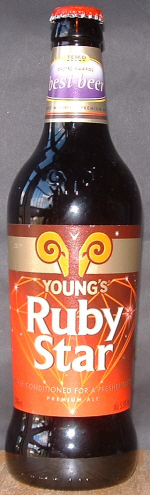 Young's Ruby Star Tesco is truly a giant among retailers. With almost a third of the UK market, the supermarket chain is easily Britain’s biggest, and people are now talking about its influence on the high street as “tescopoly”. So given the importance of supermarkets in beer retailing, how does the market leader’s beer offer measure up?
The answer is a mixed one. While some of nearly 2,000 stores devote up to 10 metres of aisle to speciality ales, the proportion of filtered lines from “usual suspects” is arguably higher than in other chains. But at the same time Tesco remains the only chain to host its own major beer award.
Formerly known as the Tesco Beer Challenge, now the Drinks Awards, the scheme has a proud record of introducing tasty new beers to the public.
The contest is discussed elsewhere in this month’s Beer, so here I’ve taken the opportunity to review three beers currently in Tesco, starting with this year’s Autumn/Winter Best Beer in the “large brewer” category, Young’s Ruby Star.
Though the label carries the Wells & Youngs Bedford address, this bottle conditioned red ale was one of the last beers from the brewery’s historic Wandsworth site.
It’s an unusual beer that’s essentially a very rich-flavoured, strong and slightly light-coloured dry brown ale. The colour is actually a delightful reddish amber, and my bottle was easy to pour crystal clear with a good sparkle and a bubbly persistent yellowish head.
There’s a creamy malt and mineral aroma with juicy berry notes just detectable, leading to more berries in a full, sappy, nicely sparkling palate with good malt and firm, slightly biting hop dryness from the start, and austere hops and generous fruit juice in superb balance.
A long finish starts off dry and gets dryer, with a hint of coffee roast, and powerful, slightly astringent peppery hop bitterness developing towards the end.
Young’s needs no introduction to What’s Brewing readers, especially since the brewery has been in the news first with its controversial decision to close its historic southwest London site and move production in with Wells at Bedford, then with the sad death of chairman and real ale champion John Young.
But the launch of a fine award-winning new bottled beer at least provides a swan song for the Ram brewery – and an excellent example of John Young’s legacy in its fine balance of innovation and traditional quality.
Read more reviews of Tesco beers in the next post.
Read more about this beer at ratebeer.com: http://www.ratebeer.com/beer/youngs-ruby-star/66281/
First published in BEER October 2006 as part of a page marking the publication of the latest Good Bottled Beer Guide. For more beers featured on this page, see previous post.
ABV: 4.7 and 5.5 per cent
Origin: Thorpe St Andrew, Norfolk, England
Website: www.thewhynotbrewery.co.uk
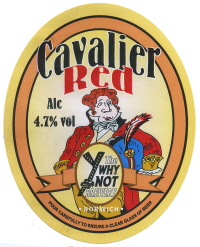 Why Not Cavalier Red Eastern England is becoming Britain’s beer heaven and Norfolk in particular boasts a long and impressive list of craft brewers. The tiny Why Not brewery (as in “Fancy a beer? Why not?!”), run by former hobby brewer Colin Emms from a shed behind his house near Norwich, joined the list in 2005 and is already holding its own among some very distinguished company.
The brewery boasts of the local provenance of its barley, grown at Branthill Farm, Wells-Next-the-Sea and malted by Crisps of Fakenham. All three current beers also feature English Fuggles and Goldings hops.
Colin is one of the few British brewers who started with Real Ale in a Bottle then branched out to cask. All the beers are well-made to distinctive original recipes, but the two featured here are the ones I found most interesting.
Cavalier Red is an unusual bitter with a ruddy twist created by judicious use of crystal and chocolate malts alongside Maris Otter pale, pouring a dark reddish amber with a little off-white head.
An inviting nutty aroma has a hint of stewed gooseberries alongside spicy roast notes, leading to a generously nutty, sappy, lightly roasted malt palate, lightly carbonated with drying but restrained herby hops. Lemon barley notes emerge in a drying and bitterish but still juicy finish.
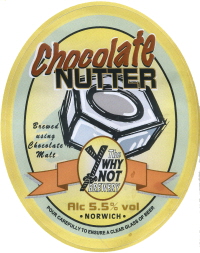 Why Not Chocolate Nutter Chocolate Nutter has a similar recipe but ups the proportion of chocolate malt to produce a very dark dry brown ale, once again with a reddish tinge, and a bubbly fawn head.
A coffee and baked vine fruit aroma sets up a chewy, very malty and slightly sweetish palate with fruit cake and chocolate notes, but light bodied and refreshing considering the colour and strength. Well-balanced burry dryness and leafy bitterness emerge and develop in a slightly smoky finish over rich malt character.
Read more about these beers at ratebeer.com:
http://www.ratebeer.com/beer/why-not-cavalier-red/59599/
http://www.ratebeer.com/beer/why-not-chocolate-nutter/63109/
First published in BEER October 2006 as part of a page marking the publication of the latest Good Bottled Beer Guide. For more beers featured on this page, see previous post.
Jaipur was also featured in BEER August 2008 as part of a piece about beers for summer outdoor drinking and in the Beer Sellers piece on Westholme Store.
Note: Kelly Ryan, who earned his brewing reputation at Thornbridge brewer before returning to his native New Zealand to work at Epic, tells me he was encouraged to apply for the Thornbridge job partly by reading this piece.
ABV: 5.9 and 7.7 per cent
Origin: Ashford-in-the-Water, Derbyshire, England
Website: www.thornbridgebrewery.co.uk
 Thornbridge Jaipur Over the past month I’ve been privileged to sample more beers from breweries featured for the first time in the new edition of the Good Bottled Beer Guide, discussed last issue. And among those making a big impression are a brace of modern interpretations of classic styles from a country house brewery in the Peak District national park.
Thornbridge Hall is a stately home just outside Bakewell with a history dating back to the 12th century. Still privately owned, it’s now a venue for events as well as a family home.
A brewery opened on site in 2004 and already boasts a string of awards from CAMRA and SIBA for its cask beers. Real Ale in a Bottle first appeared in 2005 with forays into two historic styles, India Pale Ale (IPA) and Imperial Russian Stout.
Both styles originate in late 18th century London, but their development was shaped by the export trade. Virtually extinct in their home country by the late 20th century, their recent revival has been driven at least as much by international as by domestic interest.
Given this international pedigree, it’s appropriate that a Scot and an Italian, Martin Dickie and Stefano Cossi, are the brewers behind the Thornbridge versions.
Jaipur IPA is named after the famous pink stucco city in Rajasthan, northern India, and brewed with pure Maris Otter pale malt for an authentic rich golden colour.
There’s a further international flourish in the use of American Chinook and Cascade hops. The generous hopping of IPA was originally to help preserve it during its long sea voyage, but it was this feature that endeared the style to hop-loving US craft beer fans, with the result that strong, well-hopped IPA is now much more common on the other side of the Atlantic.
“Can be enjoyed cloudy”, says the label – a good job since my sample proved impossible to pour clear. The beer emerges hazy and golden, topped with a rocky white head, yielding a strong resiny and chaffy aroma, with notes of dried apricots, sulphur and spiced orange.
The palate starts with rich, sweetish malt but nettly hop resins bite almost immediately, spicy but not yet bitter and rich with blackcurrant and apricot nectar flavours.
A burry swallow leads to a dry finish with more fruit traces, then a complex, puckering peppery bitterness becoming very pronounced and sustained. Although a touch too low in gravity for the style, this tasty beer is likely to mature in the bottle for a year or so: indeed the label boasts a space for a “best after” date, not filled in on my sample.
 Thornbridge Saint Petersburg Also borrowing its name from one of the world’s more architecturally impressive cities is Saint Petersburg Imperial Russian Stout, in another once near-extinct style now undergoing a revival of interest.
The name Saint Petersburg isn’t just an arbitrary Russian reference: a former owner of the Hall made his dosh selling Manchester textiles through the eponymous Baltic port. As with the IPA, the Derbyshire version is on the low gravity side for a style that can easily chalk up 10 per cent ABV or more, but it’s still packed with flavour.
Brewed from pale and chocolate malts, roasted barley and Galena and Bramling Cross hops, the beer emerges a shade of ruby so dark it’s almost black, with a rich, thick fawn-coloured head.
The roasty, creamy aroma has blackcurrant and leather notes but an attractive and surprisingly light freshness, leading to more roast and blackcurrant with strawberry and pear drop esters on the palate, along with cola, gravy, chocolate and a whiff of smoke.
The big dry finish boasts more dark malt and roast with emerging spicy hops and a complex fruity, liquoricey development, with enough alcohol to add a warming note.
The beer has already earned itself a well-deserved star in the Good Bottled Beer Guide and I’d rate it alongside interpretations from Harveys and Meantime as the leading British-brewed examples of this threatened style.
Read about more beers featured in the 2006 Good Bottled Beer Guide in the next post.
Read more about these beers at ratebeer.com:
http://www.ratebeer.com/beer/thornbridge-jaipur/48795/
http://www.ratebeer.com/beer/thornbridge-st-petersburg/55938/
|
|
