A sample text widget
Etiam pulvinar consectetur dolor sed malesuada. Ut convallis
euismod dolor nec pretium. Nunc ut tristique massa.
Nam sodales mi vitae dolor ullamcorper et vulputate enim accumsan.
Morbi orci magna, tincidunt vitae molestie nec, molestie at mi. Nulla nulla lorem,
suscipit in posuere in, interdum non magna.
|
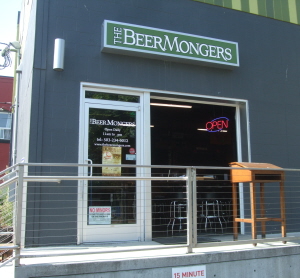 Shopfront at the Beermongers, Portland, Oregon, USA Portland, Oregon, is a beautiful, prosperous, civilised inland port city straddling the Willamette river. Looking west from the riverside, across a fine strip of parks and beyond the traffic calmed city centre with its free public transport, elegant squares and compact walkable blocks, thickly wooded slopes climb steeply, forming one of the USA’s largest and lushest urban forest parks. Besides fine views and many miles of surprisingly rugged trails, it boasts a zoo and a world famous rose garden, and you can reach it on a modern light rail system, only a few stops from the urban centre of Pioneer Courthouse Square.
Just to the north the Willamette drains into the Columbia river which divides the state of Oregon from neighbouring Washington. Tumbling from the Cascade mountains on its way to to the Pacific, the Columbia has carved a spectacular gorge 130km long and up to 1,200m deep, now protected as a National Scenic Area.
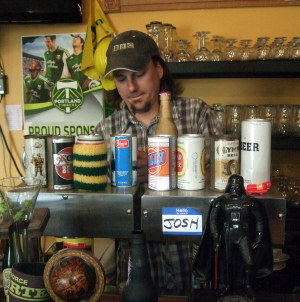 Sean Campbell pours a beer at the Beermongers, Portland, Oregon. So though it’s some way down the list of famous US cities, Portland has much to reward the discerning visitor – and even more so if one of your interests is beer. Oregon is one of the cradles of US craft brewing, home to some major names with their roots in the early growth of the movement in the 1980s, like Deschutes, Full Sail, Rogue and Widmer Brothers, this last in Portland itself.
The state is now the second largest craft beer producer and the third largest craft beer market in the country. And as its biggest city, Portland is a major focus of the industry, hosting Oregon Craft Beer Month in July and boasting 43 breweries, more than any other city in the world.
Readers who know their hops will pick up a clue to one of the reasons for such beery excellence from some of the geographical names mentioned above. Both the Willamette and the Cascade range lend their names to hop varieties, reflecting the state’s longstanding importance as a hop growing region, now the second biggest hop producing state in the US.
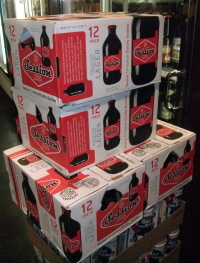 Full Sail Session Lager at the Beermongers Decent beer here has become a commonplace – even tiny local delis offer a selection of craft brewed bottles and cans. Amid such abundance, it’s more of a challenge than usual for specialist outlets to stand out, but one place that really makes an impression is the BeerMongers, one of the city’s most youthful beer venues.
The format combines a shop and a bar – a setup that’s becoming more widespread on the US scene and is also employed by another excellent Portland venue, the older-established Belmont Station, not far away. But whereas Belmont splits the space between the two functions, at the BeerMongers they coexist in a single space.
It’s in southeast Portland, some way from the city centre – I took a long walk there on a warm early autumn day, across the river and southeast following the railroad tracks, but it’s also by a bus stop with a frequent and reliable service. It’s set back from the road in a row of industrial units clustered around a little car park.
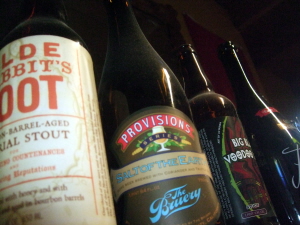 Rare and empty bottles at the Beermongers The interior of this rather smallish and rather anonymous concrete space has been turned into something that’s homely and amicably cluttered, with a mix of art, sporting ephemera and breweriana on display. An assemblage of beer bottles and cans, both vintage and contemporary, has been donated by local collectors, including a 1979 sample of the first commercial bottling of Anchor Old Foghorn, courtesy of veteran Anchor brewer Ron Wolf, who now works for local brewpub chain McMenamins and occasionally serves behind the bar at Beermongers events.
The McMenamins connection extends to cheerful and enthusiastic chief beermonger Sean Campbell, who has worked for the bigger company for 15 years and continues to do so, splitting his time with his own business. He and his business partner wanted their own beer-related project and first thought of a brewery, but decided there was too much competition already. Speciality beer stores, however, were relatively rare. “Where I live, there are three wine shops I can walk to but nobody does a good range of beer, even though everyone drinks it,” says Sean.
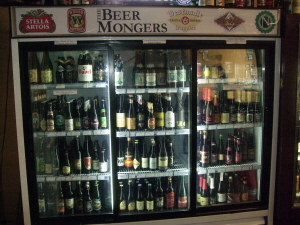 Well-stocked fridges at the Beermongers. Besides the large fridges containing around 525 bottled beers that line two walls, there are also eight draught taps – a relatively small number by US craft beer bar standards but vital nonetheless and well tended by Sean and bar manager Josh. “We always intended to have in-store consumption when we opened in 2008,” Sean explains. “The law in Oregon allows it so long as we don’t allow minors or serve hard alcohol.”
Originally the stock was just bottles, sold at the same keen prices both for drinking in and out, a policy which happily endures. “But as the first year went on,” Sean continues, “we got this really great group of customers that wanted to spend more time here, so we got the bar built and added more seating, and people have taken to it as a place they like to hang out. And that’s great – I’ve always liked working behind bars and chatting to people. I used to live in England and worked in pubs there. Not having too many taps means we focus on specials and seasonals, often from small local brewers, and we can give each beer the attention it deserves.”
Sean’s professional background explains a slight British touch to the decor – there are some second hand English church pews his parents found for him, and most of the woodwork was created by a British expat carpenter. Displays that honour the popular local proper football – as in soccer – team, the Portland Timbers, add to the effect.
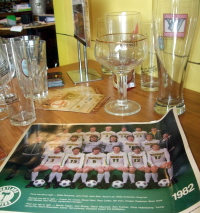 Glasses and real footie at the Beermongers The beers are arranged not, as is usual, by country and region but by style, irrespective of origin, creating some interesting juxtapositions that invite comparison and contrast. So Belgian classics like Saison Dupont line up beside American interpretations from small Oregon brewers like Ambacht, Beetje, Logsdon, Upright and the puzzlingly named Captured by Porches, while fellow Oregonians Southern Oregon and Fort George challenge Bitburger and Budvar in the pils section.
Belgian-style and genuine Belgian beers are well-represented beyond saison, with lambics from 3 Fonteinen, Boon and Hannsens and big ales and sour browns from Anker, Rochefort, St Bernardus, St Feuillien, Verhaege and lesser known names such as Gaverhopke and Schelde. These are ranged alongside American tributes and variations from the likes of Deschutes, Pelican (both from Oregon), Avery, Anchorage, Boulevard, Green Flash, Nebraska and the always appreciated but hard to find Russian River.
Still, US beers dominate, and as you’d expect, pale ales and IPAs are particularly well represented. Other small Portland brewers on the shelves include Alameda, Hopworks and Lompoc while 10 Barrel, Beer Valley, Caldera, Flat Tail, Hop Valley, Klamath Basin, Ninkasi, Oakshire, Pelican, Seven Brides and Silver Moon come from elsewhere in the state. Other West Coast brews – Diamond Knot, Fish Tail and Pike from Washington, Bison, Green Flash and Uncommon from California – line up beside admired craft brewers from across the nation. The cultish Pabst Blue Ribbon is a sole ironic nod to the mainstream, a survivor from the early days when they also offered a range of national brands but found most of them ended up in the bargain bin.
Imported offerings besides those already mentioned include Scandinavian eccentricities from Beer Here, Evil Twin, Midtfyns, Mikkeler and Xbeeriment; some British classics from Fuller’s, JW Lees and Traquair; and the odd bottle or two from Canada, Italy, the Netherlands and Japan. A small range of craft ciders is set to expand as local interest in this sector grows.
The range includes some beers the management admits are relatively slow sellers “Drinkers have gotten more experimental with sour beers, geuzes and other funky beers that they wouldn’t have recognised three or four years ago,” says Sean. “As soon as I start thinking, ‘why are we carrying that?’, someone will come in and say it’s their favourite. And our approach is good for brewers too – if they come up with something new they will often put it out to us because we’ll at least try it.”
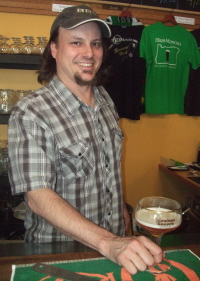 Sean Campbell of the Beermongers It’s a densely populated part of town but the shop gets visits both from across Portland and far beyond, with customers from across the US and Canada, including numerous younger craft beer fans. Sean has learned not to stereotype. “Young folks who look like they just got off their skateboard might go straight for Rodenbach,” he says. Other customers are members of the city’s sizeable home brewing community, looking to try examples of styles they intend to make.
Events include regular Meet the Brewer evenings, themed days when countries, styles or regions take over all the taps, an annual Orval event and beer festivals where they expand into a marquee in the car park. Expansions are planned, such as adding aged beers (including Orval), or even opening a second branch. Good advice is on hand when you need it. “People are here for fun and the shopping experience,” Sean confirms, “so there’s a delicate balance between education and hovering.”
Online and social marketing have proved a key to success in an increasingly web-based beer scene. “We had facebook and twitter accounts right from the beginning,” Sean recalls. “It takes your time, but it doesn’t take anything out of your pocket and I don’t think we would be nearly as successful without that stuff. I’m 40 and a bit of a dinosaur as I still read the newspapers, but lots of people younger than me get all their stuff online, including from trusted beer blogs.”
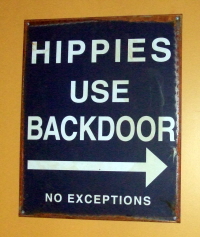 Sign at the Beermongers. I spotted exceptions. Great little places like the Beermongers are currently riding the crest of a wave of excitement in fine beer, not only in places like Portland but elsewhere. Even in the midst of recession, craft beer is flourishing as an affordable luxury that people like Sean are keen to share. “It’s great to be able to tell people they can enjoy the greatest sour beer in the world for less than $20,” he concludes. I’ll raise a glass to that.
Researched September 2011
Fact file
Address: 1125 South East Division Street, Portland OR 97202 (corner of SE 12th and Division)
Phone: +1 503 234 6012
Web: http://thebeermongers.com
Hours: 1100-2300 (Fri-Sat 2400)
Drink in? Yes
Mail order: No
Manager’s favourites: Orval, Oud Beersel Oude Geuze, Heller-Trum Schlenkerla Rauchbier Märzen, Upright Belgian-style beers
Beer picks
All from Oregon
Beer sellers: Beermongers
ABV: 5.4%
Origin: Pacific City, Oregon, USA
Website: http://pelicanbrewery.com
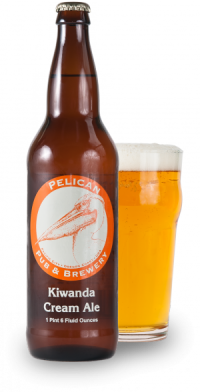 Pelican Kiwanda Cream Ale US craft brewers, particularly West Coast ones, are known to beer fans in Europe primarily as producers of extreme beers – hyper-hopped, ultra gravity, wild fermented monsters that have preferably spent two years maturing in a bourbon barrel. But the truth is most brewers pay the rent with much more everyday and approachable brews that shade towards what Brits might recognise as session beers, and in my view these are at least as interesting, particularly those that look back to historic, pre-Prohibition styles.
When brewer Darren Welch was devising the initial recipes for the nascent Pelican brewpub, right on the ocean at Pacific City, Oregon, in 1996, he puzzled about what style to adopt as the entry level beer on offer. Avoiding the obvious pale ales and lagers, Darren developed a recreation of a 19th century cream ale. This style had originally developed as the old established ale brewers’ answer to the growing popularity of pale lagers from German-American breweries, using pilsner-style ingredients and a cold conditioning period but with a warm fermenting yeast, rather like Kölsch is made in Germany today. He named it after the protected coastline of Cape Kiwanda nearby.
Kiwanda Cream uses two-row pale malt, carapils malt and flaked barley, with a single hop, Mount Hood, a variety known for its German-style subtlety rather than the vivid citric and pine flavours most associated with American hops.
A 650ml bomber bottle bought at the Beermongers in Portland, Oregon, yielded a pale yellowy gold beer with a fine and full white head and a creamy and slightly spicy malty aroma with a classic hop note. The palate was straightforward but accomplished, with cracker-like malt lifted by firmly tingly and gently flowery hops. The finish left a creamy texture in the mouth, with light citric flavours and a refreshing bitter note. Overall a very well-balanced, tasty, honest and satisfying ale.
Beer sellers: Beermongers
ABV: 7.5%
Origin: Hood River, Oregon, USA
Website: http://farmhousebeer.com
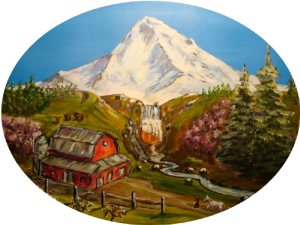 Logsdon Organic Farmhouse Brewery Dave Logsdon has more than an average brewer’s interest in yeast – he was a founder of renowned yeast culture supplier Wyeast, as well as being the original brewer at what’s now one of Oregon’s most successful craft breweries, Full Sail. So it’s perhaps not surprising that when he set up his own brewery early in 2011 with business partner Charles Porter, he turned to Belgium, with its array of weird, wonderful and wild yeast cultures, for inspiration.
This is a true farmhouse brewery in the style still occasionally found in Belgium and northern France, located on an organic farm in deep countryside south of the city of Hood River and some way east of Portland. The farm’s herd of Highland cattle feast on the spent grains, and some of the hops used is grown on site. Dave is currently raising a crop of genuine Schaarbeek cherries intended for future authentic krieks, and meanwhile the fruit beers utilise other locally grown ingredients.
The Seizoen is the brewery’s flagship beer, its spelling recalling the rare Limburg variant of the style, Sezoens Blond, brewed by Martens at Bocholt, but the beer itself owes at least as much to the classic saisons from Hainaut in French-speaking Belgium, and a good deal to individual imagination. This last factor accounts for the inclusion of locally sourced pear juice, added during fermentation though not especially present in the final flavour.
I sampled Logsdon Seizoen on draught, unfiltered and unpasteurised, at the Beermongers in Portland, but it’s also available bottle conditioned in 750ml bottles with beeswax-sealed caps. It poured a cloudy light amber with a sunshine glow and a fine yellowy head. There was a hint of orchard fruit on the creamy aroma – I noted apple but perhaps it was the pear – alongside orange and a pleasanty fruity, farmhouse-tinged yeasty touch.
A chewy palate had fruity estery notes but was well integrated and smooth, with notes of nuts and bruised apple emerging, and more fresh orange notes with touches of mint and pineapple. A pleasant finish coated the mouth with tangerine fruit, turning very lightly bitter with a hint of almond-like hops. A wonderfully refreshing, complex and elegant glassful and certainly one of the best saison-inspired US craft brews that I’ve encountered to date.
Beer sellers: Beermongers
ABV: 6.1%
Origin: Ashland, Oregon, USA
Website: www.calderabrewing.com
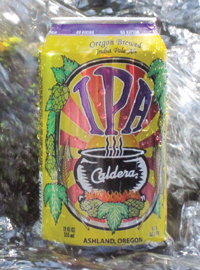 Caldera IPA Of all the taboos that craft brewers in the United States have systematically busted, the notion of craft beer in a can is arguably one of the most challenging. It certainly was to me. I listened with some incredulity when the charming Garrett Marrero of Hawaii brewery Maui first made the case to me. Surely canning was the ultimate insult, demonstrating the contempt in which the big brewers held the world’s greatest drink, and canned beer the epitome of mass produced industrial fizz?
But beyond the prejudice, canned beer makes sense. Cans offer numerous advantages that big brewers like for perfectly rational reasons – they’re lighter, sturdier, easier to pack and transport than bottles, and even have an environmental justification, particularly in cultures like the US and UK where returnable bottles are seen as a tough ask on customers. Modern can linings no longer taint beer with metallic flavours, and are fine for modern unpasteurised and naturally recarbonated craft beers. The one thing that doesn’t work so well in a can at the moment is refermentation, though some brewers are experimenting with “can conditioned” beers.
Cans were just as taboo among beer connoisseurs in the US as in Britain, but Caldera, alongside Maui, 21st Amendment, Oskar Blues and a few others, is now challenging that. Founded in the southern Oregon city of Ashland, not far from the California state line, in 1997, it originally produced only draught beer, and its IPA was one of its first recipes. When it decided to move into packaged beer in 2005, it settled on cans as the ideal vessel, the first Oregon micro to do so.
The IPA stands up very well to the process. This is very much a hop-led West Coast example of the style, dosed with Simcoe, Centennial and Amarillo to a hefty 94 IBU, but on a firm malt base that adds some Munich and Crystal to the two-row US pale malt that provides the backbone.
I enjoyed one of these colourful cans with lunch at a deli in central Portland, Oregon, whereThey’re relatively easy to come by. It was especially delightful to enjoy unusual quality beer in an otherwise perfectly everyday eating place – Portlanders take it for granted.
This amber beer turned out lightly hazy, with a thick, rocky slightly pinkish head. A relatively gentle whiff of pine and fennel set up a smooth palate with plenty of firm toffeeish malt well integrated with smooth, earthy, piny, peppery hops – considerably less overbearing than expected given the IBU. The hops clung on the swallow, but didn’t disrupt the smoothness of the finish, which remained approachable despite the vivid, drying bitter spicy notes.
I admit – I never expected to taste such a fine brew from a can.
 Glasses waiting to be filled at the Beermongers, Portland OR, September 2011 This is the fourth year of compiling a Top Tastings list and I’ve stuck to the same self-imposed rules as previously. Here are 30 beers I’ve tasted during 2011 which particularly stuck in my mind as the sensory highlights of the year, and a reaffirmation of why I spend so much time seeking out examples of the brewer’s art. They’re mainly beers new to me but not necessarily new beers – indeed some have been around for a very long time – and a few are resamplings of beers I’ve tried before.
They’re all seriously good beers but I wouldn’t say they’re necessarily the “best” I sampled – I’ve aimed for variety and beers that represent various beer travels and activities I’ve been involved with, and as before I’ve limited myself to one beer per brewer. There are a number of London beers, reflecting the work on my London guide; souvenirs of trips to Glasgow, Lille, Portland (OR) and San Francisco; unblended lambics tasted on my first Toer de Geuze; and yet another Fuller’s Vintage Ale from an astonishing vertical tasting.
Finalising the list is always painful but this year’s was particularly challenging, with so many excellent and memorable beers I simply didn’t have room for. So I’ve indulged myself for the first time with another 30 honourable mentions, listed briefly at the end. Both lists are in alphabetical order, with no further ranking intended, and the clickable links will take you to detailed tasting notes and background information.
- Bayerischer Bahnhof Gose Original Leipziger Bier Spezialität 4.6% Leipzig, Sachsen, Germany
- Bend Hop-Head Imperial India Pale Ale 9% Bend, Oregon, USA
- Boon Oude Lambik 3 jaar oud 6% Lembeek, Vlaams-Brabant, Vlaanderen
- Box Steam Funnel Blower 4.5% Colerne, Wiltshire, England
- Broumov Opat Kvasničák Pepper 5% Broumov, Králové Hradecký Kraj, Czech Republic
- Bruery Saison Rue 8.5% Placentia, California, USA
- Carlton & United Sheaf Stout 5.7% Melbourne, Victoria, Australia
- Full Sail Session Lager 5.1% Hood River, Oregon, USA
- Fuller’s Vintage Ale 2001 8.5% London W6, England
- Fyne Jarl 3.8% Cairndow, Argyll & Bute, Scotland
- Goose Island Bourbon County Coffee Stout 2010 13% Chicago, Illinois, USA
- Harveys Christmas Ale 8.1% Lewes, East Sussex, England
- Kernel Imperial Brown Stout London 1856 10.1% London SE1, England
- Kinshachi Nagoya Akamiso Lager 6% Nagoya, Chūbu, Japan
- Marble Old Manchester Ale 7.3% Manchester, England
- Mighty Oak Oscar Wilde 3.7% Maldon, Essex, England
- Moncada Notting Hill Amber 4.9% London W10, England
- Moonlight Death & Taxes 5% Santa Rosa, California, USA
- Nynäshamns Ångsbryggeri Bedarö Bitter 4.5% Nynäshamn, Södermanland, Sweden
- Orkney Dark Island Reserve (draught) 10% Quoyloo, Orkney, Scotland
- Pays Flamand Anosteké Brune Imperial Smout 8.5% Blaringhem, Nord, France
- Plzeňský Prazdroj Kvasnicový 4.4% Plzeň, Plzeňský kraj, Czech Republic
- Proef/Craig Allan Cuvée d’Oscar 7.5% Lochristi, Oost-Vlaanderen, Vlaanderen
- Redwillow Ageless Double IPA 7.2% Macclesfield, Cheshire East, England
- Steam/Epic Mayhem 6.2% Otahuhu, Auckland, New Zealand
- Texels Bock 7% Ouderschild, Texel (Noord-Holland), Netherlands
- Theillier Bavaisienne Ambrée 6.5% Bavay, Nord, France
- Tilquin Gueuze à l’ancienne 2011 6% Rebecq-Bierghes, Brabant-Wallonie, Wallonie
- Tryst Drovers 80/- 4% Larbert, Falkirk, Scotland
- Wells & Young’s Courage Imperial Russian Stout 2011 10% Bedford, Bedfordshire, England
Honourable Mentions: Adnams Tally-Ho 2007, Belhaven/Innis & Gunn Canada Day 2011, BrewDog Avery Brown Dredge, Brodie’s Red, Bouillon Médiévale Ambrée, Caldera IPA, Camden Town Show Boat, Deca/Struise Black Albert, Hardknott Vitesse Noir, Hopshackle Extra Special Bitter, Lambrate Imperial Ghisa, Lindemans Lambic 2 jaar oud (Tilquin), Logsdon Seizoen, Magic Rock Cannonball, Molen Hout & Hop, Moor Unfined Confidence, Murray’s Nirvana Pale Ale, Nøgne-Ø Imperial Stout, North Coast Merle, Olde Saratoga/Shmalz He’Brew Messiah Bold, Port/Lost Abbey Angel’s Share 2009, Rogue XS Old Crustacean, Sharp’s Turbo Yeast Unspeakable Abhorrence from Beyond…, Smuttynose Wheat Wine, Southern Tier 2xIPA, Stone Smoked Porter, Stowey Nettle Beer 2009, Thornbridge Italia Pilsner, Williams Brothers Profanity Stout, Windsor & Eton Conqueror 1075 Black IPA
Top Tastings 2011
ABV: 10%
Origin: Bedford, Bedfordshire, England
Website: www.wellsandyoungs.co.uk
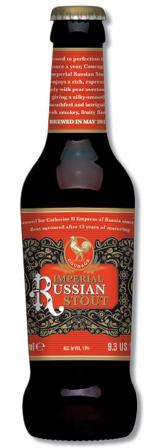 Wells & Young's Courage Imperial Russian Stout 2011 Excitement rippled through the beer world in Autumn 2011 as one of Britain’s most historic beer brands made an unexpected return from the dead. Courage Imperial Russian Stout can trace its lineage back to the Anchor brewery on the original site of William Shakespeare’s Globe theatre on Bankside, Southwark, which in 1781 became Barclay Perkins – a means to become “rich beyond the dreams of avarice” as Samuel Johnson commented when he handled the sale as the executor of deceased former owner Henry Thrale. The new owners lived up to Johnson’s word – the brewery became the world’s biggest, a major producer of the dark, vinous porter beers for which London was famed as the first capital of industrial brewing.
The beers now known as stouts evolved from strong porters which were labelled ‘stout’ in the sense of ‘strong’. Barclay Perkins led the field in exporting particularly stout bottled porters of 10% ABV or more to the Baltic nations, including to Russia which from 1703 had become more accessible with the creation of the port city of Sankt-Peterburg. These stouts even gained a following in the opulent royal palaces that brightened this massive country’s “window on the West” and were apparently appreciated by Empress and Autocrat of all the Russias Catherine the Great herself, acquiring the adjective ‘imperial’ not, as is still sometimes supposed, in honour of the British Empire but of the Russian one.
By the end of the 19th century prohibitive import duties had put an end to the Russian trade but the Anchor brewery continued brewing its imperial stout through the merger of Barclay Perkins with the nearby Courage brewery in 1955. Production was now limited to an annual brew packed in vintage dated bottles, now bearing the new owner’s brand, though the traditional technique of refermentation in the bottle was retained throughout the beer’s history – it was one of only five known British bottle conditioned beers still in production when the Campaign for Real Ale was founded in 1971, and one of the few beers then noted for its ageing potential.
By the 1970s Courage had relocated the brewing of Imperial Stout to its own facilities at Horsleydown at the south end of Tower Bridge, though continued to mature and bottle the beer at Barclay Perkins until the latter site finally closed in 1981. Production was relocated in 1983 a long way from its original home, at John Smith’s Magnet brewery in Tadcaster, North Yorkshire, where the end of the line was finally reached in 1993, the last year of regular production under the auspices of Courage.
Aside from a couple of minor glimmerings – some pasteurised bottles that briefly appeared on the Scandinavian market later in the 1990s, a one-off cask version at the 2003 Great British Beer Festival – the venerable line of brewing heritage appeared extinguished. Meanwhile other breweries moved into the gap on the shelves, notably Harveys, who recreated the stout imported into Russia from Britain in the 1820s by the A Le Coq company, itself perhaps derived from a Barclay Perkins recipe.
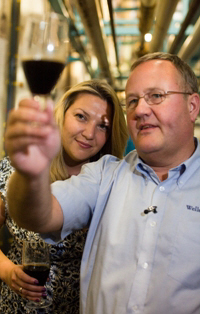 Wells and Young's head brewer Jim Robertson (foreground) admires the revived Courage Imperial Russian Stout with beer writer Melissa Cole, who helped recreate the beer. Pic: Wells & Young's Now, almost two decades after the last regular brew, Courage Imperial Russian Stout has reappeared thanks to Wells & Young’s. The enterprising new national struck a deal in 2007 to take over the production and marketing of the Courage brands from their then owner, Heineken, beginning with the standard and special bitters Courage Best and Director’s. In 2011 W&Y gained complete control of the brands and celebrated in splendid fashion in May with a new bottling of the historic strong stout, packaged in half pint bottles with red labels that pleasingly recycle elements of the iconic 1970s design.
Of course Young’s, one half of the original 2006 merger that created Courage’s new custodians, was once itself a London porter brewer, though much smaller than Barclay Perkins, and if Imperial Russian had ended up at Young’s historic Wandsworth site it would almost have been like coming home. Sadly that site now lays derelict and the 2011 version was produced at W&Y’s Bedford plant. But there’s a pleasing personal connection, as head brewer Jim Robertson is a former Courage employee who was involved in brewing the stout at Horsleydown in the early 1980s.
It was also noteworthy that W&Y chose to launch the new brew not in London, nor even in the UK, but at September’s Great American Beer Festival in Denver, Colorado, an indication of how the principal market for beers like this has shifted quite a long way west of the Baltic. Very little 2011 Imperial Stout found its way to British customers, and even beer writers and industry figures had to wait till December to get their tasting samples. Next year’s brew is expected to be more widely distributed.
Jim set out to recreate the stout he remembered from the 1980s, with pale, amber and black barley malts and lots of Styrian Goldings hops. Once again the beer is bottle conditioned. Although my sample was tasted relatively young at just over six months, it was already a mightily impressive and indulgent brew.
The beer poured near black, with a thick and creamy beige head. A sweet, caramelly aroma had notes of coffee, rum and raisin, a theme that continued in the rich and thick but sparkling palate, with fine chocolate and developing fruity raisin notes, a treacly sweetness and some biscuity malt. The finish was both drying and warming, with tannic notes and powdery bitter chocolate, swirled with complex esters that revealed late pear-like flavours.
The ageing potential is obvious, and I’m grateful to Wells and Young’s for sending me two bottles so I could stash one away to see what became of it. I also couldn’t resist cracking open one of my few precious remaining bottles of the 1993 John Smith version for comparison. It’ll be difficult to wait 18 years to taste the 2011 again.
Top Tastings 2011 (Ambrée), Beer sellers: Abbaye des Saveurs
ABV: 6.5%
Origin: Bavay, Nord, France
 Theillier La Bavaisienne (Ambrée) Northern French bières de garde are generally assumed to have deep historic roots in the local tradition of farmhouse brewing, though today’s best known and best selling brands are of more recent origin than you might expect. They’re revivalist beers developed in the 1970s (Jenlain) and 1980s (Choulette, Ch’ti, Trois Monts) by old established independent brewers who rightly decided that distinctive but accessible regional specialities might form the basis of a better survival plan than attempting to compete head-on with the lager giants.
Theillier, in the village of Bavay, an important capital in Roman times, is a little different. This small farmhouse-based operation is the oldest surviving brewery in the region and has stuck to making the same traditional styles throughout. Michel Theillier, in post since 1978, is the seventh generation of an unbroken family line that’s run the business since 1835, with production only halted once during that period, when the occupying Germans requisitioned the brewing vessels during World War I. Undoubtedly the recipes have evolved during that time, and today’s flagship Bavaisienne beers emerged in their current form in the 1980s too, but they can lay considerable claim to authenticity.
Most of the 1,000hl of annual production is sold locally but a small proportion is exported to the USA. I’ve never seen them in the UK, so I pounced when I found 250ml bottles of them on the shelves of the Abbaye des Saveurs in Lille. There are two Bavaisienne beers, the original amber and a blond, also available in 750ml bottles and only distinguishable by the label colours – blue and red respectively.
Both are brewed from pilsner malt and some coloured malt for the ambrée – some of the barley is grown locally but the historic decline of brewing in the region has largely stripped it of malting capacity so like most of its neighbouring breweries Theillier uses barley malted over the border in Belgium. Hops are Brewers Gold from Germany and yeast is obtained from Duyck, brewers of the Jenlain beers. These warm fermented beers undergo a traditional cold maturation period of a least a month at -1°C before being chill filtered but not pasteurised.
The blond was a splendid beer that poured golden with a fine white head and a richly malty, slightly lagery Germanic hop aroma. The crisp but full palate had a firm cereal character with a fine note of fruit, firm nuttiness, pleasant sweetness and a touch of slightly citric hops. The gently drying but still sweet finish became very nutty with a slightly warming note and a delicious natural grainy quality. Overall it was a well-muscled and quite straightforward beer but with a certain elegance.
The amber I found better still. It poured a classic amber with a little light beige head and a rather retiring slightly spicy aroma with nuts and cinder toffee. Like the blond the palate was firm and sweetish, with an emerging oozy lusciousness and plenty of malt character – biscuits, peanuts, even a touch of smoke. Gentle, almost medicinal spruce-like hints emerged before a nutty, coating and very satisfying finish with a light but building note of hops.
Again a straightforward beer but characterful, flawlessly made and a real taste of tradition.
I drew on the following book for some background details:
Gabriel Thierry 2010, Sur la route des bières du Nord-Pas-de-Calais, Bouvignies: Nord Avril
Top Tastings 2011
ABV: 7%
Origin: Ouderschild, Texel (Noord-Holland), Netherlands
Website: www.speciaalbier.com
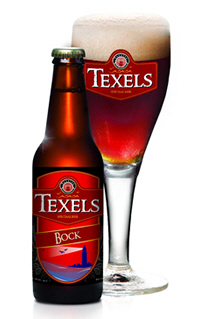 Texels Bock With my slightly sweet beer tooth, I’ve got a soft spot for the Dutch interpretation of bo(c)kbier, which has become an institution in its own right in the Netherlands, a seasonal focus for drinkers and a rallying point for the country’s beer consumer movement, PINT.
It’s even the subject of two competitions and a festival. “Het Beste Bockbier van Nederland” – the ‘best’ beer in the style – is chosen by a panel of beer experts at the Bokbierfestival organised by PINT in late October in Amsterdam, while “Het Lekkerste Bockbier van Nederland” – the ‘tastiest’ beer – is named by ordinary drinkers at a separate event organised by the Arendsnest beer pub supported by the specialist pub landlords’ organisation ABT.
Almost all Dutch brewers now produce a bok at the relevant time of year: old established brewers usually produce theirs in traditional cold-fermenting lager style while the newer micros tend to make boks as warm fermented ales. Standard strength for the style is up to 7%, though stronger variants are now made. One of the most successful standard strength microbrewed entrants in recent years is Texelse Bock, from what’s now one of the Netherlands’ most consistent and enduring new generation brewers.
The original brewery was founded in 1994 by Maurice Diks in an old dairy in the tiny fishing village of Oudeschild on Texel (pronounced ‘Tessel’ in Dutch), the southernmost and largest of the chain of Frisian islands that dots the northwest coast of the continent from the Netherlands to Denmark. It’s notably expanded since falling under new ownership in 1999.
Texels Bock is brewed from pale and roasted barley malt and hops, some of which is sourced from the island. Though a warm fermenting yeast is used, the beer undergoes extensive cold lagering before being bottle conditioned. The resulting brew was named tastiest bockbier in 2009, best in 2010, and both tastiest and best in 2011.
I encountered a bottle of the 2010 version at De Hems, Soho’s famous Dutch pub, which despite its authentic atmosphere and expat following is often disappointing as a source of more adventurous Dutch beers, so I considered myself lucky. I soon understood why the beer had been so widely praised.
Texeks Bock pours a lightly cloudy deep reddish-brown with a fine yellowy head. Notes of roasted malt, tar, banana, grapes and refined grassy hops are evident on a slightly flinty aroma. A luxurious palate has notes of burnt sugar, liquorice and cherry fruit – it’s sweet, but kept interesting with light hops and a chewy roast character.
The gently lingering finish is very well balanced, smooth and satisfying, with more malt, a bit of hop bitterness and a toasty edge. A classic, comforting cold weather brew.
For more background on the style, see Proef/SNAB Ezelenbok.
Top Tastings 2011 (bottled Cuvée d’Oscar), Beer sellers: Abbaye des Saveurs
ABV: 6.5% and 7.5%
Origin: Lochristi, Oost-Vlaanderen, Vlaanderen
Website: craigallan.fr, www.proefbrouwerij.com
 Craig Allan Cuvée d'Oscar (brewed at Proef) These beers are produced in Belgian Flanders by a Scottish brewer based in Picardy, northern France, and are decidedly international at heart. Craig Allan trained in Edinburgh but found the British brewing scene hidebound by tradition. He now lives in Méry-la-Bataille, in the Oise département, and is working with the owners of Lille’s Abbaye des Saveurs beer shop and specialist pub La Capsule to create a new range of beers. The aspiration is to open a brewery somewhere in the area but in the meantime brewing takes place at the ever reliable Proef in Lochristi, over the Belgian border, proving ground for so many interesting new beers.
Having shaken off the weight of one deep rooted brewing tradition, Craig isn’t likely to succumb to another one, and his beers are a long way from the bières de garde typical of French Flanders and Picardy, leaning instead towards US-influenced craft beer styles and a spirit of artisanal experimentation. The former tendency is most evident in Agent Provocateur, a self described hybrid of a Belgian golden ale and an IPA.
Tasted from a keykeg at La Capsule, this was a cloudy golden beer with a foamy white head and a very rich fruity aroma with notes of kiwi fruit, pineapple, resinous Cascade hops and some farmyard scents. There was less hoppy bitterness than I expected on the rich full palate, though tasty apricot jam flavours came through, and a solid maltiness coupled with the characteristic esters of Belgian yeast established the golden ale side of the hybrid. A lightly sweet, lightly drying finish had some vegetal hop character.
Much as the Agent provoked me to appreciation, Cuvée d’Oscar (‘Oscar’s brew’, named after Craig’s baby son) turned out to be something else entirely. My personal tastes veer more towards dark beer anyway, but this one was so original and unusual. It’s based on a wheat Bock of the Schneider Aventinus variety, with a “high proportion” of wheat malt joining Munich, crystal and chocolate barley malts in the grist, fermented with Bavarian wheat beer yeast and given a twist with a good dose of hops, including dry hopping with New Zealand Nelson Sauvin.
A keykeg sample was thick and chestnut brown, with a thick bubbly off-tan head, looking very much like a strong Belgian brown, but certainly not smelling like one. The aroma was very fruity, with grape and apricot notes, followed by an unusual and very complex toffee palate with apricot, pineapple, chocolate, malt loaf and a spicy, yeasty quality. A pleasant finish was packed with vivid and unusual flavours, blending chocolate and toffee notes with satsumas, grapes and a touch of roast, with spicy hops nicely balancing an overall biscuity sweetness.
The bottle conditioned version I bought in the shop left even more of an impression. This looked very similar, again with a foamy head, and again I noted grapes and apricots in a creamy aroma. These fruits showed up too in the complex, sweetish palate alongside chocolate, breakfast cereal, exotic spice and a developing hoppy bitterness, with a luscious bubbly texture adding to the sensual delight. Chocolate turned quite dark and stern in the finish with raisins, toffee and an emerging powdery dryness with roasted malt flavours rounded off by apricot nectar, with a touch of herbal, lettucey bitterness.
Another brewer to watch, without a doubt.
Top Tastings 2011
ABV: 7.2%
Origin: Macclesfield, Cheshire East, England
Website: redwillowbrewery.com
 Redwillow Ageless Double IPA Recent years have seen the emergence of a number of new, small British breweries that place themselves firmly in the international craft beer movement rather than the native real ale tradition. I hesitate to use the label “craft beer” as in my view even the most dyed-in-the-wool cask ale producers should be counted as craft breweries, but there’s certainly an emerging and influential group of young brewers who are determined to do things differently, often looking across the Atlantic for inspiration.
The most recent example I’ve encountered is Redwillow, founded in 2010 by Toby McKenzie in Macclesfield. I happened across a selection of Toby’s cask and bottle conditioned beers at one of Manchester’s burgeoning number of interesting beer venues, the Font Bar, in early December, and with limited time to spare opted to try a bottle of this US-inspired double IPA. It turned out to be a good choice.
The beer poured amber, with a very big puffy yellowish head. Grapefruit and tropical fruit notes quickly seized control of a toffeeish malt aroma. More tropical fruit exploded on a resinous palate with notes of spice, burnt toast, lavender, sesame oil and a slight washing up liquid hint – an impressive intensity of flavour but nowhere near as overbearing as some beers in this style. Pineapple, coconut and a building peppery note danced in a long finish, with a minerally, chewy quality and some spicy, seedy notes.
|
|
