Promoting an international beer culture that recognises and celebrates beers of quality, distinctiveness and local character, brewed with care and passion.
Etiam pulvinar consectetur dolor sed malesuada. Ut convallis
euismod dolor nec pretium. Nunc ut tristique massa.
Nam sodales mi vitae dolor ullamcorper et vulputate enim accumsan.
Morbi orci magna, tincidunt vitae molestie nec, molestie at mi. Nulla nulla lorem,
suscipit in posuere in, interdum non magna.
By the end of 1976, there were eight commercial breweries operating in London, none of them brewpubs. 5 were part of national groups (N), one part of a multinational (M). These breweries were:
By the end of 1975, there were nine commercial breweries operating in London, none of them brewpubs. 6 were part of national groups (N), one part of a multinational (M). These breweries were:
By the end of 1974, there were 10 commercial breweries operating in London, none of them brewpubs. 7 were part of national groups (N), one part of a multinational (M). These breweries were:
Mann Crossman & Paulin, Truman Hanbury & Buxton and Watney Mann combined into a single group, Watney Mann Truman, by existing owner Grand Metropolitan.
For definitions of a London brewery, see the current London breweries page.
By the end of 1973, there were 10 commercial breweries operating in London, none of them brewpubs. 7 were part of national groups (N), one part of a multinational (M). These breweries were:
By the end of 1972, there were 10 commercial breweries operating in London, none of them brewpubs. 7 were part of national groups (N), one part of a multinational (M). These breweries were:
Beer firm, suspended brewery Original site: 2 Stour Road E3 2NT (Tower Hamlets) Second site: The Brew Shed, 14A Queens Yard E9 5EN (Tower Hamlets) Taproom, possible future site: 1 Priestley Way E17 6AL (Waltham Forest) bigpenny.co.uk First sold beer: July 2013 (as Truman’s Beer at original site) Brewing suspended: May 2022
As explained elsewhere, Truman’s, based at the Black Eagle brewery in Brick Lane until its closure in 1989, is one of the most important names in London brewing history. That history fascinated James Morgan and Michael-George Hemus, who worked as young professionals around the site in the early 2000s, and in an inspired moment they decided to revive the brand. The trademark had been inherited by Heineken, who were eventually persuaded first to license it then to sell it.
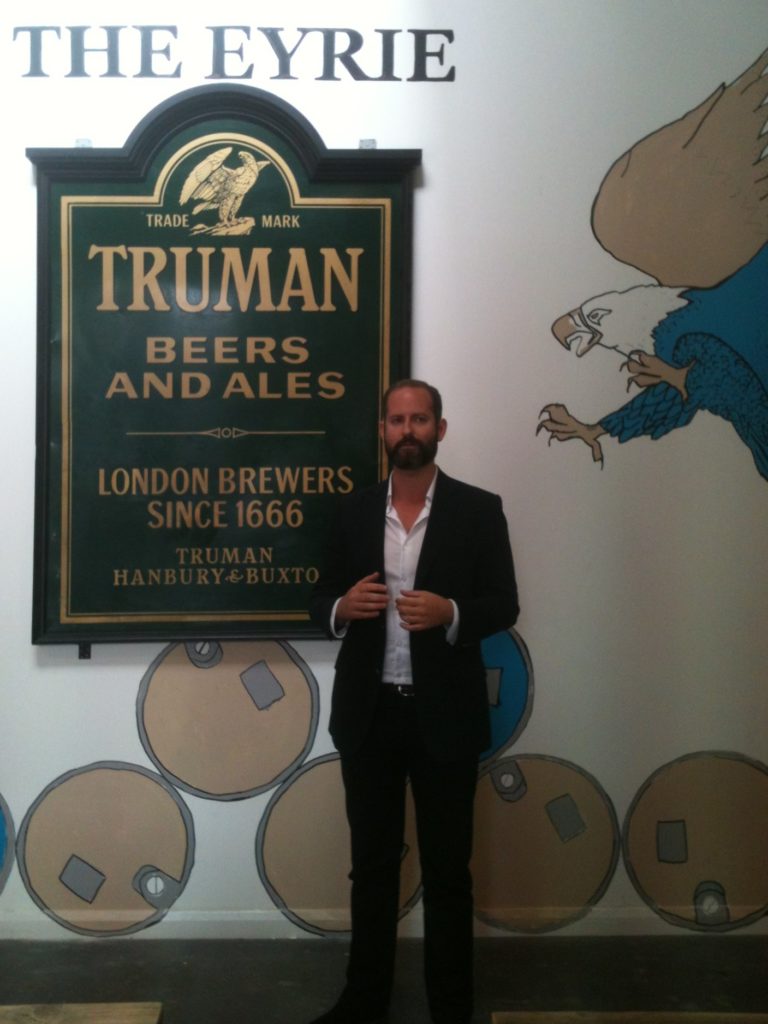
James Morgan at the launch of the new Truman’s first physical site in Hackney Wick, 2013.
In June 2010, a new beer, Truman’s Runner, based on the spirit but not the letter of the old, appeared in London pubs. At first this was cuckoo brewed outside London, initially at Nethergate in Clare, Suffolk and from October 2011 at Everards in Leicester, but always with the intention of bringing brewing back to the capital.
The historic site sadly proved impractical and unaffordable, but in July 2013 Truman’s began brewing at Fish Island in Hackney Wick using a new 33 hl brewhouse and the original Truman yeast strain, a sample of which had been deposited at the National Collection of Yeast Cultures in 1958. The original head brewer was German-born Ben Ott, formerly at London Fields and later a co-founder at 40FT. In 2015, the brewery, known as the Eyrie, expanded to a neighbouring unit previously occupied by Beavertown, with increased fermentation capacity and a new kegging line.
With production reaching 17,000 hl per year by 2019, no space for further expansion and the site under threat of redevelopment, the brewery secured much bigger premises in the growing brewing centre of Blackhorse Lane in western Walthamstow. The original intention was to install an 80 hl German-style brewhouse, a 10 hl pilot kit and a large and comfortable taproom with performance space, aiming for an annual output to 150,000 hl.
These plans were seriously disrupted by the Covid-19 lockdown in 2020, and the brewery found itself unable to install equipment at the new site before it was forced out of its Fish Island home, which was subsequently demolished. Coincidentally, Crate brewery, not far away in Queens Yard, got into difficulties at the same time, and Truman’s took over its production brewhouse from July 2020. Though the 16 hl kit here had substantially less capacity than Truman’s previous equipment, this interim arrangement provided a way out of difficult circumstances.
Truman’s still had the lease on the Blackhorse Lane site and, following the easing of the first lockdown, opened it in July 2020 as a bar and events space known as Truman’s Social Club, taking advantage of the vast size to create a purpose-designed socially distanced venue. The intention remained to relocate brewing here eventually. During this period James moved on and Michael-George, who had stepped back from the business, returned to run it.
Unfortunately this didn’t resolve the difficulties as the Queens Yard site had to close in May 2022 due to redevelopment, but still with no capacity to relocate production to Blackhorse Lane. The company shifted to contract brewing, I believe at Redchurch in Essex (formerly in London).
To raise further funds, the company sold the Truman brand in September 2022 and rebranded to Big Penny, acknowledging a former copper mill close to the Blackhorse site which supplied materials for penny coins. The Truman brand now belongs to the owners of the Old Truman Brewery in Brick Lane, who commission beers under that name from Brockley Brewery.
The main venue is now known as the Big Penny Social, and the intention remains to brew there at some point in the future.
The company also owns a West End pub, the Newman Arms in Fitzrovia, taken over in 2018 though up for sale in 2022, and an airside bar at London City Airport, originally known as Brick Lane Brews but since rebranded to Big Penny Brews.
Beers were in cask, tank, keg and can. Cask was the mainstay in the early years, and despite the difficulties of Covid, Truman’s continued with the format, though at reduced volumes, droppng it with the shift to contract brewing. Previously, Truman’s also brewed for others, notably assisting in the return of London Fields beers to London.
Brewpub 1 Mercer Walk, London WC2H 9FA (Westminster) opengatelondon.guinness.com First sold beer: 11 December 2025
Guinness is brewing in London again, though on a much smaller scale than at its former Park Royal site, closed in 2005 and subsequently demolished.
The new site has an even older brewing history: the Woodyard Brewery, later known as Combe & Co, was once an important porter brewery, operating from at least the early 18th century to 1905 when it closed after merging with two other breweries to form Watney Combe Reid. Numerous historic buildings still stand as explained on the Watney page. Appropriately enough, the Watney group ended up in the hands of Grand Metropolitan, later a co-founder of Guinness owner Diageo.
The company announced on 31 January 2022 that it was investing £75 million to create a microbrewery, bar-restaurant, shop, training centre, events space and “culture hub” called Guinness at Old Brewers Yard. Plans were delayed by planning issues but construction was underway in spring 2024.
The building work was originally due to be complete by October but further delays knocked this back into 2025. The complex since renamed in line with the visitor centre, pilot brewery and taproom at Guinness’s Dublin site, finally opened on 11 December 2025. It includes two restaurants and a bar.
Beers are in keg, sold on site, and include a wide range of styles, from an own-recipe porter to lagers, kettle sours and Belgian styles, with numerous rotating specials.
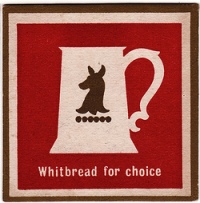
Whitbread’s well-known tankard logo on a beermat. The slogan might have rung hollow with fans of breweries that fell under the baleful shadow of the ‘Whitbread umbrella’.
Closed brewery 52 Chiswell Street EC1Y 4SD (City of London, Islington) First sold beer: by 1686 (as King’s Head) Brewing ceased: 1976
The earliest record of brewing at what became Whitbread is from 1686, when a Mr Bowes was making beer at the Kings Head Tavern, just inside the City of London on the southwest corner of Chiswell Street and Silk Street, then known as Grub Street. But it would be some decades before the Whitbread name became associated with the site.
Samuel Whitbread (1720-96), born in Cardington, Bedfordshire, was only 16 when in 1736 he apprenticed himself to John Wightman, then master of the Brewers’ Company, who likely brewed at a site known as Pye Corner, Smithfield, on what’s now the junction of Cock Lane and Giltspur Street (EC1A 9DD). This was famous as the location where the Great Fire of London stopped in 1666, as still commemorated by the Golden Boy statue in a niche on the northwest corner.
Six years later, Whitbread went into partnership with brothers Thomas and Godfrey Shewell at the Goat brewhouse at 88 Old Street, on the southwest corner of Whitecross Street (EC1V 9HU). This brewery was likely founded by a Mr Bucknall sometime before 1692 and had been operated by the Shewells since at least 1741.
Whitbread and the Shewells brewed porter here, with a separate brewhouse for ales, possibly dating from a couple of decades earlier, on the other side of Old Street at the corner with what’s now Central Street, formerly Brick Lane (EC1V 9HX). But it was porter that everyone wanted, prompting Whitbread and Thomas Shewell to seek a site where they could brew much more of it.
In 1749 they bought the then-derelict Kings Head and adjacent properties, only a short walk south from the Goat, and began creating what was likely the world’s first purpose-built porter brewery. Opened in 1750, the Chiswell Street brewery was by 1758 the biggest porter producer in Britain, with an output of 106,000 hl a year. That year, the facilities began expanding onto the north of Chiswell Street, just outside the City in Finsbury: the boundary with the London Borough of Islington still runs along the street.
The Goat closed once Chiswell Street opened, but brewing was later revived there. By 1774 it was operated by an ex-Whitbread brewer as More & Co, and by 1844 it was known as the Scottish brewery. Around 1890 it was absorbed by Watney and closed.
Back in Chiswell Street, Shewell retired in 1761 and Whitbread subsequently bought out his shares, becoming sole owner, as well as branching out into politics as an MP for Bedfordshire from 1768. By 1796, the year of his death, the brewery’s success had swelled to break further records, as brewing historian Peter Mathias recounted in 1959:
‘In 1796, Samuel Whitbread brewed, for the first time in any brewery in the world, over 200,000 barrels [327,320 hl, 57.6 million pints] of porter in a single season. This feat involved raw material costs of perhaps £200,000 [£17.9 million in 2023 prices], the upkeep of a plant which, with stocks, was worth over half a million pounds [£44.75 million], maintaining over 100 horses, and holding to account 500 publicans or more, and perhaps 1,000 other customers, for business which represented nearly thirty million retail transactions (at one quart) from a single unit of production.’
The celebrated Porter Tun Room was built between 1776-84 after fire destroyed its predecessor, at a scale sufficient to house the increasingly large vats used for maturing the beer, with a floor area of 778 square metres and the exposed timbers of a king-post roof, the widest unsupported timber span in London after Westminster Hall, over 18 m above.
Even more remarkable were the vaults below, conceived by Whitbread as a more efficient and oxygen-proof alternative to the tuns: vast watertight cisterns lined with a special cement capable of resisting the beer’s acidity, applied by ship’s caulkers, with a total capacity of 20,000 hl or almost 3.4 million pints.
The brewery was an early adopter of steam power, ordering its first engine in 1784. Microbiology pioneer Louis Pasteur (1822-95) visited in 1871, and impressed staff by using his microscope to spot a spoilage organism in a sample of a yeast culture which, it turned out, had already been identified as troublesome and taken out of use. The company subsequently invested in its own microscope.
Inevitably tastes moved on and Whitbread diversified into other styles of beer, with a fresher ‘running’ mild accounting for 10% of production by 1839. Bottling activities expanded in 1870 with the launch of a new plant not far away in Grays Inn Road (closed 1965). The last of the famous tuns was removed in 1900, though porter production, now by different methods and at declining strengths, continued until 1940.
Whitbread’s expansion was also fuelled by takeovers and mergers. Prior to World War II it absorbed at least 10 other brewing businesses, beginning in 1812 with Martineau & Bland of the Lambeth Brewery, founded in 1783: brewing at that site ceased but was later revived independently until the brewery was eventually taken over and closed by Manns.
Other Greater London acquisitions were Nicholl’s Anchor Brewery, Lewisham (founded c1800, bought and closed 1891, used as a bottling and distribution facility until 1984 and demolished 1987); Gripper Brothers Bell Brewery, Tottenham (founded 1760, bought and closed 1896, continued as a depot until mid-1985); Matthews and Canning Anchor Brewery, Chelsea (founded 1829, bought 1899, closed 1907); Jones & Co (Bromley Steam Brewery), Bromley Common (founded c1840, bought and closed 1901); Notting Hill Brewery (founded c1855, closed 1920 and later demolished with pub estate bought by Whitbread); and Forest Hill Brewery Co (founded by 1867, bought and closed 1923, converted to a dairy and later demolished).
Another significant pre-war purchase was Mackeson & Co in Hythe, Kent, founded in 1669 and noted for a pioneering sweet stout with added lactose, launched in 1909. This was initially sold to Simonds of Reading (later bought and closed by Courage) in 1920, and sold on to Jude Hanbury & Co of Canterbury in 1929, which in turn was bought by Whitbread the same year. The Mackeson brewery remained in production until 1968 when its flagship brand was switched to the former Tennant Brothers site in Sheffield, of which more below.
In the 1950s the brewery launched the so-called ‘Whitbread Umbrella’ in response to the wave of mergers then sweeping the industy, buying shares in smaller regional breweries and obtaining favourable trading agreements on the promise of protecting them from hostile takover. The umbrella might have shielded them from other brewers but not from Whitbread itself, as by the early 1970s most had been absorbed.
Whitbread bought and either immediately or eventually closed over 30 other breweries between 1946 and 1989, including major regional names like keg ale pioneer Flowers (Luton and Stratford-upon-Avon, 1961), Nimmo (Castle Eden, 1963), Lacon (Great Yarmouth, 1965), Rhymney (1966), Fremlins (Maidstone, 1967), Strong (Romsey, 1969), Brickwoods (Portsmouth, 1971) and Boddingtons (Manchester, 1989). From Tennant Brothers of Sheffield, bought in 1961 and closed in 1993, it inherited another nationally recognised bottled brand, Gold Label Barley Wine. At its peak in the 1980s it owned almost 8,000 pubs and brewing and distribution facilities in Belgium as well as the UK.
After closing Flowers in Luton in 1969, Whitbread replaced it the same year with a massive new brewery at Leagrave nearby, claimed to be the first major new-build brewery in the UK for over 30 years and the largest fully automated brewery in Europe. It produced only keg, bottled and canned beer, not only Whitbread beers but mainland European lager brands brewed under license like Heineken and Stella Artois. Two other large new plants focused primarily on lager production followed, at Samlesbury, Lancashire, in 1972 and Magor, South Wales, in 1979. The Luton plant was decommissioned in 1984 after only 15 years in production.
In the 1970s, Whitbread’s London facilities brewed a version of cask Trophy Bitter (3.6%), which was also brewed, sometimes to different recipes, at most of the group’s other sites, as well as cask Best Mild (2.8%). Alongside these were flagship keg bitter Tankard (3.9%), and bottled Light Ale (around 3%), Forest Brown Ale (around 3.2%, though some of this had been contracted to Truman), Pale Ale (around 3.5%), Brewmaster Export Pale Ale (4.8%) and, possibly, Gold Label barley wine (11.3%). Pale Ale was the last beer brewed at Chiswell Street in 1976, before the brewery closed for good.
Where are they now?
Following the closures, some of the brewery buildings continued in use as the corporate headquarters until 2005. But by then Whitbread was no longer a brewer. Having diversified into broader hotel and catering interests, it found this side of its business more profitable. It had a longstanding trading relationship with Stella brewer Interbrew of Leuven, Belgium, created in 1987 through the merger of two major Belgian brewing group, Artois and Piedbœuf. So in 2000, Whitbread sold its brewing interests, including its breweries and brands, to Interbrew, which also acquired Bass the same year (see Charrington).
Interbrew merged in 2004 with Brazilian brewing giant AmBev to create InBev, the biggest brewing company in the world. In 2008, InBev bought major US brewer Anheuser-Busch of St Louis, Missouri, to become Anheuser-Busch InBev (AB InBev). Anheuser-Busch was already active in London, having leased the Stag brewery in Mortlake from Courage to produce a regional version of its flagship Budweiser brand. This was later fully acquired by AB InBev and closed in 2015. AB InBev continues to operate the Salmesbury and Magor sites.
Whitbread continues as a hospitality company today, owning the Premier Inn hotel and Beefeater restaurant chains among others. It owned Costa Coffee between 1995 and 2019, when it was sold to Coca-Cola.
The Whitbread brands have largely disappeared, though Pale Ale has remained intermittently available in Belgium, likely brewed by AB InBev at Leuven or Jupille. In 2016, a company called Pioneer Brewing licensed the brand and worked with Windsor & Eton Brewery to relaunch the beer as a 4% cask or 4.6% bottled ale, but it’s since been withdrawn again.
AB InBev revived Flowers IPA (3.4%) and Best Bitter (4.5%) in keg and occasionally cask in the 2000s, contracting them to the Badger brewery in Blandford St Mary, Dorset. Mackeson Stout (2.8%) is still available in cans, possibly produced at Hydes in Salford. Canned Gold Label, now only 7.5%, remains available too, produced by AB InBev in Salmesbury, along with Boddingtons Bitter, now in canned and nitrokeg form only.
Things to see
Though part of the site was demolished, several historic brewery buildings still stand in Chiswell Street, in what’s now the Brewery Conservation Area, largely dating from various rebuilds in the second half of the 19th century. Most are at least Grade II-listed.
The group on the south (City) side, on the original site, are still owned by Whitbread and mainly used for hospitality. Most obvious is the Entrance Wing (52 Chiswell Street EC1Y 4SA) with its carriage arch through to the brewery yard: the arch and the bay above date from around 1890-91, while the bays to each side are earlier, around 1867. The buildings, which also have some notable interiors, were used as offices from the 1890s onwards, and have since been converted to the luxury Montcalm hotel.
A terrace of late 18th century brown brick houses stretches to the left along Chiswell Street (nos 53-55), terminating in a pub building of the same period at no 56 on the corner with Milton Street, though the frontage of this was substantially altered perhaps in the 1870s. It was once known as the St Pauls Tavern but was closed in 2008 and reopened in 2011 as an upmarket restaurant, the Chiswell Street Dining Rooms, by the ETM Group who also own the Long Arm brewpub not far away. A range of yellow brick brewery buildings perhaps from the 1870s continues round the corner along Milton Street, with tall entrance arches at each end.
To the right of the Entrance Wing, fronted by railings, is the Partners’ House (47 Chiswell Street EC1Y 4SB). The only Grade II*-listed building in the group, it’s a grand four storey early 18th century red brick house which predates the brewery but was later used as a residence for the owners and is now offices. Immediately right of this (no 49), on the corner of Silk Street, is the Kings Head, now known as the Jugged Hare. This was the site of the original brewery, though the current building is late 19th century, with 20th century additions. It closed in 2008 but was reopened by ETM under its current name in 2012. A later brewery building in red brick and granite, from 1904, is round the corner in Silk Street, next door to the pub.
It’s usually possible to walk through the main entrance arch, with its war memorial plaque on the right, into the yard behind, where many of the buildings now form part of the Brewery events and conference centre. Straight ahead is a clock in a block dated 1912. Immediately right, an enclosed iron footbridge built in 1892 connects both sides of the yard at first floor level. The octagonal building to the left is the entrance to the Porter Tun Room, which is now used for events and isn’t usually open to the public except occasionally on Doors Open Days. Beyond it, now fronted by a conservatory, is the former sugar room.
The brewery’s ‘North Side’ once stretched as far as Errol Street, covering around 1.2 ha, and is still linked to the South Side by an underground passage, now closed off. Much of it was demolished and redeveloped in the 1980s, but the front yard remains, surrounded by brewery buildings from 1870 behind a gated entrance almost opposite the South Side arch. The gates were originally wood but were replaced by the current iron ones in 1986. Immediately left of these and forming part of the same range of buildings is the Brewer’s House (no 41), with a double front door under a broad arch.
The yard is now known as Sundial Court (38 Chiswell Street EC1Y 4SB) after the 1774 sundial visible at the far end, not in its original position but moved here during the 1870s rebuild. An arch below this, blocked off in 1986, once gave access to an inner yard. The buildings to the left of the Brewer’s House are older: no 42, next door, is early 19th century, while the ‘Georgian Terrace’, nos 43-46, dates from 1774. All were once used as accommodation for brewery staff. The site is now offices, flats and student accommodation.
Some other remnants of Whitbread’s brewing days are still visible in London. The distinctive southern gatehouse of the former Bell Brewery, surmounted by a Whitbread clock and with the outline of the brewery yard obvious behind it, is also now Grade II-listed (667 High Road N17 0AE). The entrance arch of Matthews and Canning, topped by an anchor, stands next door to the former brewery tap, the Builders Arms (13 Britten Street SW3 3TY).
The Forest Hill Brewery has completely vanished, though a beautiful 1920s painted tile advertisement for its beers is visible on a wall at 2 Tintern Street SW4 7PZ: likely the building once housed an off-license. The only legacy of the Bromley Steam Brewery is the street name, Brewery Road (BR2 8BF).
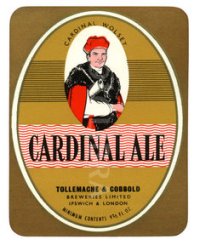
Pre-1972 Tolly Cobbold label listing its location as “Ipswich and London”.
Closed brewery Essex Brewery, St James Street E17 7FE (Waltham Forest) First sold beer: 1859 Ceased brewing: 1971
Founded as a steam-powered brewery by William Hawes, this operation was first known simply as the Walthamstow Brewery, and located on the north side of St James Street (then known as Marsh Street) immediately west of its junction with South Grove and Markhouse Road. It drew water from two artesian wells on the site, which it also supplied to locals as washing water.
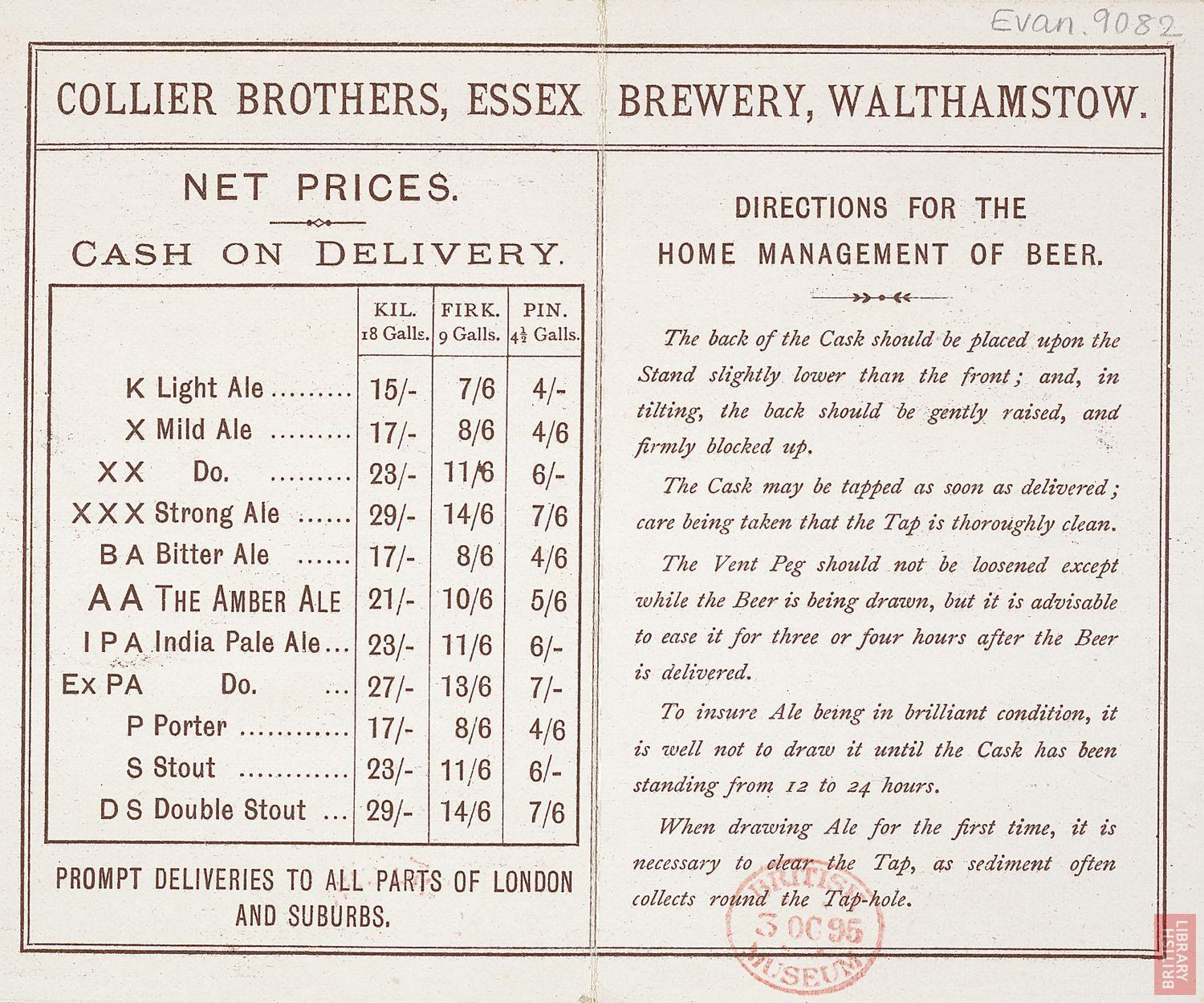
It was renamed the Essex Brewery when it was bought by the Collier brothers in 1871, at a time this area still formed part of Essex. An advertisement from 1890 shows it made an extensive range of beers typical of the day, all in cask, including four milds of varying strengths, a bitter, an amber ale, two IPAs and three porters and stouts. By 1900 the business employed over 100 staff.
The brewery and its five pubs were sold on again in 1920 to the Tollemache Brewery of Ipswich, which had been founded in 1856 as Charles Cullingham & Co, but had been in the hands of the Tollemache family since 1888. The family had ambitions to build a significant regional if not a national brewery, and the Walthamstow plant was put to use brewing Tolly brands for the lucrative London and southwest Essex markets, including a growing tied estate, a function it continued to fulfill when its owner merged with Ipswich neighbours the Cobbold Cliff Brewery (a concern that dated back to Harwich in 1723) in 1957 to form Tolly Cobbold.
Essex Brewery 1890 price list. Image: British Library.
Where are they now?
Tolly ceased brewing in Walthamstow over the Christmas period of 1971-72, by which time the Essex Brewery was likely producing a limited range of cask mild and bitter and bottled pale ale and stout. The site continued in use for bottling beer sent in tankers from Ipswich until 1974.
The parent company’s subsequent history was chequered. In 1977, as non-brewing groups began to enter the industry through developments like Imperial Tobacco’s purchase of Courage and Grand Metropolitan’s of Watney and Truman, Tolly Cobbold was sold to shipping company Ellerman Lines. But the buyer’s expectations weren’t met and the company continued to struggle with a declining reputation. In 1983 it was sold on to business tycoons the Barclay twins, later owners of the Daily Telegraph, the Spectator and the Channel Island of Brecqhou, then to the Brent Walker property and leisure group in 1989.
Brent Walker closed the brewery later that year, but it was reopened the next year following a management buyout. In 2003, it was bought and closed by family brewer Ridley, of Hartford End near Chelmsford, which was in turn bought and closed by emerging new national brewer Greene King of Bury St Edmunds in 2006. Greene King still occasionally brews Tolly brands as specials.
Tolly Cobbold’s London pubs were eventually sold to other breweries and pub groups but a couple are still known locally as ‘Tolly’s’.
Things to see
The former Essex Brewery was demolished and the site redeveloped, with a new estate of flats built in the 2010s, although street and building name such as Hops House, Malt House and Old Brewery Way recall its former use.
The brewery tap was originally on the northwest corner of St James Street and Markhouse Road, adjacent to the brewery itself, but this proved inadequate and was replaced in 1906 with a new Essex Brewery Tap on the opposite, southwest corner. It was sold to Charrington when the brewery closed in the early 1970s, and was renamed several times: it was known as the Fallen Angel before it closed around 2006. The building still stands as the only visible remnant of the brewery: the ground floor is now a fitness centre with flats upstairs (2 Markhouse Road E17 8FF).
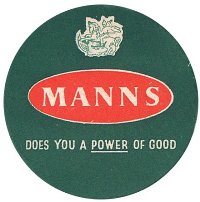
Mann’s beermat with the sort of slogan no longer permitted today.
Closed brewery Albion Brewery, Whitechapel Road E1 1BU (Tower Hamlets) First sold beer: by 1673, perhaps earlier Ceased brewing: 1979
An inn stood on the northwest corner of the junction of Whitechapel Road and Cambridge Heath Road since before 1654, with an attached brewhouse since at least 1673. It was known as the Blind Beggar after a legendary figure who supposedly begged on the site, featured in the popular ballad ‘The Blind Beggar of Bethnal Green’, known since the early 17th century. In the ballad, the beggar turns out secretly to be very rich, and in some versions is identified with Henry de Montfort, a young nobleman who was killed in 1265 during the Second Barons’ War. In these versions, Henry survived but was blinded and became a beggar.
This was long a busy and important junction on the old Roman road from London to Colchester, which becomes known as Mile End Road east of here, as the crossing was a mile (1.6 km) from Aldgate where the road left the City of London. During the 18th century the road was ‘turnpiked’ (improved by a trust which recouped its investment by imposing tolls on road users) and a toll gate installed at the junction.
In 1807, the Blind Beggar’s owner Richard Ivory enlarged and improved the brewhouse with the intention of leasing it to a third party, and in 1809 John Hoffman is listed as brewing at what was now known as the Albion Brewery. Hoffman got into financial difficulties and in 1819 the business was sold to Philip Blake and his junior partner James Mann.
Blake and Mann already owned a brewery, the Strand Bridge Brewery in College Street, Lambeth, on the riverside by Kings Arms Stairs, in what’s now Jubilee Gardens just north of the London Eye (SE1 7PB). This had been established around 1783 as a porter brewery by the Martineau family, and the firm was known as Martineau & Bland when it merged with Whitbread in 1812. Brewing ceased at the Lambeth site, but was revived when Blake and Mann bought it in 1816. Following their acquisition of the Albion, the partners concentrated their activities there, and closed the Lambeth site in 1821.
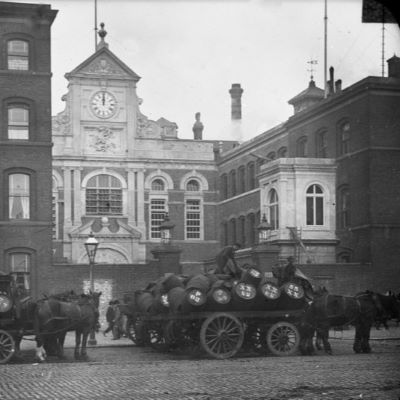
Mann’s Albion Brewery gates in the late 19th century.
Blake retired in 1826 and Mann ran the Albion on his own for 20 years. In 1846 he financed expansion by going into partnership with Robert Crossman and Thomas Paulin, both of whom had previously worked at what became the Stag brewery in Mortlake. The business was known as Mann Crossman & Paulin from 1847.
By 1850, the Albion was producing almost 100,000 hl a year, supplying 500 pubs, mainly with a porter known as Entire. The brewery was rebuilt in 1863 and expanded onto adjacent sites, including former almshouses and a workhouse, becoming the most advanced brewery of that time, with a capacity of 410,000 hl a year. Stables on the east side of Cambridge Heath Road included an automatic facility for filling 150 nosebags at a time with metal tubes from a store above.
Manns became one of the London breweries to add capacity in Burton upon Trent, opening a second Albion Brewery on the outskirts of the town at Shobnall in 1875. In 1898, by which time the firm was producing over 800,000 hl a year, the Burton site was sold to a local brewer, Marston’s, founded at the Horninglow Brewery in the town centre in 1834.
By the end of the 19th century, Manns was noted for its investment in bottled beer. Having outgrown the original bottling store on the former workhouse site, the brewery added a much larger bottling plant surmounted by a water tower a short distance away on the south side of Whitechapel Road, off Sidney Street. In 1892, it became one of the first brewers to capture carbon dioxide during fermentation, using it to carbonate bottled beers and selling it to other brewers for the same purpose.
In 1899, or possibly 1902, head brewer Thomas Wells Thorpe created a new style of bottled brown ale which was relatively low in alcohol (around 3.5%) and described at the time as ‘the sweetest beer in London’. In subsequent decades Manns Brown became the brewery’s best-known brand. Other noted bottled brands included Cream Label Stout and Rustic Ale, a pale ale.
In January 1911, the bottling plant played a role in the notorious Sidney Street Siege, an attempt by police to arrest two Latvian immigrants, assumed to be anarchists and alleged to have taken part in an attempted robbery at a Houndsditch jewellers the previous month in which three policemen had been shot dead. The two men were traced to a terraced house at 100 Sidney Street and a firefight ensued. An injured policeman was first taken to the Manns plant before going to the Royal London Hospital.
The army were called, and Winston Churchill, then responsible for the Metropolitan Police in his role of home secretary, attended. Army snipers took positions on the bottling plant’s water tower. For reasons never explained, a fire broke out inside the house but the police and Churchill stopped the fire brigade from attempting to extinguish it, and both suspects and a fireman died. The siege was sensationally reported in the media in terms of the supposed menace of foreign and likely Jewish anarchists and revolutionaries in the East End.
The company absorbed a number of other breweries in the 1920s and 1930s, including four in Greater London: Michell Goodman Young & Co of the Stamford Hill Brewery, Stoke Newington (founded by 1775, bought and closed 1919); Brandon’s Brewery, Putney (founded c1800, bought 1920, ceased brewing 1949 though continued in use for bottling for some time); Best’s Brewery, Clapham (founded by 1831, bought and closed 1924); and the Hornchurch Brewery Co (founded 1789, bought 1925, brewing ceased 1929).
Manns merged with Watney in 1958 to form Watney Mann, and was bought in turn by the Grand Metropolitan group in 1974, becoming Watney Mann Truman later that year. The Albion was closed in 1979, by which time it was making only bottled and keg beer, principally bottled Manns Brown.
Where are they now?
Watney transferred production of Manns Brown to its Stag brewery when it closed the Whitechapel site. When its parent Grand Metropolitan withdrew from brewing in 1991, the brand was sold to Refresh UK, a company set up by Watney managers who continued to brew it at another former subsidiary, Ushers of Trowbridge. This closed in 2000 and Refresh UK eventually became part of Marston’s, with Manns transferred to another of its brewing sites, Banks’s in Wolverhampton, where it remains in production today at 2.8% ABV, now part of the Carlsberg portfolio.
Brewing briefly returned to the vicinity in 2013 when a small kit was installed in the cellar of the White Hart pub, opposite the Blind Beggar on the northeast corner of the junction. It traded as One Mile End after its address. The brewery relocated to a larger site in Tottenham in 2016 and subsequently closed.
Things to see
The main gates and frontage, now Grade II-listed, still stand on Whitechapel Road, just short of the junction (333 Whitechapel Road E1 1BU), looking much as they did when the brewery was in operation. The decorative iron arch over the main gate still bears the name Mann, Crossman & Paulin, and the imposing yellow brick building behind is surmounted by a decorated pediment with a clock and flagpole. It was subsequently used as offices, though converted to flats around 1995.
The main brewery site behind this has been demolished, with much of it now occupied by a supermarket. Some of it was excavated and redeveloped again in the late 2010s and early 2020s during the construction of the Elizabeth Line through Whitechapel station, unexpectedly uncovering the brewery’s artesian well.
The Blind Beggar was rebuilt in 1894 and became notorious as the place where gangster Ronnie Kray murdered George Cornell in 1966. The building, still bearing its 1980s Watney branding, remains in use as a pub, though has a modern interior and is of no great beer interest.
Another attractive heritage building that once formed part of the site is the Brewery Engineer’s House, a little further east on the other side of the junction (27a Mile End Road E1 4TP). This is a flamboyant Edwardian neo-Baroque house built in 1905 and now Grade II-listed, though its unusual mansard and gable were added in the 1980s. The Grade I-listed 17th century Trinity Almshouses next door are unconnected to the brewery but nonetheless contribute to the interesting streetscape.
The famous stables were behind the Engineer’s House, accessed from around the corner in Cambridge Heath Road: the driveway is still there but the stables were badly bombed in the 1940s and demolished soon afterwards.
The bottling plant has also been demolished: the Silk District, an early 2020s mixed use development, now stands on the site. The besieged terrace in Sidney Street was replaced by social housing in the 1960s.
Marston’s still operates the Albion brewery in Burton, now as part of Carlsberg, and has been known to offer brewery tours (Shobnall Road, Burton upon Trent DE14 2BD). For many years the building housed the only remaining working traditional Burton Union fermentation sets in the UK. These were decommissioned early in 2024 though at least one of them is being moved to Thornbridge in Bakewell, Derbyshire.