A sample text widget
Etiam pulvinar consectetur dolor sed malesuada. Ut convallis
euismod dolor nec pretium. Nunc ut tristique massa.
Nam sodales mi vitae dolor ullamcorper et vulputate enim accumsan.
Morbi orci magna, tincidunt vitae molestie nec, molestie at mi. Nulla nulla lorem,
suscipit in posuere in, interdum non magna.
|
 Jester King Le Petit Prince Top Tastings 2012
ABV: 2.9%
Origin: Austin, Texas, USA
Website: jesterkingbrewery.com
It seems US craft beer drinkers, probably with some relief, are starting to realise there’s life below 5.5%. Session beer is one of the current buzz terms across the Atlantic, as brewers start to take up the challenge their British counterparts have long wrestled with – packing plenty of flavour and interest into the sort of gravity that won’t leave you with a headache.
Jester King, founded by brothers Jeff Stuffings and Michael Steffing in Texas hill country just outside Austin in 2010, is a noteworthy advocate for easy going beers inspired by traditional European models. It promotes itself as a farmhouse brewery, inspired by styles like Belgian saison and the bières de garde of French Flanders. But it’s rare among new craft breweries in also taking note of that often overlooked family of low gravity styles, the table beers.
Look on the edges of the beer section of any Belgian supermarket and you’ll find a small selection of low gravity (1.5%-3%) tafelbieren or bières de table, usually in 750ml screw cap bottles – Piedboeuf, from AB InBev’s Jupiler brewery, is the most common but several family owned independents are also active in the sector. Many of these beers are now bland and additive-laden, but they’re still an intriguing reminder of the days when beer was drunk throughout the day, and still thought suitable for serving to children.
Jester King’s Le Petit Prince, launched in 2011, is considerably better than a modern industrial table beer but shares something of the same aspiration to share a dining table with a simple lunch, and also offers, in the brewery’s words, “a clear, simple expression of the delightful interplay between noble hops and farmhouse yeast.”
Named after cult 1943 children’s book Le petit prince (The Little Prince) by Antoine de Saint-Exupéry, and perhaps in recollection of the family friendliness of table beer, the Texan example is brewed from organic Pilsner, two row pale and Caramunich barley malts, wheat malt and Czech Žatec and East Kent Goldings hops, perhaps with other varieties according to availability.
My sample was a cloudy blond with a good white head. A creamy, yeasty, slighty wheaty aroma had tempting notes of vanilla and spice. The attractively light and easy going palate was well balanced with a good cereal body and classic hop flavours. Though noticeably thin it was still fine enough. Light fruit from the hops came through on a chewy finish that yielded a distinct grassy noble hop hum.
I tasted the beer poured from a 750ml bottle at the Borefts Bierfestival at De Molen brewery in Bodegraven, the Netherlands, in September 2012, where it held its own impressively against a range of weird and wonderful brews at the sort of strengths you definitely wouldn’t want to serve to children.
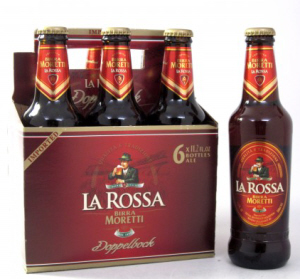 Heineken Italia Moretti La Rossa Top Tastings 2012
ABV: 7.2%
Origin: Milano, Lombardia, Italy
Website: birramoretti.com
Even before the current crop of craft brewers producing weird beers in designer bottles, Italy deserved at least a footnote in any survey of world brewing. Although more famous for its wines, there has long been a market on the peninsula for beer.
In the north Italy borders on the German speaking world: some of its territory was once under Austrian influence and communities of German speakers still exist. So unsurprisingly Italian brewers tended to follow German models when brewing took off as a major industry in the 19th century.
The big names still surviving from this period are now mainly owned by multinationals, but the occasional historic speciality has been retained. One such is La Rossa, which I’ve been looking out for since reading Michael Jackson’s writings about it – a beer with the colour of a Vienna lager but the strength of a Maibock.
It originated at the Moretti brewery, founded in Udine, in the far northeast not far from what’s now the Slovenian border, in 1859. Moretti became one of Italy’s big players, establishing its soft pale lager Birra Moretti as a national brand. The brewery was bought by Interbrew (now AB InBev) in 1989, then sold on to Heineken in 1996. The Dutch company had been active in the Italian market since 1974 when it bought the Dreher brewery in Trieste, originally an offshoot of the celebrated brewery of the same name in Wien, where Vienna lager had been perfected.
The plants in Udine and Trieste are long closed, as are several others Heineken took over, and it’s difficult to say exactly where La Rossa is now brewed. Heineken’s Italian production is allocated from a corporate headquarters in Milano between four breweries in Assemini (Sardinia), Comun Nuovo (Lombardia), Massafra (Apulia) and Pollein (Valle d’Aosta).
Nonetheless La Rossa, though filtered and pasteurised, is still a pretty good beer, as I discovered when I stumbled unexpectedly on it in the fridge at the Albion pub in London W14. This friendly pub is Good Beer Guide listed and a former local CAMRA pub of the year with a few well kept cask beers from Caledonian and Theakston – it happens to have a Heineken tie through the brewery’s ownership of Scottish & Newcastle. But it’s hardly a specialist beer haunt, and indeed the manager felt obliged to forewarn me about the beer’s strength before I bought it.
La Rossa’s rich reddish chestnut brown colour lives up to its name, with a thick foamy light beige head. A lightly nutty spiced toffee aroma has a very Germanic ring, with grassy noble hops and soft chocolate notes from the coloured malt.
The firm raisin and nut palate rapidly dries with notes of chocolate, minerally pencil lead and treacle toffee. The swallow is very smooth, setting up a dried fruit finish with an emerging hop bite and some roast.
Overall this is a big boned but smooth beer, spicy and complex enough to reward considered sipping, and surely one of the most interesting entrants in Heineken’s international portfolio of brands.
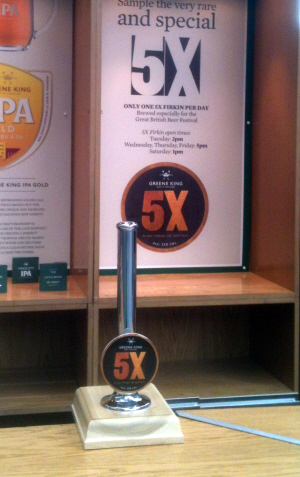 The unlikely handpump that lured the bloggerati — Greene King Old 5X on cask at the Great British Beer Festival, London, August 2012. Top Tastings 2012
ABV: 12%
Origin: Bury St Edmunds, Suffolk, England
Website: www.greeneking.co.uk
It has to be admitted that these days the Greene King bar is rarely the hottest place to be at a beer festival. Yet at the Great British Beer Festival (GBBF) at Olympia, London, in August 2012, that expectation was turned on its head.
At an appointed time in the early afternoon of the first day’s trade session, many of the most influential beer opinion formers in Britain could be found gathering around the Suffolk brewer’s bar – top beer writers, widely read bloggers, international beer judges and various other industry figures.
And no, they hadn’t all suddenly undergone a mysterious conversion to the delights of Greene King IPA. Instead they were there for the GBBF debut of one of the most extraordinary beers brewed by an old established British cask ale brewery. The beer was Old 5X, a unique matured stock ale that has miraculously survived in an era when its brewer has become the biggest of Britain’s “new nationals”.
I’ve written about Old 5X at length before on this blog – but this was before I had a chance to taste it neat, as until very recently it was only made publically available as a component of blends. At 12% it’s strong stuff, brewed with roasted malt and rich cane sugar, with Challenger, First Gold and Target hops, but what’s more remarkable is the process used to produce it.
Following primary fermentation it’s matured for at least a year in two old oak vats holding 100 barrels (16,366l) each, retained by the brewery for the purpose, before being blended with younger beer for release. For years it’s been mixed with Burton Pale Ale, another beer not allowed out on its own, to make bottled speciality Strong Suffolk, and more recently it’s emerged in Old Crafty Hen.
Long maturation and blending were once common in brewing – at a certain stage in its history, porter was a blend of wood matured beer which had become flat and vinous, or “stale” as it was once termed, with young “mild” or “running” beer. Inevitably, wild yeasts and other microflora resident in the wood contributed a certain character and complexity, and often a sour or funky note, to vatted beer.
Before such practices were revived in the more experimental corners of the contemporary craft beer world, Greene King was the only British brewery at which they clung on, though like so many quirky old techniques they could be encountered more readily in Belgium. West Flemish oud bruin, once an everyday quencher in its region of origin and now a prized speciality, is brewed in a similar way, and the huge oak foeders still in use at Rodenbach in Roeselare bear obvious resemblance to GK’s vats.
GK long resisted suggestions from beer lovers to make Old 5X more widely available in its own right, insisting that nobody would want to drink it – widely interpreted as yet another sign of how out of touch the Bury St Edmunds brewery was with the way the specialist beer market is developing, and perhaps how dedicated it had become to the pursuit of blandness in the name of palatability.
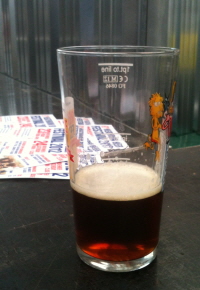 Cask Greene King Old 5X So what changed the brewery’s mind? Apparently a long serving local CAMRA volunteer was due to retire and head brewer John Bexon suggested creating a special beer for him at the East Anglian Beer Festival, held at Bury. Instead the volunteer requested a cask of Old 5X. Contrary to John’s expectations, the cask rapidly sold out, prompting the brewery to repeat the experiment.
The cask version at GBBF, available as a limited edition of one nine gallon firkin (41l) a day, was a year-old ale kräusened with fresh beer. Served by the third pint (197ml) nip, it poured a hazy rich reddish brown with a thick yellow head. The aroma was beautifully full, rich and very fresh with chocolate and orange peel notes, and just a hint of sourish balsamic vinegar.
The palate was sherry-sweet, nicely matured and, to me, utterly luxurious, again with just a slight funky sweet-sour touch, almonds and citrus. The big, orangey and nuttily malty finish wasn’t quite as long as expected, but amazingly rounded for the strength.
I spoke to John at GBBF and he still seemed bemused, though pleased, with the interest in the beer. Let’s hope it prompts further releases, and perhaps a special edition bottle conditioned version.
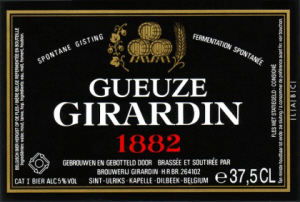 Gueuze Girardin 1882 (Zwart etiket) Top Tastings 2012
ABV: 5%
Origin: Sint-Ulriks-Kapelle, Vlaams-Brabant, Vlaanderen
Website: www.brouwerijgirardin.com
Girardin is arguably the most consistently and rootedly traditional of all the lambic breweries. The others were either founded since the self conscious revivalism of the 1970s or, like Cantillon, heavily influenced by it – or at the other extreme pursued the commercial path towards the fruit syrup bottle and the aspartame jar.
Instead what we have at Sint-Ulriks-Kapelle is something pretty close to the traditional independent farmhouse lambic brewery the Girardin family first took over in 1882 – the date that still appears on the bottles. The family remains in charge, still producing a simple and limited range: a filtered and unfiltered geuze, a faro, a kriek and a framboise.
Throughout, the brewery has also continued to make its unblended lambic widely available to pubs, geuzestekerijen (independent blenders) and other brewers. This policy alone has got many a revivalist out of a difficult spot, and in the process made a major contribution to the continued health of lambic culture.
Girardin’s unfiltered geuze doesn’t carry the recent Oude Gueuze appelation, though this is nonetheless what it is. Instead it’s identified by the black colour of the simple, classic label (zwart etiket or étiquette noire), as opposed to the white label of the filtered version. It’s the sort of beer that I don’t drink often enough, but I picked up a 375ml bottle at the London Drinker beer festival in March 2012 and reminded myself of how great it is.
This pale gold beer has a warm orange glow, topped by an unusually persistent fine white head. The characteristic pippy, funky lambic aroma has fruit and citrus peel, with hints of mastic.
The fine and very well integrated palate yields grapefruit pith and lemon marmalade, with slight sweetness offsetting a thick, petrolly lambic smack. There are elusive herbal notes on an apple core and marmalade finish.
Tim Webb, the leading writer on Belgian beer, says he uses this geuze to demonstrate to the unitiated what lambic is all about. You can see why – the beer is properly, authentically tart, but not severely so, and an excellent example of its kind.
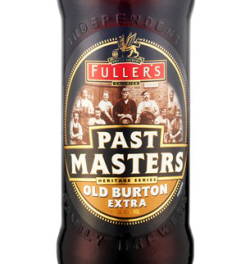 Fuller’s Past Masters Old Burton Extra Top Tastings 2012
ABV: 7.3%
Origin: London W4, England
Website: www.fullers.co.uk
Burton Ale is one of the great near-lost beer styles, and one that has intrigued certain beer writers (including myself) thanks in part to its difficult to explain contemporary obscurity. Most beer enthusiasts who read the occasional book or blog can tell you a (not necessarily accurate) thing or two about the history of porter or India pale ale, and if you mention Burton will probably assume the latter.
But in fact Burton ale was a distinctive style on its own account, different from pale ale. Although it originated or was perfected in the great brewing centre of Burton upon Trent, Staffordshire, in the days before the regulation of designations of origin it became a generic term for beers in the style wherever they were brewed. And it remained widely consumed right into the 1950s as what beer historian Martyn Cornell describes as “one of the three most popular draught beer styles in Britain” – by then more appreciated in London than in its Midlands homeland.
Burton was a dark, sweetish beer already around before pale ale took off in the town, originally made from brown malt in the days before pale malts became widespread and affordable. Like most beers it was later modified to fit the now ubiquitous practice of basing beer recipes on pale malt, with additions of coloured and speciality malts as required. It therefore became paler in colour, though still brown, giving rise to the confusing term Burton Pale Ale (BPA) – pale in comparison to the old brown malt version but still notably darker than the beers we now think of as pale ales.
Like porter, Burton was originally made in a variety of strengths, including very strong versions which at one point were widely exported, but by the time the first stages of the current beer revival kicked off in the 1970s, it had fallen from favour so comprehensively it was near-completely forgotten. It didn’t help that the few remaining Burtons to survive now hid under other names.
The most familiar is Young’s Winter Warmer, a cask London Burton of moderate strength renamed in 1971 and still regularly brewed today as a tasty seasonal by Wells & Young’s. A BPA is also one of the components of Greene King’s blended bottled speciality Strong Suffolk but hasn’t been sold in its own right for decades.
Only in the past few years has the history of Burton Ale been rediscovered, though revivalist experiments remain rare even among brewers who make a habit of such things. It was particularly exciting, then, when John Keeling announced he was dusting down a 1931 Burton recipe for the third entry in Fuller’s Past Masters series of revived beers from the archive.
Old Burton Extra is a relatively strong version of the style at 7.2%, made from pale and crystal barley malts boosted by maize and brewing syrup. The hops are a traditional combination of English Fuggles and Goldings used both in the copper and to dry hop the beer.
The result is a rich deep Burgundy brown with a thick yellow beige head. There’s sultana and chocolate on a rich, smooth, malty and slightly spicy aroma with honey, black grape and a subtle hint of violet.
A thick, cakey and very fruity palate dries rapidly, revealing roasted notes over a treacle base with spicy orange around the edges. A charred dry finish has an almost iron-like quality, with more chocolate, cake and spice.
Given its historical interest, I was particularly eager to try this beer when the taster sample arrived from the brewery, and I wasn’t’ disappointed. A wonderfully rich bottleful that’s also beautifully poised, this is a very welcome revival, and if it contributes to the growth of interest in the style, all the better.
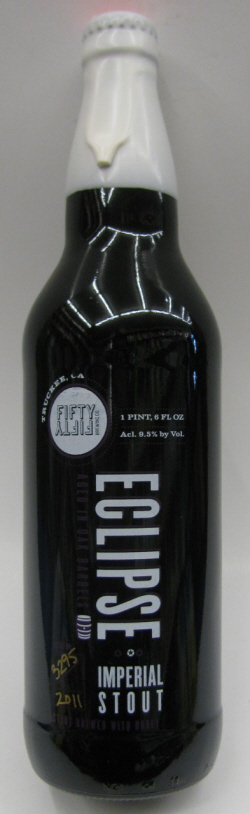 FiftyFifty Eclipse Imperial Stout 2011, white wax version Top Tastings 2012
ABV: 9.5%
Origin: Truckee, California, USA
Website: www.fiftyfiftybrewing.com
Craft brewers, particularly in the United States, are increasingly recognising the potential for “event beers” and limited editions in capturing the growing market of beer connoisseurs prepared to pay over the odds for something a bit rare and special. There’s an obvious temptation towards cynical exploitation in this, resisted so long as the quality of the contents lives up to the hype and the restricted supply.
Based on a recent tasting, one brewery reliably ensuring that all the fuss – and the cash – is worthwhile is FiftyFifty at Truckee, not far from the state line in Nevada County, northeast California. FiftyFifty is also a brewpub and restaurant producing a range of beers from the sessionable to the challenging but is best known beyond its own locale for the Eclipse range of barrel aged imperial stouts.
Brewer Todd Ashman was one of the earliest US champions of barrel ageing at his previous brewery, Flossmoor Station in Illinois, and was instrumental in persuading the Brewers Association to recognise such beers as a competition category in their own right in the early 2000s.
His first experiments in ageing FiftyFifty’s award winning Totality Imperial Stout to create Eclipse were in 2007 and since then approaching 30 different expressions have emerged.
Totality is already a complex brew, with more than 18 separate ingredients. The grain bill alone contains various pale, coloured, Munich, chocolate, brown and black malts from Crisp, Gambrinus, Rahr and Simpsons, red wheat malt and roasted barley, plus dry malt extract, brown rice syrup solids and exotic sugars. Besides this, the hops seem relatively straightforward – German Magnum and Perle and US Mount Hood.
The stout is brewed and conditioned in March or April and put into barrels in May, with bottling and kegging taking place in November for a December release. To add to the mystique, beers from different barrels are packaged in identical 650ml bomber bottles, but sealed with different coloured wax to indicate their provenance, with a key on the brewery website.
Healthy Spirits in San Francisco’s Dubose Triangle is a regular outlet and I found several 2011 vintages on sale there in October 2012 – I was particularly recommended the white wax version, which had spent six months in Elijah Craig 20-year-old bourbon barrels (that particular whiskey is not regularly released as a 20-year-old so this particular barrel was itself a rarity).
This was a very dark mahogany coloured beer that left oily yellow iodine-like traces on the glass, with a deep tan foam. A smooth and inky aroma had raisin and berry fruit, dark malt and woody whisky fumes.
There was plenty of fruity, oily sweet bourbon-tinged malt on the full, smooth, lightly honeyed palate, which warmed and dried out in the mouth with woody tannins softened by raisins and chocolate.
The sweet black coffee finish was very long with delicate wood notes and late cigar ash. Overall, this was an amazingly complex but well integrated, long lasting and delightful beer that amply evidenced the care spent on it.
At $28.99 (£19, €22.30) the price might seem steep, but as always it’s worth remembering what you’d expect to pay for a wine of such quality.
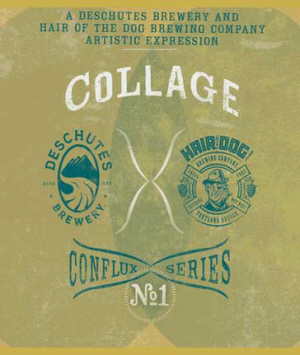 Deschutes / Hair of the Dog Conflux No 1 — Collage Top Tastings 2012
ABV: 11.6%
Origin: Bend, Oregon, USA
Website: www.deschutesbrewery.com, www.hairofthedog.com
Two of the best known and highest achieving craft breweries in the general vicinity of Portland, Oregon, got together to produce this long anticipated collaboration beer. Over two years in the making, it became the first of the new Conflux series of collaborations overseen by Deschutes, now one of the US’s bigger craft breweries.
The Bend-based brewery’s bread and butter is the easy going pale ale Mirror Pond, one of the top ten best selling craft beers in the US, but it retains credibility among the cognoscenti with a highly rated range of specials, experimental and extreme beers. Among the most celebrated are The Dissident, a hyped-up take on a Flemish oud bruin infused with brettanomyces and matured in wine barrels, and The Stoic, a strong but conventionally fermented abbey-style beer with pomegranate that’s also barrel matured.
Hair of the Dog in Portland is smaller and more specialised, admired for strong and curious hybrids and obscure historical revivals created by brewer Alan Sprints, who founded the company in 1993. Alan’s first beer was Adam, a recreation of a defunct beer style from Dortmund rediscovered by local beer writer and historian Fred Eckhardt, whom Alan then honoured with a distinctive Belgian-inflected barley wine named Fred.
In Spring 2012, Alan got together with Deschutes founder Gary Fish to brew special batches of all four beers at the latter’s brewery in Bend. These were then aged for two years in a wide variety of different casks – refill rye whiskey, cognac, sherry, pinot noir, bourbon and new American and Oregon oak – to produce around 100 distinct beers which were then used to create a final blend. The limited edition of only 200 barrels (235hl) was released in May 2012.
I have to admit to a growing cynicism about well-publicised collaborations that seem designed primarily to push obsessive beer geeks’ buttons, but my admiration for both breweries overcame this when I saw the beer listed at upmarket San Francisco beer restaurant the Abbot’s Cellar in October. Unusually, the restaurant serves selected bottled beers by the glass in small measures, providing the opportunity for solo diners to try rare and strong stuff without the financial and hepatic challenge of buying a whole big bottle.
The beer poured a deep plum-brown colour with a light swirl of off-white head with a fine, light carbonation. An intense but refined aroma had black cherry and marzipan, with some wood and toffee notes.
The palate was delightfully smooth, rich and complex with dark chewy fruit, chocolate, wood, gravy and complex spice that reminded me of Zinfandel grapes. Wafts of alcoholic spirit, tantalisingly light sourness and funky brett flavours added to the mix.
A dark and sappy finish had plenty of fruit and moist tobacco tones, with spiced orange and more oaky wood. The beer earned its high price by sticking around for a long time, developing comforting alcoholic warmth without burning.
Overall, this distinguished and sophisticated beer more than lived up to its fanfare – a worthy demonstration of great brewers’ meeting of minds.
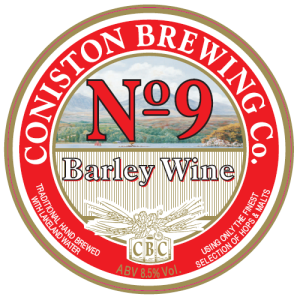 Coniston No 9 Barley Wine Top Tastings 2012
ABV: 8.5%
Origin: Coniston, Cumbria, England
Website: www.conistonbrewery.com
The results of CAMRA’s annual Champion Beer of Britain competition regularly provoke dark mutterings. Usually I hear them from trendy young hopheads convinced that the judging panel favours supposedly boring traditional low gravity styles but this year it was the turn of the old guard.
“What’s the point of picking an 8.5% beer that none of my customers are going to touch?” said a veteran pub landlord to me soon after the 2012 results were announced at the Great British Beer Festival trade session. Well, other than the obvious point that the UK’s best known national beer competition isn’t staged purely for the benefit of that particular gentleman and his customers, there’s something to be said for consumer education. And if encouraging the country’s supposed millions of nothing-over-4.5% session drinkers to experiment with something that can’t be necked down in seconds is a worthwhile aspiration, then Coniston No 9 is a good place to start.
I sampled the beer in January 2012 at the National Winter Ales Festival in Manchester, where it claimed a relatively modest third place in the Champion Winter Beer of Britain judging, qualifying it for consideration alongside the other category medallists as a potential overall champion in August. In Manchester I was also finally introduced to Coniston’s owner and head brewer Ian Bradley, another of those great enthusiasts so prevalent in the industry.
Set up in 1995 when Ian’s father decided the family’s pub, the Black Bull at Coniston in the English Lake District, would benefit from own brewed beer, the brewery rapidly won accolades, It first claimed Champion Beer of Britain in 1998 for its beautifully balanced and easy going golden bitter Bluebird. A bottle conditioned contract brewed version soon enjoyed national distribution.
No 9 is so called as it was the ninth beer Coniston brewed and like many of the others it was designed in collaboration with busy brewing consultant David Smith. It uses only English ingredients – pale and crystal malts and Challenger and Goldings hops.
The beer is brewed in small runs on an occasional basis and matured at the brewery for three months before being kräusened with fresh Bluebird to reawaken the yeast. Most then goes for bottling – originally the bottled beer was filtered but short run bottle conditioning is now taking place – and a little into casks.
It was the cask version that won the beer its 2012 medals. The sample I tried in Manchester was amber gold, with a very slight head and a rich aroma of toffee, orange and a whiff of spirit. A very full and sweetish orange-tinged palate had wood, mint and sherry notes from maturation and a haze of hops far back.
The very long, smooth and subtle finish warmed the mouth with woody vanilla notes and emerging grapefruit and orange peel bitterness, with plenty of fruity interest. Overall this was a traditional take on the style – very much like a strong bitter – but beautifully integrated and highly accomplished.
Ian later sent me a (filtered) bottle which if anything was even better. This version had a livelier condition with a fine bubbly white head, and notes of wood, sultana and marzipan in the sweetish aroma.
Orange was evident once again on a sweet but smooth and fine palate, alongside sherryish alcohol, salted nuts, herbal hops and gently building warmth. A long, lightly sweet and still smooth finish developed a big rooty hop flourish.
Ian, also a keen motorcyclist and motorsport fan who knows a bit about winning and losing, had been heard remarking rather ruefully in recent years that he’d “peaked early” as a brewer with his 1998 win. So walking off with a second well deserved gold medal 14 years later must have been an unexpected pleasure.
Meanwhile, the nothing-over-4.5% brigade don’t know what they’re missing.
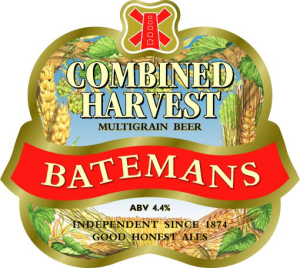 Batemans Combined Harvest Multigrain Beer Top Tastings 2012
ABV: 4.4%
Origin: Wainfleet, Lincolnshire, England
Website: www.bateman.co.uk
Under its picturesque disused windmill, Batemans has proved one of England’s more enduring and adaptable independent breweries since half the Bateman family took the leap of faith necessary to buy out the other half and keep the brewery open back in the 1980s. Sales of solid traditional cask bitters like XB and XXXB may be declining, but the brewery has compensated by introducing new styles and specials, both in cask and in attractively packaged bottles for supermarkets and export.
Combined Harvest is once such novelty. Head brewer Martin Cullimore set out specifically to experiment with several different brewing grains when he created it for the bottled market in 2001, including malted oats, rye and wheat in the grist as well as barley.
The bottled beer proved a notable success, winning a gold medal at the International Beer and Cider Awards in 2002 and being selected for inclusion in the book 1001 Beers You Must Try Before You Die. A cask version now appears as an occasional special, at a lower gravity (the bottled beer is 4.7%) and with a single hop, Challenger, at a modest IBU rating of 32.
It was the cask version that proved to be one of my pleasant beer surprises of the year when I happened upon it in top condition at a suburban Wetherspoon – a truly unusual and very complex beer that’s packed with flavour for a modest gravity.
The pale copper beer had a bubbly yellowish head and a very alluring aroma with fruit, slightly oily spice and malty cinder toffee. The palate was very full and complex with grainy rye bread notes, a touch of roast and vivid citrus hints emerging, the combination of grains yielding an intriguing mix of spicy dryness and firm sweetish malt.
A very smooth and nutty swallow was followed by a subtle and gentle but tasty and notably lasting finish, with orchard fruit and a gentle hop burr building to a light bitter bite.
You can read more about the brewery in a useful and relatively recent writeup by Roger Protz.
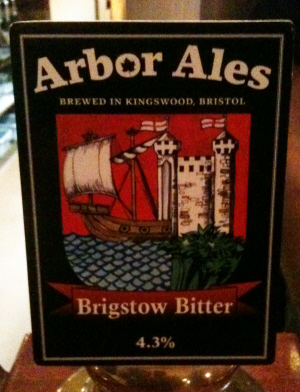 Arbor Ales Brigstow Bitter. Pic: Wonker – Creative Commons Top Tastings 2012
ABV: 4.3%
Origin: Bristol, England
Website: arborales.co.uk
Bristol is one of Britain’s more exciting beer cities at the moment, with some outstanding pubs, a small but growing cluster of decent small breweries and a flourishing homebrew scene. Besides Bath Ales, actually now much closer to Bristol than Bath and a well established and successful micro with a small estate of well regarded pubs, the two names that most excite contemporary beer drinkers are Arbor Ales and the Bristol Beer Company.
I’ve enjoyed some excellent and innovative beers from both brewers but it was Arbor that particularly stood out for me when I found myself in the city in September 2012 as a judge in the UK National Homebrew Competition. The night before I spent some time in Arbor’s pleasant brewery tap, the Three Tuns, where unsurprisingly I bumped into a few of my fellow judges.
Arbor was founded in 2007 by brewer Jon Corner with Megan Oliver in a small space behind the Old Tavern in Stapleton, northeast Bristol. A year later that pub closed and the brewery upgraded to a 10hl kit on an industrial estate in Kingswood, moving again early in 2012 to inner city Upper Easton.
Jon is known for his contemporary hoppy pale ales and ‘Freestyle Fridays’ rarities but the beer that most impressed me was the brewery’s take on a traditional English brown bitter, Brigstow. It’s made with exclusively English hops – Challenger for bitterness and substantial amounts of Fuggles and East Kent Goldings – with crystal malt and caramalt giving a firm backbone.
My pint from the cask at the Three Tuns was a warm amber colour with an orangey-beige head and a smooth, very chaffy and classic aroma with leafy hops. The palate, too, had that chaffy cereal and hopsack character, with clean malt, distinctive autumn fruit and orange notes, honey and bittering citrus.
A spicy swallow set up a hop-dominated finish with a solid grainy backdrop, with pithy grapefruit bitterness and earthy vegetal notes balanced by honey and biscuit.
Much as I’m delighted at the spirit of adventure sweeping many of the newer British microbreweries, it’s also reassuring to know that the future of the more traditional easy drinking styles of ale is in good hands.
|
|
