Promoting an international beer culture that recognises and celebrates beers of quality, distinctiveness and local character, brewed with care and passion.
Etiam pulvinar consectetur dolor sed malesuada. Ut convallis
euismod dolor nec pretium. Nunc ut tristique massa.
Nam sodales mi vitae dolor ullamcorper et vulputate enim accumsan.
Morbi orci magna, tincidunt vitae molestie nec, molestie at mi. Nulla nulla lorem,
suscipit in posuere in, interdum non magna.
Includes information for The Botanist and The Lamb (closed brewpubs).
Brewhouse and Kitchen, London N1
Brewpubs, some no longer brewing brewhouseandkitchen.com Highbury: 2a Corsica Street N5 1JJ (Islington) First sold beer: 22 June 2015
Hoxton: 397 Geffrye Street E2 8HZ (Hackney) First sold beer: December 2018 Ceased brewing: by January 2025
Islington: Torrens Street EC1V 1NG (Islington) First sold beer: October 2014 Ceased brewing: September 2022
Entrepreneur Kris Gumbrell’s Convivial pub chain ventured into brewing from 2011 with the Botanist on Kew Green (3 Kew Green, Richmond TW9 3AA, first sold beer September 2011) and later the Lamb in Chiswick (9 Barley Mow Passage W4 4PH, first sold beer September 2012). By December 2013, Convivial had been sold to Mitchells & Butlers and brewing ceased at both sites, but inspired by the experience, Kris went on to conceive an entire chain of brewpubs, Brewhouse and Kitchen, in partnership with former M&B executive Simon Bunn.
The first Brewhouse and Kitchen opened around the corner from Angel station in October 2014, with South African-born Pete Hughes, later the head brewer for the whole group, in charge of the former Botanist 4 hl brewhouse. The facilities here were later upgraded to a new 5 hl copper kit, with the original donated to Ignition brewery.
A second branch, with the 8 hl kit from the Lamb, opened in a former tramshed just off Highbury Corner the following year. After some years, a third London branch opened next door to Hoxton station in July 2018, in a former cocktail bar occupying three arches of the London Overground viaduct, one containing a new 4 hl copper brewhouse which wasn’t active until a few months later. There are also now around 20 branches in other parts of the UK.
The original Islington branch closed ‘temporarily’ in September 2022 for ‘refurbishment’ — in fact a radical rebuilding of the whole site to create a new development known as Angel Square, with provision for a new Brewhouse and Kitchen in the completed buildings.
Originally all branches brewed beer for cask, keg and minicask, mainly sold on their own sites under names with local themes, though with some sharing of supplies between sites. The exact recipes varied from site to site, within a common template. Some branches, including Highbury, dispensed some lines direct from conditioning tanks.
But in November 2024 the company announced it was removing the brewhouses from some of its sites, which would become ‘craft houses’, retaining their emphasis on beer but supplied from other sites. The brands have consequently become more generic, and it’s likely the chain will eventually move towards a model of supplying all its outlets from a single production brewery, likely outside London.
Brewing ceased at Hoxton in early 2025, with the bar renamed the Hoxton Hound that spring: the equipment is due to be removed and the space converted to seating. Though the Islington site is due to open by the end of 2025, it’s understood there are no plans to revive brewing. This leaves Highbury as the only London site still brewing.
Closed brewery Original site: 66 Southwark Bridge Road SE1 0AS (Southwark, since closed) Second site, later pilot brewery: 79 Enid Street SE16 3RA (Southwark, since closed) Barrel Store: 1 Bellenden Business Park SE15 4RF (Southwark, since closed) Production brewery: South Warehouse, Greenwich Beach, Morden Wharf Road SE10 0PA (Greenwich) bbno.co First sold beer (at original site): 12 December 2012 Brewing ceased: Early March 2024
Brew by Numbers, or BBNo as it was later branded, was started on a very small scale by Tom Hutchings and Dave Seymour. They met each other while rock climbing in southeast Asia and became close friends with both the Kernel and Partizan in the early days of those breweries. Homebrewing began in the basement of a house a friend was renovating near Bankside, using a 50 l kit. The duo kept track of their experiments with a numbering system, the origin of the name and the later beer designations. Following positive feedback, in summer 2012, they upgraded the equipment and were selling bottled beer by the end of the year.
BBNo became the third Bermondsey brewery in May 2013 when it moved into an arch at 79 Enid Street, around the corner from the original Kernel site, with an 18 hl kit hand-built from recycled stainless steel vessels. The expansion was partly thanks to investment from BrewDog, which later sold its shares back at cost price.
The brewery then expanded several times, leasing a second arch a few doors northwest, with a new bottling line, cold store, barrel vault and taproom in action by summer 2015. Various improvements including the addition of a canning line increased production to around 5,000 hl a year in 2019, by which time Dave had stepped back from day-to-day involvement, leaving Tom to lead the project.
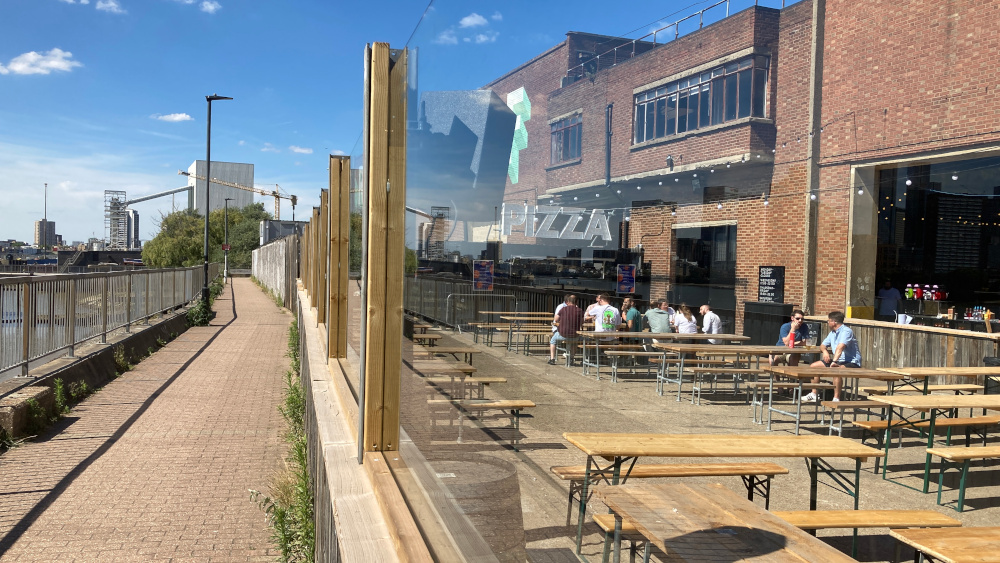
Numbers-on-Thames: BBNo’s Morden Wharf site at Greenwich Beach SE10.
A second arch-based site in Peckham opened in January 2019. Known as the Barrel Store, this was primarily a barrel-ageing facility and satellite taproom, though it was equipped later in the year with a small brewhouse used intermittently to make small runs for ageing. The site was closed in autumn 2021.
Following a crowdfunding campaign, BBNo undertook a major expansion in 2021 to a much bigger site beside the river Thames, a former glucose refinery dating from late Victorian times in the redevelopment area of Morden Wharf on the west side of the Greenwich peninsula. This was open to the public from September when it hosted a riverside beer festival, and beer from the 50 hl brewhouse was flowing by November.
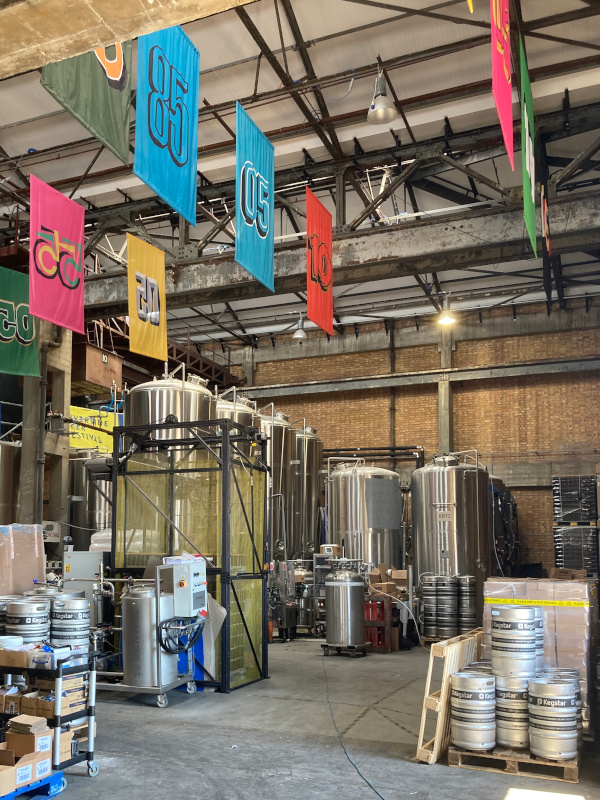
BBNo’s Morden Wharf brewhouse, London SE10.
BBNo retained its presence in Bermondsey but vacated Arch 75 in January 2022, continuing with a taproom at Arch 79. This was equipped with a 1.5 hl pilot brewery previously belonging to Josh Mellor (see Mellor’s), and was used to brew specials for the taproom.
Due to licensing problems, brewing at the Bermondsey arch ceased and the kit was removed in March 2023. The arch continued for a short time as a taproom but closed completely in early May 2023, with the brewery announcing it was concentrating activities in Greenwich ‘due to the combined COVID-19 debt burden and the recent cost of living crisis’, while undergoing financial restructuring and seeking new investors.
BBNo entered administration as a going concern in June, originally in the expectation that it would be bought out by a group of friendly investors. But on 24 August private equity company the BREAL group confirmed it had acquired the company, adding a third brewery to its portfolio after its well-publicised acquistion of Black Sheep in Masham, North Yorkshire, and Brick in London. BREAL closed the latter late in 2023, relocating its kit to Masham.
Initially the BBNo taproom remained open and no staff were laid off. But on 5 November the taproom closed at short notice ‘for the winter season’. Following much speculation, a news report on 12 February 2024 confirmed that though brewing continued for a short time under an ex-Brick brewer to build up a stock of both BBNo and Brick beers, the kit was to be moved ‘in three weeks time’ to Masham where a new brewhouse is being created for both brands, with the Greenwich site subsequently vacated. In future some brewing may also take place at Purity in Alcester, Warwickshire, which BREAL bought in January 2024.
In late February 2024, BREAL renamed itself the Keystone Brewing Group.
Beers were almost entirely in keg and can and follow a numbering system: originally there was a two digit number indicating a broad style and another designating a specific recipe, though today only the first number is used. They were in a wide range of styles with varying recipes: by April 2021, BBNo had produced around 400 different beers. It’s unclear which recipes Breal will retain.
Brewpub, no longer brewing 63 Lambs Conduit Street WC1N 3NB First sold beer: August 2014 Ceased brewing: October 2015
Bloomsbury began as a small brewery in the cellar of the Perseverance pub, an ex-Charrington free house at the above address, installed by then-owner Pete Millington. It brewed only occasionally with beers intermittently available in the pub, and despite plans to ramp up production, operations ceased when the business was closed and sold in October 2015. The pub subsequently enjoyed mixed fortunes, reopening and closing again, until it was bought and reopened by Market Taverns, owners of the famous Market Porter in Borough Market and several other London pubs, in July 2018, though brewing hasn’t been restored. A Bloomsbury brand has subsequently appeared on unrelated beers commissioned for the Bloomsbury Leisure/Pivovar group of pubs and bars.
Big Smoke Brew Co, Kingston upon Thames (London) KT6
Brewpub, now brewing outside London 87 Maple Road, Surbiton KT6 4AW (Kingston upon Thames) wbigsmokebrew.co.uk First sold beer: September 2014 Ceased brewing in London: March 2019
Ash Zobell and the aptly named Pete Brew reinvented Twickenham’s Sussex Arms as a top class beer outlet in 2010. Pete and the pub’s assistant manager Nick Blake brewed experimentally on a non-commercial basis in the back garden.
In 2014, the trio spearheaded a similar makeover of the Antelope in Surbiton, this time as a brewpub, for the same pub group as the Sussex Arms. The brewery, known as Big Smoke and overseen by Nick and Pete, operated from a converted stable block at the rear of the pub, with an 8 hl brewhouse from Pallet Brew in Horwich, expanding capacity significantly with additional fermenters in May 2016.
A wide range of beers was sold in cask, keg and bottle conditioned, with all production unfiltered, unfined and vegan-friendly. Though the brewery was primarily started to supply the pub and others in the group, the beers increasingly found their way elsewhere.
Pete and Ash left to set up the Black Dog pub in Brentford, opened in 2018 and with its own brewery, Fearless Nomad, from January 2020. Both pub and brewery are completely independent of Big Smoke.
Demand for Big Smoke beers continued to rise, necessitating some contract brewing elsewhere, and in March 2019 the brewery, still with Nick as head brewer, relocated to a much bigger site on an industrial estate in Esher, Surrey, with a new Gravity Systems 33 hl brewhouse and a canning line. Although only 6 km from the original location, this is outside Greater London, so Big Smoke has technically left the Big Smoke and therefore my area of coverage. Its previous home has been converted into an “indoor outdoor” patio for the Antelope, and the beers are still stocked here and in other pubs in the group.
Brewery 18 Manford Industrial Estate, Manor Road, Erith DA8 2AJ (Bexley) bexleybrewery.co.uk First sold beer: 25 September 2014
This operation on an industrial estate beside the river Thames, by Crayford Marshes on the edge of Erith, is the first standalone brewery in Bexley since Reffell’s was closed by Courage in 1956. It’s a family business run by former IT manager Cliff Murphy, his wife Jane, once a teacher, and their son Cameron. The local focus is evident from its mascot, a ring-necked parakeet: there are now feral colonies of these exotic birds all over London but they were first noted in Bexley.
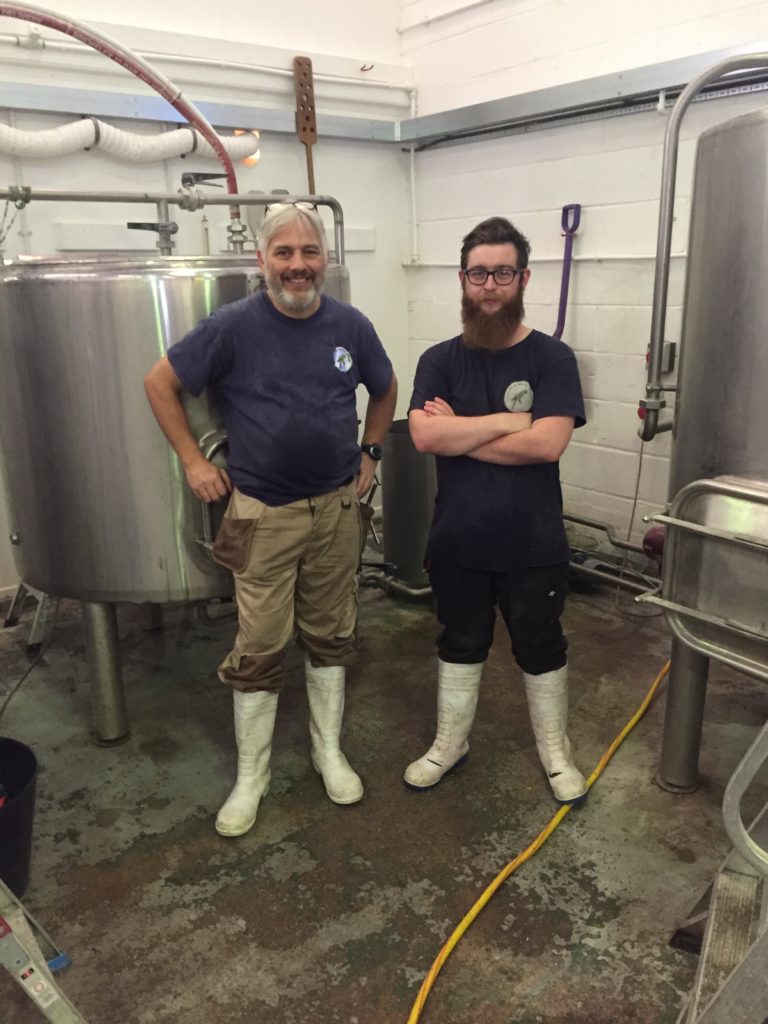
Bexley co-founder Cliff Murphy (left) with brewer Tom.
The 10 hl brewhouse was bought new from Brewing Vessels in Stockport. Fermentation capacity has been increased though there’s room for more: the unit is currently much less cramped than many London breweries, and was the smallest suitable and affordable space the founders could find.
The industrial location isn’t particularly favourable to a taproom, especially as the estate gates close at night, though the brewery has long held occasional open days and in 2021 began opening regularly on Saturday daytimes. The Murphys had always planned a micropub as part of the business and in April 2018 opened one in Barnehurst, the Bird and Barrel (100 Barnehurst Road, Barnehurst DA7 6HG), which stocks a comprehensive range of the beers.
Beers are in cask – still accounting for 80% of sales – with some keg and bottle-conditioned. All bittering hops are from Hukins in Tenterden, Kent, though some aroma hops are imported.
For some years Bexley was host to a fermenter belonging to Brixton brewery Clarkshaws but this arrangement had ceased by 2021.
Brewery 36 Jaggard Way (taproom 44 Jaggard Way) SW12 8SG (Wandsworth) bellevillebrewing.co.uk First sold beer: 30 March 2013
Musician Adrian Thomas was prompted to become a homebrewer when he organised a beer festival as a fundraiser for his son’s school, Belleville Primary. He took things a stage further by getting together with nine other Belleville dads to set up a brewery on a small industrial estate on the other side of the railway from Wandsworth Common station.
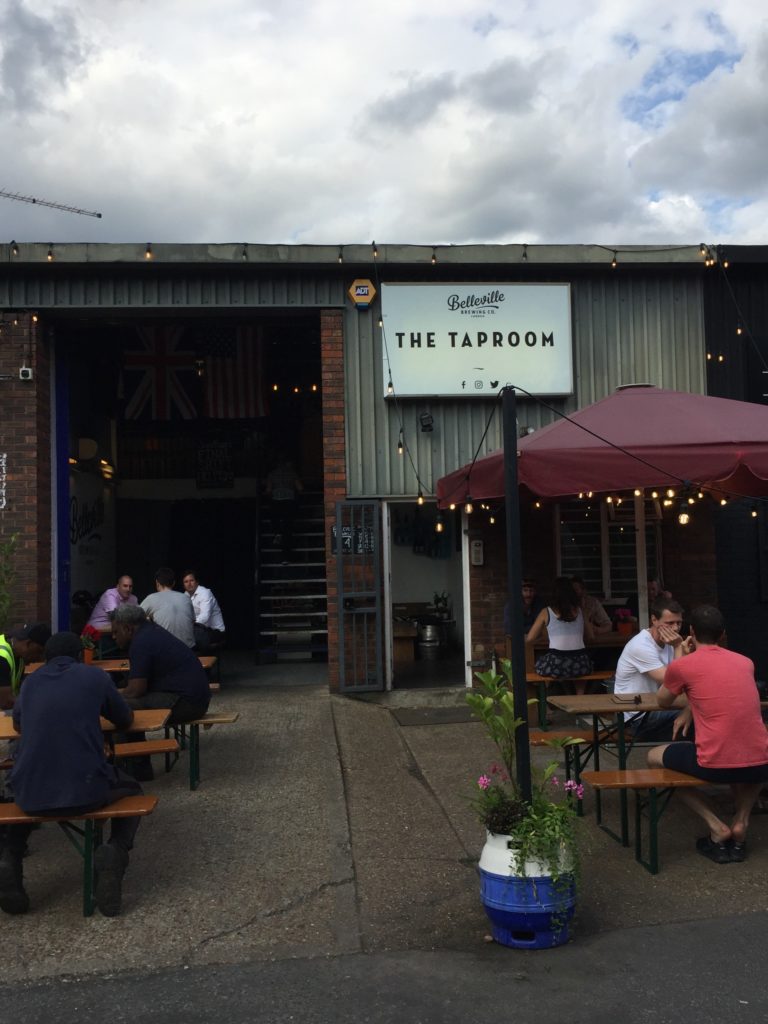
Belleville’s taproom.
It began with an 8 hl kit, selling mainly through local outlets. After successfully fighting off a misjudged legal threat from AB InBev in 2013, alleging infringement of its trademark for sweetened lambic Belle Vue, it expanded in the summer of 2016 with a new 24 hl brewhouse from American Beer Equipment in Lincoln, Nebraska, alongside a canning line. A taproom was opened a few doors down in January 2017.
Beers are mainly in keg and can, with a few casks for selected outlets. The US slant is acknowledged in the longstanding strapline “Beers from over there, brewed over here”.
Beavertown Brewery, London N17 and Enfield (London) EN3
Breweries and brewpub Original site: Duke’s, 33 Downham Road N1 5AA (Hackney) Second site: 4 Stour Road E3 2NT (Tower Hamlets), Tottenham site: 17 Lockwood Industrial Park, Mill Mead Road N17 9QP (Haringey) Former brewpub: Marketplace, Tottenham Hotspur Stadium, 782 High Road N17 0BX (Haringey) Production site: 102 East Duck Lees Lane, Enfield EN3 7SS (Enfield) beavertownbrewery.co.uk First sold beer: February 2012
Perhaps the most ambitious and restlessly expansive of new London breweries, Beavertown was founded by Logan Plant, son of Led Zeppelin singer Robert. It began with a US-style brewpub and barbecue restaurant, Dukes Brew and Que, with a 6.5 hl kit in a corner of the kitchen producing beers designed to match the food. The name was taken from the local pronunciation of De Beauvoir Town, the Hackney district where it was located. Demand for the beers steadily increased and the brewery installed extra fermentation capacity in a lock-up some distance away, transporting hopped wort by car.
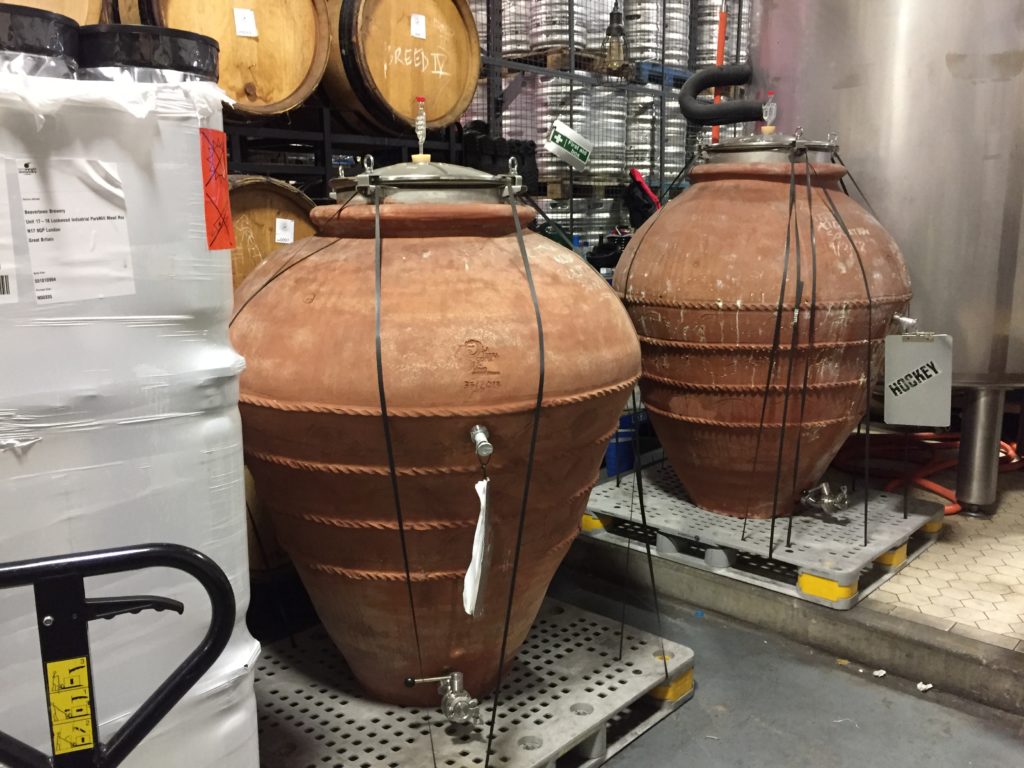
Ceramic amphorae with wooden barrels behind at Beavertown’s Tempus Project.
On 10 May 2013, brewing relocated to a bigger site in Hackney Wick next door to the new Truman’s brewery, with the same brewhouse as at Dukes but several more fermenters. Once again demand outstripped capacity and in April 2014, the business moved again to a much bigger site on an industrial estate near the Lee Valley Park at Tottenham Hale, with a new 50 hl kit fabricated in Bulgaria and an on-site taproom. A bottling line was soon ditched as Beavertown became one of the first breweries in the UK to popularise ‘craft’ beer in cans, providing a perfect canvas for the distinctive style of designer Nick Dwyer, a former waiter at Dukes who is now creative director.
Early in 2015, the fermenters expanded into another unit opposite, also home to the brewery’s Tempus side project, where beer is aged in a variety of wooden wine barrels, Belgian-style foeders and even ceramic amphorae, and the original Dukes brewhouse, now used as a pilot kit. In December 2017, Dukes was quietly closed as it was “no longer a natural fit for Beavertown’s future”: after a brief period as Beef and Brew, in October 2019 it was reopened under its original name the Duke of York by Barworks. By now even the Tottenham plant was bursting at the seams, with some beers contract-brewed in Belgium.
In June 2018, Beavertown announced it had sold a minority stake in the company, subsequently confirmed as 49.1%, to the Dutch-based multinational brewer Heineken. The investment financed yet another expansion to a site beside the River Lee Navigation near Ponders End, not far from Camden Town‘s production brewery. Opened in August 2020, this is the biggest purpose-built brewery in London for decades, with a potential output of 500,000 hl a year. It boasts a high-end 150 hl brewhouse from Krones in Germany, 38 fermentation and maturation tanks and new canning and kegging lines, the latter capable of handling 30,000 330 ml cans per hour. From 1886, the site housed the Edison Swan Electric Light Company, where the first electronic valves were developed: the factory later passed through several hands including Philips, AEI and Thorn, before closure and demolition in 1970.
Plans for the Enfield site originally included an extensive visitor centre and taproom with a waterfront terrace, and even a promise of a boat service linking with the Tottenham site. These plans were disrupted by the 2020-21 Covid-19 lockdowns, though the production brewery has been open to the public for special events during 2021.
A third brewery in the rebuilt Tottenham Hotspur stadium opened in April 2019, using a 35 hl German-built BrauKon kit and opened as a brewpub on match days. Brewing here was suspended early in 2023 and the equipment had been removed by early 2024.
The Corner Pin, a historic landmark pub opposite the stadium, reopened as a Beavertown outlet in September 2021. Following a long closure during the Covid-19 pandemic, the taproom at the Tottenham Hale site reopened in February 2022.
In September 2022, Heineken bought the remaining 50.9% of Beavertown it didn’t already own. Logan stepped down as chief executive but remained as an “adviser”.
In December 2023, in the middle of the busiest period of the year for hospitality venues, both the Corner Pin and the Tottenham Hale taproom were closed ‘temporarily…whilst we work on improving the experience’, with no reopening dates since announced. The registered office address was changed in May 2024 from Tottenham to Enfield, prompting rumours that the former site was being wound down. The Corner Pin has since reopened but is no longer run by the brewery.
Beers are in keg and can. Previously, Tempus beers were hand-bottled in distinctive 375 ml bottles, but these appear no longer to be available.
Brewpub, no longer brewing 92 Wood Street, Barnet EN5 4HY blackhorsebarnet.co.uk First sold beer: March 2013 Ceased brewing: November 2021
This sprawling Victorian pub just outside Barnet town centre was relaunched late in 2012 by Oak Taverns, a group that runs several brewpubs outside London. The 2.5 hl brewery, in an outhouse at the side, was supplied by Iceni in Norfolk, partly recycling vessels from the old Federation brewery in Newcastle. Brewing was started with some help from XT Brewing in Thame, which is linked to the group.
Longstanding brewer Nick Zivkovic regularly provided beers in broadly traditional styles, under both Barnet and Hadley brands. Thee were usually available only in the pub on cask, with very occasional hand bottlings.
Brewing ceased in November 2021 when Oak Taverns gave up the lease on the pub and management reverted to freeholders Heineken. The pub closed altogether in September 2025.
Brewery Original site: 18 Druid Street SE1 2HH (Southwark) Production site: 11 Valley Point Industrial Estate, Beddington Farm Road, Croydon CR0 4WP (Sutton) anspachandhobday.com First sold beer: February 2014
When childhood friends and former musicians Jack Hobday and Paul Anspach won a homebrew competition, one of the judges, TV presenter and wine writer, Oz Clarke, suggested they turn professional. They were further encouraged when a homebrew sneakily entered in a commercial competition won a medal. Tasting samples were available under the name Alements in summer 2012 but it wasn’t until March 2014 that Jack and Paul opened the fifth new brewery in Bermondsey, restoring brewing to Druid Street after the Kernel’s relocation.
The first brewhouse was a very small 1 hl installation from ES Stainless Applications, also used by Bullfinch in its early days as a cuckoo. This was replaced only a few months later with a 4 hl PBC kit, then a new 14 hl brewhouse from Willis European was installed in 2016, with the old one sold to Affinity.
With no room for further expansion in the arch, in early 2020 A&H relocated production to an industrial unit at Beddington near Croydon, just across from Signal. The existing brewhouse was relocated here and remained in use, though with much-increased fermentation capacity and a new canning line. There is a taproom on the site though currently it opens only for special events.
The original site has been retained as a bar and barrel vault with some fermentation capacity. In in November 2018 the brewery added a pub in Camberwell, the Pigeon, but this closed in August 2022.
Further expansion followed a new crowd-funding round in November 2021, with a new nitrokeg dry stout, London Black, launched as a London-brewed alternative to big brands. This has proved a major success and has rapidly become the brewery’s best seller.
Beers are mainly keg and canned, with some specials hand-bottled in 750 ml and a small but increasing amount of cask.
This really was an idle moment, prompted by a Twitter discussion about the meaning of various words for beer measures. Self-explanatory, I hope, and comments and suggestions very welcome.
l
ml
fl oz US
pt UK
fl oz UK
Measure
Use
0.029574
29.57353
1
0.052042
1.040843
1 US fl oz
Sample measure at Great American Beer Festival and other US beer festivals
0.1
100
3.381402
0.175975
3.519508
10 cl
Sample measure at Zythos beer festival (Belgium) and some other mainland European festivals
0.142065
142.0653
4.803799
0.25
5
1/4 Imp pint, gill
Archaic Imperial fluid measure, not legal for draught beer in UK
0.147868
147.8676
5
0.260211
5.204214
5 US fl oz
Small measure used for strong beers in US specialist bars
0.15
150
5.072103
0.263963
5.279262
15 cl
Sample measure at many Belgian and Dutch beer festivals
0.18942
189.4204
6.405066
0.333333
6.666667
1/3 Imp pint, nip
Smallest legal measure for draught beer in UK, historically also used for bottled strong beers
0.2
200
6.762805
0.351951
7.039017
20 cl, fluitje (NL), Stänge (Köln), Seven (Aus)
Smallest customary draught beer measure in Germany, Netherlands, Australia, other countries
0.236588
236.5882
8
0.416337
8.326743
1/2 US pint, cup
Small customary draught beer measure in US
0.25
250
8.453506
0.439939
8.798771
25 cl, 1/4 litre, pintje (NL/BE)
Usual measure for everyday draught beer in Netherlands, Belgium and some other countries, also for everyday bottled beer in Belgium
0.284131
284.1306
9.607599
0.5
10
1/2 Imp pint
Most common small measure for draught beer in UK, legal measure including multiples, occasionally used for bottles, also found in Ireland, formerly for cans in Canada
0.285
285
9.636996
0.50153
10.0306
Middy, half (Aus)
Standardised Australian metric equivalent of Imp half-pint for draught beer
0.3
300
10.14421
0.527926
10.55852
30 cl
Typical bottle size for everyday bottled beer in Netherlands, common draught measure in some countries including New Zealand
0.33
330
11.15863
0.580719
11.61438
33 cl, 33’er (NL/BE), ≈ 1/3 litre
Usual measure for draught and packaged speciality beer in Belgium, NL, France, also common for packaged speciality beer in many other countries incl UK, Ireland
0.354882
354.8824
12
0.624506
12.49011
12 oz
Standard small beer bottle and can size in US and Canada, also sometimes used for draught measures
0.375
375
12.68026
0.659908
13.19816
37.5 cl, 1/2 wine bottle, stubby (Aus)
Small bottle size for Belgian lambic and other beers from Belgium and elsewhere in wired cork bottles; also standard small bottle size in Australia
0.378841
378.8408
12.81013
0.666667
13.33333
2/3 Imp pint, schooner (UK)
Recently legalised measure for draught beer in UK, often used for ‘craft’ beers
0.4
400
13.52561
0.703902
14.07803
40 cl
Canned and draught beer in France, also draught in Germany and elsewhere
0.425
425
14.37096
0.747896
14.95791
Schooner (Aus)
Common Australian draught beer measure
0.44
440
14.87817
0.774292
15.48584
44 cl
Mainstream canned beers in UK and some other countries, sometimes also used for craft beer
0.473176
473.1765
16
0.832674
16.65349
US pint
Customary draught measure in US, also used for some canned beers
0.5
500
16.90701
0.879877
17.59754
1/2 litre
Standard bottle size in Germany, Czech Republic, UK, Ireland, also used in many other places, customary draught measure in many parts of Germany, Austria, Czech Republic.
0.568261
568.2612
19.2152
1
20
Imp pint, chopine (Can)
Customary (and legal) draught measure in UK and Ireland, occasionally used for bottles, also sometimes used in US and Canada
0.57
570
19.27399
1.00306
20.0612
Pint (Aus)
Standardised Australian metric equivalent of Imp pint for draught beer
0.650618
650.6177
22
1.144927
22.89854
22 fl oz, bomber
Large bottle size common in US particularly among craft brewers, also can
0.75
750
25.36052
1.319816
26.39631
75 cl, 3/4 litre, wine bottle, long neck (Aus)
Large bottle size for many Belgian speciality beers and others from elsewhere, especially when in wired cork bottles; common large bottle size in Australia
0.946353
946.3529
32
1.665349
33.30697
Howler
Customary smaller measure for take-home draught beer in US and elsewhere
1
1000
33.81402
1.759754
35.19508
1 litre, Maß
Large draught measure in Germany and some other countries, particularly associated with München Oktoberfest, also for take-home draught beer and some packaged beer
1.136522
1136.522
38.43039
2
40
Quart, 2 Imp pt, pinte (Can)
Former common UK/Irish measure for draught and bottled beer, still used for takeaway “hopper” cartons, still customary measure in Canada
1.892706
1892.706
64
3.330697
66.61394
Growler
Customary measure for take-home draught beer in US and elsewhere
2
2000
67.62805
3.519508
70.39017
Metric growler
Common measure for take-home draught beer in Germany, also used in US and elsewhere
2.273045
2273.045
76.86079
4
80
1/2 Imp gallon
Relatively common size of container for takeaway draught beer in UK
3
3000
101.4421
5.279262
105.5852
Jeroboam
Large champagne-style bottle occasionally used for beer, especially in Belgium
3.785412
3785.412
128
6.661394
133.2279
US gallon
Large size container for takeaway draught beer in US and basis of other bulk measures
4.5
4500
152.1631
7.918894
158.3779
Rehoboam
Large champagne-style bottle occasionally used for beer, especially in Belgium
4.54609
4546.09
153.7216
8
160
Imp gallon
Large size container for takeaway draught beer in UK and basis of other bulk measures
5
5000
169.0701
8.798771
175.9754
Minikeg, minicask
Measure for pre-packaged take-home draught beer particularly popular in Germany, also elsewhere in Europe
6
6000
202.8841
10.55852
211.1705
Methuselah
Very large champagne-style bottle occasionally used for beer, especially in Belgium
9
9000
304.3262
15.83779
316.7557
Salmanazar
Very large champagne-style bottle occasionally used for beer, especially in Belgium
10
10000
338.1402
17.59754
351.9508
10 l, minipin (UK)
Small size of draught beer keg intenationally, also used for keykeg and bag-in-box
12
12000
405.7683
21.11705
422.341
Balthazar
Very large champagne-style bottle occasionally used for beer, especially in Belgium
15
15000
507.2103
26.39631
527.9262
Nebucadnezzar
Very large champagne-style bottle occasionally used for beer, especially in Belgium
18.92706
18927.06
640
33.30697
666.1394
5 US gal, Cornelius keg
Slimline keg devised for soft drinks though in wide use internationally by home brewers and occasionally craft brewers
19.55796
19557.96
661.3333
34.4172
688.3441
5 1/6 US gal, sixth barrel
Common small size of draught beer keg in US
20
20000
676.2805
35.19508
703.9017
20 l, polypin (UK)
Common size of draught beer keg internationally, also used for keykeg and bag-in-box
20.4574
20457.4
691.7471
36
720
4.5 Imp gal, pin
Smallest size of draught beer cask in UK
29.33694
29336.94
992
51.6258
1032.516
7 3/4 US gal, pony
Common size of draught beer keg in US
30
30000
1014.421
52.79262
1055.852
30 l
Most common size of draught beer keg internationally
40.91481
40914.81
1383.494
72
1440
9 Imp gal, firkin
Most common size of draught beer cask in UK
50
50000
1690.701
87.98771
1759.754
50 l
Large size of draught beer keg internationally
58.67388
58673.88
1984
103.2516
2065.032
15 1/2 US gal, half barrel
Large size of draught beer keg in US
81.82961
81829.61
2766.988
144
2880
18 Imp gal, kilderkin
Large size of draught beer cask in UK
100
100000
3381.402
175.9754
3519.508
Hectolitre (hl)
Standard international brewers’ bulk measure, rare as an actual container
117.3478
117347.8
3968
206.5032
4130.064
31 US gal, US barrel
Standard US brewers’ bulk measure, now rare as an actual container
163.6592
163659.2
5533.977
288
5760
36 Imp gal, Imp barrel
Standard UK brewers’ bulk measure, now rare as an actual container