A sample text widget
Etiam pulvinar consectetur dolor sed malesuada. Ut convallis
euismod dolor nec pretium. Nunc ut tristique massa.
Nam sodales mi vitae dolor ullamcorper et vulputate enim accumsan.
Morbi orci magna, tincidunt vitae molestie nec, molestie at mi. Nulla nulla lorem,
suscipit in posuere in, interdum non magna.
|
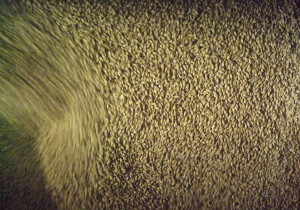 Best pale malt running into the hoppers at Brains, Cardiff. At the end of October 2013 I spent a very pleasant and interesting day at S A Brain in Cardiff, helping create my first ever collaboration beer, Brabo, on the Brains Craft Brewery. The resulting beer didn’t win the Brains competition for the year, but it’s received some very positive feedback.
This piece, which I’m publishing in several parts, documents the experience in detail — you might find it interesting as an insight into the process of brewing, Brains brewery and the craft brewery project, and the origins of the spéciale belge style of Belgian pale ale. This section on the process of mashing our beer was preceded by sections on developing the recipe, Brains brewery and its ‘craft’ offshoot and an introduction; a final section will cover the boil and getting the beer to fermentation.
You don’t need to have direct experience of brewing to understand that it’s a complicated and difficult process. Makers of wine, cider and perry no doubt face their own challenges, but at a basic level all they have to do is extract the sugar rich fruit juice, and allow it to ferment with yeasts that are conveniently already present on the skin of the fruit.
Brewers, in contrast, start from several stages back. Their chosen raw material, grain, is also rich in carbohydrate, but in the form of insoluble and unfermentable starch. Facilitating the chemical reactions that will convert this efficiently into a tasty meal for the yeast, while avoiding too many unwanted byproducts that would taint the end result, accounts for much of the challenge.
These days, this process has usually already started in the maltings, when the early stages of germination create the conditions for the release of sugars that, if nature took its course, would fuel the growing plant. Brewers have to complete this process, deploying hot water, or liquor as it’s known in the trade, to prompt the release of enzymes.
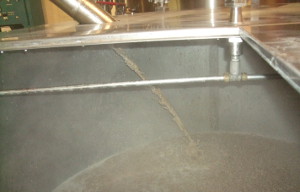 Grist mixed with hot liquor fills the mash tun as the brewing of Brabo gets underway. These naturally occurring chemical helpers then break the links between the chains of molecules in the starch to create something water can dissolve and yeast can metabolise. It’s not surprising that many brewers have a scientific background, even if their hearts and palates are firmly in the arts.
Working through a brew day highlights the immense patience and impeccable timing needed to achieve this. Good brewing involves bouts of physical activity and long periods of waiting, for precisely the right time when precisely the right amount of water at precisely the right temperature acheives ‘saccharification’, as the breakdown into sugar is known.
Then there’s the lengthy boil necessary to ensure the appropriate levels of hop bitterness make it into the finished product. It’s also not surprising that brewers, present company included, are generally sociable types, filling the inevitable longueurs with easy conversation.
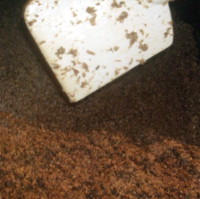 The thickness of the mash is evident from the way it sticks to this spade. When I arrive at the brewery at my luxuriously late hour, one of head brewer Bill Dobson’s colleagues has already mixed and milled the ‘grist’ – the brewer’s term for the dry ingredients – and left it ready in the grist case above the mash tun. Bill himself has warmed the tun by flushing it with hot water, like a giant teapot. I’m reminded that in certain parts of England, making tea is known as ‘brewing’ or ‘mashing’.
Mashing, that all important soaking of the grist in hot liquor, is the first major stage of the brewing process, and I’ve seen it taking place before in other breweries, but I’ve never been there for ‘mashing in’, when grist and liquor first fill the tun.
Brains uses ‘town’s liquor’ drawn from the regular water supply, although there is a disused well on site. This is easily improved for brewing purposes by adding small amounts of minerals, so 800g of calcium chloride and 1.3kg of calcium sulphate have been sprinkled into the grist case too. The liquor is heated at a central point and piped around the plant along with cold liquor so both can be mixed at the vessel to achieve the right temperature.
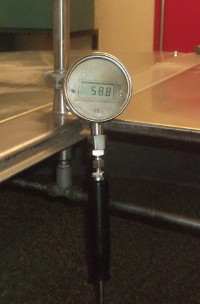 Not quite there yet: checking the temperature of the mash. The ‘strike temperature’ – the temperature of the liquor as it strikes the grist – is the first of a number of crucial parameters: in this case, it’s 73°C. Bill first runs 170l of liquor into the tun, carefully checking the flow rate to ensure it’s at the optimum 55l per minute.
Once the plates at the bottom of the tun are safely covered with water, the grist case is opened. Both grist and liquor then mix in the pipe above to create a notably thick, porridge-like, sweet smelling slurry.
Even this relatively simple process takes patience and care: the mash must flow at the right rate and with the right consistency, so it flows evenly into the vessel without piling up into a heap. Occasionally Bill assists the flow with the lo-tech expediency of a few blows from a rubber mallet
Brabo will undergo a simple ‘infusion mash’ at a single temperature, traditional in British brewing and in some styles of Belgian brewing, including for the creation of old fashioned ales like ours. The mash tun itself isn’t heated, so depends on the heat of the added liquor and good insulation – the outside of the vessel stays remarkably cool.
It takes 20 minutes to fill the mash tun, and then we leave the mixture to stand for an hour at a temperature around 66°C. It’s a great opportunity for breakfast in the staff kitchen: toast with some of Bill’s own delicious homemade jam. Although he’s not a home brewer, he clearly can’t stop coaxing interesting chemical reactions from sugary liquids heated in large metal containers even in his spare time.
 Additional hot liquor sparging the grains — difficult to photograph thanks to the steam. Back in the brewhouse, I realise that fluid dynamics plays a role as well as chemistry. Like most people with more than a passing interest in brewing I could tell you that mashing is followed by sparging and then boiling, but what I never thought about until now is quite how much is involved in getting the sweet liquid from the mash tun – the unhopped wort,– into position for the boil.
Some larger brewhouses dedicate an entire specialised full sized vessel, the lauter tun, to this delicate process, but in typical small British breweries, as here, the mash tun and a few other bits and pieces do the trick.
Sparging involves spraying more hot water gently on top of the wort, and the mash tun is fitted with a rotating sprinkler arm for this purpose. The procedure rinses away as much fermentable material as possible from the grains and makes up the wort to the correct concentration of sugar, but what I’ve only just realised is that it also plays a role in moving the wort from one stage to the next.
Think about it for a minute. You have 450kg of grains suspended in 1,250l of hot liquid in a big metal container, and you now have to get that liquid out cleanly so that it can be boiled. Simple – you put a hole at the bottom of the container with a mesh filter so the liquid simply flows through, and then pump it to wherever you want it next.
The problem is those grains – currently they’re easy to deal with as they’re floating, but as the liquid drains away they’ll start to settle under gravity, and if it happens too fast they’ll form a practically impermeable plug that traps the liquid nearest the top in the tun.
 Unhopped wort for Brains Brabo, like liquidised sweet cereal. The answer is to regulate the flow, and the sparging works to do this alongside the ‘underback’, the recycled keg mentioned earlier, which helps ensure a steady flow from below. The underback is fitted with an automatic detector which triggers a pump when the contents reaches a certain height, and the first clear wort begins to run into the next vessel, the copper.
Sparge liquor is usually hotter than the mash but not too hot that unwanted compounds like proteins and polyphenols start to seep out. The water currently spraying from the sprinkler at 15l a minute is heated to a steady 77°C.
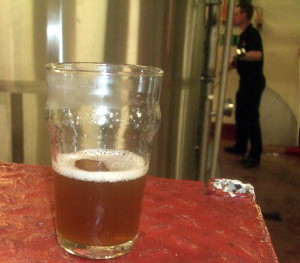
It’s time to take our first sample, admire its rich amber colour and and sneak a quick taste. It’s not the first time I’ve tasted unhopped wort but there’s something even more enjoyable about trying some for a beer I have a hand in creating.
 A selection of hydrometers (saccharometers) for beer and wine making. Pic: Stevenson Reeves Ltd. I’ve got a sweet tooth, and it’s luxuriously sweet, but with that crispy, slightly drying cereal character coming through from the coloured malt. Beer judges and reviewers often mark finished beers down for a ‘worty’ note, usually a sign that the beer hasn’t fermented out properly and residual sugars are too apparent, though I secretly enjoy a touch of lingering liquidised breakfast cereal.
But there are more accurate ways than our taste buds of judging whether those enzymes are behaving as expected. We take our sample to a bench and sink round the corner, where Bill pours it into a double-walled copper flask, and runs cold water between inner and outer walls.
When the wort is cool enough, he pops in a hydrometer, or more precisely, a saccharometer: a glass instrument with a long, thin tube emerging from a bulbous weighted float. Sugar solution is denser than water, so the sweeter the liquid, the higher the tube will float, enabling us to read off the ‘specific gravity’ (also known as ‘relative density’) from a calibrated scale engraved into it.
It might sound trivial, but seeing this simple instrument bobbing about in my wort gives me a resonant moment. The saccharometer was one of the earliest scientific instruments adopted by brewers during the early expansion of industrial brewing in the 18th century, as they sought greater reliability and predictability for their growing brands.
 One of brewing’s earliest scientific instruments: the hydrometer tests the gravity of the first runnings of our wort. It was first used for brewing in 1770 and was soon afterwards deployed at Henry Thrale’s porter brewery on London’s Bankside, later Barclay Perkins, one of the most celebrated breweries of all time.
As Bill predicted, the instrument tells us the wort has a sugar content of around 8.5%, usually expressed by English speaking brewers in parts per thousand and notated as 1085. Assuming practically all this sugar was fermented into alcohol, a finished beer made from this liquid would finish up at around a hefty 8.5% alcohol by volume (ABV), rather stronger than we’re after for our everyday refresher.
Bill expects the next sample we take will be sweeter still, but as the sparge liquor trickles through, the gravity will drop towards our intended 1050.
As the slow process of filling the copper continues, we head for the place anyone with a passion for beer would look forward to visiting: the hop store.
Read about boiling with hops and the journey to the fermentation vessel in the next and final part.
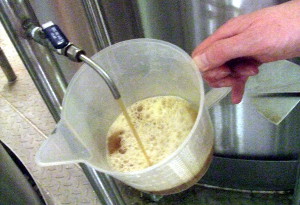 The wort for Brains Brabo ready for testing. At the end of October 2013 I spent a very pleasant and interesting day at S A Brain in Cardiff, helping create my first ever collaboration beer, Brabo, on the Brains Craft Brewery. The resulting beer didn’t win the Brains competition for the year, but it’s received some very positive feedback. This piece, which I’m publishing in several parts, documents the experience in detail — you might find it interesting as an insight into the process of brewing, Brains brewery and the craft brewery project, and the origins of the spéciale belge style of Belgian pale ale. This section on how we developed a recipe for a Welsh-brewed spéciale belge was preceded by a background section on Brains brewery and its ‘craft’ offshoot and an introduction; later sections will cover the brewday itself.
A collaboration brew is a chance to create something out of the ordinary. Among my competitors, Pete Brown has gone for a dubbel, Glenn Payne for a rye IPA and Adrian Tierney-Jones for a saison full of C-hops.
Choosing an unassuming, straightforward style is probably tying one hand behind my back, though I’m comforted to note that Sophie Atherton, bless her, has made a similar decision – she’s brewed a classic Munich-style Märzen, and rather good it is too.
And my choice is at least a beer that’s rarely attempted in the UK, despite its obvious affinity to British brewing traditions. I want to brew a spéciale belge.
 “Just say bolleke“: one of the best known spéciales belges, Antwerp’s De Koninck, in romantic mood. Spéciale belge is an everyday Belgian pale ale that could be described as like a British bitter but with a Belgian twist, at a moderate strength of no more than 5% ABV. The best examples are amber or copper in colour, with a similar biscuit malt character to a good bitter but typically less hoppy and with a fruity, spicy note from the yeast.
The classic example is De Koninck, which is to Antwerp what Guinness is to Dublin or, indeed, what Brains is to Cardiff. It’s served by default in a goblet-shaped glass known as a bolleke, which always raises titters among British English speakers but simply means ‘little ball’.
Beer hunter Michael Jackson loved De Koninck: on his first ever visit to Belgium he “lost an afternoon” drinking it in a backstreet Antwerp pub that he never managed to find again. I love it too, particularly as an indivisible part of the experience of my favourite Belgian city.
Like many aficionados, I head for Den Engel, the classic bruin café on the Grote Markt, renowned for the freshness of its beer, and enjoy a bolleke looking out on the astonishing 16th century stadhuis (city hall) with its mix of Gothic and Renaissance styles, and the fountain depicting Brabo lobbing a giant hand at the river. More of him later.
There are other examples. Palm from Steenhuffel is the best seller but I find it slightly bland and oversweet. Special De Ryck, from a small family brewer in Herzele, is a deliciously authentic example but hard to find, as is the similarly old fashioned Tonneke from Contreras. Zinnebir, from the excellent Zennebrouwerij/Brasserie de la Senne in Brussels, is a poised and accomplished modern interpretation.
The similarity to English ales is not accidental. By the end of the 19th century, imports from the UK, as well as Germany and Bohemia, had become very popular among Belgian drinkers.
The domestic industry was not well placed to challenge this competition, as Belgian brewers rarely looked beyond local sales, producing idiosyncratic local and regional styles that were appreciated by drinkers used to them but were less than ideal material for building the sort of mass market that was already enriching brewers elsewhere.
 The Exposition Universelle in Liège in 1905 where the results of the competition to create a national Belgian beer style were announced also marked the 75th anniversary of Belgian independence. In response to this, in 1904 the Unie van Belgische Brouwers (Union of Belgian Brewers, today known simply as Belgische Brouwers) organised a competition to create a new and contemporary beer that might build a following throughout Belgium. Doubtless there was also a more deeply ideological outcome in mind too – such a beer might contribute to a sense of shared national identity and unity in a nation state that was (and remains) an uncomfortable bracketing of disparate linguistic and cultural communities.
Entry guidelines were kept deliberately broad: the beer could be made using any ingredients or methods, so long as it had an original gravity of 4-5 Belgian degrees (1040-1050 original gravity) and cost 15-20 cents per glass.
The results were unveiled at the 1905 Exposition Universelle et Internationale in Liège. Out of 73 entries (including seven lagers and nine spontaneously fermented beers), the winner was Belge du Faleau from Brasserie Binard in Châtelineau, Hainaut – an easy drinking amber beer that stood out at a time when most domestic products were wheat beers or brown ales.
The brewery is long gone but its beer left a long legacy, as many other Belgian breweries gradually began to copy it, often appending the adjective belge to the results. De Koninck’s version was launched in 1913; Palm is a relative latecomer, from 1928.
Today’s examples are relatively few – the huge growth in popularity of pilsner-style beer following World War II devastated pale ales just as it did the wheaty, dark and wild beers those pale ales were originally intended to supersede. This trend didn’t reverse until the growth of interest in local, artisanal and speciality beers in the 1980s and 1990s.
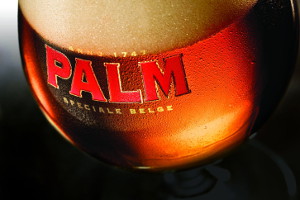 The amber glow of Palm spéciale belge. Photo: Palm. Thankfully spéciale belge survives as a healthy niche product. It’s now recognised officially in Belgium as a streekprodukt (regional product) and there’s an application pending with the EU for Protected Geographical Indication status.
Recipes are generally simple: pale malt and a bit of Germanic-style coloured malt, a restrained dose of some relatively traditional and unassertive European hops, and a fruity but still relatively clean house ale yeast.
De Koninck is made just from pilsner and Vienna malts, Czech & Belgian Žatec (Saaz) hops, and the brewery’s own yeast culture, which is famously also sold by the shot at the brewery tap as a chaser for the beer. There are some more elaborate recipes listed on homebrewing sites, involving black malt and all kinds of other stuff, but Brains head brewer Bill Dobson and I have agreed to keep it simple.
I’m lucky, too, to have access to the advice of two of the world’s leading craft beer gurus, brewers and writers Stan Hieronymus and Randy Mosher, both fellow judges at the Great American Beer Festival in Denver, Colorado. We hold our conversation in the appropriate setting of the brewhouse at Great Divide, at a North American Guild of Beer Writers social event.
“Where are you brewing it?” asks Randy. “At Brains? Oh, just tell them to brew one of their regular bitters or pale ales but with a Belgian yeast.”
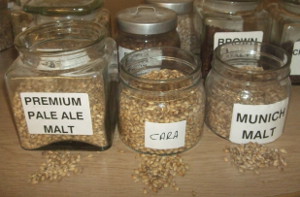 Barley malts used in Brains Craft Brewery Brabo: pale, Munich and caramalt. Is it really that simple? “Well, it would probably be more authentic to use German specialty malts rather than British ones. But try using East Kent Goldings as the single bittering hop. Lots of traditional Belgian brewers use Goldings.”
Stan agrees. “The hop rate should be low anyway, but you might think about using a classic European hop for a hint of aroma, like Saaz or Hallertauer. It has to be a Belgian yeast. If you can’t get one from one of the Belgian breweries, White Labs and Wyeast have some good ones.”
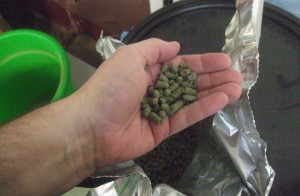 East Kent Goldings hop pellets destined for Brains Craft Brewery Brabo. Following some email exchanges and some of Bill’s own research, he devises a final recipe. Ideally we’d use pilsner malt but we settle for ease on Brains’ regular stock of Simpsons Perle pale malt from the big silos in one corner of the brewery yard. We’ll use a mix of Weyermann Munich malt and caramalt to deepen the beer, Goldings as the bittering hop and a mixture of Goldings and Žatec as a late addition for aroma.
As to the vital choice of yeast, we consider White Labs’ appropriately titled Antwerp Ale Yeast, but Bill in the end picks Wyeast’s Belgian Ardennes strain (3522).
Here’s the grist bill for an initial mash with about 7.5 barrels (1250l) of liquor (water):
- 300kg (66.7%) pale ale malt
- 100kg (22.2%) Munich malt
- 50kg (11.1%) caramalt
Following sparging, for a total wort volume of 17 barrels (2780hl), we’ll add:
- 2kg East Kent Goldings as a bittering hop at the beginning of the boil
- 1kg East Kent Goldings and 1kg Žatec as a late hop at the end of the boil
To get the right strength of around 5% ABV, we’re aiming for 2.5l of liquor for every 1kg of malt.
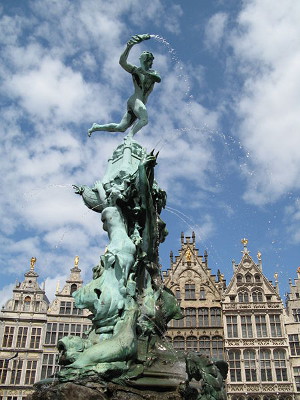 The Brabo fountain outside the Stadhuis on the Grote Markt in Antwerp, Belgium. Note the water-spouting severed hand. Pic: Ph.Viny, Wikimedia Commons. Oh, and then there’s the name. It crosses my mind to suggest Brains Bolleke, but I can see myself accused of bringing the industry into disrepute with schoolboy humour and shamefully vilified on Pump Clip Parade, the online rogues’ gallery of misadvised beer branding. So my mind goes back to that statue of Brabo on the Grote Markt in Antwerp, sculpted by Jef Lambeaux in 1887.
Low Countries folklore is full of stories of giants, or reuzen in Dutch, a particularly frightening notion in such a flat landscape. One such reus, by the unlikely name of Druon Antigoon, guarded the river Schelde at Antwerp, extorting tolls from people crossing the river. He was notorious for cutting off the hands of those who couldn’t or wouldn’t pay, and throwing them into the water.
The giant was finally slain by a brave Roman soldier, Silvius Brabo, who exacted poetic justice by cutting off and throwing away the giant’s own hand. Unreliable folk etymology attributes the name of the province and former duchy of Brabant to Brabo, and the name of the city to his deed – hand werpen in Dutch means to throw a hand, and sounds a bit like ‘Antwerpen’, the city’s Dutch name.
I doubt I will metaphorically slay my competitors, the giants of beer writing like Brown and Tierney-Jones, nor do I have any desire to amputate their writing hands and lob them in the Taf or the Thames. But Brabo still sounds a good name for a beer.
For more about the brewday itself, see the next part.
 Y ddraig goch welcomes you to Brains brewery in Cardiff. At the end of October 2013 I spent a very pleasant and interesting day at S A Brain in Cardiff, helping create my first ever collaboration beer, Brabo, on the Brains Craft Brewery. This piece, which I’m publishing in several parts, documents the experience in detail — you might find it interesting as an insight into the process of brewing, Brains brewery and the craft brewery project, and the origins of the spéciale belge style of Belgian pale ale. This section on the Brains brewery and its ‘craft’ offshoot was preceded by an introduction; later sections will cover developing the recipe and the brewday itself.
Brains Craft Brewery is itself an interesting project, demonstrating one way Britain’s remaining stock of old established independent family brewers is responding to the changing market for speciality beer, and in particular the emergence of so-called ‘craft’ beer as a distinct product category.
Rather than simply stamp that slippery word on the same-old same-old, the Welsh brewer has taken the trouble not only to create an additional facility small enough to make experimentation economical, but actively sought to engage with opinion formers and consumers.
It’s a particularly striking departure as previously Brains’ image was rather staid and traditional. Founded in 1882, S A Brain & Co Ltd is still in the hands of descendants of the uncle and nephew team who developed the original brewery site on St Mary Street in Cardiff city centre. It’s been best known in the post-CAMRA era for two classic but very traditional cask ales – SA, a distinctive best bitter, and a mild simply designated Dark.
Its bread and butter beer was for decades its ordinary bitter, but this has recently been overtaken by dark bitter The Rev. James. Ironically this is a beer inherited from former arch rival Crown Buckley of Llanelli, which Brains bought out and closed down in 1998. Located in the shadow of the Millennium Stadium, the brewery is also known for a long and very successful link with Welsh rugby union and such is the demand for its beers during important matches that brewing schedules are planned around the national team’s fixtures calendar.
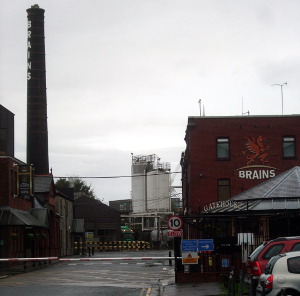 A brewery on a wet Welsh autumn morning. Brains, Cardiff, October 2013. As one of only two surviving historic independents in Wales, Brains is a remarkable and persistent survivor in a country once swamped by national groups. In 2000 the family got the last laugh on another once bitter rival, Bass, as the iconic Burton brewer fell to Interbrew and Coors (now AB InBev and Molson Coors).
Abandoning its historic site for redevelopment as a retail complex at a time the Welsh capital was on the up following devolution, Brains snapped up Bass’s Cardiff facility, the old Hancock’s brewery, on the other side of the main railway line. This is a much larger site with a capacity well beyond the current demand for Brains’ own brands, so the company has developed a profitable second business in contract brewing, mainly on behalf of multinationals.
Now the craft brewery is diversifying the portfolio further. It happened thanks to a strong alliance between brewing and marketing – a relationship that doesn’t always run smoothly in bigger breweries, but in this case both sides were keen to tap the growing market for distinctive and unusual beers in a variety of styles.
As an old school vertically integrated brewer, Brains also had its own 270-strong pub estate with a ready market for seasonals and guest beers. The problem was that when the smallest batch you can brew is 150 barrels (245hl), experimenting is a risky business. So the case emerged for a smaller pilot plant, and luckily there was an obvious opportunity to create one.
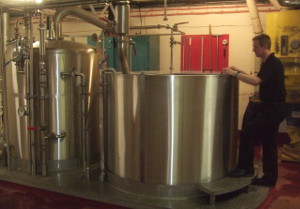 Bill Dobson expertly flies the Brains Craft Brewery kit. An ancient disused mash tun took up twice this space, and more on the floors below. Right in the middle of the brewery was an old and crumbling cast iron mash tun, disused and sealed since Hancocks days. Head brewer Bill Dobson made the case not only for clearing the obstruction but creating space for a more nimble installation.
Getting rid of the tun was an involved business that eventually cost more than its replacement: like many vessels in the old Victorian tower brewery it penetrated through several floors and the girders on which it rested were packed with asbestos.
When the lid was finally removed the staff were hoping for a dramatic discovery, the skeleton of a drowned brewer, perhaps, or a few cases of ancient barley wine, but it turned out to be clean and empty. “Not even a dead rat,” recalls Bill.
The craft brewery now occupies exactly half the area taken up by the old vessel, but just on the uppermost floor of the main brewery building. Fabricated to Bill’s own specification in collaboration with George Thompson of Willis European near Derby, it’s a standard British-style microbrewery with two main vessels, a mash tun and a copper, with a brew length of 15 barrels (25hl). On the floor below is a small underback made from a converted keg.
 Not a prop from a 1950s science fiction film but the underback at Brains Craft Brewery, made from an old keg. The brewery stands right next to one of the full size 250 barrel (400hl) mash tuns used for brands like Brains Bitter and Rev. James, and, unusually for a brewery of these dimensions, is fully integrated with the main brewery systems and services, an advantage a big brewer has over a standalone microbrewery.
“If we’d built it in an outhouse off in a corner somewhere,” says Bill, “it would have needed its own heating and supplies, but here it can benefit from the same economies of scales as the rest of the operation.” So the copper is heated by steam pipes from Brains’ central supply, and the whole kit is plugged into the same pipework that moves essential liquids around the entire site.
 Reinventing the brand: Brains Craft Brewery distinguishes itself from its parent. Pic: Brains. The new kit was up and running early in 2012 and right from the beginning it operated under its own distinct Brains Craft Brewery brand. There’s a separate website and visual identity, presenting a quirky, light hearted, more cosmopolitan alternative to the main brand with its rather stern and decidedly Welsh ddraig goch (red dragon).
The beers produced have run the gamut of styles, with wheat beers, green hop ales, fruit beers, golden ales featuring oatmeal, black IPAs, honey beers inspired by traditional bragawd (bragget), saisons, tripels, imperial stouts and even a chocolate beer with added bacon.
Beer writers and bloggers are cultivated by inviting them to collaborate on beers for an annual competition, judged on the day of the British Guild of Beer Writers dinner and awards ceremony in December. Last year the theme was IPAs, and two beers from that batch have since graduated to the grownup brewery, though retain the Craft Brewery branding. These are Barry Island IPA, created with cult video blogger Simon Martin; and competition winner Boilermaker, a US-style IPA matured on oak chips infused with Penderyn single malt Welsh whisky, created with Tom Sandham and Ben McFarland.
This year I’ve made the list of invitees, charged with helping create a ‘continental’ style. There have been other collaborations too, including with Brains’ licensees and pub staff.
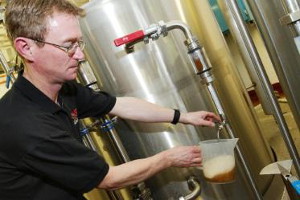 Bill Dobson taking a sample from the Brains Craft Brewery. Pic: Brains. Bill’s enthusiasm is clearly a major driver. A keen cyclist and jam maker as well as a brewer, Bill found himself on surprisingly familiar ground when he moved to Cardiff. Trained as a chemical engineer, he went straight into a job at the old Ind Coope brewery in Burton upon Trent, then owned by Carlsberg-Tetley.
“When I graduated I was offered two jobs, one at Cadbury’s and one at Carlsberg, so I chose beer over chocolate,” he recalls. “Carlsberg owned the Firkin chain back then, so I got a chance to brew on small kits when they sent me out to the Firkins.”
When Carlsberg sold its Burton brewery to next door neighbour Bass in 1997, Bill transferred to the new owner. With the additional capacity at Burton, Bass decided its Cardiff plant, then used for the Worthington brands, was surplus to requirements, and Bill was one of the team sent to organise the transfer of production. In the end the Cardiff brewery remained open as Brains took it on, and a few years later Bill found himself back there as head brewer.
Now he’s lucky to have the best of both worlds – on the main brewery he’s mainly a manager, with a team of hands-on staff, while on the craft brewery he gets to do the cooking. And unlike his colleagues in the standalone microbrewery sector, he just has to concentrate on brewing, while all the other bothersome stuff that goes with running a commercial brewery – HR, logistics, marketing, finance – goes on elsewhere.
Read more about developing the recipe for my beer in the next part.
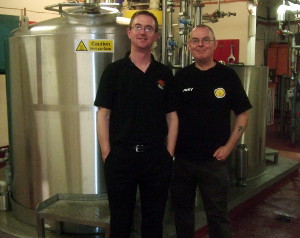 Two hungry brewers: Brains head brewer Bill Dobson (left) with the author in front of the Brains Craft Brewery, Cardiff, Wales. Photo: Ffion Jones. At the end of October 2013 I spent a very pleasant and interesting day at S A Brain in Cardiff, helping create my first ever collaboration beer, Brabo, on the Brains Craft Brewery. This piece, which I’m publishing in several parts, documents the experience in detail — you might find it interesting as an insight into the process of brewing, Brains brewery and the craft brewery project, and the origins of the spéciale belge style of Belgian pale ale. This introduction will be followed by sections on the brewery, developing the recipe and the brewday itself.
This is supposed to be a collaboration but I’m already feeling a little guilty for my lack of effort, if not quite surplus to requirements. All morning, sprightly head brewer Bill Dobson, has been bouncing around his pride and joy, the Brains Craft Brewery pilot kit, tweaking taps and levers here, checking temperatures there, coaxing into existence a beer that, a few weeks from now, will have my name on the label.
My only previous experience of brewing was a couple of Boots homebrew kits back in my teenage years, the greatest distinction of which was to produce the only booze left undrunk at the end of the party, outlasting even the oversweet artichoke liqueur someone had brought back from a Mediterranean package holiday. And I’ve often said that while I’m happy to write about beer, with so many fantastic brewers in the world, I’d rather leave the making of it to the experts, so no wonder I’m standing on the sidelines.
What it’s like when all the collaborators are actual brewers? Do they naturally fall into each other’s rhythm of temperature rests and hop additions? Or do they quarrel and get under each other’s feet, elbowing for control of valves and thermostats and sneaking in handfuls of hops behind each other’s backs?
I’d already suspected I was getting off lightly. I was steeling myself for the industry’s traditional early start, so was surprised when asked to present myself at the brewery gates at a relatively tardy 0800hrs. And then when out for a drink the night before we bumped into several of the S A Brain’s senior executives, including chairman John Rhys, who was due to brew on the craft brewery himself the following week.
“Eight o’clock?” he spluttered indignantly “They’re making me get there by seven.” Sure enough, Bill was in action long before I arrived, and already had the grist poised for mashing in.
Don’t get me wrong, I’m not unengaged or bored – I contributed to the recipe and now I’m fascinated with every detail of the tortuously complicated process of extracting one of the world’s greatest drinks from a soup of breakfast cereal, hedgerow weeds and fungal spores.
I know this process. I’ve been able to recite the sequence of mash-sparge-boil-pitch-ferment-condition and talk knowledgeably about grist, liquor and wort since I first read the Good Beer Guide in the early 1980s, studying its quaint flow diagrams and brewery cutaways in faux Victorian style.
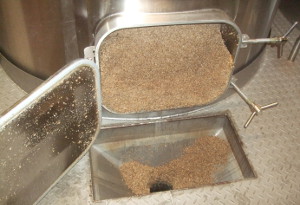 Spent grain destined for cattle feed waiting to be scraped out by hand at Brains Craft Brewery. Since then I’ve visited lots of breweries and talked to lots of brewers. But I’ve never seen brewing in action from beginning to end, so this is a great opportunity, with all sorts of unexpected observations along the way. It’s just that I feel I’m letting Bill do all the work.
And then, with the wort safely heating in the copper, it’s time to clear out the mash tun. Now the liquid containing its precious fermentable sugars has been drained away, almost half a tonne of grain has sunk down into a steaming mass not far off the consistency of concrete.
Bill’s big grownup mash tuns nearby are equipped with mechanical paddles to scrape this stuff out but here in the craft brewery it has to be done by hand through a hatch at the bottom of the vessel. I’m handed a rake, while Bill wields an instrument that, though with a plastic blade, bears a remarkable resemblance to the eponymous spade adorning the logo of Munich’s historic Spaten brewery.
I don’t think I’ve done so much sustained physical labour for years. It takes a good 20 minutes to get the spent grain down a chute in the floor which leads to a conveyor belt beneath – eventually it’ll end up with every last scrap of carbohydrate extracted in the efficient stomachs of cattle.
Meanwhile we’re in need of carbohydrates ourselves, so Bill phones down to Ffion Jones, Brains’ assistant brand manager, to say we’re ready for lunch. “You’ve got two hungry brewers up here,” he says. I modestly suggest I’m not really entitled to that designation.
“Well,” says Bill, “you’ve scraped out your first mash tun. I’d say that makes you a brewer.”
Yes, I think proudly, pondering my complaining biceps. Perhaps it does.
Read the next part of this piece for more on the background to S A Brain and the Craft Brewery.
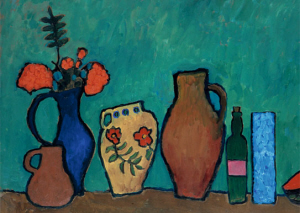 Gabriele Münter (1877-1962),
Stillleben mit Vase, Flaschen und Zweigen eines Vogelbeerbaumes (Still life with vases, bottles and rowan branch), 1908/09. Did any of these vessels contain beer? When dedicated beer tourists descend on Bavaria, they tend to head north, for Bamberg and the bucolic Bierkellern of Upper Franconia, where the concentration of breweries per square kilometre is famously the densest in the world. But anywhere you go in this most beer friendly of German Länder, something of interest is never far away. Even the ubiquitous big Munich breweries, most now in the grip of multinationals, still turn out beers of at least passable standard.
Oberbayern, or Upper Bavaria, is the historic core of the former kingdom – Franconia, for all its fame, only became part of Bavaria in 1803. Oberbayern is a triangular area with Munich (München) at its centre, and it gets its name from its higher elevation. Around the state capital the countryside is relatively flat, but head south and it’s not long before the land starts rising and falling before clambering to the cracked and jagged heights of the Alps, where the mighty Zugspitze – Germany’s highest peak at 2,962m – guards the border with Austria.
This is the Bavaria of the tourist brochures, where the whitewashed walls of shallow roofed houses bear religious paintings and homilies in Gothic script, and the locals obligingly wear Lederhosen and felt hats stuck with feathers when popping out to the post office. Numerous lakes hide among the lower peaks of the Voralpen, creating jaw-droppingly beautiful vistas of placid blue waters and fertile flower meadows surrounded by rugged snow-capped peaks. The natural beauty is reason enough to visit, but the region is also known for its health spas and Kuren, and Germans are as likely to come to recuperate as to walk, cycle or gaze.
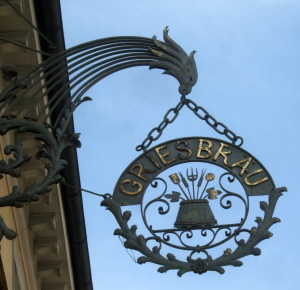 Sign at Griesbräu, Murnau am Staffelsee, Bayern, Germany. Murnau am Staffelsee is one of the region’s principal centres, originally a waypoint on the Roman road to the Brenner pass and now a pretty little town in an idyllic setting just above the lake known as the Staffelsee, with excellent rail connections. The local tourist board markets the town and its hinterland as das Blaue Land, the Blue Land, exploiting its connection to the early 20th century group of Expressionist artists known as der Blaue Reiter, the Blue Rider, led by Wassily Kandinsky and Franz Marc. Kandinsky’s partner and fellow artist Gabriele Münter lived in Murnau and her house is now a visitor attraction, while her work helps draw the crowds to the Schloßmuseum. Münter entertained numerous other arty notables here, including Paul Klee and Arnold Schoenberg, until driven out by the Nazis.
Back then, the town had nine breweries and brewpubs. As the century drew to a close, only wheat beer brewery Karg remained, though since 2000 brewing has been restored with great success at one of the old brewpubs, Griesbräu. Murnau is no Bamberg, but between them Karg and Griesbräu, each at different ends of the picturesque market street that bisects the town, well reward the beer explorer. Both in their own way demonstrate how Germany’s notoriously traditional and conservative brewing industry is subtly adapting to contemporary trends.
In a country where breweries regularly claim several centuries of tradition, Karg is a relative newcomer. It was opened in 1899 on the Lederergasse, in the shadow of the typically southern German St Nicholas church. Andreas Karg bought the brewery in 1912 and his grandson, Franz Schubert (no relation to the similarly named Austrian composer and songwriter, as far as I’m aware), has presided since 1977, following a stint at Kloster Andechs. In recent years, Franz has run the business jointly with his daughter Victoria.
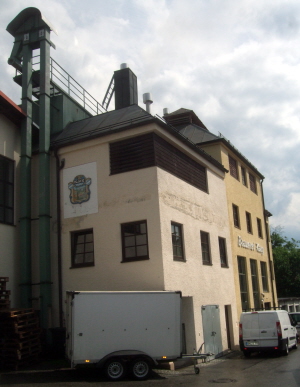 Brauerei Karg, Ledergasse, Murnau am Staffelsee, Bayern. Head down the Untermarkt, the southern part of the main drag, and you’ll find the Karg Bräustüberl or brewery tap at number 27. The view, with the mountains looming ahead, is very much as it looks on Karg’s labels, where it’s ringed with the blue and white checkers of the Bavarian flag. Lederergasse runs near parallel at this point and the brewery itself is just across the road at the back of the pub. It’s an unremarkable but not unattractive building with windows giving a view of the brewing vessels from the street, a compact and businesslike old-style town centre brewery, though with up to date and automated equipment.
Karg once brewed the full spectrum of Bavarian beer styles but in 1980 Franz decided to concentrate on warm fermenting wheat beers, and with notable success. Its lengthy stint as the town’s only brewer has given Karg a local cachet and a strong regional customer base, but it also ships its beer to the rest of Germany and other countries, including the UK and US, producing a total of 10,000hl a year. I’ve long thought of it as a producer of tasty and interesting minor classics in the traditional Weizenbier style, but recent developments indicate the brewery is willing to push that particular envelope and it’s likely to become even more interesting in future.
I didn’t pre-arrange a visit and called at a time when the Bräustüberl was closed for refurbishment following the retirement of a longstanding landlord. But poking around looking for off sales I bumped into Victoria Schubert herself, who somehow found time off from the pressures of the imminent reopening to chat for a while. By then it was too late in the day for a brewery tour – they normally operate for pre-booked groups on Tuesdays.
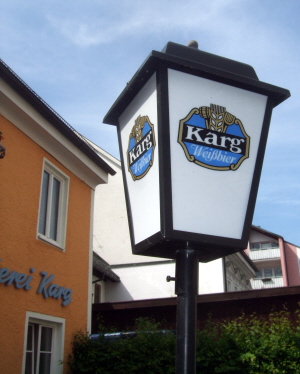 The Bavarian colours of Karg. Victoria is an enthusiastic and energetic young woman with a broad background in the industry, a qualified beverage industry manager and a beer sommelier. She’s a former Londoner – Meantime was her local brewery when she lived in Greenwich and she’s impressed by their approach and their beers. The refurbished Bräustüberl, which reopened in mid-July, aims to stock international beers as well as Karg’s own brews, and to match them with food, both highly unusual practices in Germany. “Most people round here just drink the beer from Murnau or Munich,” she tells me. “But there are now sensational beers from around the world, and we want to help our customers discover them.”
This international awareness is also rubbing off on Karg’s own beers. A new pale wheat beer, Staffelsee-Gold, was launched last year to celebrate the centenary of family ownership. Despite reviving a brand name last used 60 years ago, this is a contemporary creation, describing itself as stark gehopt, strongly hopped. While it’s unlikely to challenge hopheads schooled on double IPAs, it’s strikingly assertive by local standards, and the hops used – notably English-grown Cascade – lend vivid floral and citrusy tones quite different from the subtle grassiness of more traditionally Germanic ‘noble’ varieties, adding further layers of complexity to the fruitiness of the Karg yeast. The combination has proved a winner with customers and the beer, originally a one-off special, is becoming a permanent addition to the range. Read tasting notes.
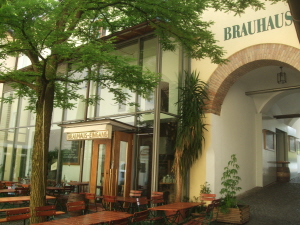 The lovely shaded courtyard at Griesbräu, Murnau. To find Murnau’s second brewing gem you need to turn your back reluctantly on the mountains and head in the opposite direction to reach Obermarkt 37. While the current brewery is a 21st century addition, the site can claim a history considerably longer than Karg’s. There’s been a hostelry here for centuries, and brewing since at least 1676. The old brewpub was built from distinctive gravelly stone, hence the name Griesbräu, from an old local word for gravel (Kies in modern German). That building was destroyed in a massive fire in 1835, along with most of the street, so the quaint mediaeval-style façades seen today are actually more recent rebuilds.
Griesbräu was rebuilt in its current sprawling form in 1836, and brewing continued until 1917 when the business was bought out by the Thomas brewery of Munich, later absorbed by Paulaner. Brewing ceased, though the building continued in use as a big pub and hotel. In 1922 the Gilg family took over the running of the place and in 1997 the latest generation, Michael Gilg and his wife Barbara, found themselves in charge.
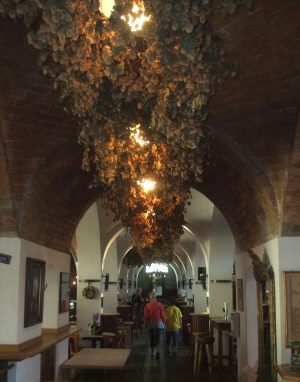 Beer from the vaults. Griesbräu, Murnau am Staffelsee. Michael was then still in his early 20s, and the concept of business as usual didn’t make sense, for all that his inheritance was a local institution that counted Kandinsky and Münter among its former regulars. “By that time it was clear,” he recently told a local magazine, “that we had to modernise.” The complex included a big vaulted space used as a storeroom, but Michael saw the potential to convert it into a brewpub, preserving a traditional atmosphere alongside a modern brewery and more contemporary beers.
The reinvented Griesbräu opened in 2000 and very impressive it is too. Head through the coaching arch with its filigree metal sign to find yourself in a delightful courtyard beer garden insulated from the bustle of the street by those solid early 19th century buildings and the dappled shade of trees. Big picture windows in front of you reveal the brewhouse. The hotel, restaurant and lagering hall are off to the right but allow yourself to be lured by the gleam of copper into the pub.
The interior has bare brick walls and typically simple but sociable chunky wooden tables, its vaulted ceiling festooned with hops. It’s spacious and might be cavernous, but good design keeps it friendly and inviting as a place to linger. The natural elegance of the brick arches helps achieve an effect that’s pleasingly clean, simple and contemporary though gemütlich enough to tempt the more conservative locals to cram its wooden benches with their well-stuffed Lederhosen. A food buffet dispenses hearty local cuisine at very reasonable prices, with a surprisingly impressive array of vegetarian options alongside substantial chunks of poultry and meat, and bread made with spent grains.
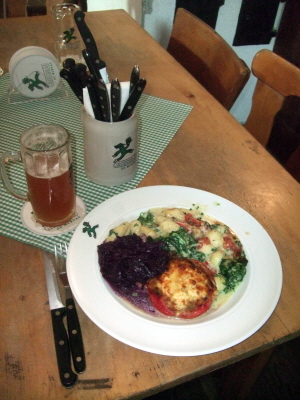 Hearty — and vegetarian — fare at Griesbräu. The computer controlled 10hl kit springs to life two or three times a week. It’s a typical modern German microbrewery, with only two vessels, a mash tun/copper and a lauter tun, and a whirlpool in the cellar beneath. It produces three regular beers – a helles, a dunkles and a Weizenbier – plus a changing seasonal, served unpasteurised and unfiltered in the pub or to carry out in hand filled and labelled 1l Maurerflaschen (flip top bottles). All are impressive – the full bodied, perfumed helles is outstanding – but the brewery is also noteworthy in its realisation that it can no longer take the appreciation of the Bavarian beer drinker for granted.
Every month Michael Gilg gives Bierseminaren, introducing customers to brewing techniques and the varied flavours of his beers and rewarding them with a Bierkennerdiplom (Beer Expert Diploma). He’s also not afraid to stretch the locals’ accustomed tastes – this year’s summer seasonal, a golden wheat beer called Sommerfrische, came bursting with aromas of Amarillo and Citra hops. And if a beer seminar sounds forbiddingly academic, be reassured by Griesbräu’s strapline, “Wo´s Bier Spaß macht!” – Where beer is fun. Read tasting notes.
I’m grateful to Ramblers Worldwide Holidays for my Bavarian trip – you can read more about it in a future issue of BEER magazine.
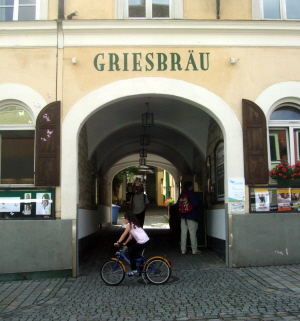 Griesbräu, Murnau am Staffelsee, Bayern, Germany. ABV: 5.1%, 5% and 4.8%
Origin: Murnau am Staffelsee, Bayern, Germany
Website: www.griesbraeu.de
Griesbräu zum Murnau is a sprawling historic inn in Murnau, on the edge of the Bavarian Alps, that was once patronised by Blaue Reiter artists Vassily Kandinsky and Gabriele Münter. Like many such establishments it long boasted its own brewery, thus the name — which it continued to use even after one of the emerging Munich giants swallowed it up and shut down brewing in 1917.
Since 2000, it has lived up to its name once again: an in-house microbrewery was installed during a major refurbishment, and now produces some impressive beers to enjoy in a very attractive environment. Alongside wheat beer specialist Karg, it’s one of two breweries in Murnau, both of which I investigated on a recent visit: read more here.
I’m always heartened by a brewery that has obviously taken great care to get its standard everyday beer right, and Griesbräu is an excellent example. Helles, the soft, not too hoppy, pale lager that is the backbone of much south German beer culture, may not be the world’s most cutting edge and exciting style, but at its best it’s a perfect example of how beer can match seductive complexity with the power to refresh.
 Griesbräu Helles Griesbräu Hell hits the spot perfectly. It’s fermented for seven days, lagered for up to six weeks and, served unfiltered and unpasteurised fresh from the tank, it arrives a hazy deep blond with a thick and very fine whipped cream head. A fecund, lightly yeasty aroma has gentle citric notes and a spicy hop character.
The palate is beautifully soft and lightly marmaladey around the edges, with a relatively gentle carbonation allowing the appreciation of a complexity that also stretches to light peach tones and nutmeg. The finish is slightly plainer by comparison, with more citrus and spice, lightly chewy malt and slightly more assertive hop bitterness than you might expect. My glass held a full bodied and very well integrated beer that was skilfully made and matured to perfection.
Werdenfelser Ur-Dunkel, named after the wealthy mediaeval county that once covered the area and a now-rare breed of local cattle, is a worthy companion piece. A hazy deep amber beer with a light yellow head, it has rich cereal malt on the aroma underlying notes of dates and redcurrants.
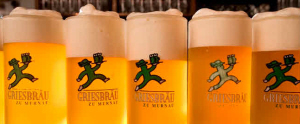 Glasses on parade at Griesbräu, Murnau am Staffelsee. The palate is also sumptuously malty, with chocolate, figs and raisins, leading to a lightly tangy finish with a gentle hint of bittering roast layered with grassy hops. It’s another chewy and substantial brew.
Earlier I’d been down the road at Karg chatting to co-owner Victoria Schubert about a new beer with Cascade hops, so perhaps I should have been expecting to find Murnau’s other brewery exploring more exotic hop varieties too, but even so the whiff of the New World that emerged from my glass of summer seasonal Sommerfrische was a pleasant surprise. New for this year, it’s a slightly darker variant on the brewery’s regular wheat beer, warm amber in colour with a rich off-white head clinging to the glass.
A very herbal and fruity aroma has notes of tropical fruit, citrus and ripe apricots, with a slightly soapy perfume. The palate is intensely spicy and fruity, with more tropical fruit and very ripe stone fruit alongside sweet orange and lavender, locked together by a smooth malty base. The finish stops short of cloying with fruity overkill, leaving a lightly bitter and spicy trace against a fresh cereal backdrop.
Curiously nutty regular wheat beer Griesbräu Weisse is also well worth exploring — some fans rate it the brewery’s best but I found the other beers just pipped it at the post.
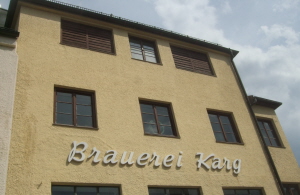 Brauerei Karg, Murnau am Staffelsee, Bayern, Germany ABV: 5% and 5.8%
Origin: Murnau am Staffelsee, Bayern, Germany
Website: www.karg-weissbier.de
Karg, in picturesque Murnau am Staffelsee on the edge of the Alps, has long been one of the more interesting small Bavarian Weizenbier brewers. As I found out on a recent visit to Murnau, it’s likely to get more interesting still with a dash of quiet innovation and international awareness, thanks in part to trained beer sommelier Victoria Schubert, the latest generation of the owning family. Read more here.
 Karg Helles Hefe-Weissbier The brewery’s flagship traditional pale wheat beer is true to style and consistent but with plenty of flavour and character of its own, delivering all the expected fruity, yeasty, spicy flavours in vivid profusion against a solid, slightly gritty backbone. A proper bottle conditioned Hefeweizen, it pours a cloudy amber with a big creamy pinkish head. There’s a very slight whiff of smokiness on the spiky, clove-tinged aroma, alongside soft strawberry fruit and vanilla.
A soft and creamy palate is rich in banana and soft fruit flavours, with a light swish of complex citrus and rolling notes of light grassy hops, clove and fennel. The lightly drying finish -yields bubblegum, another typical flavour note, with more ripe fruit and citrus.
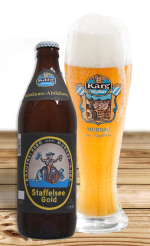 Karg Staffelsee Gold In 2012 Karg celebrated its 100th anniversary of ownership by the same family — the special beer created for the occasion revived an old brand name, Staffelsee Gold, but the recipe certainly didn’t look backwards. Instead the brewers took note of contemporary trends towards lighter coloured, more hop-forward beers while remaining within the parameters of this dedicated wheat beer brewery. The result, originally planned as a one-off, has proved such a good seller it’s likely to be become a regular.
The label bears the warning ‘stark gehopt‘, strongly hopped, which needs to be interpreted in context. IBU junkies might be disappointed, but by local standards the hops are notably more assertive than usual. They’re also remarkable for their untypical flavours: instead of the soft grassy burr of middle European ‘noble’ hops you’ll smell and taste the more citric, fruity notes of English-grown Cascade.
The beer is a deep shade of gold, lighter than the standard Helles, but just as reassuringly thick with suspended yeast. The hop component of the aroma isn’t in your face but there are firm notes of citrus, pineapple and tropical fruit to complement the more expected yeasty banana notes.
A mouth filling, heady and complex palate is flowery and citric against a smooth banana toffee backdrop, with a light building bitterness and subtle hints of liquorice and cinnamon. Ripe fruit emerges on the swallow, and banana and toffee notes reappear on a long lasting finish that’s dry rather than assertively bitter. Citric fruity notes linger to the last.
Innovation in German brewing is still relatively rare but experimenting with hops is one way brewers can expand their flavour profiles without abandoning the purity law, and Karg are by no means the only brewer doing so. Nonetheless it’s great to see a local stalwart like this stretching its wings with very satisfying results.
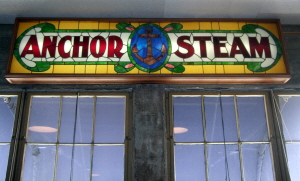 Elegant lightbox at Anchor, San Francisco. The Anchor brewery in the City of San Francisco deserves a guaranteed place on any list of the most important brewing sites in the world. Not only is Anchor the last surviving pre-Prohibition brewer of the historic local style of steam beer, it’s also arguably the starting point of the modern craft beer movement and played a key role in the resurrection of porter and the diversification of beer styles in the United States. The warm welcome it lays on to visitors additionally makes it an essential stop on any beer tourist’s itinerary.
So it was remiss of me to visit San Francisco five times before I finally found my way to the brewery in October 2012. While there, as well as taking the brewery tour, I had the chance to interview veteran head brewer Mark Carpenter, who has worked there since the early days of the brewery’s renaissance in 1971. In the time it’s taken me to write this up, things have moved on further, with Mark entering semi-retirement while Anchor prepares for a major expansion to a second site in San Francisco.
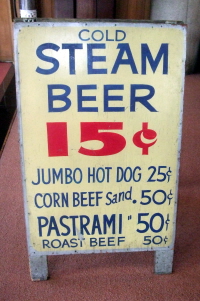 Steam beer in old prices, Anchor brewery, San Francisco. The Anchor story should be a familiar one to anyone who has ever read a couple of world beer guides, and you’ll hear it retold in energetic style on the brewery tour. Steam beer evolved as expatriate brewers from the German-speaking world arrived in rapidly expanding Gold Rush-era San Francisco with lager yeasts developed to ferment at low temperatures, only to find a complete lack of cold caves, cooling equipment or ice.
Luckily, the City’s unusual geography ensures a climate that’s considerably cooler than surrounding areas, so the brewers found they could just about make things work by using broad, shallow fermenting vessels, similar to the koelschepen employed in lambic brewing. The greater surface area permitted more rapid cooling, sometimes boosted by locating the vessels on rooftops where they benefitted from ocean breezes. The resulting beer, though drinkable, was a sort of halfway house between a lager and an ale, with a particularly high carbonation and distinctive flavours produced by yeasts working outside their comfort zone.
The origin of the term ‘steam beer’ is uncertain – Anchor claims it referred to the steam given off when hot wort was pumped into rooftop fermenters and exposed to the chill of a foggy City day, creating a haze that hung over the breweries. The hiss of carbon dioxide as barrels of this very fizzy beer were vented could also have reminded people of steam. And some of the brewers might have been familiar with Dampfbier, a straight translation of steam beer – this was a Bavarian warm fermented style named, so it’s claimed, because the vigorous activity of ale yeasts on the surface of the wort resembled boiling and steaming liquids.
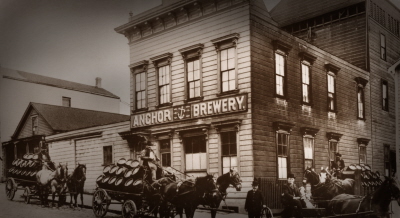 The post-Earthquake Anchor brewery at 18th and Hampshire streets, San Francisco. Pic: Anchor. By the end of the 19th century, steam beer was the standard everyday beer style of San Francisco, a cheap blue collar refresher made by around 25 breweries. One of them was Golden City Brewing, founded in 1871 in a former saloon on Pacific Street near Russian Hill by German immigrant Gottlieb Brekle. In 1896 the brewery was sold to two other businessmen of German descent, Ernst F Baruth and his son in law, Otto Schinkel Jr, who renamed it Anchor – a common brewery name in Europe and one particularly appropriate to such an important port city.
The partnership proved ill fated. Baruth died suddenly in 1906, just two months before a massive earthquake devastated San Francisco. The brewery withstood the initial quake but was consumed by the fire that followed it – a dog grooming service stands on the site today.
Schinkel rebuilt Anchor at 18th and Hampshire streets, the first of four sites in the general area of Potrero Hill where today’s brewery stands – these southeastern suburbs were favoured by relocating businesses as the underlying geology was more rocky and solid than the sandier neighbourhoods north of Market Street, and had suffered comparatively little earthquake damage. Only a year later Schinkel died too in a freak accident, run over by one of those characteristic City icons, a cable car. Two other Germans, Josef Krauss and August Meyer, then took over.
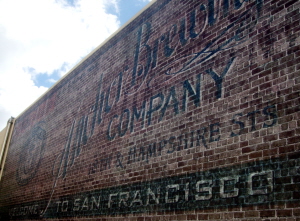 Historic brick sign from previous site at rear of Anchor brewery, San Francisco. Prohibition wreaked far greater devastation on the brewing industry than any earthquake or fire. There’s no record of Anchor’s activities during the dry years of 1920-33, though there are some suspicions that it continued operating illegally. In any case it became one of only 164 US breweries out of 1,392 to re-emerge once the madness was over, and the only remaining steam beer brewery in San Francisco.
But now it faced a new challenge – the rise of the giant brewing combines with their heavily marketed national brands, whose dominance increased ever more quickly after World War II. The original rationale for steam beer was long gone, with technology now widely available to produce bland, though clean tasting, golden lagers that suited the streamlined and slickly branded ethos of the Big is Beautiful 1950s.
Under Krauss and a new partner, Joe Allen, Anchor soldiered on at a new site at 17th and Kansas streets, having relocated again following another fire only a few months after repeal. But demand steadily dwindled, not encouraged by hygiene problems that frequently resulted in infected beer, and in 1959 Allen, who had outlived Krauss, shut up shop. The next year a new owner, Lawrence Steese, reopened Anchor on Bryant Street but was soon struggling to make it pay.
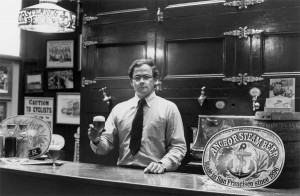 Fritz Maytag in his early days at Anchor. Pic: Anchor. Enter Fritz Maytag, a still youthful Stanford graduate and heir to a washing machine empire on the lookout for a mission in life. Maytag had already attempted to get into the drinks business by becoming one of the first to import Chilean wine to the US, with little success. One day in 1965, so the story goes, he was enjoying a steam beer at North Beach beatnik haunt the Old Spaghetti Factory when owner Fred Kuh advised him to make the best of it as the brewery was about to close.
Intrigued, Maytag visited Anchor and, despite finding a decrepit and rat-infested plant which he later described as “mediaeval”, ended up buying 51% of the company to keep the steam beer flowing. He spent the next few years learning all he could about brewing, with numerous brewery visits and study tours, including to Europe, and finally took on full ownership in 1969.
It’s tempting to view Maytag’s intervention as a romantic folly, the sort of risk no rational, sensible capitalist should ever take, but which nonetheless eventually paid off many times over, not only in financial terms but in the impact of what followed on the world of brewing. A real San Francisco tale, indeed, of a successful challenge to conventional wisdom. But while I’m sure there was an element of impulse and inspiration, the investment was shrewder than it might at first have seemed.
 Anchor Steam Beer. By the mid-1960s, the glamour of consumer society that had so seduced the previous generation was wearing thin, and a critical discourse emerged to challenge the homogeneity of large scale production and the intellectual vacuity of mass marketing. Significant groups of consumers, particularly among the newly educated and economically empowered baby boomer generation, began demanding products that appeared more authentic, natural, idiosyncratic and hand crafted than prepackaged supermarket fodder. If these came with a whiff of nostalgia for an earlier pre-corporate age, so much the better.
San Francisco was a city with a long tradition of radicalism, progressiveness, rugged eccentricity and alternative lifestyles, a tradition shortly to achieve perhaps its most famous expression as the local hippie culture went global with the 1967 Summer of Love. San Franciscans were way ahead of the trend in seeking alternatives to the offerings of corporate America. If they could be persuaded to take a beer into their hearts, then steam beer – as quirky and Victorian as the painted wooden houses so beloved of Haight-Ashbury longhairs – was the perfect candidate. And the association of the beer with the City would help too in catching the eye of discerning drinkers elsewhere, whom Maytag knew he had to reach if the project was to be viable.
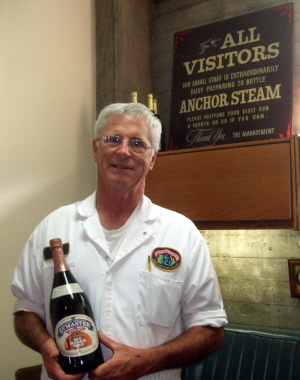 Anchor head brewer Mark Carpenter at the brewery, October 2012, with a magnum of Mark’s Mild. “Fritz had unbelievable foresight,” says Mark Carpenter. “He saw what was coming when I swear no one else did. His very first big contribution, aside from all the great beer and the creativity, was that you could get a higher price for a domestic beer. No one was doing that. All the small regional breweries were all selling under the price of Budweiser, Miller and Coors. That’s no recipe for success. Fritz had the nerve and pride to charge a higher price, between national brands and imports. He had the wherewithal to be very patient and let it grow and become profitable, and by 1974 we were profitable and have been in profit ever since.”
Though Mark wasn’t in at the very beginning of the new era, his history with Anchor dates back to the days when Maytag’s patience was most tested. Mark joined in 1971, just after the owner had made another crucial decision, investing in a small bottling machine. Now steam beer was available in bottles for the first time, giving the product a reach far beyond its traditional market of local saloons and bars and accessing a more affluent and widely dispersed customer base.
“I guess I was looking for a change in my life,” recalls Mark. “The 1960s were just over and people were doing different things with their lives, an amazing time really in San Francisco. I worked for a telephone company – I was doing just fine, I’d worked my way up there since high school, but I just wanted something more interesting. I took a tour of the brewery with a couple of friends and thought I should ask for a job here. So I went back a few months later and luckily I got in to talk with Fritz and we got along and he hired me.
“It was such a cool time, and the perfect learning environment. We had this old 57 barrel (67hl) brewhouse but were only making a little under 1,000 barrels (1,173hl) of beer a year, so we didn’t have to brew much, only once every few weeks. There were only five of us – Fritz, the secretary and three of us in the brewery. When we bottled, Fritz and the secretary would come out and help us.
“Fritz was developing an entirely new market when we started bottling in 1971. We couldn’t even get into Fisherman’s Wharf [a picturesque tourist honeypot centred on a quayside historically used by small fishing boats], even though we had a beer in a bottle with an anchor on it, made here in San Francisco. So we had to go further afield. We used Guinness as an example, because back in the early 1970s Guinness was in many bars in the United States, and although you rarely saw anyone drinking it, they sold about 75,000 barrels (88,000hl) in total. That’s the sort of market Fritz was aspiring to, a specialist beer.”
Another crucial instance of Maytag’s farsightedness was his recognition that resistance to the homogeneity of industrial brewing would eventually express itself in the demand for variety of beer styles, each with distinct flavours. In 1973, Anchor launched its first new beer of the modern era – a porter. Today such a move wouldn’t merit even a twitch of an eyebrow, but back then it was brave and radical and, perhaps, as romantically irrational as taking on the brewery in the first place.
Porter, the beer that originally drove the industrialisation of brewing and the first world beer style, had fallen extinct in its British homeland in the 1950s and had disappeared from the US years before that, though it survived as a minor cold fermented speciality in Northern Europe. Anchor Porter, brewed with ale yeast, was almost certainly the first warm fermented porter of the contemporary era.
There was some historical precedent for a San Francisco porter. When Maytag bought Anchor, the brewery did have a second, dark beer – a distant echo, perhaps, of the German custom of offering a light and a dark lager. But the dark beer was simply the regular steam beer with caramel colouring. “That was not Fritz’s style,” says Mark. “But we also had some old advertising for porters brewed here from before prohibition, so there was a bit of a story there.”
Mark recalls challenging his boss’s judgement. “I asked him, ‘Why are we making this porter? This is just extra trouble for us when the steam beer’s going real well.’ And he said to me, ‘Look, Mark, pretty soon there’s going to be lots of little breweries around the US making a number of different beers and we can’t be seen just to be making Anchor Steam Beer’. It was incredible when I look back on that conversation and the foresight Fritz had.”
The innovations kept coming. In 1974, Maytag returned from a visit to the UK with a fascination for barley wine, another style then unknown in US brewing. He’d been struck, says Mark, by “how it had fallen completely out of favour, the only time you’d see people drinking it was a couple of little old ladies in the corner of a pub, but that was just down Fritz’s alley. He told us how they all have funny names like Owd Roger or Old Nick, so one of the guys said how about Old Foghorn and the name stuck.” Anyone who has ever spent time in the City and heard the mournful chorus of foghorns that strikes up to greet the frequent incursions of ocean fog will recognise the local relevance of the name.
By 1975, the bicentenary of the signing of the Declaration of Independence was only a year away and the nation was gearing up to celebrate. “But it wasn’t Fritz’s style to jump on that one,” Mark recalls, “so he goes with the 200th anniversary of Paul Revere’s ride in 1775, on April 18th, which also happens to be the anniversary of the earthquake.”
The response was arguably Anchor’s most influential beer, Liberty Ale, the first beer to use Cascade as an aroma hop and the first dry hopped beer in the US. The irony of borrowing the latter characteristically British technique for a beer commemorating a key event in the successful rebellion against British rule was doubtless intentional. At the time some people said the result was too highly hopped to be drinkable. “Liberty Ale hasn’t changed,” comments Mark. “But drinkers’ tastes have.”
Later additions to the range included the first US seasonal craft beer, Christmas Ale (sometimes known as Our Special Ale), also in 1975; Summer Ale, the first American wheat beer since Prohibition, in 1984; and Small Beer, a revival of the old European tradition of producing low alcohol everyday beer from the second runnings of the mash, in this case from Old Foghorn, in 1998. “It’s the only draught beer we can sell in Utah,” comments our tour guide Daniel.
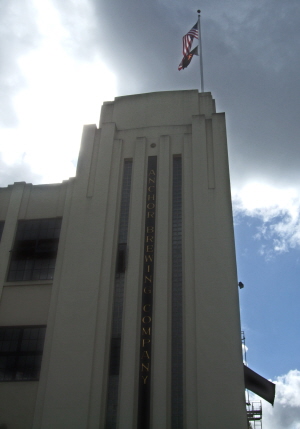 Anchor Brewing Company, Mariposa Street, San Francisco, California 94107 By then the brewery had relocated to its present site, a handsome old coffee roasting plant with art deco flourishes, just over the crest of Potrero Hill. “We bought it in 1977,” says Mark, “and it took us two years to convert it. We had to sandblast the entire building as it still smelt of coffee – a wonderful smell, but not for a brewery! At that time we never thought we’d fill it, so we rented out part of the warehouse.” But the 1980s turned out to be a prosperous period for the brewery, and it soon needed “every inch” of space.
In 1993 Maytag set off in yet another direction by adding a craft distillery at a time when these were relatively rare. The first product was a single malt rye whiskey, Old Potrero, joined in 1997 by Junipero gin – its name referencing Father Junipero Serra, the evangelical Mallorcan-born Franciscan monk in charge of founding the first permanent European settlement in the area, the Misión de San Francisco de Asís, not far from the present brewery site, in 1776. Serra rather fortuitously shared his first name with that of juniper, the perfumed berry used in flavouring the spirit and the origin of the word ‘gin’ itself.
After tapering off a little in the 1990s, the last decade has seen Anchor once more in rapid growth as the craft beer sector as a whole has started to go mainstream. Where once few in San Francisco would touch its products, now, as Mark says, “it’s hard to find a bar in the City without them, thank God.” Exports, particularly to Scandinavia and the UK, also make a major contribution to sales.
Mark’s recollection of how the export side first developed reveals the steelier side of Anchor’s inspirational saviour. “Our first exports were to the UK because there were people ripping off the steam beer name and Fritz was keen to protect it,” explains Mark. “You can’t stop them if you’re not selling too, so Fritz figured even if we lost a little money on exports it’s a lot cheaper than hiring lawyers”.
Indeed Maytag has been assiduous in his efforts to reserve ‘Steam Beer’, which before Prohibition was simply a generic style designation, as an exclusive Anchor trademark, a policy that, while successful, has not been uncontroversial since registration in 1981. One result has been the coining of the rather inelegant term ‘California common’, now used in official style guidelines such as those of the Brewers Association and the Beer Judge Certification Program (BJCP) for beers using comparable techniques of forcing lager yeasts to ferment at warmer temperatures.
All enterprises largely driven by a single individual eventually encounter the question of succession and in the late 2000s, as Maytag reached his 70s, he began looking for a buyer for the brewery. “Fritz knows he’s not the type of person to let somebody else run his business, so he decided to sell it outright,” comments Mark. He found what he was looking for in the Griffin Group’s Keith Greggor and Tony Foglio, two local entrepreneurs with a similar long range vision who had previously played a role in the success of specialist vodka brand SKYY. They took control in August 2010.
The new owners promoted Mark to Brewmaster, encouraging him to experiment with some of the ideas he’d not been able to convince his old boss to authorise. “We don’t have a pilot brewery, so you think twice about how much you’re going to experiment,” Mark explains. “After a while we kind of stopped making new styles. There was this period in the late 1980s with brewers making all these goofy styles like apricot ale that were unappealing to us, so we backed off. But the new owners were keen to add new beers.”
The first fruit of this new approach was Brekle’s Brown, an unusual but highly successful brown ale that both tips its hat to the original founder of the brewery and foregrounds the very contemporary flavour of the Citra hop. In 2011 Mark celebrated his 40th year at Anchor with the launch of the Zymaster series of annual specials, the first of which fulfilled a long held desire to brew a mild. Late in 2012 the brewery launched Californian Lager.
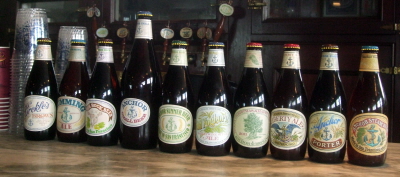 The Anchor range. All these beers perpetuate a tendency to look to Europe’s brewing heritage for inspiration, and a fondness for easy drinking quenchers that until recently contrasted with the popular image of US craft beer.
“I’m not a big fan of high alcohol beers because my elbow goes at a certain rate and you just get too drunk,” says Mark. “That’s what I like about visiting England. With something like my Mark’s Mild you can drink it all evening and still be in good shape. I thought, I’m never going to win the hop war, no one is going to think, ‘Man, has Anchor outdone everyone with that one,’ so we just tried to do other things. But now of course the craft beer pendulum is swinging back towards session beers.”
The brewery’s sense of place remains important. “That’s probably what helped us survive early on,” Mark reflects. “There are many disadvantages to brewing in San Francisco, we are brewing in one of the most expensive environments you could have, but we have all these wonderful tourists that come see us. They’re not going to Chico to visit Sierra Nevada, not that their brewery isn’t interesting but it’s out of the way. And which other brewery has a view like ours?” He’s referring to the impressive vista of the City and San Francisco Bay from the windows of the highly amenable tasting room with its fascinating collection of breweriana where our tour starts.
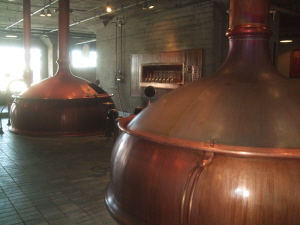 Anchor’s vintage German-built copper brewhouse. The neat little brewhouse is immediately visible through the glass partitions of the tasting room. A German-built 150hl (125 US barrel) copper kit dating from the 1950s, it was acquired during the move to the current building in 1977 from a small brewery in Karlsruhe which was going out of business. “We even bought the fourth vessel which German brewhouses always have, the decoction vessel,” says Mark, “but we don’t need it as we do an infusion mash, and sadly I’ve never been able to find an alternative use for it.” A whirlpool system clears the wort before fermentation.
With up to six brews a day emerging from the kit, it’s certainly put to good use – Mark says they could go up to seven batches a day but lack the fermentation capacity. The total output currently stands at 110,000 barrels (130,000hl) a year, of which about 60% is bottled, and with around 150 staff the brewery is a remarkably compact operation for such a well known brand.
“Compared to some of our competitors, we’re still a very small brewery – Sierra Nevada is ten times our size,” observes Mark. “Sierra’s founder Ken Grossman had a whole different set of goals to Fritz, who always wanted a simple operation that was fun and profitable, a five day a week operation with the vast majority of people on a single shift and where he knew everybody personally.”
 Whole hops destined for Anchor beers. One change under the new regime is greater openness about recipes and ingredients, which were formerly the subject of much secrecy. “We still don’t like going into detailed specifications,” says Mark, “but I’m happy to tell you we use US two-row pale malt. The pale is all Western malt which is famous for being the best in the US if not the world. Fortunately we live here so it’s easy to get it. Before Fritz owned it, the brewery was going through hard times and used sugar in Steam Beer. But since Fritz took over all the beers have been all malt. Steam is mainly pale with some caramel, and Northern Brewer hops. That hop was going away, dramatically, and we helped revive it.”
Mark insists that there has been no change to this basic steam beer recipe in the four decades and more that he’s been on the payroll. “Within my first month at the brewery, [well known Portland, Oregon-based brewing historian and home brewer] Fred Eckhardt came down to brew with us. Then about eight or nine years ago I was doing an event with him and he said, ‘You guys have changed your steam beer,’ and I said, ‘No, we haven’t.’ So he started to ask me what’s our original gravity, what’s this and what’s that, and then he pulled out his notebook with his notes from the 1970s and said, ‘Well, you’re right’.”
Behind the brewhouse is the unique feature that provokes such interest among brewing geeks – the steam room. The traditional shallow fermenters are still present and correct, though don’t expect to see them steaming on the rooftops; instead their contents bubble away behind glass in a temperature controlled chamber with filtered air.
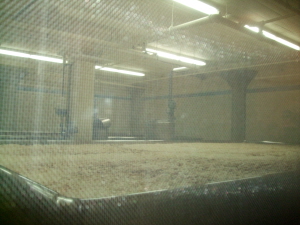 Glimpsed through the glass: shallow steam beer fermenters at Anchor, San Francisco. “In the old brewery they still had a fermenter made from redwood lined with pitch,” recalls Mark, “but they’d since lined it again with stainless steel. It had pretty crude welds around the joints and we had to get a torch out and heat them up every couple of months to keep the bacteria down. Then we were still fermenting in the old fashioned way, taking advantage of our cool climate here. We didn’t have filtered air, but if you give me good clean water and a clean fermenter and clean yeast, I can give you clean beer in an open room.
“The current fermenters, although they keep that same shape, we made when we moved into this building. We maintain that room at 61°F (16°C), and I think we spend more time heating it than cooling it!
“When I started,” Mark continues, “we brewed so rarely and didn’t have the ability to cultivate yeast so we would borrow yeast from other breweries every time. Then in 1974 or 1975 we got a very old strain of Wallerstein Labs lager yeast and that’s what we’ve been using ever since. Wallerstein Labs no longer exists but their yeast lives on here. We just collect it from the fermenters and reuse it. So many brewers today say they have to change the yeast after so many generations but we’ve never found that necessary.
“We also have an ale yeast we got years ago and that’s what we use for all our ales, even the wheat beer. We recently did a special high alcohol export stout for the Great British Beer Festival and for the first time in many years we brought in a different yeast.”
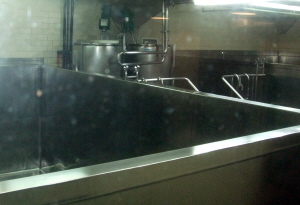 Anchor’s Ale Room: British-style square fermenters. Downstairs in the Ale Room is a sight that will be familiar to habitual visitors to British breweries but is nonetheless relatively rare in the US – a set of stainless steel ‘Yorkshire Square’ style fermenters, not as broad and shallow as the steam room vessels but also open. These are used not only to ferment all the rest of the regular range, but also to finish off fermentation of the steam beer – after three days in the shallow vessels, it’s pumped down here for three more days.
In the basement is a densely packed lagering hall with cylindrical tanks where the beer receives its final conditioning – Steam Beer spends three weeks down here at a temperature of around 0°C. At the back of plant are two busy bottling lines: the biggest, for the standard 12oz (355ml) bottles, fills 420 bottles every minute, while the second is for 22oz (650ml) bottles and magnums.
One significant departure from old fashioned methods that might disappoint purists is that all the regular brands are flash pasteurised, both in bottle and keg, a practice introduced by Maytag early on as part of his crusade against infection and unreliability. Given the increase in hygiene since then, the practice is perhaps less justified than it once was, but certainly the beers don’t taste the worst for it – Anchor products today are excellent and flavoursome beers and include at least a few world beating classics.
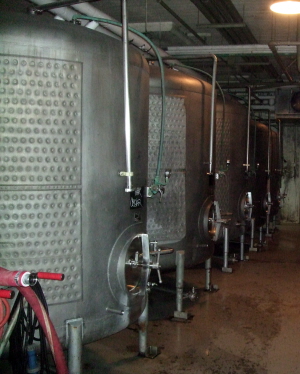 Anchor’s lagering hall, with cylindrical vessels. I wonder whether Mark has any views on how the big changes in craft beer in recent years might impact the brewery in future. “We always looked to Europe to inspiration,” he reflects, “because there was no inspiration domestically, but now you have the whole world creating unusual beers and I think you’ll see us doing a lot more different beers.
“The styles I’m most interested in are the styles I haven’t brewed yet. There are many styles out there that brewers never seem to look up. I don’t want to talk about it because I don’t want to give away any ideas, but it surprises me that everyone seems to be stuck with very highly hopped IPAs and Imperial Stouts when there are so many other possibilities.
“What I do see changing is – we and a handful of other older craft breweries distribute our beers nationally, which we had to do in order to make money. If Anchor started up now, we would probably only sell in California because we could make a living doing that, the market is there. So will brewers like us who sell over wide areas still be able to sell over wide areas? I don’t think we’ll lose our market in the major cities, but in these little areas where you have all these little local breweries, are we going to have to pull back from those areas? It’s going to be interesting to see how it shapes up.”
Since my visit, Anchor’s confidence in the future has been signalled by the announcement in February 2013 of a major new project to quintuple its capacity from 120,000 to 600,000 barrels (141,000hl to 704,000hl) a year. Several other Californian craft breweries, including Green Flash, Lagunitas and Sierra Nevada, are also working on expansion plans, but these all involve new plants on the East Coast. Anchor, meanwhile, is staying true to character by expanding within San Francisco.
The site is Pier 48 at Mission Rock, a major new mixed use development on the eastern waterfront facing the Bay, on land belonging to the City’s successful baseball team the San Francisco Giants and adjoining their stadium at AT&T Park. The plans include a restaurant and visitor centre/museum as well as a new brewery. Construction is due to start in 2015 and the new facility could be online by 2018.
Anchor’s progression – from rough and ready supplier of an everyday quencher that barely merited a passing thought among its customers to world famous tourist attraction and cultural icon – is a striking demonstration of the transformation of brewing in the craft beer era. Fritz Maytag’s insight in the late 1960s that a whole new and more middle class audience might be prepared to pay a bit more for traditional local beer styles established economic credibility for the huge growth in craft beer that followed. And Anchor’s nostalgic reclamation of its working class roots was a forerunner of the post-industrial style now exploited not only by craft brewers but by other specialist food and drink producers across the world.
But above all Anchor made, and continues to make, good beer – and without that, none of what followed would have been possible.
Read notes from the Anchor tasting room.
Visit Anchor’s official website.
Thanks to Mark Carpenter, tour guide Daniel and Candice Uyloan of Dog and a Duck PR for setting up the interview. The history of Anchor outlined above is drawn from the brewery’s official history on its website, information imparted during the tour and the brewery’s entry by Jay R Brooks in The Oxford Companion to Beer.
 San Diego, California, USA: Best Damn Beer Shop and no bull. You have to have a huge amount of self confidence – or possibly hubris – to name your business the best damn anything. But Sid and Omar Mikhail clearly have the knowledge, youthful enthusiasm and determination to set false modesty aside and ensure that their flourishing specialist retailer, the Best Damn Beer Shop, stands a chance of living up to the claim in its name.
It helps that the shop is sited in downtown San Diego, with around 50 craft breweries close at hand, including internationally renowned heavy hitters like AleSmith, Green Flash, Port/Lost Abbey and Stone. The city is one of the brightest stars of the rapidly expanding galaxy of US craft brewing, emerging in the past few years as the centre of one of the world’s most exciting beer regions.
Basking in the sunshine of the Pacific coast, San Diego occupies the far southwestern corner of the United States. Take the tram, or trolley as it’s known locally, from round the corner from the shop to the end of the line and you can cross the border on foot from what was once known as Alta (upper) California to Tijuana in the Mexican state of Baja (lower) California.
 This unassuming San Diego 7th avenue grocery storefront conceals thousands of beery delights. With a big university, a naval base, the inevitable cross cultural influences of a border town and a long tradition of civic pride and culture, it’s a city of considerable interest. Balboa Park, one of the oldest public parks in the US, occupies almost 500 magnificently verdant hectares in the heart of the city, replete with a bundle of museums, theatres and historic gardens. It’s perhaps not surprising that this richly textured urban fabric has provided such a keen customer base for craft beer.
As the second biggest city in California, San Diego is industrial too and was once a major beer producer: it even recovered sufficiently from the calamity of Prohibition to the extent that it supplied a quarter of the beer output of the whole state by the late 1940s. But in a handful of years the big national groups decimated the local industry and the last old school brewer closed in 1953. The current renaissance dates back to 1989 when the Karl Strauss brewery became San Diego’s first new wave brewpub.
This a city of local neighbourhoods more vibrant and alluring than the rather low density downtown area, which seems curiously lacking in a satisfactory focus other than the historic Gaslamp Quarter with its specialist shops and venues. That might be why, despite the steady growth of the local beer culture over the last decade, it lacked a decent bottle shop until 2008 when the Mikhail brothers first turned their passion into a business.
 Sid (left) and Omar Mikhail displaying some of the hidden treasures of their cellar. Sid and younger brother Omar have an interesting cross cultural history themselves. Sid was born in Baghdad and Omar in Manchester. Their family are Iraqi Christians educated in the UK, who fled their home country in 1989 when things started getting sticky for religious minorities, and settled in San Diego where the brothers grew up.
The unit that now hosts Best Damn Beer Shop was originally a family owned grocery store known as Super Junior Market, only a few steps from the Gaslamp, which Sid started managing in 2002 after leaving education. “I studied physical therapy,” he says, “so I didn’t plan on sticking around for very long.” What changed all that was his passion for beer.
“I just loved craft beer,” he recounts. “I was on the forums and the blogs way before the big revolution in craft brewing when everything took off. Back then we only sold the big commercial beer brands. I wanted to start letting my customers know about the beers I enjoyed, so after a while we started getting in the usual suspects like Port, Sierra Nevada and Stone.
 “Massive walls of beer” at Best Damn Beer Shop, San Diego. “At first we’d end up having to discount unsold stock so we could ensure the IPAs were properly fresh – not something you’ll find in every shop in town. We opened the Best Damn Beer Shop as a feature inside the store in 2008, and business started to build. Then suddenly about three years ago things really took off and even the regular Budweiser drinkers started to ask about IPAs. It’s a different world now.”
That different world includes a selection of over 1,000 different beers – a truly dazzling choice that nonetheless shows evidence of being lovingly hand picked. 70% of the range is local or Californian.
“We’ll give any new local brewery a shot if it does bottles,” Sid explains, “and any limited release of a local beer will always sell out no matter how many cases we buy. But we’re also blessed in San Diego in getting deliveries from great breweries across the country, and if it comes here, we try to grab some of it.” The Mikhails also research new beers and follow up customer requests, often contacting breweries directly to source supplies.
 Tempting specialities from the US and Europe. So as well as extensive ranges from some of the local stars – including less well known names like Coronado, Iron Fist and Mad Lab – there are other serious Californians from Bear Republic, The Bruery, Drake’s, Firestone Walker, Knee Deep, Lagunitas, North Coast, Russian River and Upright. Out of state brewers include Alaskan, Allagash, Dogfish Head, Grand Teton, Jester King, Logsdon, Pretty Things and Shipyard.
Then there are the imports – mainly from Belgium, with a few from Germany and the UK (Buxton, Meantime, Harviestoun) and international craft producers like Emelisse, Evil Twin, Haand, Mikkeller and De Molen. A display of sour beers stretches to various Cantillons, Rodenbach Grand Cru and bottles from Italy’s Lover Beer alongside domestic offerings; a similarly extensive barley wine selection includes offerings from Great Divide and Telegraph alongside Manchester’s Marble.
Behind the scenes there are even more delights to set a beer geek’s eyes boggling. Sid has been collecting beers since 2006, hunting down rarities and setting aside a case in his own cellar. This is where he keeps the limited edition Cantillons, the Lost Abbey rarities and the New Belgium Lips of Faith, though most of them are not on regular sale.
“At first it was for own consumption,” he explains, “but I ended up overwhelming myself, and thought I ought to share it and do something more creative with it. So I ran a special event called Sid’s Cellar Release during San Diego Beer Week where I put some of it on sale. We had lines around the block and it was all gone in an hour.” Bottles from the collection also surface at the tastings Sid hosts on an occasional basis at various pubs around town, attracting crowds of hundreds.
 Specialist malts from Best Damn Beer Shop’s homebrew section. Then there’s the comprehensive homebrew supplies section, added in 2011, presided over by brewer Damien Binder. It’s an obvious way of connecting with the longstanding and still flourishing local homebrew scene that cradled so many of today’s admired professional brewers.
“If you’re a homebrewer,” observes Sid, “you drink craft beer, and there are plenty of craft beer drinkers who might get interested in brewing, so we do starter kits. We’re very hands on with our customers – we’ll even give feedback on beers that went wrong.”
In August 2012, the whole store got a revamp, rebranding as Krisp Market and bringing the overall stocking policy more in line with the craft beer side by focusing on natural, artisanal, local and organic food and other specialities. The fine wine range is expanding, and a well chosen selection of specialist spirits, notably whiskies and bourbons, complements the beer offer.
Such initiatives have helped build up a loyal following including some who are daily or near-daily visitors. But the beer tourists who flock to San Diego in increasing numbers are calling in too after seeking out the place online. The Mikhails have also noticed more women discovering craft beer, particularly sour beers and stouts. “The old association with beer bellies is going at last,” says Omar.
There’s a recognition too that what the brothers call their “massive wall of beer” can be intimidating to the newcomer, and they or their equally well informed staff are always on hand to offer recommendations and advice.
Indeed this is a major part of the job satisfaction. “One of the best feelings you have is introducing someone to craft beer,” says Omar, with obvious evangelical zeal. “You’re saying try this and this, and you can see how excited they’re getting, and six months later you see them come back with a list, and it’s such a cool feeling because you helped them, you were a part of it. That’s why we love doing this.”
Researched October 2012.
 Jazz-inspired brewing genius at Best Damn Beer Shop. Fact file
Address: 1036 7th Avenue, San Diego CA 92101 (inside Krisp Market)
Phone: +1 619 232 6367
Web: bestdamnbeershop.com
Hours: 0700 (0800 Sat-Sun)-2400
Drink in? No
Mail order: No
Manager’s favourites: Lambics particularly Girardin Gueuze 1882 Black Label (“my first sour beer”) and Cantillon, sours from Cascade (Portland OR) and Russian River, anything from AleSmith.
Beer picks
All from San Diego and surroundings, California, USA.
 Stone Arrogant Bastard Ale Best Damn Beer Shop
ABV: 7.2%
Origin: Escondido, California, USA
Website: www.stonebrew.com
Stone is the original bad boy brewer, with brand values that deliberately risk alienating certain groups of potential customers in order to boost the affinity of others. Offset by an obvious sense of humour and backed up by top quality products (elements sometimes missed by others who have attempted a copycat approach), the strategy has helped Stone grow since its foundation in 1996 into the 10th biggest craft brewer in the US and the third biggest in California.
Arrogant Bastard Ale, launched in 1997, is the name everyone remembers and the figurehead of the brand. A beer drinking demon scowls forbiddingly from the screen printed bottle, above the words “You’re not worthy.” On the back is a lengthy, blustering essay that begins: “This is an aggressive ale. You probably won’t like it. It is quite doubtful that you have the taste or sophistication to be able to appreciate an ale of this quality and depth.”
I certainly wasn’t worthy when I first sampled the beer back in 2007. This dark amber-brown beer with a fluffy fawn head looked innocent enough, and the rather gentle aroma of lychees, peaches and caramel, with a slight hint of farmyard funk, didn’t betray any demonic tendencies.
 Stone Oaked Arrogant Bastard Ale But on the palate I found Arrogant Bastard too aggressive, not only for its massive thistly citric hop bite but also a strong thread of burnt vine fruit emerging from cakey cola-flavoured malt. A rather hot finish puckered the tongue with bitter vegetal resins and bone dry dark chocolate notes. Finishing a whole 650ml (22oz) bottle was something of a challenge.
Since then my taste buds have recalibrated to cope with higher IBUs, and I’ve also discovered a more sophisticated and approachable incarnation of this particular beer. In 2004 Stone introduced a limited edition version aged on oak chips, initially in locked 3l bottles, which proved so successful it’s become a year-round standard.
The oak – and perhaps the additional ageing – seem to calm the beer and integrate the flavours better while still retaining their distinctiveness and punch. A bottle bought from Best Damn Beer Shop in San Diego in October 2012 yielded a Burgundy-shaded beer with a subtle aroma of sweet tropical fruit, mandarin and a very light touch of wood.
Deep malt flavours established themselves early on the palate, with complex peachy fruit and building bitter resins that were still assertive but very smooth, complemented by subtle oaky vanillin. The finish was long and still bitter, with a rooty and slightly earthy quality, and a long build to a final intense dryness with wood and dark chocolate notes.
Not such a mean Bastard after all.
For more on the brewery see my review of Ruination IPA.
|
|

